The global Bitcoin mining landscape experienced a period of significant contraction during the week ending November 2, 2026, characterized by a cooling in asset prices, a decline in mining profitability, and a widespread sell-off across publicly traded mining equities. As network difficulty reached new heights, operators faced increased pressure to optimize fleet efficiency, with hashprice—the revenue potential per unit of computing power—dropping to levels that challenge the operational breakeven point for less efficient hardware configurations.
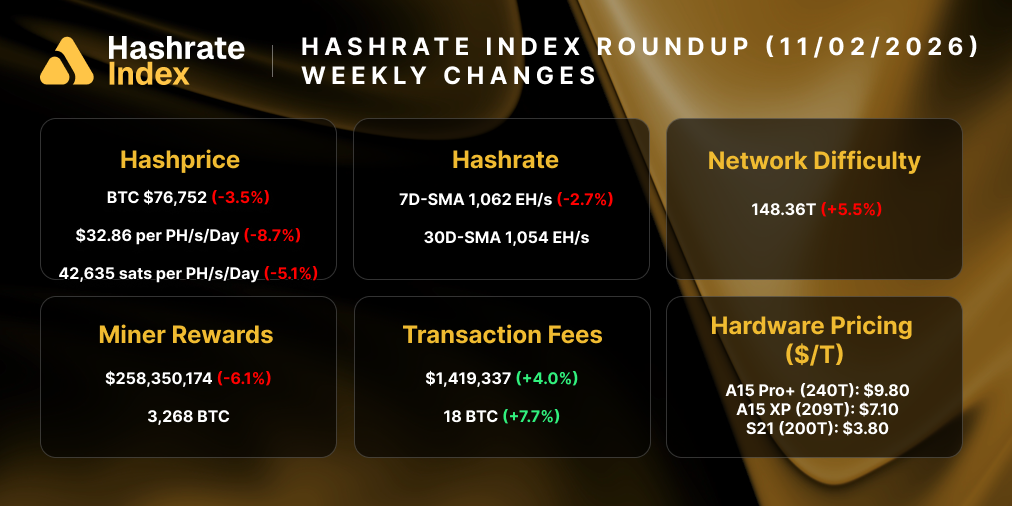
Market data for the seven-day period indicates a broad downturn. Bitcoin’s spot price retreated by 3.5%, sliding from approximately $79,510 to $76,752. This downward movement contributed to a year-to-date performance decline of 12.2%, reflecting a broader period of consolidation in the digital asset markets. As the primary revenue source for miners, this price depreciation directly impacted the sector’s profitability metrics.
Analyzing the Erosion of Hashprice and Profitability
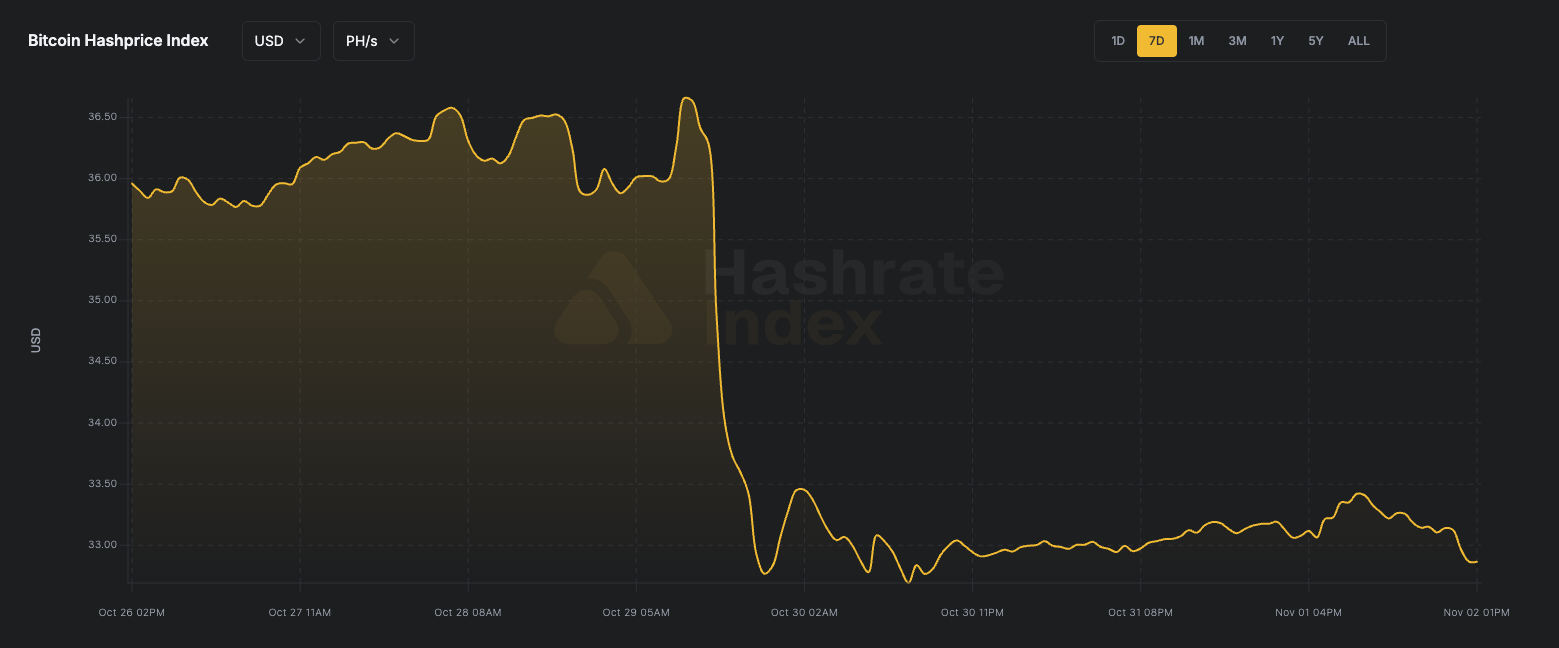
Hashprice, the industry-standard metric for measuring daily earnings per unit of hash rate, saw a sharp decline of 8.7% over the week, moving from $35.99 to $32.86 per PH/s/Day. This contraction was exacerbated by the interplay between a rising difficulty level and a lower BTC price, creating a "double-squeeze" on mining margins.
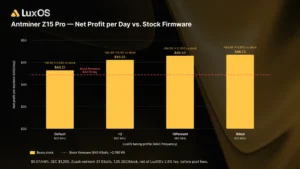
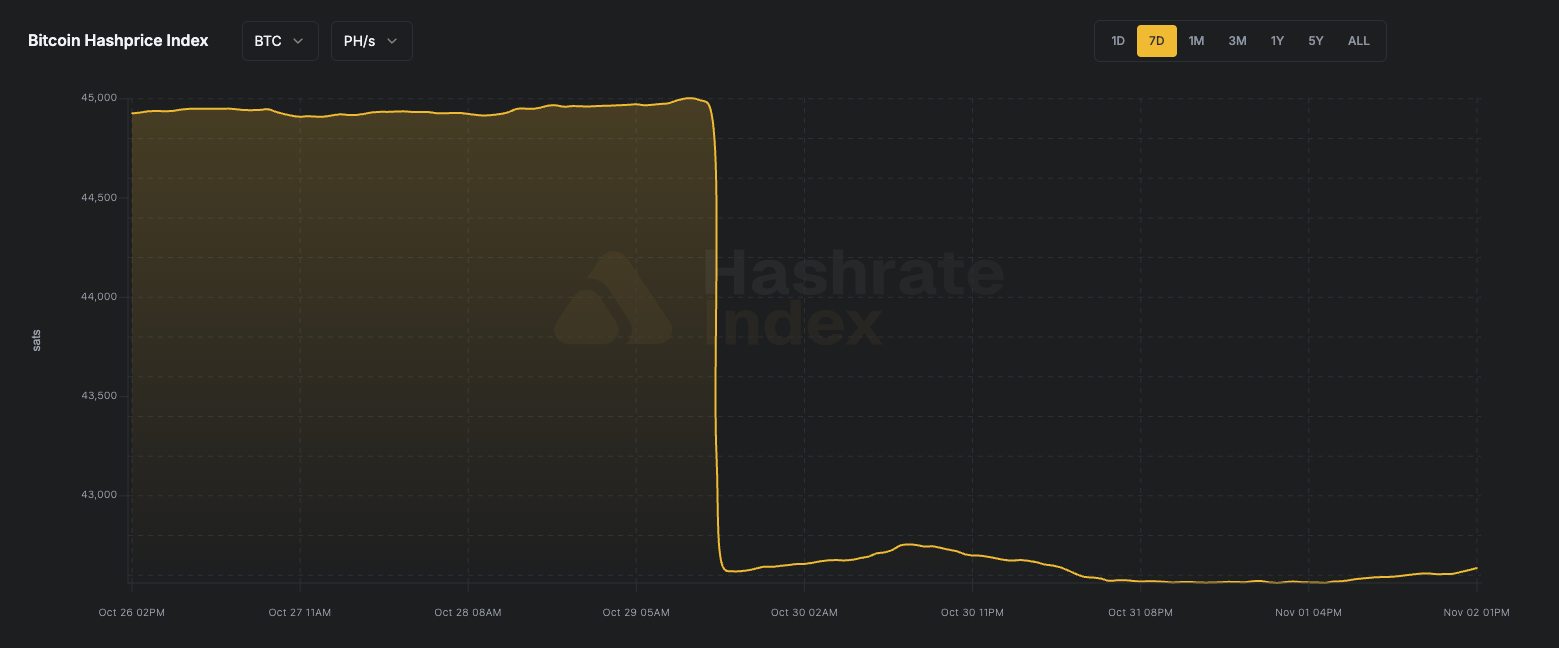
The Bitcoin-denominated hashprice also saw a decrease, falling 5.1% to 0.00042635 BTC per PH/s/Day. For mining firms, these figures serve as critical indicators of operational health. When hashprice drops significantly, firms operating older-generation equipment, such as various iterations of the S19 series, often find their energy costs exceeding their daily revenue. This reality has forced a strategic shift across the industry, with many operators pivoting toward firmware optimization—such as the solutions offered by Luxor—to extract higher efficiency from existing assets like the S21 series to maintain a competitive edge.
Network Dynamics: Difficulty Adjustments and Hashrate Shifts
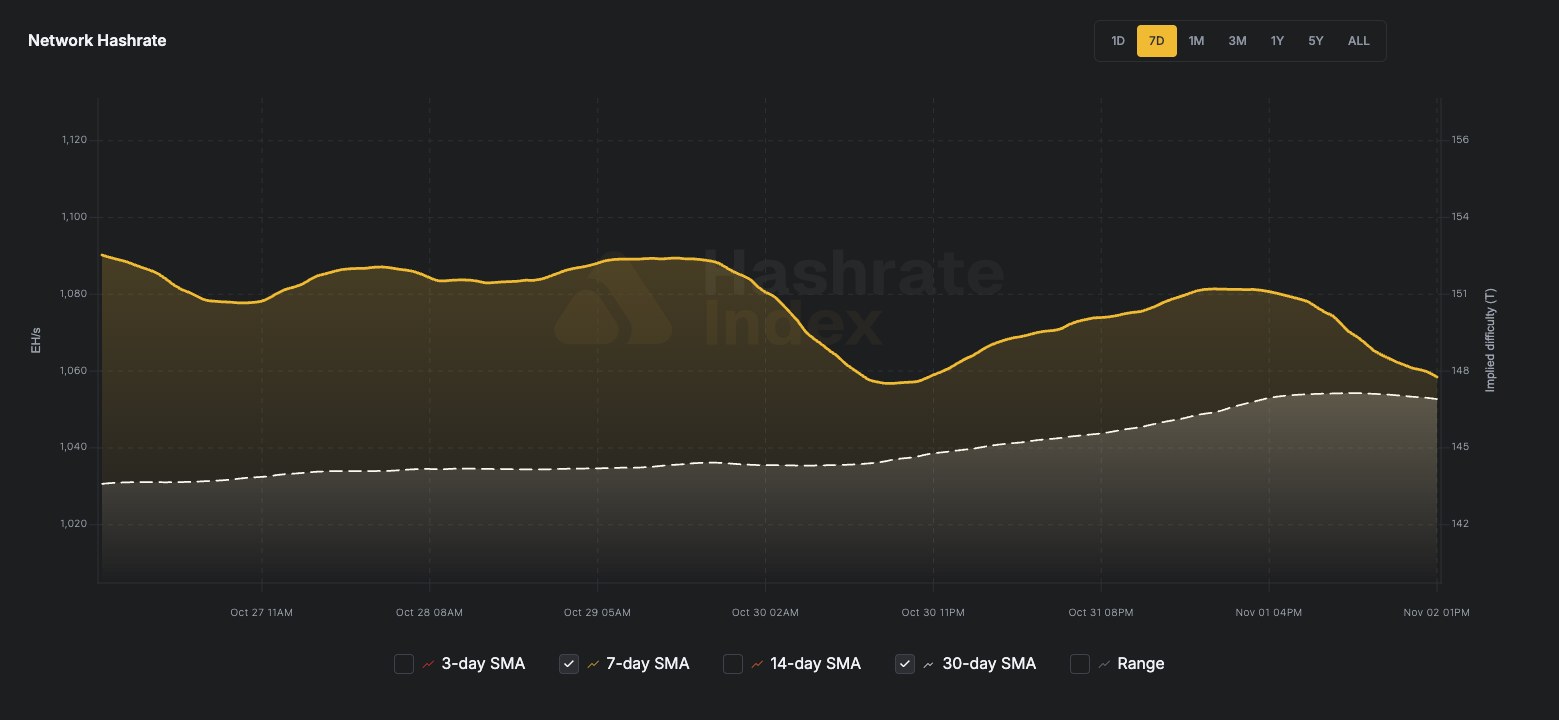
The Bitcoin network underwent a notable difficulty adjustment on October 29, 2026, which saw the mining difficulty climb by 5.5% to reach 148.36T. This adjustment reflects the high competition among miners for the limited supply of new Bitcoin. While the 7-day simple moving average (SMA) for the network hashrate sat at 1,062 EH/s—a 2.7% decrease from the previous week’s 1,091 EH/s—the sheer volume of compute power dedicated to the network remains near historical highs.
The next difficulty adjustment is projected to occur around November 13, 2026, with current estimates suggesting a potential decrease of 2.8%. While such estimates are subject to change based on short-term block-time volatility, a downward adjustment could provide some temporary relief to mining operators by lowering the barrier to successful block discovery. Average block times over the last 24 hours have hovered around 10 minutes and 17 seconds, indicating that the network is operating slightly slower than the protocol’s 10-minute target, a common precursor to a negative difficulty adjustment.
Transaction Fee Contribution and Revenue Streams
While block rewards represent the lion’s share of miner revenue, transaction fees provide the necessary volatility hedge. Over the past week, miners processed approximately 3,268 BTC in total rewards, with transaction fees contributing 18 BTC, or roughly $1.42 million. This represented about 0.55% of the total rewards.
Despite the relatively low share of total revenue, transaction fees saw an uptick of 17.4% compared to the previous week, rising to an average of 0.0183 BTC per block. This growth suggests an increase in on-chain activity or a shift in the composition of transactions being broadcast to the network. Sustained growth in transaction fees is widely regarded by industry analysts as a vital long-term component for securing the network as block rewards continue to decrease following successive halving events.
Institutional Sentiment and the Equity Sell-off
The impact of these market conditions was acutely felt in the public equity markets. Bitcoin mining stocks faced a rigorous week, with 17 out of 18 tracked companies reporting declines. The sector saw a median movement of -11.0%, highlighting a bearish sentiment among investors toward mining-related equities.
Notable laggards included BTDR, which saw a 15.1% drop, and ABTC, which fell by 14.2%. Even industry stalwarts were not immune, with Marathon Digital (MARA) and Riot Platforms (RIOT) experiencing pullbacks of 5.7% and 7.2%, respectively. In a market where liquidity is often prioritized, investors appeared to be rotating out of mining stocks as the immediate outlook for margin expansion weakened.
The lone outlier during this period was SLNH, which recorded an 11.5% gain, suggesting that company-specific developments or idiosyncratic factors may have shielded the stock from the broader industry malaise. Market participants continue to monitor these equities closely, as they provide a leveraged proxy for Bitcoin’s performance, albeit one currently hampered by the rising costs of energy and hardware depreciation.
Forward Outlook and Market Derivatives
Looking toward the horizon, the Luxor Hashrate Forward Market provides a glimpse into professional expectations for the coming months. The market is currently pricing in an average hashprice of $33.04 (or 0.00043 BTC) over the next six months. This pricing suggests that while the current environment is difficult, traders and institutional miners are not necessarily anticipating a prolonged collapse in revenue, but rather a period of stabilization.
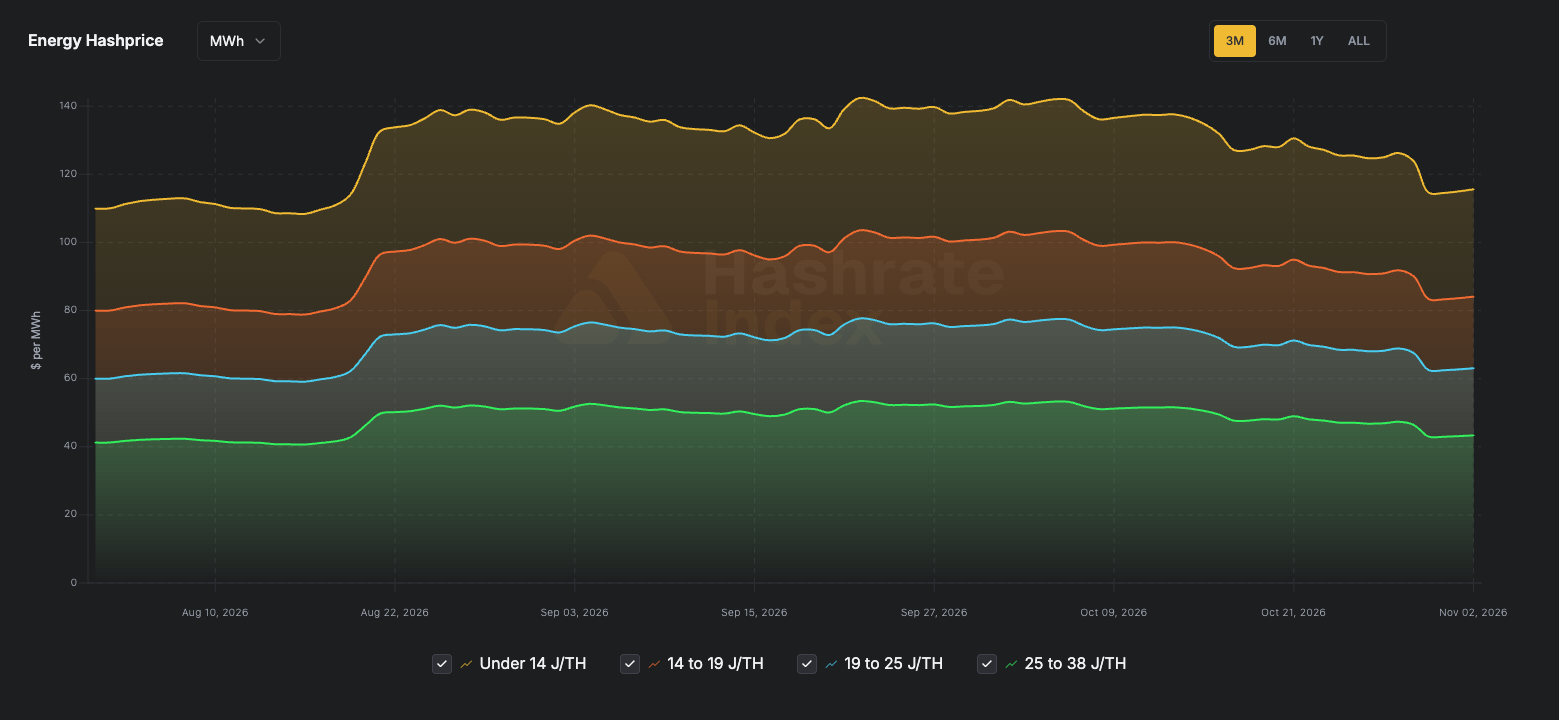
The ability of miners to survive this cycle will depend largely on their energy procurement strategies and their access to capital. As the network becomes more efficient and more professionalized, the barrier to entry has shifted from mere hardware acquisition to a sophisticated mastery of energy markets and grid integration.
Broader Implications for the Ecosystem
The current state of the Bitcoin mining industry suggests that the market is in a phase of structural maturation. The high hash rate, despite the downward pressure on prices, demonstrates the resilience of the network and the commitment of participants to maintaining the underlying security of the Bitcoin protocol.
For the average operator, the coming weeks will likely focus on three core pillars:

- Efficiency Upgrades: Transitioning to lower-joule-per-terahash hardware to ensure profitability even at lower price points.
- Operational Flexibility: Utilizing curtailment programs and demand-response strategies to minimize costs during periods of high energy prices or low hashprice.
- Financial Hedging: Leveraging forward contracts and derivative products to lock in future revenue and mitigate the risks associated with price and difficulty volatility.
As the industry moves toward the November 13 difficulty adjustment, stakeholders remain focused on block-time trends and the potential for a respite in competitive pressure. While the recent decline in stock prices and hashprice has undoubtedly created short-term headwinds, the underlying fundamentals of the network—its security, decentralization, and increasing efficiency—continue to form the bedrock upon which the mining industry rebuilds its margins.
The integration of advanced firmware and the increasing institutionalization of the mining sector suggest that future cycles may be defined less by speculative booms and more by technical optimization and energy-market participation. For now, the "hash wars" continue, with only the most efficient and well-capitalized operators poised to emerge unscathed from the current market consolidation.