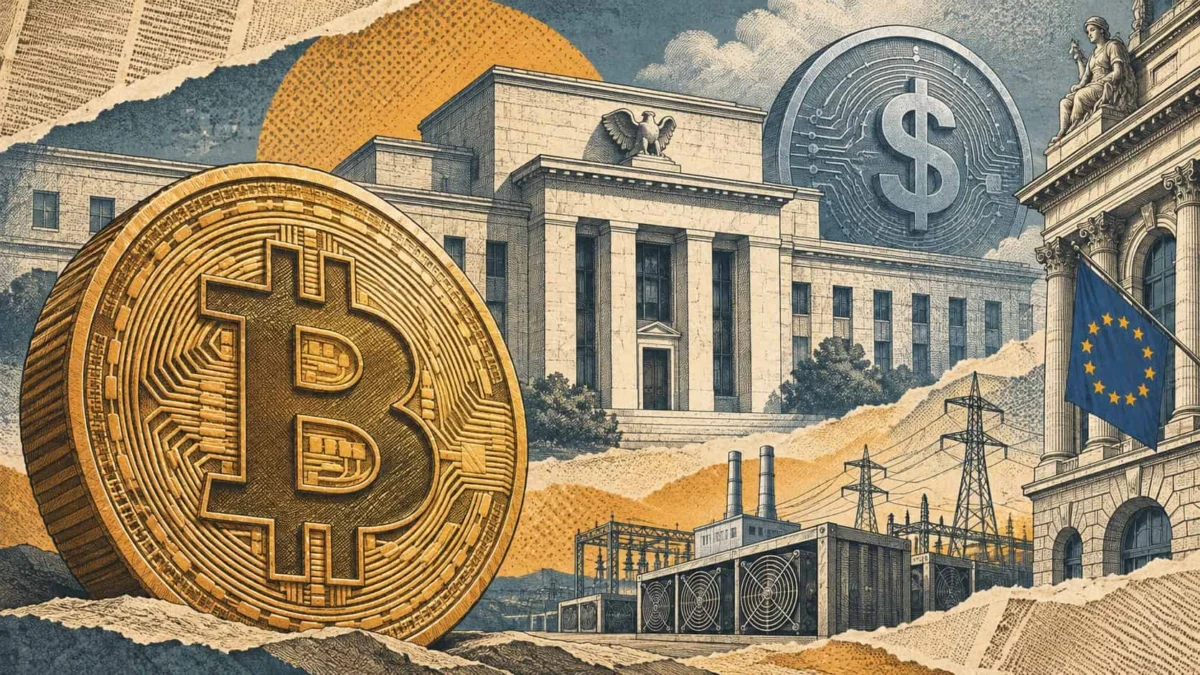
The digital asset ecosystem is navigating a complex landscape defined by shifting macroeconomic signals, corporate treasury strategies, and evolving international regulatory frameworks. Over a critical multi-day window in November, cryptocurrency markets faced a triple-pronged test: a hawkish warning
from a key Federal Reserve official following persistent U.S. inflation data, a massive liquidation of digital assets by one of the world’s largest publicly traded Bitcoin miners, and a landmark regulatory transition for the leading stablecoin, USD Coin (USDC), within the European Union.
These developments underscore the intricate web of global economics, corporate financing, and compliance that increasingly dictates market sentiment. As institutional participation deepens, stakeholders are forced to look beyond superficial price action and examine the underlying structural mechanisms governing monetary policy, miner behavior, and stablecoin oversight.
Macroeconomic Pressures and the Federal Reserve’s Inflation Test
The intersection of macroeconomic data and monetary policy continues to cast a long shadow over non-yielding assets like Bitcoin. On the macroeconomic front, the U.S. Bureau of Labor Statistics released its consumer price index (CPI) figures, revealing that headline consumer prices rose by 0.4% in October, following a 0.6% increase in September. More concerning for policymakers was the trajectory of core CPI—which strips out volatile food and energy components—posting a 0.3% increase for the third consecutive month. While monthly headline inflation showed signs of slowing, the sticky nature of underlying price pressures signaled that inflation has not yet been definitively conquered.
This persistent metric directly intersected with warnings issued by Federal Reserve Governor Christopher Waller. In a speech delivered prior to the official data release, Waller laid out explicit conditions for future monetary tightening. He stated that if the October core CPI figures remained at or around the 0.3% threshold, the Federal Open Market Committee (FOMC) would need to consider a more aggressive policy response at its upcoming December meeting.
"I believe a 50 basis point hike in the policy rate should be considered at the December meeting," Waller declared in his address.
With the October data meeting the specific conditional parameters outlined by Waller, financial markets immediately began re-pricing risk. However, analysts emphasize a crucial distinction: while the economic data matched Waller’s conditional threshold, it does not constitute a formal policy decision or a guaranteed post-release endorsement from the broader central bank committee. Monetary policy remains a collective decision dictated by consensus among FOMC members.
The implications for Bitcoin and the broader cryptocurrency market are rooted in the fundamental mechanics of liquidity. Higher interest rates increase the opportunity cost of holding speculative or non-yielding assets. As cash, Treasury bills, and other interest-bearing instruments offer attractive risk-free returns, capital frequently rotates away from digital assets. Furthermore, historical data from previous tightening cycles demonstrates that abrupt shifts toward hawkish monetary policy often induce short-term liquidity contractions, putting immediate downward pressure on high-beta assets.
Adding a layer of technical complexity to the economic picture, the Bureau of Labor Statistics noted that October annual changes for most CPI series could not be published due to missing survey data resulting from a federal funding lapse in October 2025. Consequently, financial analysts have cautioned market participants against relying on unofficial, third-party estimates for headline annual inflation rates, advising strict adherence to verified seasonally adjusted monthly metrics.
Corporate Treasury Realignment: MARA’s $1.1 Billion Asset Monetization
While macro traders digested the Federal Reserve’s next potential moves, the corporate mining sector delivered a stark reminder that institutional digital asset treasuries are dynamic financial instruments rather than static holdings. MARA, one of the premier publicly traded Bitcoin mining enterprises, disclosed a massive asset liquidation in its third-quarter shareholder letter filed on November 9.
According to the regulatory filing, MARA sold 13,597 Bitcoin following the close of the third quarter on September 30. The tokens were disposed of at an average price of approximately $81,039 per coin, generating total gross proceeds of roughly $1.1 billion. This large-scale transaction represented roughly 40% of the 34,012 Bitcoin the company reported holding on its balance sheet at the end of the quarter.

The primary driver behind this multi-million-dollar sell-off was debt reduction and balance sheet optimization. MARA disclosed that $750 million of the proceeds was specifically allocated toward the full repayment of its Bitcoin-collateralized term loans. This strategic debt clearance successfully released 17,477 pledged coins that had previously been encumbered as collateral.
"We expect to continue to monetize bitcoin to enhance our financial flexibility," management stated in the shareholder communication. The firm noted that remaining proceeds would be deployed to maintain operational liquidity, fund ongoing capital expenditure projects, and support broader corporate initiatives, subject to prevailing market conditions and strategic capital allocation priorities.
This disclosure challenges a prevailing narrative among retail crypto investors who often view corporate balance sheet accumulation as a permanent withdrawal of supply from the open market. MARA’s actions demonstrate that for capital-intensive operating companies, digital asset treasuries can function as a vital, liquid financing resource during periods of corporate restructuring or deleveraging.
Market analysts emphasize that the transaction should not be misinterpreted as a bearish bet by management on Bitcoin’s long-term price trajectory. Instead, it highlights the operational reality of managing capital expenditure, debt servicing, and treasury health in a cyclical industry. Furthermore, because the sales were executed incrementally following the quarter’s close rather than as a single panicked market order, the immediate downward price impact was absorbed differently than a sudden, unannounced spot market dump.
Regulatory Evolution: USDC Enters Dual EU Oversight Under MiCA
While proof-of-work miners navigate corporate debt and macroeconomic headwinds, the stablecoin sector is confronting a monumental shift in regulatory oversight. On November 12, USD Coin (USDC)—issued by Circle Internet Financial Europe SAS—officially entered a dual supervision framework under the European Union’s landmark Markets in Crypto-Assets (MiCA) regulation.
The European Banking Authority (EBA) initially announced this historic classification on October 14, designating USDC as the first "significant" e-token operating within the European Union under the MiCA umbrella. The arrival of the November implementation date transforms that regulatory designation from a policy announcement into an operational reality for issuers, exchanges, and European users.
Under the new dual supervision structure, authority is shared between European and national regulators. The EBA assumes direct, centralized responsibility for monitoring USDC’s own funds, asset reserves, liquidity requirements, and comprehensive recovery and redemption plans. Simultaneously, France’s Autorité des Marchés Financiers and the Autorité de Contrôle Prudentiel et de Résolution (ACPR) retain localized oversight over corporate governance, organizational outsourcing arrangements, and internal conflict-of-interest policies.
This collaborative oversight model represents a significant departure from the largely decentralized and fragmented regulatory environment that previously characterized the European stablecoin market. For institutional and retail users alike, the practical implications center on counterparty transparency and redemption security. The EBA’s direct supervision ensures that the reserve assets backing USDC in Europe are subjected to rigorous, standardized stress tests and regulatory audits, mitigating the systemic risks associated with unbacked or poorly reserved stablecoin alternatives.
Industry stakeholders and legal experts point out that while this regulatory milestone provides unprecedented legal clarity and institutional legitimacy, it does not alter the fundamental utility of the asset for holders. It does not introduce new contractual yields or speculative trading gains; rather, it institutionalizes a robust framework of safety, transparency, and consumer protection for a foundational payment and settlement instrument.
Implications and What to Watch Next in Global Crypto Markets
The convergence of Waller’s hawkish monetary warnings, MARA’s aggressive balance sheet restructuring, and the implementation of Europe’s MiCA framework for USDC highlights the increasing maturation and complexity of the digital asset economy.
Looking ahead, market participants and institutional investors must monitor several critical vectors to gauge future price direction and sector health:
- Central Bank Communications: Observers will closely watch upcoming speeches and statements from Federal Reserve officials to determine whether consensus is building around Waller’s proposed 50-basis-point rate hike for the December FOMC meeting, or if cooler economic data subdues the tightening rhetoric.
- Corporate Treasury Disclosures: Subsequent filings and shareholder letters from major public mining companies and corporate holders will be scrutinized to see if MARA’s strategy of asset monetization and debt repayment signals a broader industry trend toward balance sheet de-risking.
- European Regulatory Implementation: The operational rollout of MiCA’s dual supervision for USDC will serve as a foundational test case for how stablecoin issuers adapt to stringent European compliance, potentially setting a global precedent for cross-border digital currency regulation.
Ultimately, superficial market bounces or short-term volatility will not resolve these foundational questions. True market direction will be determined by the evolution of global monetary policy, disciplined corporate capital allocation, and the successful operational enforcement of regulatory safeguards across major international jurisdictions.