
The artificial intelligence landscape crossed a significant threshold on November 13, 2026, as two of the industry’s foremost heavyweights, OpenAI and Google, simultaneously launched competing financial integration features. Rather than focusing solely on generative conversational text or software-based coding, both tech giants turned their attention directly to the consumer wallet. The simultaneous announcements, however, revealed a striking divergence in product philosophy. OpenAI has chosen to empower its autonomous digital agents with transactional authority, enabling them to purchase products directly on behalf of users. Google, conversely, has integrated its Gemini assistant with Google Wallet to serve as an analytical advisor, utilizing read-only data access to help consumers track spending, monitor subscriptions, and optimize budgets without touching their capital.
This dual rollout signifies a major maturation phase for consumer artificial intelligence. For years, AI chatbots have acted primarily as brainstorming partners, researchers, and content generators. They could recommend a laptop, draft an itinerary, or summarize an invoice, but the final, friction-filled step of executing a payment always fell back on the human user. By bridging the gap between conversational recommendations and commercial execution, OpenAI and Google are attempting to redefine the boundaries of e-commerce and personal finance management. Yet, their contrasting strategies raise critical questions about data privacy, security tokenization, and the psychological readiness of consumers to hand over the keys to their financial lives.
The Evolution of Agentic Commerce and Financial Management
To understand the weight of the November 13 announcements, one must examine the broader trajectory of the artificial intelligence sector over the preceding twenty-four months. The concept of "agentic AI"—software systems capable of executing multi-step workflows independently—has rapidly transitioned from a computer science laboratory concept into commercial reality. Throughout 2025 and early 2026, tech firms raced to deploy always-on assistants capable of browsing the web, managing calendars, and interacting with third-party software applications.
However, the monetization of these agents remained an unresolved puzzle. Traditional web-based monetization relies heavily on advertising banners and affiliate links. An agentic internet, by contrast, threatens to bypass traditional web browsing entirely. If a user asks an AI agent to buy the cheapest, highest-rated pair of running shoes in size 10, the user never visits an aggregator website or views display ads. They simply receive a notification that the transaction is complete.
Recognizing this paradigm shift, OpenAI developed its always-on agents, colloquially termed "dots," to take the next logical step: actual purchasing power. Simultaneously, traditional financial institutions and fintech infrastructure providers, such as Plaid and major credit card networks, have grown increasingly receptive to secure, API-driven AI integrations. This environment created the backdrop for OpenAI and Google to stake their respective claims in the financial technology sector, albeit through fundamentally different lenses.
ChatGPT Wallet and the Rise of Autonomous Purchasing
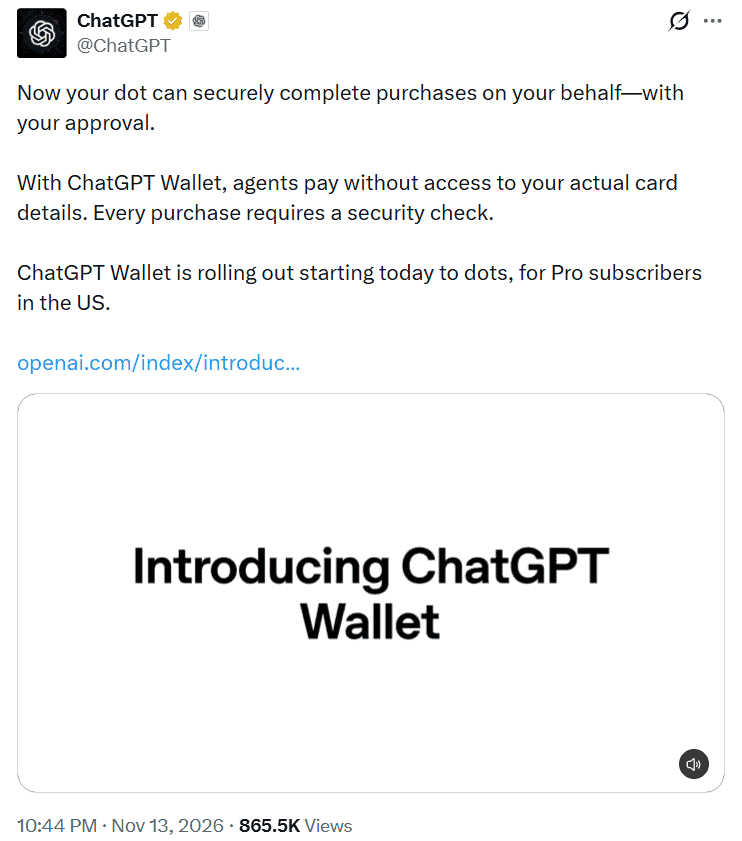
OpenAI’s introduction of the ChatGPT Wallet marks a watershed moment for e-commerce. Designed specifically for its always-on AI agents, the feature allows these digital assistants to complete online transactions on supported e-commerce websites after receiving direct human authorization.
The mechanism is built around a rigorous balance of autonomy and oversight. When an OpenAI agent identifies a product that matches a user’s prompt—such as booking a specific flight, purchasing groceries, or restocking household goods—it curates the options and pauses. The user is then presented with a comprehensive summary detailing the selected items, the exact purchase total, and the designated payment method. To finalize the transaction, the user must clear a biometric security gate, such as Apple’s Face ID or a device-level fingerprint scan.
Security architecture forms the cornerstone of OpenAI’s commercial go-to-market strategy. Rather than storing raw credit card numbers within the AI infrastructure or exposing sensitive data to third-party merchants, OpenAI has forged direct partnerships with major global payment networks, including American Express, Mastercard, and Visa. The system relies entirely on tokenization. Once a user approves a purchase, the relevant payment network instantly generates a temporary, cryptographically secure digital substitute—a token—that contains only the information strictly necessary to clear that single transaction.
This tokenized framework ensures that neither the OpenAI agent nor the online merchant ever gains access to the user’s actual primary account number or sensitive personal financial data. Furthermore, OpenAI has confirmed that eligible purchases executed through the ChatGPT Wallet retain standard cardholder protections, rewards programs, and dispute-resolution policies.
Industry stakeholders have voiced cautious optimism regarding this model. Sherri Haymond, Executive Vice President at Mastercard, emphasized the collaborative nature of the rollout, noting that an AI agent making a commercial purchase must fundamentally strengthen, rather than bypass, the inherent trust built into modern payment networks.
In its initial deployment phase, OpenAI has intentionally constrained the availability of the ChatGPT Wallet. As of November 13, the feature is rolling out exclusively to US-based ChatGPT Pro subscribers aged 18 and older who possess eligible US-issued payment cards. This measured approach allows the company to evaluate real-world transaction data, monitor edge cases, and refine interoperability with banks and online merchants before scaling the service globally.
Google Gemini and the Read-Only Personal Finance Assistant
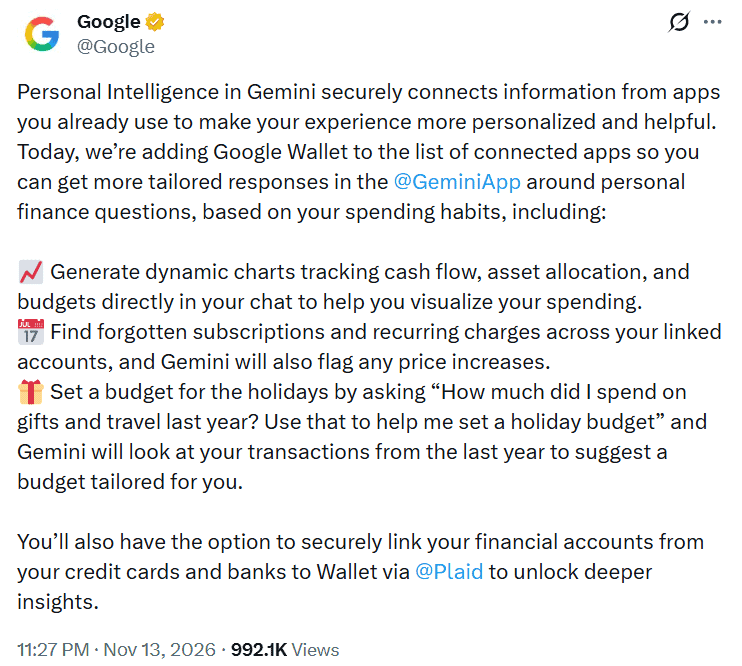
While OpenAI chases the frontier of agentic commerce, Google has chosen a complementary yet distinct path, integrating Google Wallet directly into the Personal Intelligence framework of Google Gemini. Rather than authorizing payments or moving capital, Google’s approach transforms its AI assistant into a deeply personalized financial analyst.
US-based users can connect their Google Wallet and optional third-party financial accounts—via a secure integration with Plaid—to the Gemini application. By simply tagging @Google Wallet within a chat interface, users can converse naturally about their spending patterns, monthly budgets, and cash flow dynamics. In response, Gemini generates dynamic, real-time visual charts and graphs directly inside the conversation thread, breaking down asset allocation and expenditure categories.
A standout capability of the Google Gemini integration is advanced subscription tracking. The assistant systematically scans connected accounts to identify recurring charges, flagging unexpected price hikes or dormant subscriptions that continue to drain consumer funds. Additionally, the system provides contextual budgeting support. For example, if a user tasks Gemini with saving $1,000 over a three-month period ahead of the holiday season, the assistant evaluates historical spending data across categories such as dining out, ridesharing services, and entertainment, subsequently offering targeted, data-backed recommendations on where to trim expenses.
Crucially, Google has drawn a rigid firewall around Gemini’s capabilities. Unlike OpenAI’s transaction-executing agents, Google Gemini possesses strictly read-only access to connected financial information. The assistant cannot move money, transfer funds, manage investments, or authorize purchases. Google executives have underscored this limitation, explicitly stating that the system cannot manage or invest user capital. Users maintain absolute control, with the ability to toggle the Google Wallet connection on or off at any time within their Personal Intelligence settings.
Comparative Security Models and Privacy Implications
The contrasting feature sets of ChatGPT Wallet and Google Gemini highlight two fundamentally different philosophies regarding AI security and consumer privacy.
OpenAI’s security model is transaction-centric. It focuses on shielding sensitive payment credentials during active commerce through tokenization and mandatory biometric checkpoints. The primary risk profile in OpenAI’s model involves the authorization boundary: ensuring that an autonomous agent never misinterprets a prompt and executes an unapproved or erroneous purchase. By requiring physical biometric confirmation for every single transaction, OpenAI attempts to mitigate this risk, though the psychological friction of constant approvals remains an open question for user experience designers.
Google’s security model, conversely, is data-centric. Because Gemini does not execute transactions, the primary vector of concern is the accumulation and analysis of private financial histories. By utilizing read-only access and leveraging trusted financial data aggregators like Plaid, Google avoids the liabilities associated with payment processing. However, consumers must weigh the convenience of having an AI analyze their complete transaction history against the privacy implications of feeding granular spending habits into a large language model’s memory architecture.
Both companies recognize that long-term success in the financial AI sector hinges entirely on consumer trust. Transparent authorization mechanisms, robust encryption, and absolute clarity regarding data usage will dictate whether everyday consumers embrace these tools or treat them with skepticism.
Market Implications and the Future of Financial AI
The simultaneous debut of these features does not signal an immediate winner in the race for financial AI dominance. Instead, it highlights a division of labor that may characterize the industry for years to come.
OpenAI currently holds an early tactical advantage in the realm of automated commerce. By bridging product discovery with frictionless, tokenized payment execution, the company is laying the groundwork for an autonomous shopping ecosystem. Its high-profile partnerships with legacy card networks lend institutional credibility to its agentic model, though merchant adoption rates and the initial limitation to high-tier US subscribers may temper rapid market penetration.
Google, meanwhile, commands a formidable position in personal financial management. By leveraging the expansive footprint of Google Wallet and the analytical prowess of Gemini, Google provides a comprehensive diagnostic tool for everyday budgeting and wealth tracking. The read-only constraint acts as a safety blanket for mainstream consumers who may feel hesitant about trusting an AI with their checking accounts, yet desire deeper insights into their financial health.
As both ecosystems mature, the broader economic implications will ripple through traditional banking, e-commerce platforms, and retail merchant networks. Banks will need to adapt their fraud detection algorithms to distinguish between human-initiated and agent-initiated tokenized transactions. Retailers will be forced to optimize their digital storefronts not just for human eyes and search engine optimization, but for the parsing capabilities of AI agents seeking precise product specifications and competitive pricing.
Ultimately, the November 13 rollouts represent the opening salvo in a much larger transformation. Whether consumers ultimately prefer an assistant that actively buys goods on their behalf or one that quietly helps them manage their money remains to be seen. What is certain is that artificial intelligence has officially moved out of the chat window and into the bank account.