
The global Bitcoin mining landscape navigated a period of notable volatility during the final week of September 2026, characterized by a slight appreciation in the underlying asset price contrasted against a sustained contraction in profitability metrics. As of the market close on September 28, 2026, the Bitcoin network exhibited robust growth in total hashrate, yet miners faced mounting pressure as the daily revenue per unit of computing power, known as hashprice, dipped, forcing operators to balance operational efficiency against rising transaction fee contributions.
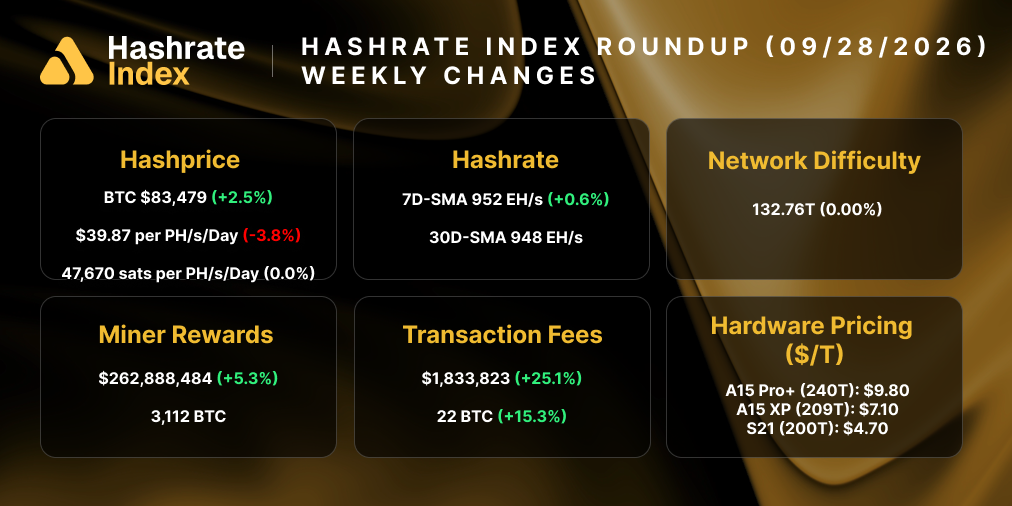
Total block rewards for the week reached approximately 3,112 BTC, valued at roughly $262 million. While the price of Bitcoin climbed 2.5% over the seven-day period, reaching $83,479 from a previous mark of $81,412, the broader year-to-date performance remains in negative territory at -4.5%. This persistent gap between asset appreciation and mining profitability underscores a challenging environment for operators, where the cost of production is increasingly sensitive to network difficulty adjustments.
Chronology of Network Metrics and Difficulty Dynamics
The Bitcoin network continues to demonstrate resilience, with the seven-day simple moving average (SMA) of the network hashrate climbing to 952 EH/s, representing a 0.6% increase from the previous week’s 946 EH/s. The 30-day SMA, currently tracking at 948 EH/s, reflects a steady, if not aggressive, expansion of total network compute power.
The last significant inflection point for miners occurred on September 19, 2026, when the network protocol enacted a +4.16% difficulty adjustment, pushing the difficulty to 132.76T. This adjustment served to recalibrate the time taken to produce blocks, which has stabilized at an average of 10 minutes and 4 seconds over the past 24 hours. Looking forward, the next difficulty adjustment is projected for October 3, 2026. Current estimates suggest a minor downward correction of -0.66%, which may provide marginal relief to miners struggling with current hashprice levels.
Hashprice Compression and Profitability Challenges
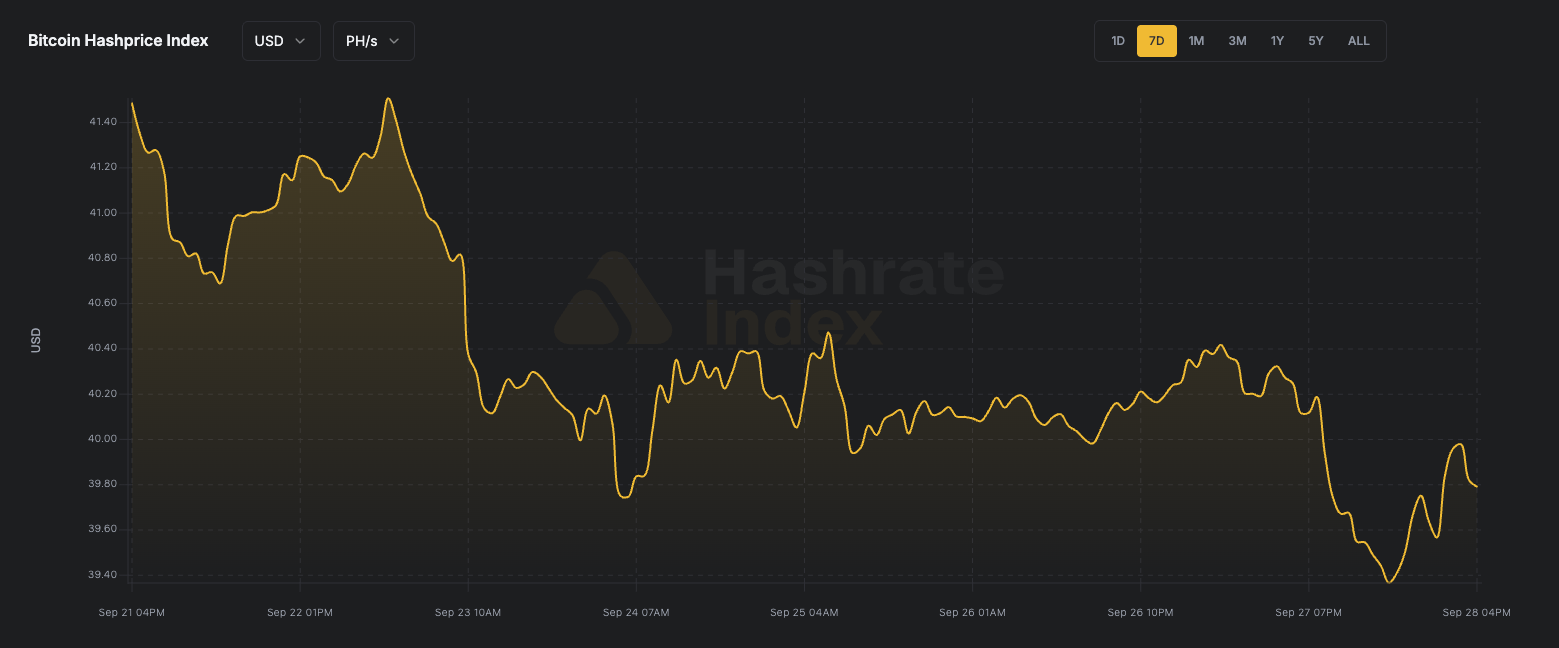
The most critical indicator for the mining industry, USD hashprice, fell by 3.8% during the week, moving from $41.45 to $39.87 per PH/s/Day. This contraction indicates that even with a rising Bitcoin price, the increased network competition is diluting the revenue share for individual mining operations. The 30-day average hashprice of $39.29 suggests that the industry is hovering near a critical breakeven threshold, particularly for firms utilizing legacy hardware that has not been upgraded to more power-efficient models.
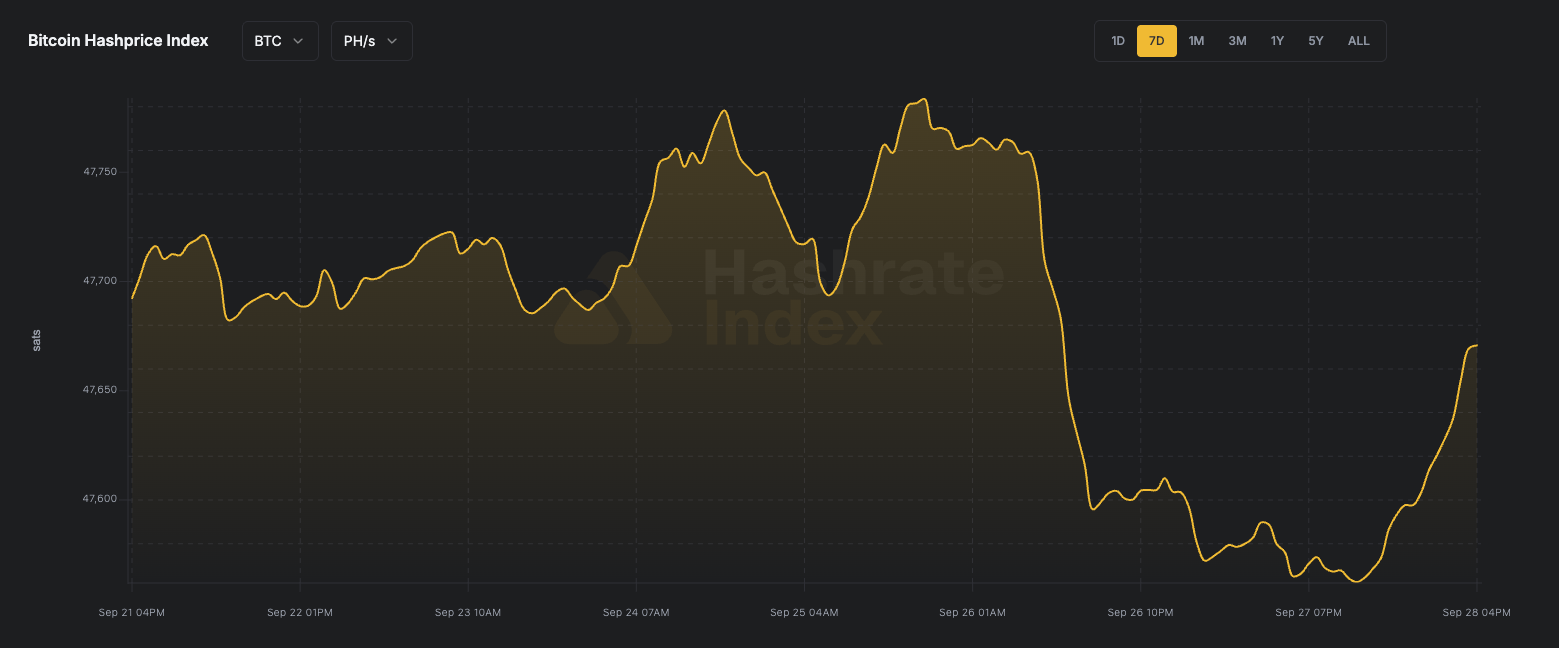
In BTC terms, the hashprice remained relatively stagnant, moving from 0.00047692 BTC per PH/s/Day to 0.00047670 BTC per PH/s/Day. This lack of movement in Bitcoin-denominated rewards, despite the fluctuations in USD value, highlights the influence of market volatility on mining business models. Operators who have not secured energy hedging or invested in next-generation ASIC infrastructure are finding it increasingly difficult to remain competitive as the energy-to-revenue ratio tightens.
Transaction Fee Contributions and Revenue Diversification
A notable development in the weekly data is the rise in transaction fee contributions. Fees accounted for 22 BTC, or 0.70% of total block rewards, totaling approximately $1.83 million. On a per-block basis, miners collected an average of 0.0217 BTC, a 12% increase compared to the previous week’s 0.0194 BTC.
This uptick in transaction fees is significant as it signals an increase in on-chain activity. While transaction fees still represent a small fraction of the total revenue generated through the block subsidy, a sustained increase in this metric is vital for the long-term sustainability of the network. As block subsidies are halved over time, miners must rely more heavily on transaction-based revenue to offset the costs of electricity and hardware maintenance.
Broader Market Implications for Mining Stocks
The equity markets reacted sharply to the compressed profitability environment throughout the week. Major Bitcoin mining stocks saw broad-based declines, reflecting investor caution regarding the sector’s immediate prospects. For instance, Iris Energy (IREN) saw a 11.7% decrease in valuation, while CleanSpark (CLSK) and Marathon Digital (MARA) recorded declines of 9.6% and 8.8%, respectively. The downward trend was consistent across the industry, with companies like Bitfarms (BTDR) and Riot Platforms (RIOT) suffering double-digit percentage drops.
These stock movements suggest that investors are closely monitoring the interplay between the spot price of Bitcoin and the operational hashprice. When hashprice trends downward, mining firms often see an immediate impact on their market capitalization as analysts recalibrate expectations for quarterly earnings and cash flow generation. The market appears to be discounting the potential for immediate margin expansion, favoring instead companies with lower debt loads and higher fleet efficiency.
Future Outlook and Derivative Market Sentiment
The Luxor Hashrate Forward Market provides a glimpse into industry expectations for the coming months. The forward curve is currently pricing in an average hashprice of $38.34, or 0.00046 BTC, over the next six months. This anticipation of lower revenue per unit suggests that market participants expect the network hashrate to continue its upward trajectory or remain elevated, thereby maintaining pressure on the hashprice.
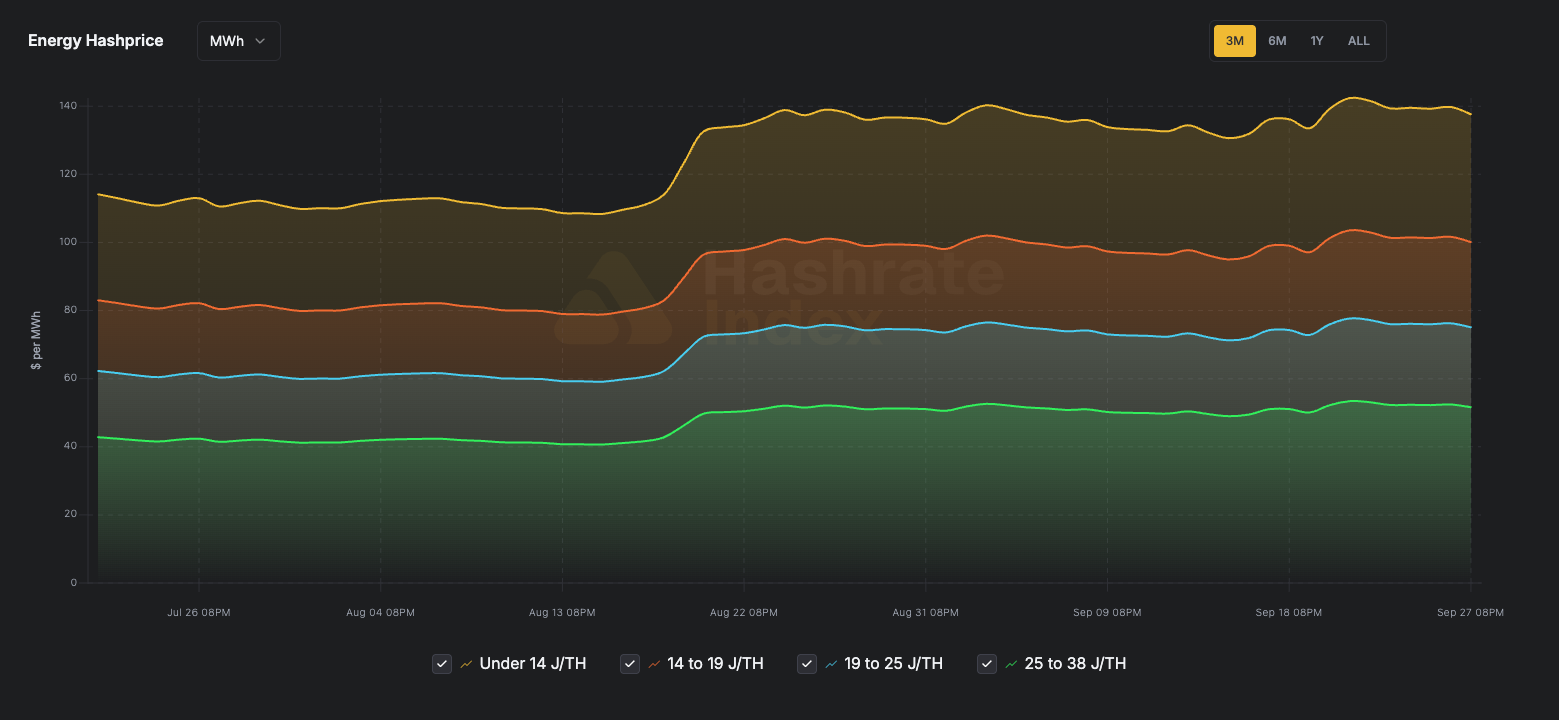
Industry analysts suggest that the next few months will be a defining period for many firms. The focus has shifted from simple expansion to rigorous efficiency optimization. Mining companies are increasingly turning to proprietary firmware solutions—such as those offered by Luxor—to extract higher hash rates and improved efficiency from existing S19 and S21 series hardware. By optimizing power consumption and cooling, these firms aim to lower their effective cost per terahash, providing a buffer against the prevailing market conditions.
Conclusion
The state of the Bitcoin mining industry as of late September 2026 remains in a delicate equilibrium. While the network hashrate continues to climb, demonstrating strong confidence in the underlying protocol, the financial reality for miners is characterized by tight margins and a reliance on efficiency gains. The upcoming difficulty adjustment in early October will be a pivotal event, potentially offering a slight respite to miners. However, until the USD hashprice recovers, the industry will likely remain in a consolidation phase, where the most efficient operators continue to outpace those with higher overhead costs. As the market enters the final quarter of the year, the correlation between transaction fee revenue, energy costs, and hardware efficiency will remain the primary drivers of industry health.