The decentralized finance landscape on Ethereum Mainnet has reached a structural milestone with the official rollout of multicollateral margin on Synthetix. In what protocol developers and market analysts are calling a foundational shift for derivatives trading on Layer 1, traders can now deposit Ether (ETH) directly as native collateral to open and manage perpetual futures positions. This release marks the first time in the history of the Ethereum network that native ETH can be utilized directly as margin without requiring wrapped tokens, bridging assets, or forcing users to liquidate their underlying holdings.
Historically, decentralized perpetual exchanges operating on Ethereum Mainnet have relied heavily on stablecoins—primarily USDT or USDC—as the sole foundational collateral for trading operations. While effective for risk management and margin calculations, this limitation forced traders who were structurally bullish on ETH to either sell their holdings for stablecoins or navigate multi-step cross-chain bridging processes to access derivatives liquidity elsewhere. Synthetix’s integration of ETH as a primary margin asset fundamentally alters this paradigm, unlocking a multi-billion-dollar pool of idle capital anchored directly to the Ethereum layer-one ecosystem.
Background Context and Evolution of Synthetix Perps
To understand the significance of the multicollateral margin deployment, one must examine the iterative architecture of Synthetix over recent years. Originating as a synthetic asset issuance platform, Synthetix has evolved into one of the premier liquidity backbones for derivatives trading in decentralized finance. Its perpetual futures (perps) infrastructure is designed around a high-performance engine that settles trades transparently and natively on Ethereum Mainnet.
While Layer-2 scaling solutions have dominated discussions regarding retail trading volume due to lower gas fees, Synthetix has steadfastly maintained its commitment to Ethereum Mainnet settlement, leveraging the unmatched security, composability, and liquidity depth of the L1 environment. However, operating exclusively on Mainnet with stablecoin-only margin introduced capital inefficiencies for sophisticated market participants. Traders seeking to execute delta-neutral strategies, such as basis trades, were encumbered by the necessity of holding cash equivalents rather than putting their productive crypto assets to work.
The introduction of multicollateral margin addresses this architectural bottleneck. By establishing a unified account system where disparate assets can cooperate under a single risk framework, Synthetix has built a bridge between long-term asset accumulation and short-term derivatives trading.
Mechanics of Native ETH Margin: Haircuts, Indices, and Risk Management
The implementation of ETH as a margin asset is governed by a rigorous risk mitigation framework designed to protect the protocol and its liquidity providers against sudden market volatility. When a trader deposits ETH into their unified Synthetix margin account, the protocol evaluates the asset using its live decentralized index price.
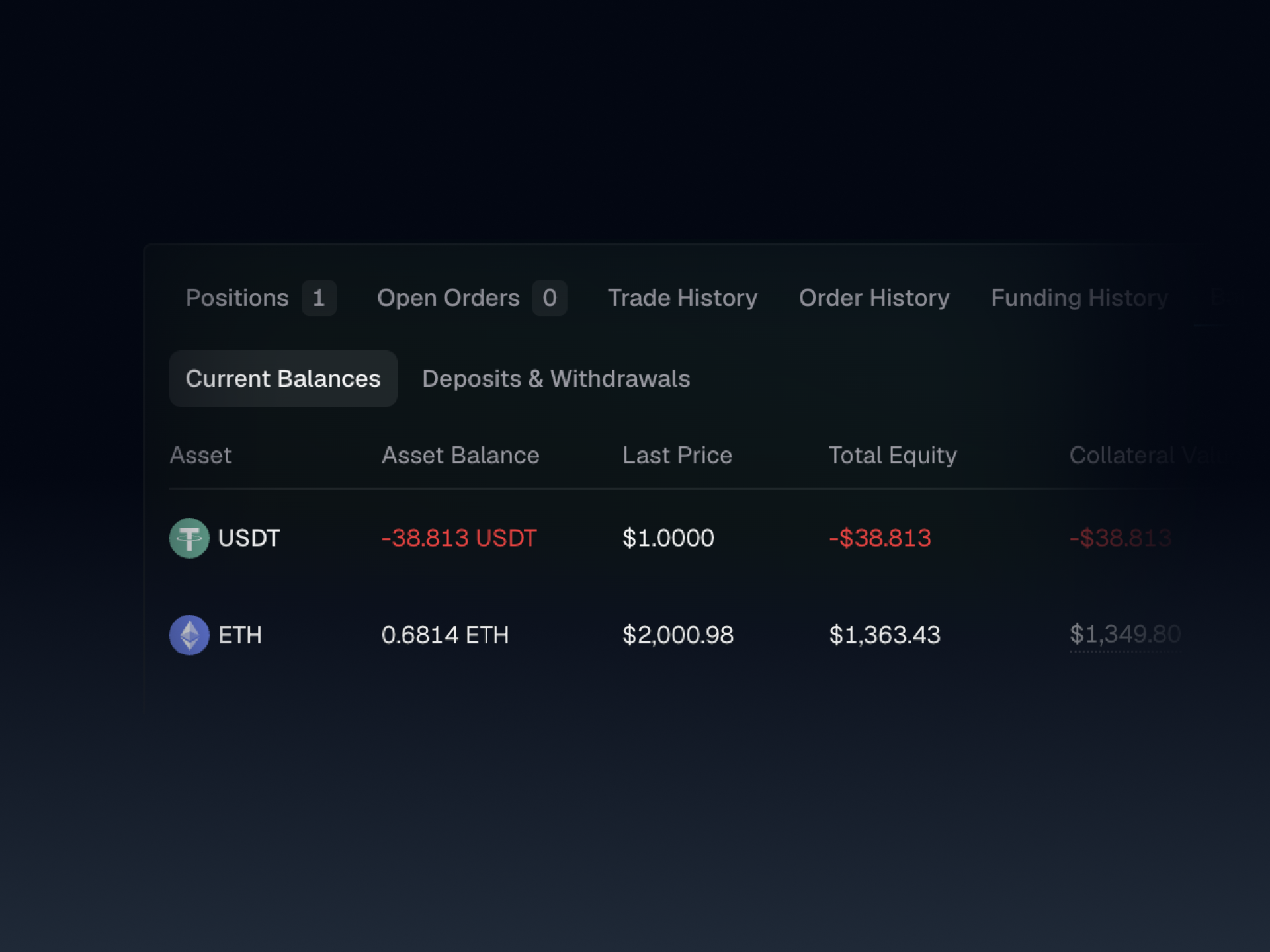
Because ETH carries directional price volatility—unlike stablecoins pegged to the US dollar—the protocol applies a dynamic risk discount, commonly referred to as a "haircut," to the asset’s market value. The resulting figure represents the user’s effective Collateral Value, which dictates their borrowing and leverage capacity across USDT-settled perpetual markets.
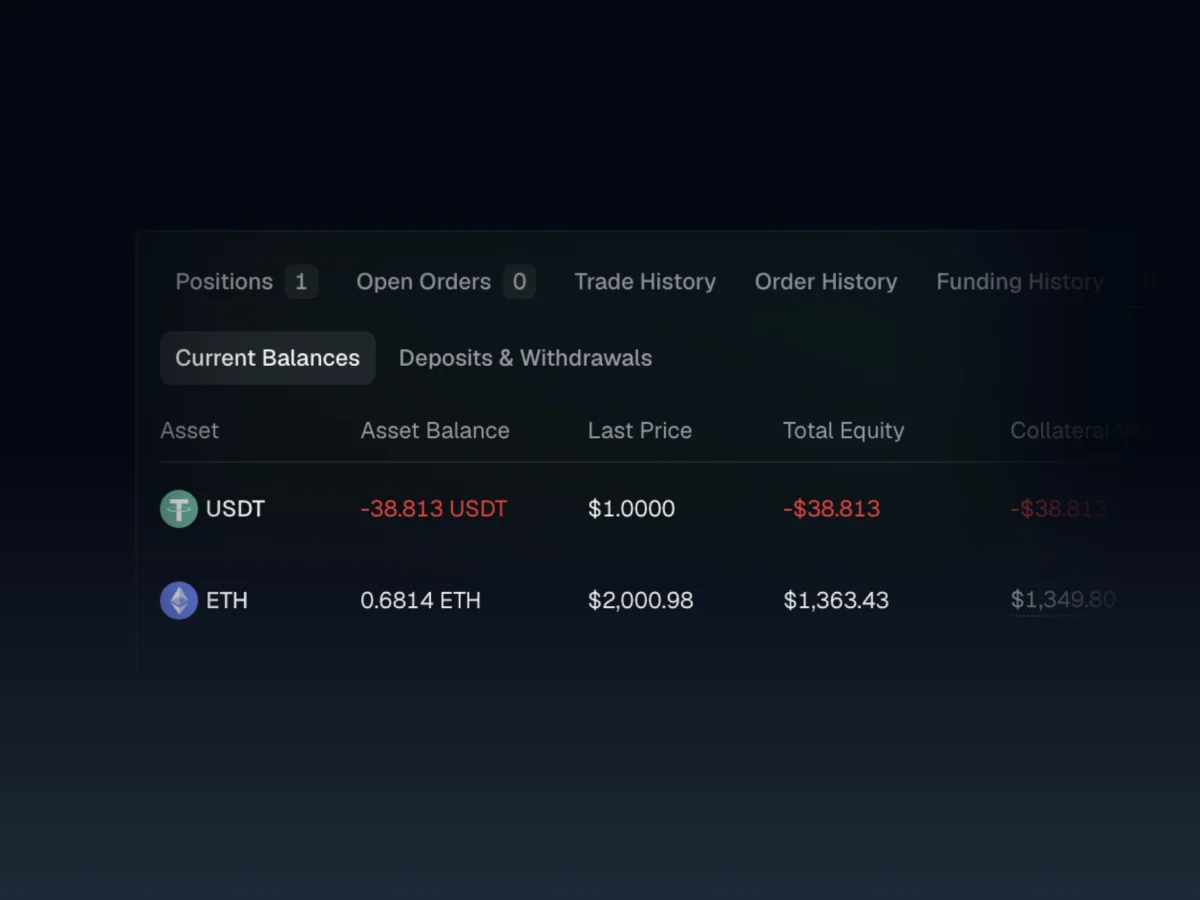
A distinguishing feature of the Synthetix multicollateral architecture is its flexibility regarding account balances. Because all positions ultimately settle in USDT, trading on ETH collateral without an accompanying USDT balance can cause a user’s USDT ledger to reflect a negative balance while positions remain active. This is an intentional design choice that allows traders to utilize the underlying purchasing power of their deposited ETH without executing disruptive spot market sales. Users maintain the autonomy to resolve negative USDT balances at any time by utilizing the protocol’s internal swap function to convert a portion of their ETH directly into stablecoins.
To maintain systemic stability, the protocol continuously monitors the health of each unified account. If the price of ETH depreciates significantly, reducing the total collateral value below required maintenance thresholds, the system is engineered to execute automated risk-mitigation protocols—such as converting a portion of the user’s collateral to USDT. Consequently, risk managers and traders are advised to maintain a healthy collateral buffer and monitor index price movements alongside position Profit and Loss (PnL).
Unlocking Advanced DeFi Strategies: The Mechanics of Efficient Basis Trades
The arrival of native ETH margin has immediate implications for institutional and advanced retail traders seeking to execute classic decentralized finance strategies with minimal friction. Chief among these is the basis trade—a foundational market-neutral strategy that captures the yield differential between the spot market price of an asset and its perpetual futures contract price.
Previously, executing a basis trade on Mainnet required complex allocations of capital across multiple venues or the conversion of productive assets into stablecoins, incurring opportunity costs and tax events. With Synthetix’s new architecture, a trader can deposit ETH as collateral, open a corresponding short ETH perpetual position of equal size, and construct a delta-neutral portfolio entirely within a single account on Ethereum Mainnet.
In this scenario, the directional price movements of the collateral and the perpetual position largely offset one another, neutralizing market exposure while allowing the trader to collect ongoing funding rate payments. Market analysts note that as basis trading becomes more capital efficient and frictionless on Synthetix, liquidity providers and arbitrageurs will naturally tighten funding rates and narrow bid-ask spreads across the exchange, creating a more robust and competitive marketplace for all participants.
Broader Implications for the Ethereum Ecosystem and Liquidity
The total addressable market for this upgrade is substantial. With well over $100 billion in idle ETH sitting natively on Ethereum Mainnet, the potential to integrate a fraction of this capital into the derivatives ecosystem represents an unprecedented expansion of utility for the network’s native asset.
Industry observers have pointed out that if Synthetix captures even a modest percentage of the average monthly derivatives volume currently transacted across competing platforms, it could initiate a powerful economic flywheel. Higher trading volumes generate increased fee revenue, which in turn deepens liquidity pools, attracts larger institutional market makers, and enhances the overall composability of the Ethereum DeFi stack.
Furthermore, the protocol has confirmed that ETH is merely the first non-USDT asset to be integrated into the multicollateral framework. The underlying infrastructure has been intentionally engineered to scale, paving the way for additional collateral types—including yield-bearing assets such as liquid staking tokens (LSTs)—to be incorporated into user margin accounts in future upgrades. This roadmap points toward a future where capital efficiency in decentralized derivatives matches, and potentially exceeds, that of traditional centralized financial institutions.
Getting Started and Future Outlook
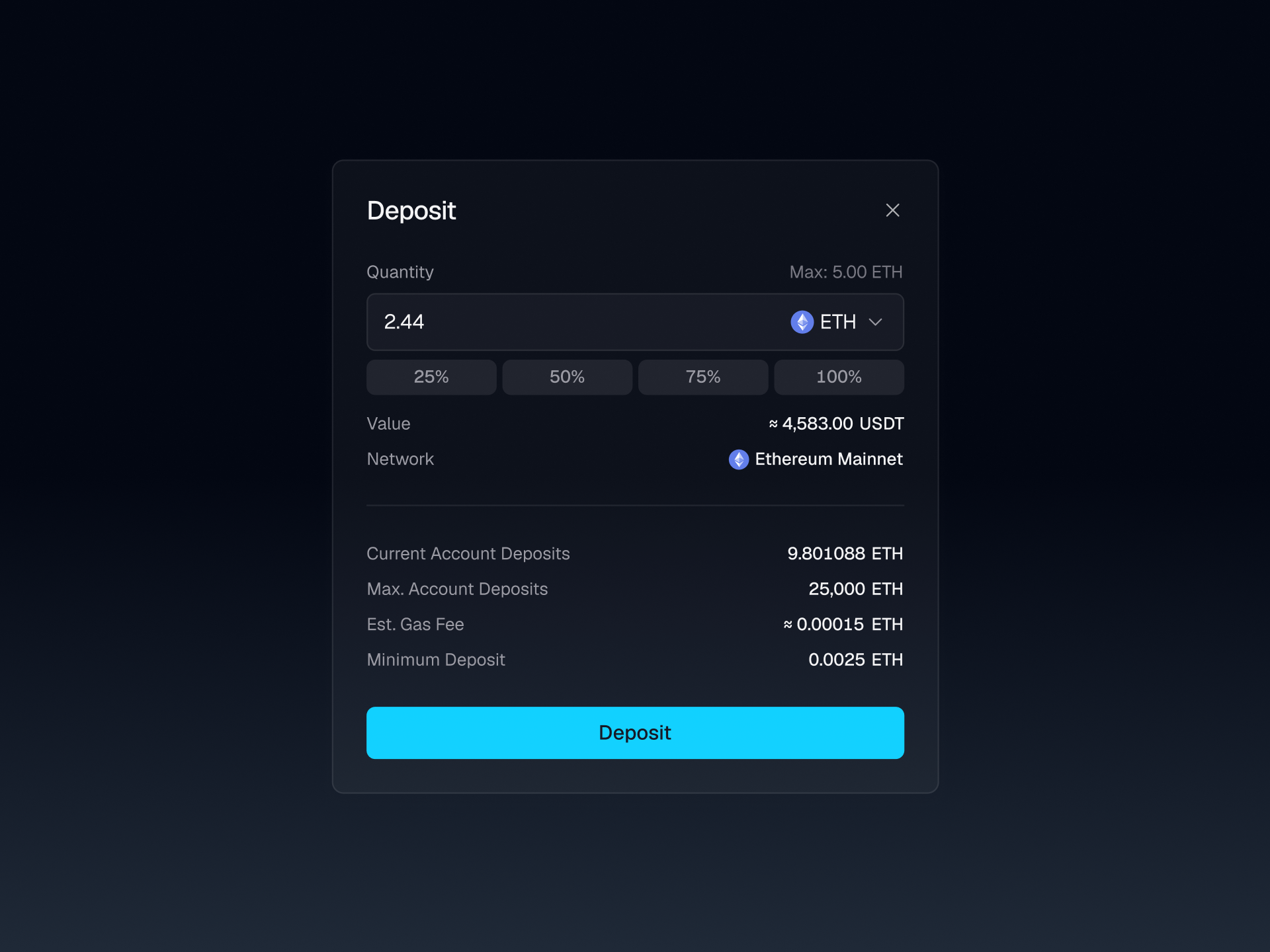
The rollout of multicollateral margin is now fully live for all users on Synthetix Perps. Traders can access the feature directly through the platform interface, where comprehensive details regarding deposit minimums, account caps, and asset-specific risk parameters are outlined within the deposit workflow.
As the protocol continues to refine its mainnet infrastructure, developers encourage market participants to review the official documentation for granular insights into haircut calculations, collateral withdrawal limits, and account health maintenance. With native ETH margin now operational, Synthetix has cemented Ethereum Mainnet’s position as a premier, high-performance venue for decentralized derivatives trading, signaling a mature new chapter for capital efficiency in decentralized finance.