The 2026 edition of Yotta, hosted at the Caesars Forum in Las Vegas, served as a definitive turning point for the digital infrastructure sector, drawing more than 6,500 industry leaders, 600 CEOs, and 350 exhibitors to participate in over 180 technical and strategic sessions. Having rapidly outgrown its previous venue at the MGM Grand, the event’s expansion to a larger footprint reflects a broader macro-trend: the total convergence of power, real estate, capital, and silicon into a single, cohesive industrial asset class. As the demand for artificial intelligence and high-performance computing (HPC) scales exponentially, the infrastructure required to support these workloads has transitioned from specialized, bespoke projects into a structured, commoditized market.
A Convergence of Capital and Infrastructure
The central theme permeating Yotta 2026 was the dissolution of silos between traditional infrastructure segments. George Rockett, co-founder of Yotta, highlighted in his opening remarks that the conversation surrounding data centers is no longer fragmented. Historically, site selection, power procurement, chip acquisition, and capital financing were handled as separate, often disconnected, workflows. Today, these elements are inextricably linked.

This evolution is reflected in the shifting vocabulary of the boardroom. Executives who once focused solely on hardware procurement—specifically, how many H100 units could be secured—are now fluent in the language of commodity markets. Discussions on the expo floor were dominated by metrics such as forward curves, residual value, basis risk, and yield. This transition mirrors the evolution of Bitcoin mining, where specialized compute (SHA-256 hashrate) matured from a niche technical specification into a hedgeable, transparently priced commodity. While AI compute is currently in the early stages of this journey, the presence of major financial institutions—including Apollo, BlackRock, and KKR—signals that institutional capital is now treating GPU clusters with the same rigor applied to toll roads or power plants.
The Challenge of Compute Derivatives
A significant hurdle in the maturation of this market is the development of reliable index construction. While several initiatives for cash-settled compute futures are underway—notably from the CME Group, ICE, and Nodal Exchange—the progress has been slower than market participants initially anticipated. The Commodity Futures Trading Commission (CFTC) recently extended its review of proposed CME compute contracts by 45 days, citing complex questions regarding price manipulation and index transparency.
The core issue lies in the fact that the majority of compute trades occur via long-term, private, bare-metal rental contracts or bespoke token-generation agreements. Existing indexes, which rely heavily on public, on-demand bare-metal pricing, capture only a thin, unrepresentative slice of the actual market. Consequently, the "derivatives market" for compute is already flourishing, albeit in the form of physically delivered, over-the-counter (OTC) contracts rather than exchange-listed futures. Industry experts at the event, including representatives from Luxor Technology, noted that until data transparency improves and standardized index benchmarks are established, listed derivatives will remain a secondary concern to the robust, private market for capacity.

Economics of the AI Factory
The economics of the AI sector are experiencing a profound shift. While the market for tokens is characterized by thin, volatile margins, the revenue derived from the underlying compute layer is becoming increasingly bankable. This is largely due to the capital-intensive nature of the hardware; with the latest generation of B300 nodes costing significantly more than their predecessors, providers are under immense pressure to secure predictable, long-term revenue streams.
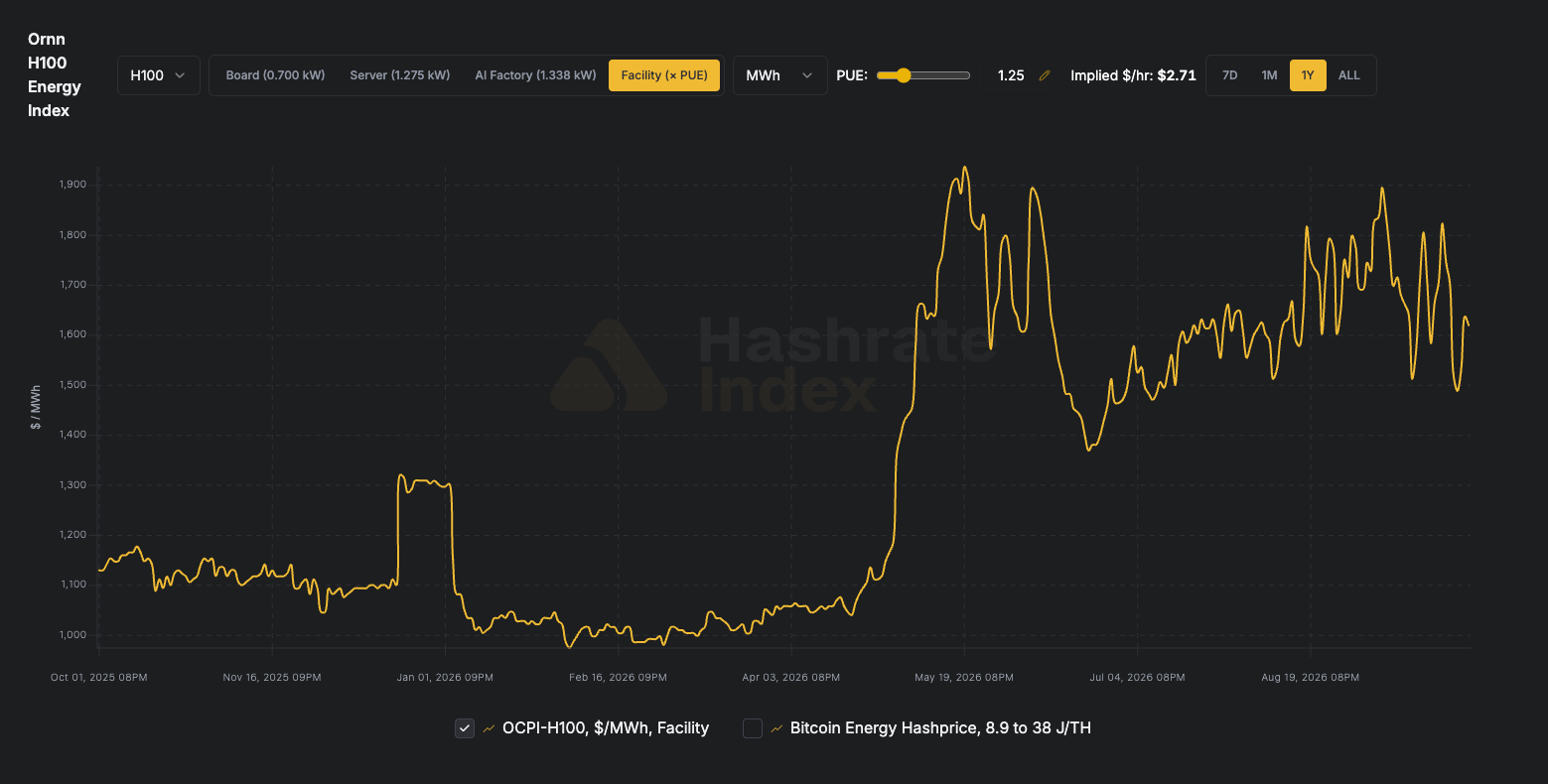
This has led to a "tiering" of the industry. Inference providers, who occupy the layer closest to the end-user, often find themselves squeezed between the downward price pressure of open-weights models and the high capital expenditure required to maintain GPU clusters. Conversely, compute providers—those who control the physical infrastructure and the power—are capturing the most stable value. This stability is reflected in the rise of "energy-denominated" pricing models. By viewing GPU clusters as an extension of power infrastructure, operators can utilize metrics similar to "energy hashprice" to track the profitability of their units in real-time, regardless of the fluctuating value of the tokens being generated.
Modular Data Centers: From Concept to Reality
One of the most visible indicators of industry maturation at Yotta 2026 was the deployment of modular data centers on the Forum Plaza. Moving beyond the renderings and pitch decks that defined previous years, these exhibits showcased working, field-ready units equipped with microgrid generators and closed-loop liquid cooling systems.

The adoption of modular pods is driven by the need for speed. As permitting and interconnection timelines for traditional, brick-and-mortar data centers continue to extend, modular units offer a way to compress construction schedules from years to months. While these units involve higher costs per megawatt and offer less flexibility than custom-built facilities, the trade-off is increasingly viewed as an acceptable price for speed-to-market. Notably, the thermal engineering required for these pods—which must manage 120 kW-class racks—represents a significant leap in complexity compared to the cooling systems used in earlier Bitcoin mining container designs.
Regulatory Headwinds and Global Arbitrage
The United States is currently facing a tightening regulatory environment for high-load infrastructure. Following New York’s recent moratorium on new hyperscale data centers, approximately 15 other states have introduced or are considering similar restrictions on power-intensive developments. This regulatory uncertainty, combined with grid congestion and transmission delays, has forced capital to look elsewhere.
This search for stable, accessible power is driving a surge in international investment. Emerging markets are becoming increasingly attractive, provided they offer a degree of political and economic stability. Investors who previously avoided these regions are now underwriting projects based on the strength of the offtake agreement. If the underlying contract is creditworthy, the jurisdiction often becomes a secondary pricing input rather than a disqualifier. This shift is highly reminiscent of the geographic migration seen in the Bitcoin mining sector, where operators leveraged stranded power in regions like Brazil, Paraguay, and Ethiopia.
Strategic Implications for Operators
For infrastructure operators, the takeaway from Yotta 2026 is clear: the industry is becoming a sophisticated commodity play. The ability to manage power, secure grid relationships, and maintain hardware lifecycles is now the primary competitive advantage. The success of AI compute as an asset class will depend on the continued integration of sophisticated financial tools—such as revenue floors and forward contracts—that allow operators to manage the risks inherent in such a capital-intensive business.
As Ethan Vera, COO of Luxor, observed during the event, the "bind" for any given project will fluctuate between electrons, data center capacity, capital, and end-client demand. The operators who succeed will be those who can navigate these bottlenecks with agility. Bitcoin miners, having already spent a decade refining the art of flexible, power-sensitive, and capital-efficient operations, are uniquely positioned to transition into this new era of AI infrastructure.
The final consensus at Yotta 2026 was that while the technology underlying AI is complex and rapidly evolving, the infrastructure supporting it is becoming remarkably traditional. It is an industry built on physics and finance, where the most durable positions are held by those closest to the energy source. As the industry looks toward 2027, the focus will undoubtedly shift from the novelty of the AI hardware to the efficiency and scalability of the "AI factories" that house them.