A Year of Retrenchment and Recovery
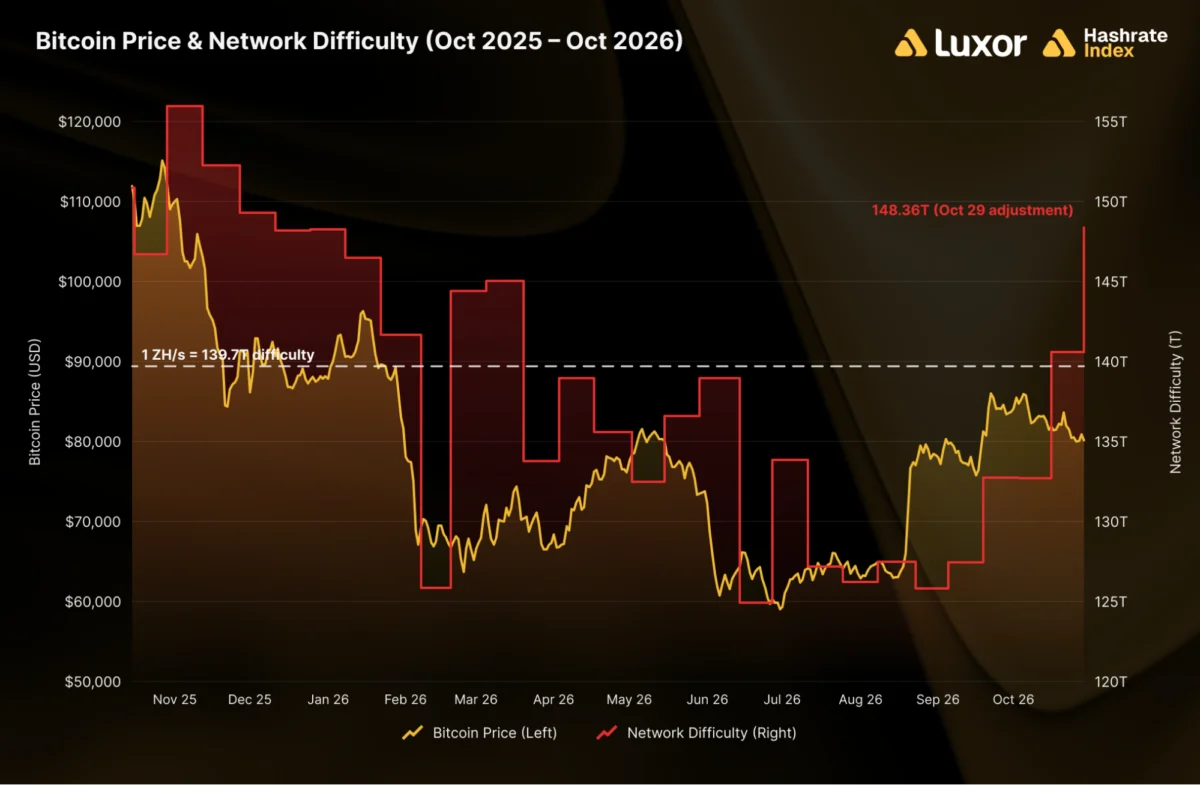
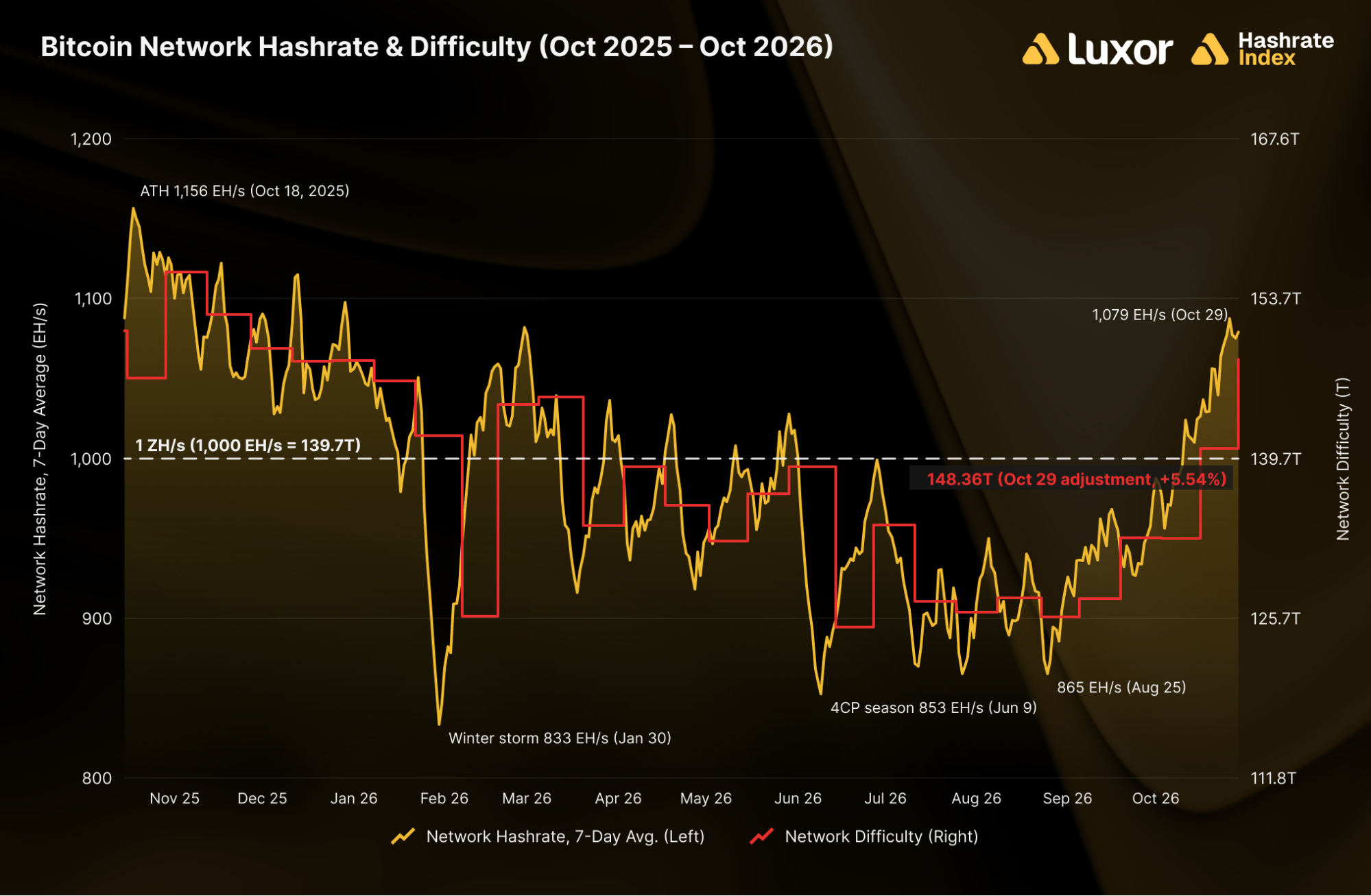
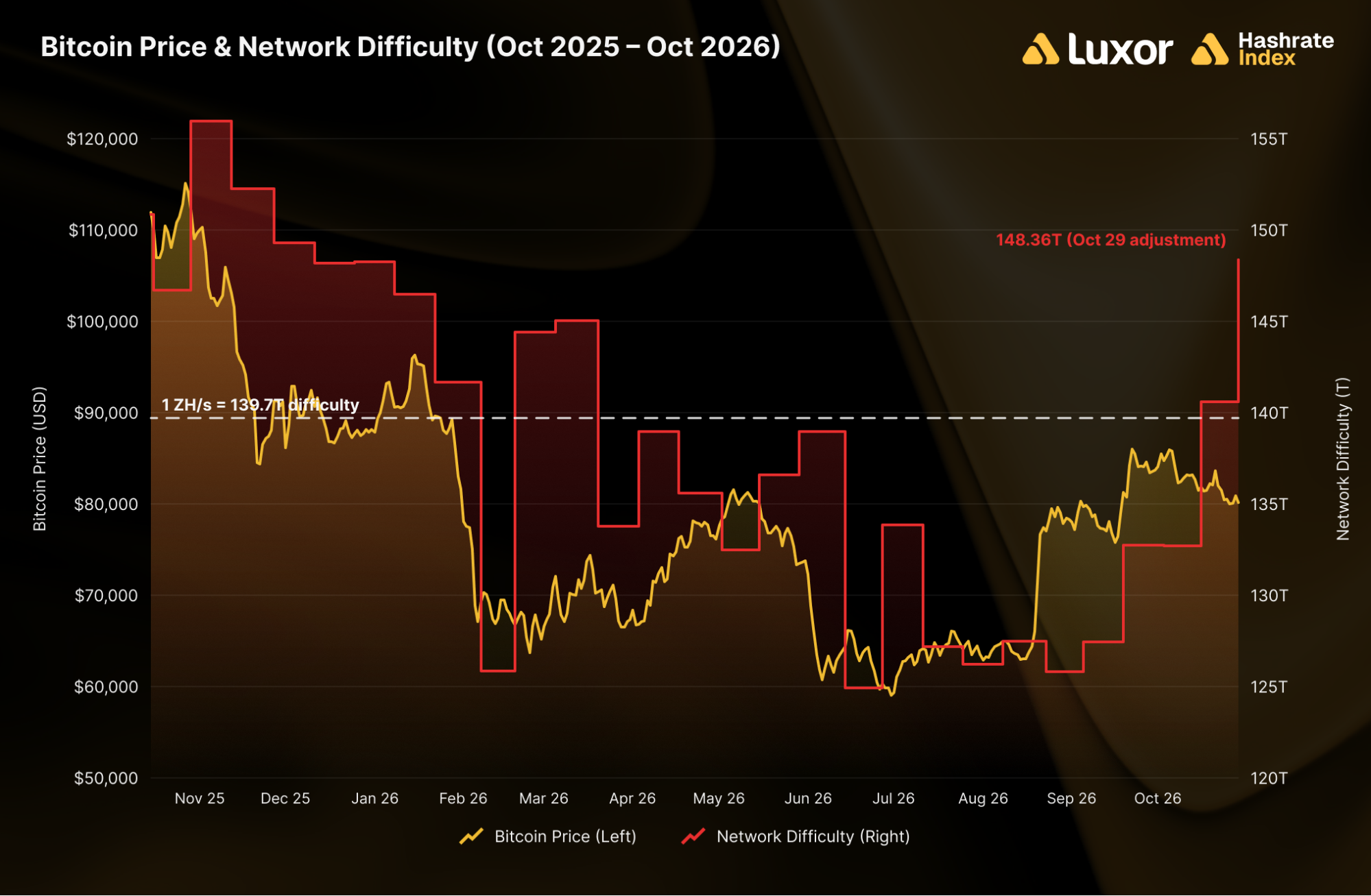
The journey to 1 ZH/s has been defined by a volatile twelve-month cycle. In October 2025, the Bitcoin network reached an all-time high in terms of computing power, hitting a 7-day average hashrate of 1,156 EH/s. At that zenith, the network difficulty soared to a record 155.97T, while Bitcoin’s price reached an unprecedented $124,485. During that period, hashprice—the revenue miners earn per unit of hashrate—was approximately $46 per PH/s/day.

The subsequent year forced a brutal correction. As Bitcoin’s price entered a corrective phase, falling by over 36% from its peak, the mining industry faced a triple-threat environment: reduced block rewards, compressed margins, and the inherent seasonality of power markets. By the first half of 2026, network difficulty tracked the downward trend of the asset price. However, the recovery observed in August 2026, driven by a renewed rally in Bitcoin’s market value, provided the necessary tailwind for miners to bring dormant capacity back online. By October 26, 2026, the 7-day average hashrate had climbed to 1,088 EH/s, signaling that the network’s total capacity is once again approaching its historical high.
Seasonality and the 4CP Effect
A critical factor in this year’s hashrate fluctuation was the Four Coincident Peaks (4CP) demand response program administered by the Electric Reliability Council of Texas (ERCOT). Because many of the world’s largest Bitcoin mining operations are concentrated in Texas, their participation in the 4CP program—which incentivizes load curtailment during periods of maximum grid demand—directly impacted the global hashrate.

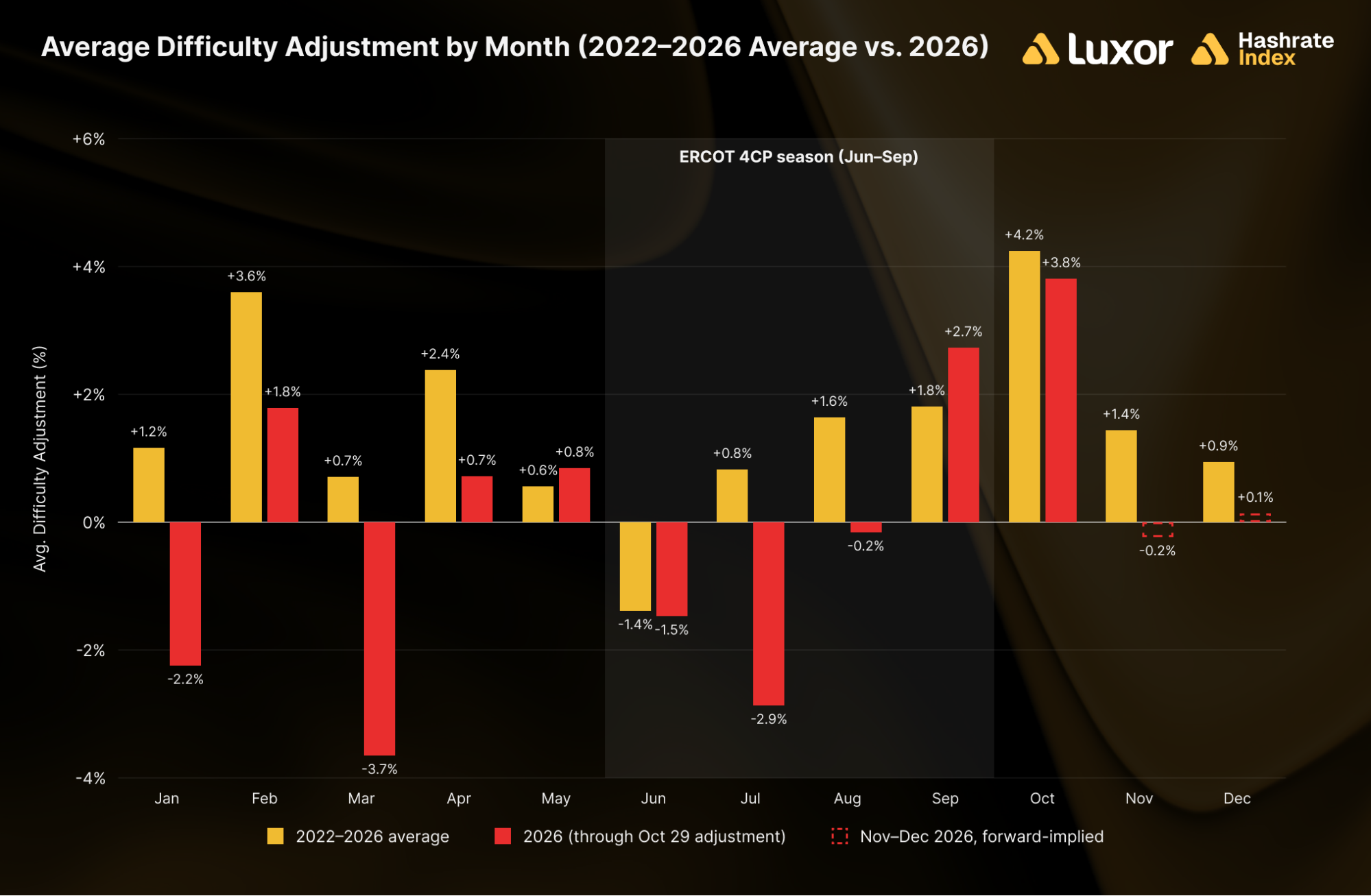
The 2026 4CP season saw peaks hit on June 18, July 22, August 24, and September 12, with an average grid load of 87.3 GW. The cumulative effect of these curtailments, compounded by price-driven shutdowns, resulted in eight consecutive difficulty adjustments between June 14 and September 19 that averaged -0.44%. Most notably, the June 14 adjustment saw a 10.09% decline, the eighth-largest drop in the modern ASIC era.
Historically, the period between June and September is characterized by lower growth in network difficulty due to these power-saving measures. Conversely, October has historically served as a high-growth month as industrial operations resume full-capacity mining. Data from 2022 through 2026 shows that while non-peak months average a 1.90% increase in difficulty, October averages a 4.25% increase. The current year has followed this seasonal script perfectly, with a cumulative 16.4% increase in difficulty since the final 4CP peak on September 12.
Market Sentiment and the Hashrate Forward Curve
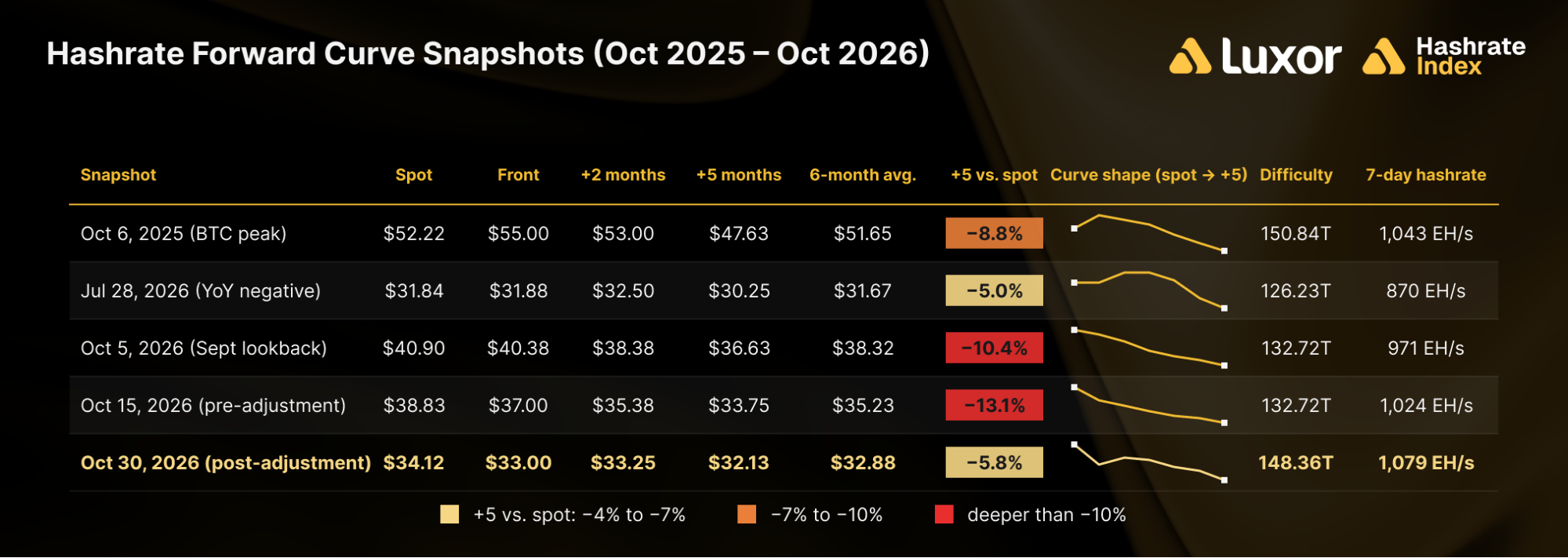
The evolution of the Hashrate Forward Market provides a clear lens into how institutional participants have navigated these shifts. As of July 2026, the forward curve was largely flat, reflecting a market consensus that expected stagnation in difficulty growth. However, by October 5, the curve had shifted into backwardation, suggesting that market participants were beginning to anticipate a more aggressive return of network power.
The market’s expectation was realized ahead of schedule in October. Following the October 16 adjustment, the front-month contract in the hashrate forward market traded significantly below spot, indicating that traders were hedging against the rapid return of network capacity. By the time of the October 29 adjustment, the market had begun to price in a period of consolidation. The forward curve currently suggests a pause in rapid growth through the end of 2026, with only modest increases projected for early 2027. This shift from a growth-oriented curve to a flatter, more stable outlook reflects a mining industry that is prioritizing operational efficiency over blind expansion.
Implications for Fleet Efficiency
The fact that the network has returned to 1 ZH/s while Bitcoin’s price remains significantly lower than its 2025 peak reveals a fundamental transformation in mining fleet composition. The "new" hashrate currently populating the network is markedly more efficient than the hardware that was forced offline during the downturn. Miners have spent the last year upgrading to next-generation ASIC models that produce more terahashes per watt, allowing them to remain profitable even as hashprice has settled near $34—down from the $46 seen during the 2025 peak.
For miners, this environment necessitates a sophisticated approach to risk management. The ability to hedge hashprice is no longer a luxury but a requirement for survival in a highly competitive, industrialized market. Mining firms are increasingly using forward contracts to lock in revenue, hedge against electricity price volatility, and secure capital for further hardware acquisitions. As the network stabilizes above 1 ZH/s, the focus for the industry will likely shift from sheer power growth to the optimization of energy procurement and the refinement of operational margins.
Broader Industry Outlook
The transition back above the 1 ZH/s milestone is more than a technical achievement; it is a signal of the maturity of the Bitcoin mining sector. By decoupling total network power from the extreme price swings of the past, the industry is demonstrating that mining is no longer a speculative venture but a core utility-like service.
Industry analysts observe that the current consolidation of hashrate—where only the most efficient fleets remain operational—strengthens the overall network security. Furthermore, as miners continue to integrate more deeply with energy providers, their role in grid stabilization is becoming increasingly recognized by regulators and power companies alike. While the forward market anticipates a period of slower growth through the winter months, the foundation has been laid for the next cycle of capacity expansion, likely led by advancements in cooling technology and decentralized energy microgrids.
For the average stakeholder, the return to 1 ZH/s confirms that the fundamental infrastructure of the Bitcoin network remains robust, capable of weathering both the macro-economic pressures of 2026 and the seasonal challenges of the Texas power grid. As the industry looks toward 2027, the focus will remain on technological efficiency, with the 1 ZH/s threshold serving as the new baseline for a global, industrialized, and increasingly resilient mining network.