The digital infrastructure landscape underwent a seismic shift at Yotta 2026, held at the Caesars Forum in Las Vegas, as more than 6,500 industry leaders gathered to address the unprecedented demands of the artificial intelligence era. The event, which has doubled in size over the past year, marked a departure from the traditional data center discourse. By bringing together over 600 CEOs, 300 speakers, and 350 exhibitors, the conference served as a barometer for a sector that has moved past the experimental phase and into the reality of massive, capital-intensive industrialization.
For years, the components of digital infrastructure—power, real estate, hardware, and capital—were treated as siloed operational concerns. Yotta 2026, framed by co-founder George Rockett, signaled the definitive end of that era. The conversation is no longer about simply sourcing chips or securing megawatts; it is about the complex, integrated lifecycle of "compute" as a foundational global commodity. As firms like Luxor Technology Corporation, led by CEO Nick Hansen and COO Ethan Vera, navigated the floor, the discourse shifted toward the vocabulary of commodity markets: forward curves, basis risk, and residual value.
A New Language for a New Asset Class
The evolution of AI compute is mirroring the path previously carved by Bitcoin mining. Just as SHA-256 hashrate transitioned from a niche technical specification to a transparently priced and hedgeable asset, general-purpose compute is currently traversing the same developmental arc. Three years ago, procurement officers were primarily focused on the availability of NVIDIA H100 units. Today, those same buyers are interrogating asset yields, utilization risk, and five-year residual valuations.

This shift has profound implications for how capital is deployed. The financial industry is beginning to treat GPU clusters with the same rigor it applies to toll roads or utility-scale power plants. This is facilitated by the introduction of derivative products aimed at creating a more efficient market. While exchange-listed, cash-settled compute futures—such as those proposed by the CME Group, ICE, and Nodal Exchange—are currently facing regulatory scrutiny regarding index construction, the underlying market for "physically delivered" compute is already thriving.
The primary hurdle for regulatory-approved futures remains data transparency. Current indices rely heavily on on-demand bare metal rental pricing, which represents only a thin slice of the actual market. Most large-scale compute trades occur via long-term, private contracts between hyperscalers and frontier AI labs. Because this data is proprietary, index providers struggle to satisfy the stringent listing requirements of the Commodity Futures Trading Commission (CFTC). Despite these challenges, the industry is moving toward greater standardization. The publication of the Ornn Compute Price Index and various AI hardware price indices marks a significant step toward the price discovery necessary for institutional-grade financial products.
The Economics of the AI Factory
One of the most critical takeaways from the event was the growing tension between token-based revenue models and the underlying costs of infrastructure. While the end-product of much AI work is the generation of tokens—often at thin, volatile margins—the "compute layer" beneath it is becoming increasingly bankable.
Hardware costs are climbing as each generation of silicon grows more sophisticated. Data from the AI Hardware Price Index shows an 8-GPU B300 node currently priced at approximately $544,280, compared to roughly $40,555 per GPU for an H100 node. This 1.68x increase in capital expenditure per GPU necessitates a stable, predictable revenue stream that is decoupled from the fluctuations of the token market.

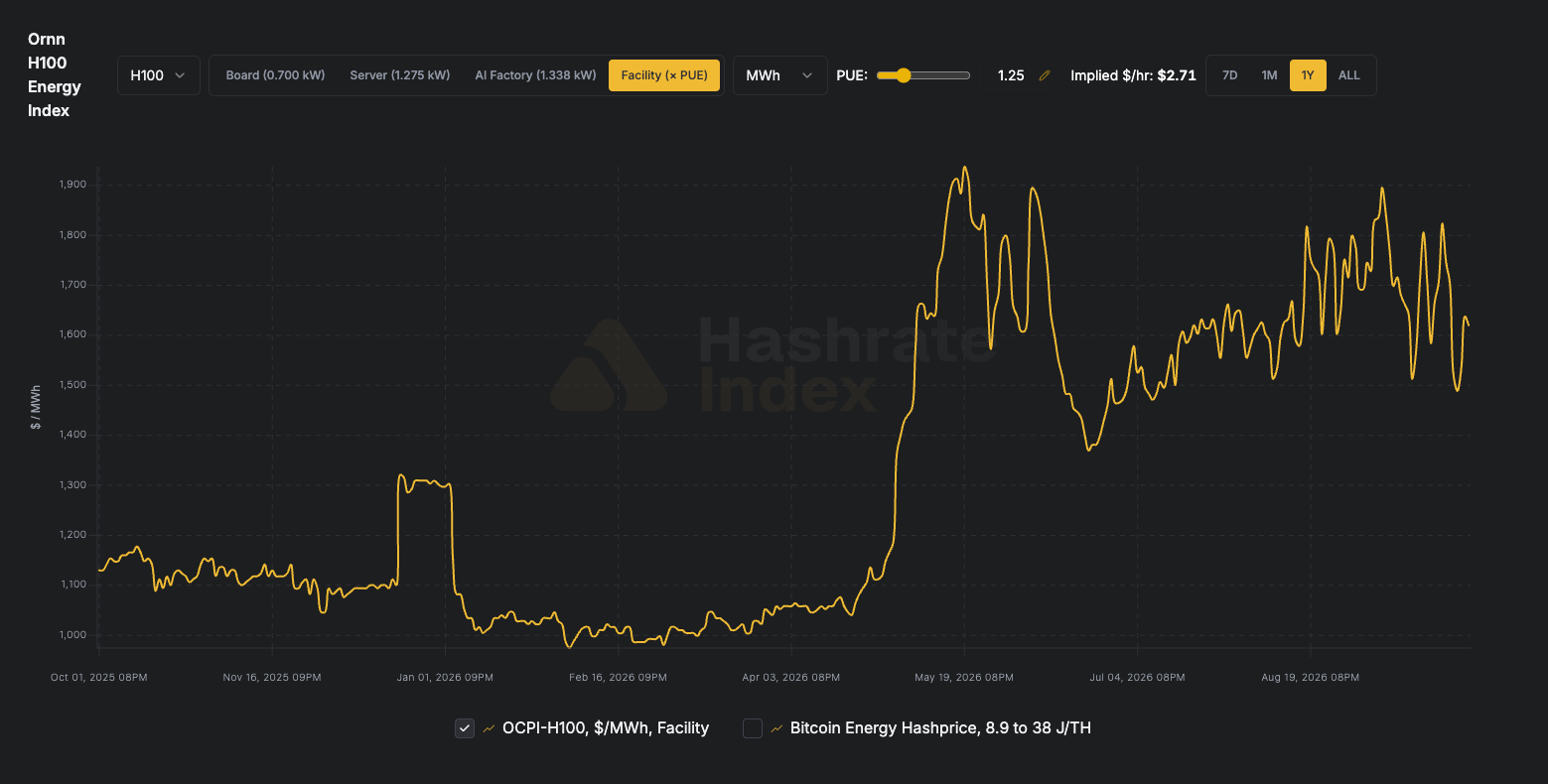
This reality is driving a fundamental change in how data center operators view their business. The focus is shifting from "how many tokens can we generate" to "what is the energy-denominated return on a unit of compute." By tracking the energy-denominated price of compute, operators can better align their site economics with the realities of power pricing and grid constraints. Consequently, financing structures are evolving. NVIDIA’s recent memoranda of understanding with major financial institutions—including BlackRock, Blackstone, and KKR—to create $500 billion in compute financing platforms underscores the move toward treating GPUs as institutional collateral.
Modular Innovation and Physical Scaling
Beyond the financial engineering, Yotta 2026 highlighted a maturation in physical deployment strategies. The "Campus Exhibit" on the Forum Plaza showcased modular data centers and closed-loop liquid cooling systems at a commercial scale. These pre-fabricated, modular units represent a tactical shift in how companies manage the "sequencing" of infrastructure build-outs.
In a market where permitting, grid interconnection, and long-lead electrical equipment can delay projects for years, modular pods offer a vital solution. By moving assembly from the job site to the factory, operators can compress timelines significantly. While these units come with higher costs per megawatt and less customization than traditional stick-built facilities, they offer a hedge against time-to-market risks.
This modular approach draws heavily from the lessons learned in the Bitcoin mining industry, though with a distinct evolution in thermal management. AI pods must accommodate racks exceeding 120 kW, requiring sophisticated manifolds and coolant distribution units that far exceed the requirements of standard ASIC containers. The demand for "enterprise-grade" reliability—evidenced by the preference for established hardware providers like Dell, HPE, and Supermicro—indicates that the market is prioritizing uptime and long-term support over the "Wild West" procurement strategies of early crypto mining.

Regulatory Headwinds and Global Arbitrage
The domestic U.S. regulatory environment has become a significant variable in the global infrastructure calculus. With a moratorium on new hyperscale data centers in New York and similar legislative or local restrictions appearing in over 15 states, the path to grid interconnection is becoming increasingly fraught. These constraints are forcing capital to look beyond traditional hubs, leading to an increase in interest regarding emerging markets.
In the same way that hashrate migrated to Paraguay, Brazil, and Ethiopia to seek stranded, low-cost power, compute infrastructure is now exploring international jurisdictions that offer greater regulatory clarity and grid stability. However, the requirement for low latency and high physical security creates a higher barrier to entry than what was required for Bitcoin mining. Institutional lenders, once skeptical of emerging-market compute, are increasingly willing to underwrite projects in these regions, provided the offtake contracts are sufficiently creditworthy.
The Path Forward for Operators
As the industry looks toward 2027 and beyond, the message from Yotta 2026 is clear: the most durable position in the AI value chain is proximity to the energy source. The volatility of the AI application layer—the tokens, the models, and the software—will continue to be unpredictable. However, the physical infrastructure that powers these services is being rapidly commoditized.
For Bitcoin miners, this transition is an opportunity to leverage a decade of experience in managing high-density, energy-intensive hardware. The "flexibility playbook"—the ability to curtail load during peak demand or pivot between revenue streams—is a highly transferable skill in the age of AI. As an example, the recent instance of an AI GPU responding to an ERCOT 4CP (Four Coincident Peaks) signal demonstrates that the operational discipline developed in crypto-mining is becoming a critical asset for the broader data center industry.
In summary, the consensus from the event is that while capital is currently abundant, the true bottlenecks of the next five years will be energy availability, regulatory permitting, and the effective lifecycle management of depreciating hardware. The companies that succeed will be those that view their compute capacity not as a digital asset, but as an industrial utility. As the market continues to develop, the emergence of standardized compute derivatives and robust financing vehicles will likely solidify the shift of compute from a specialized niche to a cornerstone of the global economy. Luxor and other infrastructure specialists are now positioning themselves as the architects of this new, commodity-driven landscape, ensuring that the necessary tools for price discovery and risk management are available as the sector matures.