In the high-stakes environment of organ transplantation, minutes can dictate the boundary between life and death. When a viable organ becomes available, a complex, high-velocity relay begins. A harvested human heart, for instance, remains viable outside the body for only a matter of hours. Within that narrow window, a multitude of moving parts across hospitals, regional agencies, and national coordinators must function in absolute harmony. Every single piece of medical data, patient consent, and logistical authorization must be flawlessly accurate and instantly verifiable. A misplaced paper form, a delayed validation, or a fraudulent signature can abruptly derail a life-saving procedure.
To mitigate these systemic vulnerabilities, Argentina’s national organ donation authority has taken a groundbreaking step. The Instituto Nacional Central Único Coordinador de Ablación e Implante (INCUCAI)—operating in tandem with Latin American decentralized-identity pioneer Extrimian and utilizing the IOTA mainnet—has successfully transitioned its nationwide organ, tissue, and cell transplantation system onto a public, verifiable digital-identity and notarization infrastructure. This deployment marks a monumental shift for public sector administration, proving that decentralized technology can effectively secure and streamline critical, life-saving public services on a national scale.
The Scale of Argentina’s Transplant Network
To understand the magnitude of this technological overhaul, one must examine the intricate bureaucracy governing Argentina’s healthcare logistics. INCUCAI functions as the central national coordinator for all organ procurement and transplantation activities across the country. However, its mandate requires constant, seamless collaboration with 24 distinct jurisdictional procurement agencies—encompassing every Argentine province alongside the Autonomous City of Buenos Aires—as well as an extensive network of public and private hospitals and specialized transplant clinics.
Historically, coordinating life-or-death decisions across this sprawling, decentralized network relied heavily on traditional administrative workflows, legacy databases, and physical paperwork. While rigorous, these conventional systems introduced friction, potential bottlenecks, and vulnerabilities to human error or administrative delay. Ensuring absolute transparency, unassailable data integrity, and rapid cross-jurisdiction communication is a daily operational challenge. Recognizing the urgent need to modernize this digital backbone, INCUCAI sought a robust architecture capable of guaranteeing security without compromising administrative agility or patient privacy.
The Technology Stack: Self-Sovereign Identity and IOTA
To engineer a solution tailored to these stringent requirements, INCUCAI partnered with Extrimian, a recognized leader in Latin American digital identity systems. Extrimian specializes in Self-Sovereign Identity (SSI) frameworks, a model that empowers individuals and institutions with direct, unmediated control over their digital identities and the specific data they choose to share. The overarching goal of Extrimian’s architecture is to instill absolute transparency and user-centric efficiency into digital interactions spanning healthcare, education, and government administration.
For the underlying public ledger, Extrimian selected IOTA. Functioning as a neutral, scalable, and highly secure foundational layer, IOTA enables institutional identities and document integrity to be verified instantaneously without third-party gatekeepers or restrictive friction.
A vital architectural pillar of the INCUCAI-Extrimian deployment is strict adherence to data privacy regulations and ethical medical standards: zero patient-identifiable information is ever stored directly on the blockchain. Instead, the system anchors only cryptographic proofs—specifically, mathematical hashes of documents and discrete process steps—onto the public ledger. This ingenious cryptographic methodology guarantees complete immutability and tamper-proof verification while shielding the deeply personal and sensitive details of patients and grieving families. Medical professionals, regulatory agencies, and families can independently verify that every step of the transplant authorization protocol occurred precisely as recorded, all while the underlying private data remains strictly confidential.
Furthermore, the technological deployment leverages open, verifiable standards. Identities and credentials strictly follow World Wide Web Consortium (W3C) specifications, and INCUCAI’s institutional identity is cryptographically bound to its official government domain. This ensures that any observer can scientifically confirm the identity belongs to the legitimate state institution rather than an impostor. Additionally, critical components of the architecture integrate with ARSAT, Argentina’s state-owned telecommunications and infrastructure company, ensuring that foundational elements remain securely under national jurisdiction.
Chronology of Implementation: From Conception to Resolution 199/2026
The journey toward a fully onchain national transplant system culminated in mid-2026, backed by formal regulatory changes within the Argentine government.
Early Development and Integration: Extrimian and INCUCAI spent months designing, testing, and deploying the decentralized infrastructure, ensuring seamless integration with SINTRA (Sistema Nacional Procuración y Trasplante de la República Argentina), the country’s national procurement and information management system.
June 10, 2026: The decentralized identity and document-signing infrastructure officially went live on the public IOTA Mainnet, allowing institutional identities and cryptographic proofs to be independently verified by external auditors and the public.
June 2026 (Resolution 199/2026): Through the publication of Resolution 199/2026 in the national Official Gazette (Boletín Oficial), INCUCAI formally mandated the implementation of electronic signatures across all donation and transplant processes managed via SINTRA. This administrative decree provided the necessary legal certainty and framework for blockchain-backed evidence to govern institutional workflows.
Mid-July 2026: Public auditing confirmed the robustness of the system. Independent checks verified that all 24 provincial identities resolved correctly on the IOTA Explorer, matching the established trust federation and confirming that the entities controlling each identity were properly accredited.
The Role of IncucaiID and the Paperless Workflow
At the heart of the user-facing deployment is IncucaiID, the ecosystem’s official decentralized wallet application, available for download on major mobile platforms including the Apple App Store and Google Play.
Through IncucaiID, registered patients, accredited healthcare professionals, and authorized administrative personnel receive verifiable digital credentials. Users can securely prove their identity and electronically sign legal and medical documents tied to the donation and transplant lifecycle. Every interaction is cryptographically secured, timestamped, and immutably recorded to facilitate future audits without exposing private medical histories.
The rollout is intentionally phased. Initial implementation focuses heavily on the waiting-list registration workflows, beginning specifically with heart and lung transplant lists before systematically scaling to cover all remaining organ categories. Over time, the framework will absorb the entirety of SINTRA’s administrative processes, successfully transitioning Argentina’s national transplant network into a fully digital, paperless ecosystem that eliminates the historical delays associated with physical document transport and manual provincial gatekeeping.
Official Statements and Leadership Perspectives
The successful realization of this national-scale blockchain integration has drawn praise from technology leaders and healthcare administrators alike, underscoring its profound implications for public sector modernization.
Daniela Hansen Krogh, Director of Information Technology and Information Systems at INCUCAI, emphasized the foundational role of trust in medical administration:
"Trust is at the heart of every organ donation and transplantation process. Our responsibility is to ensure that every decision is supported by reliable, secure, and verifiable information. By incorporating decentralized identity and cryptographic verification into our national systems, we are strengthening the integrity, traceability, and legal certainty of every critical stage, while safeguarding sensitive patient information. This initiative reflects INCUCAI’s ongoing commitment to modernizing Argentina’s transplant system through secure, transparent, and citizen-centered digital innovation."
Echoing this sentiment, Esteban Musso, Professional Services Manager and Partner at Extrimian, pointed to the practical viability of decentralized architecture in modern governance:
"At Extrimian, we believe that trust is the foundation of every digital transformation. By combining open standards with privacy-preserving technologies, we’ve helped build a solution that enhances traceability, security, and interoperability while respecting the privacy of every participant. Projects like this demonstrate that decentralized technologies are no longer a vision for the future—they are delivering tangible value today in critical public services."
Dominik Schiener, Co-Founder and Chairman of the IOTA Foundation, highlighted the broader utility of open ledger technology:
"This is what IOTA’s open technology can do for critical public services at national scale: real infrastructure, already coordinating decisions that save lives."
Implications and Future Outlook
The integration of IOTA and Extrimian’s infrastructure into INCUCAI’s daily operations serves as a watershed moment for the application of distributed ledger technology (DLT) in government institutions. For decades, public sector blockchain initiatives have struggled to move past the conceptual or pilot-project phase, often criticized as solutions searching for problems.
By contrast, the Argentine model addresses a hyper-specific, high-stakes logistical challenge where immutability, cryptographic verification, and absolute data integrity provide undeniable operational value. By eliminating paperwork, securing inter-provincial communication, and safeguarding patient privacy through zero-knowledge principles, Argentina has established a blueprint for public administration modernization.
As other nations observe the successful deployment of Resolution 199/2026 and the widespread adoption of tools like IncucaiID, the paradigm for institutional trust is evolving. Verifiable trust is rapidly shifting from an idealistic technological theory into core public infrastructure—proving that when deployed thoughtfully, decentralized systems can actively assist in safeguarding human life.
In the high-stakes environment of organ transplantation, every fraction of a second carries profound weight. When a donor heart becomes available, a tightly compressed operational countdown begins immediately. Human organs possess a strictly limited window of viability outside the human body—often spanning only a few hours. Within this narrow timeframe, a complex choreography must unfold across multiple locations. Dozens of medical professionals, provincial coordinators, institutional administrators, and national regulators are required to act in synchronized sequence. Every medical record, authorization, and legal consent must be fundamentally accurate and completely undisputed upon first review. In this delicate ecosystem, a misplaced document, a disputed signature, or an unverifiable record can result in the catastrophic loss of a human life.
To mitigate these systemic risks and safeguard the integrity of its life-saving pipeline, Argentina has undertaken a monumental digital transformation. The nation’s central authority for organ, tissue, and cell procurement and transplantation—the Instituto Nacional Central Único Coordinador de Ablación e Implante (INCUCAI)—has officially integrated its national infrastructure onto a live, publicly verifiable decentralized identity system. Developed in strategic collaboration with Latin American digital identity pioneer Extrimian and anchored securely to the IOTA mainnet, this deployment establishes a new benchmark for how public institutions can leverage distributed ledger technology to protect human life without compromising individual privacy.
The Structural Architecture of Argentina’s Transplant Network
At the heart of Argentina’s donation framework is INCUCAI, a state entity tasked with managing the national waiting list, establishing regulatory protocols, and overseeing the entire lifecycle of organ and tissue procurement. However, national coordination is only as strong as its regional nodes. INCUCAI operates in constant tandem with 24 distinct jurisdictional procurement agencies—encompassing every Argentine province alongside the Autonomous City of Buenos Aires—as well as a vast network of public and private hospitals, surgical suites, and specialized transplant clinics.
Coordinating life-or-death decisions across this sprawling national footprint has historically presented logistical vulnerabilities. Managing physical paperwork, disparate provincial databases, and manual verification steps introduced friction and potential delays into a process where absolute efficiency is mandatory. Recognizing the urgent need for modernization, INCUCAI sought a technological partner capable of delivering absolute institutional transparency, immutable record-keeping, and high-speed interoperability.
Enter Extrimian, a specialized Latin American technology firm recognized for its expertise in self-sovereign identity (SSI) frameworks. SSI empowers individuals and institutions by granting them direct, cryptographic control over their digital identities and the specific data they choose to disclose. Extrimian’s overarching mission focuses on driving efficiency, security, and institutional transparency across heavily regulated sectors, including healthcare, public administration, and education. To support INCUCAI’s massive operational scale, Extrimian required a robust, scalable, and environmentally sustainable public ledger. They selected IOTA, a neutral, verifiable decentralized layer capable of authenticating institutional identities and validating document integrity without reliance on centralized gatekeepers or proprietary intermediaries.
Decentralization Meets Strict Data Privacy
A primary concern in deploying blockchain-based solutions within healthcare environments is the protection of sensitive medical data. Privacy regulations, medical ethics, and basic human dignity demand that a patient’s private health information remains strictly confidential. The architecture deployed by Extrimian and INCUCAI addresses this concern through cryptographic minimalism.
Under the newly implemented system, no patient-identifiable information or raw medical records are ever stored on the public blockchain. Instead, the architecture relies exclusively on cryptographic hashes—mathematical fingerprints—of official documents and procedural steps. These hashes are anchored directly to the IOTA ledger, creating an immutable, timestamped proof of existence and integrity.
This separation ensures that while doctors, regulatory agencies, and legal auditors can mathematically confirm that every procedural step occurred exactly as recorded, the underlying personal and medical details remain fully protected. Grieving families and vulnerable patients can entrust their most critical moments to the system with the absolute assurance that their privacy is uncompromised, even as systemic accountability is rigorously enforced.
Chronology of Implementation: From Conceptualization to Resolution 199/2026
The integration of Argentina’s transplant system onto the blockchain is the culmination of meticulous planning, technical testing, and regulatory alignment.
The groundwork for the project involved rigorous development phases to align W3C-compliant decentralized identifiers (DIDs) with institutional sign-offs. A critical milestone was reached when INCUCAI’s official institutional identity was formally anchored to the IOTA mainnet, featuring cryptographic domain linkage to its official government signing platform. This linkage ensures that any external observer can independently verify that the digital entity controlling the credentials belongs to the authentic national authority rather than an impostor. Furthermore, portions of the critical infrastructure were integrated with ARSAT, Argentina’s state-owned telecommunications and digital infrastructure company, ensuring that foundational components remain firmly under sovereign national control.
The formal transition into operational adoption arrived in June 2026. Through Resolution 199/2026, published officially in the national Boletín Oficial, INCUCAI mandated the implementation of advanced electronic signatures across every operational process managed through SINTRA—Argentina’s National Procurement and Transplant Information System—and its connected institutional workflows. This regulatory mandate provided the legal framework necessary to transition certification, authorization, and validation processes into a blockchain-backed operational reality.
As of June 10, 2026, the foundational identity and notarization layers went fully live on the public IOTA Mainnet. Following this deployment, INCUCAI introduced IncucaiID, the ecosystem’s dedicated mobile application wallet available for download across major app stores. Through this application, authorized healthcare professionals, administrative personnel, and patients receive verifiable credentials, authenticate their identities, and apply legally binding electronic signatures to transplant-related documentation.
The phased rollout begins specifically with the registration processes for heart and lung transplant waiting lists. Over subsequent phases, the system is scheduled to expand to encompass all remaining organ and tissue lists, eventually absorbing the entirety of SINTRA’s documentary and procedural workflows to establish a fully paperless, frictionless national environment.
Independent Verification and Technological Integrity
In adherence to the core cryptographic philosophy of "don’t trust, verify," the technological integrity of the INCUCAI-Extrimian deployment has been subjected to independent audit. External observers, including technical teams from the IOTA Foundation, conducted independent reviews operating solely from public endpoints and the IOTA Explorer.
The audit confirmed that all 24 provincial agency identities successfully resolved on-chain, all public explorer verification links matched institutional data, and direct ledger queries verified that the entities controlling each decentralized identifier were precisely those accredited within the national trust federation. This level of verifiable transparency ensures that the system is entirely resistant to internal tampering, unauthorized credential alteration, or external interference.
Official Perspectives and Institutional Leadership
The convergence of advanced distributed ledger technology with public healthcare administration has drawn praise from key leaders guiding the initiative.
Daniela Hansen Krogh, Director of Information Technology and Information Systems at INCUCAI, emphasized the foundational role of trust in organ donation. "Trust is at the heart of every organ donation and transplantation process," Hansen Krogh stated. "Our responsibility is to ensure that every decision is supported by reliable, secure, and verifiable information. By incorporating decentralized identity and cryptographic verification into our national systems, we are strengthening the integrity, traceability, and legal certainty of every critical stage, while safeguarding sensitive patient information. This initiative reflects INCUCAI’s ongoing commitment to modernizing Argentina’s transplant system through secure, transparent, and citizen-centered digital innovation."
Echoing these sentiments, Esteban Musso, Professional Services Manager and Partner at Extrimian, highlighted the broader paradigm shift represented by the project. "At Extrimian, we believe that trust is the foundation of every digital transformation," Musso noted. "By combining open standards with privacy-preserving technologies, we’ve helped build a solution that enhances traceability, security, and interoperability while respecting the privacy of every participant. Projects like this demonstrate that decentralized technologies are no longer a vision for the future—they are delivering tangible value today in critical public services."
Dominik Schiener, Co-Founder and Chairman of the IOTA Foundation, underscored the immense societal value of deploying distributed ledger technology at a national scale. "This is what IOTA’s open technology can do for critical public services at national scale: real infrastructure, already coordinating decisions that save lives," Schiener remarked.
Implications and Broader Impact on Public Sector Digital Infrastructure
The successful migration of Argentina’s organ transplant verification framework onto a public ledger establishes a transformative precedent for public administration worldwide. Historically, government agencies have struggled to balance the demands of absolute transparency with the legal imperative of data privacy, frequently defaulting to siloed, opaque, and vulnerable centralized databases.
By deploying an open standards-based, self-sovereign identity architecture anchored to a neutral public layer, INCUCAI and Extrimian have demonstrated that modern cryptographic tools can optimize high-stakes state logistics without sacrificing citizen privacy or national technological sovereignty. As the implementation scales to cover all provincial agencies and transplant waiting lists across Argentina, the model offers a replicable blueprint for public health authorities globally, proving that decentralized technology can effectively transition from theoretical discourse into life-saving, everyday institutional practice.
In the intricate architecture of modern healthcare, few systems operate under constraints as absolute as those governing organ donation and transplantation. When a viable organ becomes available, a race against time begins instantly. A donated human heart, for instance, remains viable outside the body for only a matter of hours. Within this narrow window, a complex network of medical professionals, provincial coordinators, institutional administrators, and national authorities must act in precise sequence. Every medical record, every legal consent form, and every official authorization must be authenticated with absolute precision on the first attempt. In this high-stakes environment, a misplaced document, a fraudulent signature, or a delayed verification can mean the difference between life and death.
Recognizing the critical need for absolute security, transparency, and operational efficiency, Argentina has fundamentally modernized its national organ procurement infrastructure. Through a groundbreaking collaborative effort between the country’s central transplant authority and Latin American decentralized identity pioneers, Argentina has successfully transitioned its national organ, tissue, and cell donation framework onto a live, publicly verifiable blockchain ledger. This digital transformation represents a major milestone in the practical application of decentralized technologies to vital public sector operations, offering a blueprint for governments worldwide seeking to enhance institutional trust and data integrity.
The Operational Scope of Argentina’s National Transplant Authority
At the heart of this transformation is the Instituto Nacional Central Único Coordinador de Ablación e Implante, universally known as INCUCAI. Established to oversee, regulate, and coordinate the allocation of organs and tissues throughout the South American nation, INCUCAI operates as the central administrative engine for the country’s entire transplantation ecosystem. The institution manages the centralized national waiting list, ensuring equitable access and strict adherence to medical allocation priorities.
However, the geographic and administrative scale of Argentina presents unique logistical hurdles. INCUCAI does not operate in a vacuum; it functions in constant coordination with 24 distinct jurisdictional procurement agencies—encompassing every individual province alongside the Autonomous City of Buenos Aires—as well as an extensive network of public and private hospitals and specialized transplant centers. Coordinating life-or-death decisions across these disparate regional entities demands a digital backbone capable of immediate authentication, flawless interoperability, and immutable record-keeping.
To solve this challenge, INCUCAI partnered with Extrimian, a prominent Latin American technology company specializing in decentralized digital identity and self-sovereign identity (SSI) frameworks. Extrimian’s core mission centers on developing infrastructure that grants individuals and institutions direct, cryptographic control over their digital identities and shared data. By bringing transparency and user-centric security to complex interactions across health, education, and government, Extrimian provided the conceptual architecture required to overhaul INCUCAI’s legacy systems.
For the underlying public ledger, Extrimian selected IOTA, a scalable, energy-efficient, and neutral decentralized network. IOTA serves as the foundational verification layer, enabling institutional identities and document integrity proofs to be validated globally without relying on centralized gatekeepers or introducing operational friction.
Chronology of a National Digital Evolution
The integration of decentralized identity and electronic signatures into Argentina’s healthcare infrastructure is the culmination of meticulous planning, legal reform, and technical deployment. The chronology of this transformation highlights the deliberate steps taken by national authorities to ensure regulatory compliance and technical resilience:
Foundational Development (2024–2025): Extrimian and INCUCAI collaborate with the IOTA Foundation to design a privacy-preserving architecture tailored to Argentina’s legal and administrative requirements. The framework is engineered to align with World Wide Web Consortium (W3C) open standards for decentralized identifiers (DIDs) and verifiable credentials.
Infrastructure Integration (Late 2025 – Early 2026): Portions of the decentralized infrastructure are integrated with ARSAT, Argentina’s state-owned telecommunications enterprise. This ensures that critical components of the system remain under national sovereign control while leveraging public blockchain verification layers.
Legal Authorization (June 2026): The regulatory foundation is formally established with the publication of Resolution 199/2026 in the Argentine Official Gazette (Boletín Oficial). This resolution officially authorizes the implementation of electronic signatures across all processes managed by SINTRA, the National Procurement and Transplant Information System.
Mainnet Go-Live (June 10, 2026): The system officially goes live on the IOTA Mainnet. Institutional identities for INCUCAI and all 24 provincial procurement agencies are established onchain, equipped with cryptographically linked domain verifications.
Public Rollout and Wallet Deployment (July 2026): INCUCAI launches IncucaiID, the official ecosystem wallet application available on major mobile platforms. Implementation commences with heart and lung transplant waiting-list registrations, setting the stage for a fully paperless, blockchain-secured workflow across all national transplant categories.
Architectural Design and Privacy-First Engineering
A primary concern when introducing distributed ledger technology to healthcare is the protection of sensitive patient data. Medical records, genetic profiles, and personal histories are among the most private information entrusted to any institution. To address this, the Extrimian-IOTA architecture was designed from the ground up to adhere to strict data minimization and privacy principles.
Crucially, no patient-identifiable information or raw medical records are ever stored on the blockchain. Instead, the system utilizes cryptographic hashes—mathematical fingerprints generated from official documents and process steps—which are permanently anchored to the IOTA ledger. This mechanism guarantees absolute document integrity and chronological proof without exposing any underlying personal data.
Through this approach, doctors, regional agencies, and families can independently cryptographically verify that every authorization, medical check, and administrative step occurred exactly as recorded. Meanwhile, the sensitive details of patients and grieving families remain strictly confidential.
The technical deployment relies heavily on several key components of the IOTA ecosystem:
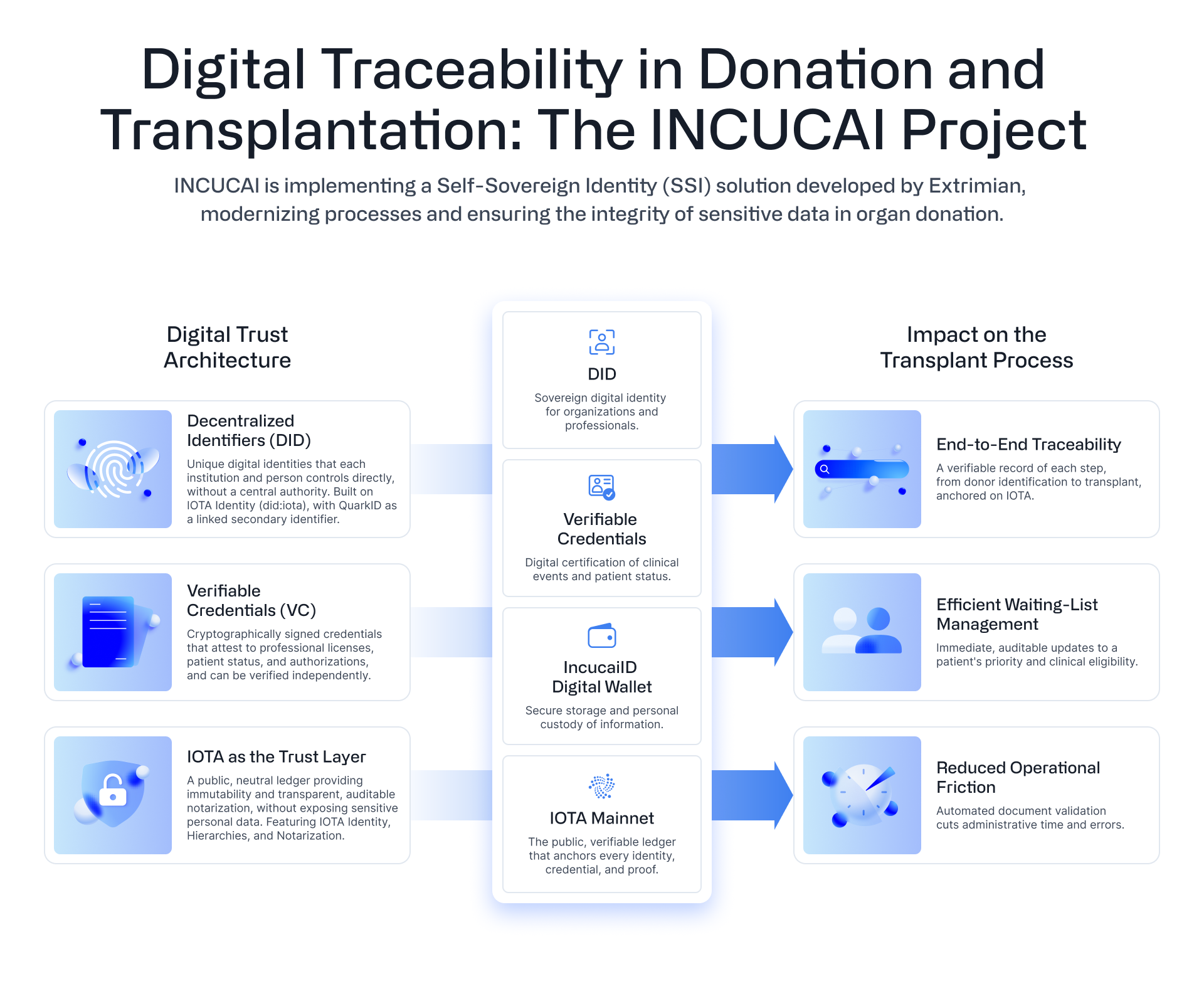
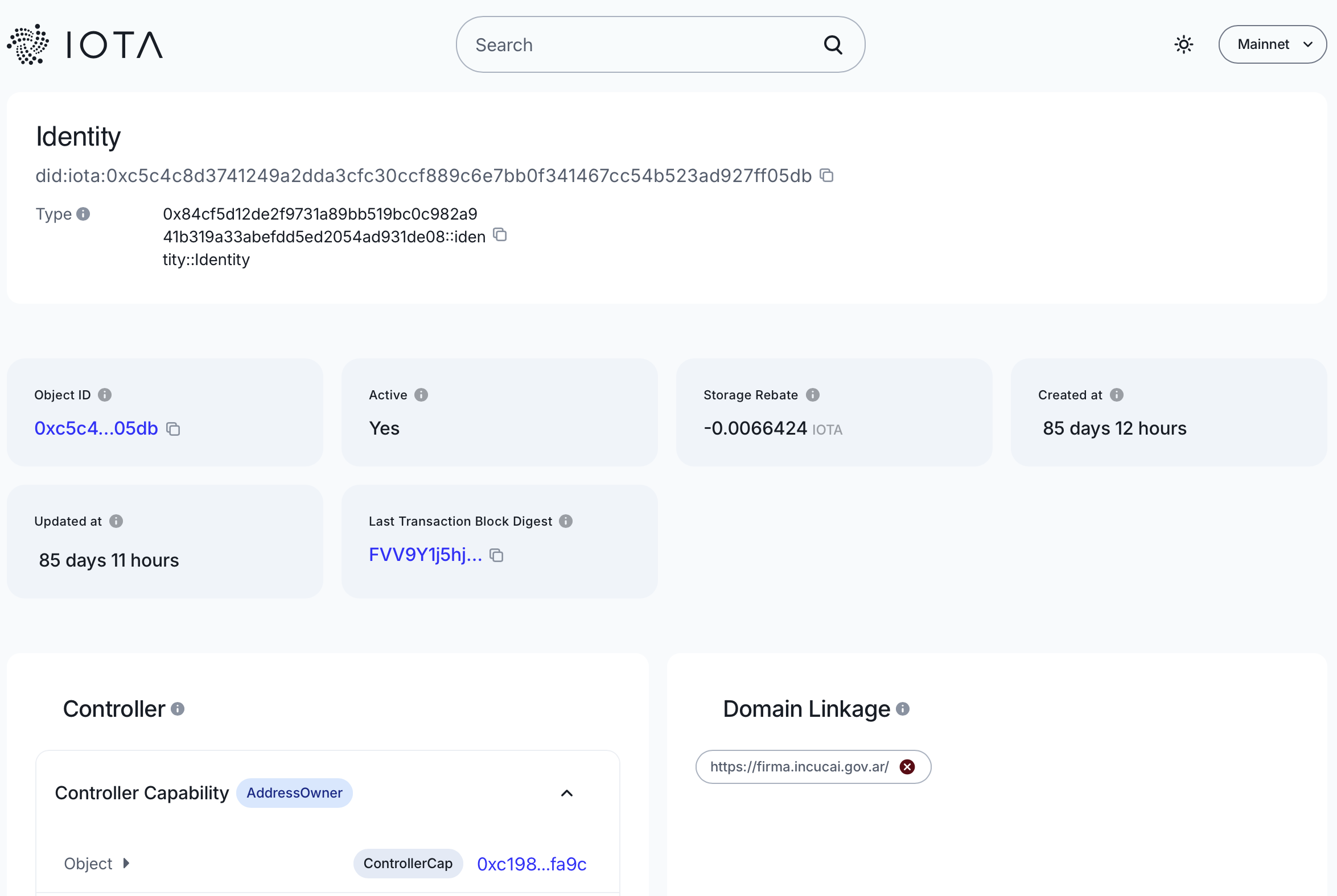
Decentralized Identifiers (DIDs): W3C-compliant identifiers that give INCUCAI and its 24 provincial agencies sovereign digital identities. INCUCAI’s root identity is cryptographically linked to its official government domain (firma.incucai.gov.ar), enabling anyone to confirm that an entity is genuinely accredited by the state rather than an impostor.
Verifiable Credentials: Tamper-proof, cryptographically signed digital documents issued to authorized participants, healthcare professionals, and patients via the IncucaiID mobile wallet.
Onchain Anchoring: Micro-transactions on the IOTA Mainnet (costing fractional amounts of IOTA in network gas fees) that permanently timestamp and notarize document hashes, creating an immutable audit trail.
To ensure total transparency, the IOTA Foundation conducted independent verifications of the deployment using only public endpoints and the IOTA Explorer. Independent audits confirmed that all 24 provincial identities resolved correctly, their respective trust federations matched onchain data, and the entities controlling each identity possessed the precise accreditation required by the state.
Official Statements and Institutional Perspectives
The successful deployment of this infrastructure has drawn praise from technology leaders and healthcare administrators alike, highlighting the tangible utility of decentralized systems in real-world public administration.
Daniela Hansen Krogh, Director of Information Technology and Information Systems at INCUCAI, emphasized the foundational role of trust in organ donation:
"Trust is at the heart of every organ donation and transplantation process. Our responsibility is to ensure that every decision is supported by reliable, secure, and verifiable information. By incorporating decentralized identity and cryptographic verification into our national systems, we are strengthening the integrity, traceability, and legal certainty of every critical stage, while safeguarding sensitive patient information. This initiative reflects INCUCAI’s ongoing commitment to modernizing Argentina’s transplant system through secure, transparent, and citizen-centered digital innovation."
Esteban Musso, Professional Services Manager and Partner at Extrimian, pointed to the broader significance of the project for enterprise and government adoption of blockchain technology:
"At Extrimian, we believe that trust is the foundation of every digital transformation. By combining open standards with privacy-preserving technologies, we’ve helped build a solution that enhances traceability, security, and interoperability while respecting the privacy of every participant. Projects like this demonstrate that decentralized technologies are no longer a vision for the future—they are delivering tangible value today in critical public services."
Dominik Schiener, Co-Founder and Chairman of the IOTA Foundation, underscored the societal impact of deploying public ledger infrastructure at a national scale:
"This is what IOTA’s open technology can do for critical public services at national scale: real infrastructure, already coordinating decisions that save lives."
Implications and Future Outlook
The integration of blockchain-backed electronic signatures and decentralized identity into Argentina’s transplant network establishes a powerful precedent for digital governance. By eliminating reliance on physical paperwork, manual provincial handoffs, and centralized databases prone to single points of failure, INCUCAI has created a resilient, paperless workflow.
As the implementation expands from initial heart and lung registry lists to encompass all remaining organ categories and institutional processes within SINTRA, the system is expected to drastically reduce administrative friction and response times. Furthermore, by embedding verifiable trust at the source using open W3C standards and sovereign national infrastructure hosted in part on ARSAT, Argentina has future-proofed its national health administration against fraud, data tampering, and bureaucratic delay.
Ultimately, the collaboration between INCUCAI, Extrimian, and IOTA demonstrates that decentralized ledger technology has evolved past theoretical speculation. In Argentina, it is actively operating as critical public infrastructure—safeguarding privacy, ensuring legal certainty, and streamlining the complex choreography required to save human lives.
In the high-stakes environment of organ transplantation, every second counts. When a donor organ becomes available, a race against time begins immediately. A human heart, for instance, remains viable outside the body for only a matter of hours. During this narrow window, a complex chain of custody must unfold seamlessly across multiple hospitals, provincial healthcare agencies, and a central national authority. Dozens of medical professionals, coordinators, and administrators must execute their duties in precise chronological order. Every medical record, authorization, and consent form must be accurate, immutable, and trusted instantly. In this critical domain, a lost document, a forged signature, or an unverified record can carry irreversible consequences.
To eliminate these vulnerabilities, Argentina has taken a pioneering step in public administration. The nation’s central authority for organ, tissue, and cell procurement and transplantation—the Instituto Nacional Central Único Coordinador de Ablación e Implante (INCUCAI)—has modernized its digital backbone. In partnership with Latin American decentralized-identity innovator Extrimian and utilizing the IOTA mainnet, INCUCAI has integrated a live, publicly verifiable digital-identity and document-signing system across its entire national network. This includes the central body and all 24 jurisdictional procurement agencies spanning Argentina’s provinces and the Autonomous City of Buenos Aires.
The Architectural Framework of Trust
The deployment relies on Self-Sovereign Identity (SSI) architecture, a model that empowers individuals and organizations with direct, cryptographic control over their digital identities and the specific data they share. Extrimian selected the IOTA network to serve as the foundational public layer for this infrastructure. IOTA provides a neutral, scalable, and cost-efficient public ledger where institutional identities and document integrity can be validated directly by any authorized stakeholder, eliminating traditional gatekeepers and administrative friction.
A critical design choice in this implementation is the absolute protection of patient privacy. No personally identifiable information (PII) or sensitive medical data is ever stored on the public blockchain. Instead, the system utilizes cryptographic hashes—unique, irreversible mathematical fingerprints—of documents and procedural steps. These hashes are anchored directly to the IOTA ledger. This methodology guarantees absolute tamper-proof verification while leaving the underlying sensitive data entirely private. Physicians, regulatory agencies, and families can cryptographically confirm that every step of the transplant pipeline occurred exactly as recorded, without exposing the deeply personal details entrusted to the medical system during times of grief and critical care.
The technological stack adheres strictly to open, verifiable global standards. The identities and credentials deployed across the network comply with World Wide Web Consortium (W3C) specifications. Furthermore, INCUCAI’s onchain institutional identity is cryptographically linked to its official government domain, enabling anyone to verify that the entity executing a transaction is the authentic governmental body rather than an impostor. Portions of the operational infrastructure are hosted on ARSAT, Argentina’s state-owned telecommunications and satellite solutions company, ensuring that critical data handling remains under sovereign national control.
Chronology and Implementation Milestones
The integration of blockchain-backed decentralized identity into Argentina’s national health system represents the culmination of rigorous planning, technological development, and regulatory reform.
The timeline of adoption unfolded through several key phases:
Foundational Development: Extrimian and INCUCAI collaborated to build an interoperable, privacy-preserving infrastructure tailored to the specific legal and operational demands of Argentina’s public health sector. The framework was engineered to integrate smoothly with SINTRA (Sistema Nacional Procuración y Trasplante de Argentina), the nation’s centralized information system for organ procurement and transplantation.
Regulatory Authorization: In June 2026, the regulatory framework caught up with technological readiness. Through Resolution 199/2026, published in the national Official Gazette (Boletín Oficial), INCUCAI officially mandated the rollout of electronic signatures across all processes managed through SINTRA and its associated networks. The resolution aimed to imbue every certification, authorization, and validation act with maximum legal certainty and immutable traceability.
Mainnet Go-Live: On June 10, 2026, the decentralized identity and notarization system went live on the IOTA Mainnet. This deployment established live, publicly verifiable identifiers for INCUCAI and all 24 provincial procurement agencies.
Ecosystem Rollout via IncucaiID: Alongside the backend integration, INCUCAI launched IncucaiID, an official digital wallet application available on the Apple App Store and Google Play. Designed for patients, medical professionals, and administrative personnel, the wallet allows users to hold verifiable credentials, prove identity attributes, and execute legally binding electronic signatures for donation and transplant workflows.
Phased Clinical Integration: The transition to a paperless, blockchain-secured workflow began with waiting-list registration processes. Initial deployment focused specifically on heart and lung transplant waiting lists, with a structured roadmap designed to expand into other organ registries and comprehensive SINTRA document workflows over time.
Independent Verification and Transparency
In alignment with the foundational blockchain ethos of "don’t trust, verify," independent technical audits were conducted to validate the system’s integrity. Following the June 2026 launch, technical teams utilized public endpoints and the IOTA Explorer to independently analyze the network deployment.
The audits confirmed that all 24 provincial institutional identities successfully resolved onchain, and their corresponding federation trusts matched the recorded data. Direct queries to the IOTA ledger verified that the entities controlling each decentralized identifier matched the accredited regional authorities. Furthermore, administrative actions—such as document notarizations executed by INCUCAI’s root authority address—demonstrated high computational efficiency, requiring minimal transactional gas fees while permanently anchoring the integrity of the national transplant pipeline.
Official Statements and Leadership Perspectives
The successful deployment of this national-scale blockchain application has drawn praise from technology leaders and healthcare administrators alike, underscoring the practical viability of decentralized infrastructure in the public sector.
Daniela Hansen Krogh, Director of Information Technology and Information Systems at INCUCAI, emphasized the human and institutional dimensions of the technological upgrade. "Trust is at the heart of every organ donation and transplantation process," Krogh stated. "Our responsibility is to ensure that every decision is supported by reliable, secure, and verifiable information. By incorporating decentralized identity and cryptographic verification into our national systems, we are strengthening the integrity, traceability, and legal certainty of every critical stage, while safeguarding sensitive patient information. This initiative reflects INCUCAI’s ongoing commitment to modernizing Argentina’s transplant system through secure, transparent, and citizen-centered digital innovation."
Echoing this sentiment, Esteban Musso, Professional Services Manager and Partner at Extrimian, highlighted the broader significance of the project for enterprise and governmental blockchain adoption. "At Extrimian, we believe that trust is the foundation of every digital transformation," Musso remarked. "By combining open standards with privacy-preserving technologies, we’ve helped build a solution that enhances traceability, security, and interoperability while respecting the privacy of every participant. Projects like this demonstrate that decentralized technologies are no longer a vision for the future—they are delivering tangible value today in critical public services."
Dominik Schiener, Co-Founder and Chairman of the IOTA Foundation, pointed to the national scale of the implementation as proof of the technology’s maturity. "This is what IOTA’s open technology can do for critical public services at national scale: real infrastructure, already coordinating decisions that save lives," Schiener noted.
Broader Implications and Future Outlook
The integration of IOTA-powered decentralized identity into Argentina’s transplant apparatus signals a profound shift in how governments can leverage emerging technologies to solve complex coordination challenges. By replacing fragmented paper trails and vulnerable centralized databases with an immutable, privacy-respecting public ledger, INCUCAI has established a new benchmark for administrative transparency in healthcare.
As the implementation expands from heart and lung registries to encompass the entirety of Argentina’s organ and tissue allocation networks, the system is expected to drastically reduce bureaucratic friction, eliminate the risk of document tampering, and accelerate the response times of life-saving medical interventions. More broadly, the success of the INCUCAI-Extrimian initiative serves as a compelling case study for public sector digital transformation globally, proving that decentralized, self-sovereign infrastructure can be successfully integrated into mission-critical government operations without compromising citizen privacy or institutional sovereignty.
In the high-stakes arena of organ transplantation, every single second counts. When a donor heart becomes available, a tightly compressed window of viability—often lasting only a few hours—dictates the pace of operations. Dozens of medical professionals, provincial coordinators, institutional leaders, and administrative personnel must act in absolute synchrony. Every medical record, authorization, and consent form must be unimpeachably accurate the very first time. In this critical environment, a misplaced document, a delayed verification, or a forged signature can carry irreversible consequences.
To mitigate these systemic risks and safeguard the integrity of one of the nation’s most vital humanitarian efforts, Argentina’s national organ donation authority has taken a groundbreaking leap. The Instituto Nacional Central Único Coordinador de Ablación e Implante (INCUCAI), operating in tandem with Latin American decentralized identity specialist Extrimian and the public ledger technology of IOTA, has successfully integrated Argentina’s entire national transplant network onto a live, publicly verifiable decentralized identity and digital notarization system.
This technological overhaul anchors the administrative backbone of 24 provincial agencies, the Autonomous City of Buenos Aires, and hundreds of public and private hospitals onto the IOTA mainnet. By leveraging self-sovereign identity (SSI) frameworks, open standards, and cryptographic proofs, the initiative establishes a tamper-proof digital infrastructure designed to eliminate administrative friction while preserving the strict confidentiality of patients and grieving families.
The Bureaucratic and Logistical Challenge of National Transplants
INCUCAI serves as the central governing body overseeing the allocation of organs, tissues, and cells across Argentina, managing the national waiting list in close coordination with 24 jurisdictional procurement agencies. The logistical complexity of orchestrating life-or-death decisions across a geographically expansive nation cannot be overstated. Historically, the pipeline relied on a combination of centralized databases and physical paperwork, systems that, while functional, exposed vulnerabilities in traceability, inter-agency communication, and auditability.
Recognizing the urgent need for modernization without compromising security, INCUCAI partnered with Extrimian, a firm renowned for engineering decentralized digital identity solutions across health, education, and government sectors. Extrimian utilizes self-sovereign identity architectures to grant individuals and institutions direct ownership and control over their digital credentials. For the underlying public network, Extrimian selected IOTA—a scalable, fee-efficient, and neutral distributed ledger that allows institutional identities and document integrity to be validated autonomously, removing single points of failure and third-party gatekeepers.
The operational architecture of this deployment is meticulously designed to protect sensitive data. At no point are patient-identifiable details or private medical records stored on the public blockchain. Instead, only cryptographic hashes—unique mathematical fingerprints of signed documents and procedural milestones—are anchored to the IOTA ledger. This guarantees absolute immutability and tamper resistance while ensuring that the profound privacy of patients and donors remains entirely uncompromised. Doctors, auditors, and regulatory bodies can independently verify that every step of a transplantation protocol occurred exactly as recorded, without ever exposing the underlying personal information.
Chronology of Implementation and Resolution 199/2026
The integration of blockchain-backed verification into Argentina’s medical infrastructure represents the culmination of years of digital strategy and regulatory adaptation. The foundational development phase saw Extrimian and INCUCAI map out the complex legal and technical requirements of the nation’s SINTRA (National Procurement and Transplant Information System) framework.
By June 2026, the digital architecture reached a critical milestone with its official activation on the IOTA Mainnet. This deployment coincided with a major regulatory shift marked by Resolution 199/2026, published in the national Official Gazette (Boletín Oficial). The resolution authorized the formal implementation of electronic signatures across all donation and transplant processes managed via SINTRA and its associated institutional networks.
The roll-out plan follows a carefully staged methodology. Implementation commenced with the waiting-list registration workflows, prioritizing high-acuity categories such as heart and lung lists. Over subsequent phases, the system is scheduled to expand to cover remaining organ lists and eventually encompass the entirety of SINTRA’s administrative documentation.
To facilitate widespread participation, the ecosystem introduced "IncucaiID," a dedicated mobile wallet application available on major app stores. Through IncucaiID, authorized healthcare professionals, patients, and administrative personnel receive W3C-compliant verifiable credentials. Users can authenticate their identities and apply legally binding electronic signatures to documents tied to the donation process. Every transaction is cryptographically secured, allowing for seamless post-hoc auditing while shifting the national transplant network toward a streamlined, paperless paradigm.
Technological Architecture and National Sovereignty
The resilience of the INCUCAI-Extrimian deployment relies on a multi-layered technological stack that marries global cryptographic standards with national infrastructure control.
At the core of the system are decentralized identifiers (did:iota) adhering to World Wide Web Consortium (W3C) specifications. INCUCAI’s institutional identity is cryptographically linked directly to its official government domain (firma.incucai.gov.ar), enabling any external observer or auditor to confirm that the entity interacting with the network is the legitimate state authority rather than a malicious actor. Furthermore, critical components of the node and verification infrastructure operate on ARSAT, Argentina’s state-owned telecommunications and satellite solutions company. This integration ensures that the foundational data layers remain anchored within national jurisdiction.
Adhering to the blockchain ethos of "don’t trust, verify," independent technical evaluations conducted by the IOTA Foundation confirmed the integrity of the deployment. By querying public endpoints and the IOTA Explorer, engineers verified that all 24 provincial institutional identities resolved correctly, trust federations matched onchain data, and the root authority address—interacting via nominal transaction gas fees—consistently processed document notarization hashes.
Official Statements and Institutional Perspectives
The adoption of decentralized technologies for national healthcare governance has drawn praise from key stakeholders across the public and private sectors, emphasizing a shared commitment to transparency and patient welfare.
Daniela Hansen Krogh, Director of Information Technology and Information Systems at INCUCAI, underscored the foundational role of trust in medical logistics: "Trust is at the heart of every organ donation and transplantation process. Our responsibility is to ensure that every decision is supported by reliable, secure, and verifiable information. By incorporating decentralized identity and cryptographic verification into our national systems, we are strengthening the integrity, traceability, and legal certainty of every critical stage, while safeguarding sensitive patient information. This initiative reflects INCUCAI’s ongoing commitment to modernizing Argentina’s transplant system through secure, transparent, and citizen-centered digital innovation."
Echoing this sentiment, Esteban Musso, Professional Services Manager and Partner at Extrimian, highlighted the real-world utility of decentralized systems: "At Extrimian, we believe that trust is the foundation of every digital transformation. By combining open standards with privacy-preserving technologies, we’ve helped build a solution that enhances traceability, security, and interoperability while respecting the privacy of every participant. Projects like this demonstrate that decentralized technologies are no longer a vision for the future—they are delivering tangible value today in critical public services."
Dominik Schiener, Co-Founder and Chairman of the IOTA Foundation, pointed to the broader significance of deploying public ledger infrastructure for humanitarian applications: "This is what IOTA’s open technology can do for critical public services at national scale: real infrastructure, already coordinating decisions that save lives."
Implications and Future Outlook
The successful migration of Argentina’s transplant coordination system to the IOTA mainnet marks a watershed moment for the practical application of decentralized ledger technology in public administration. For decades, blockchain initiatives have frequently been categorized as experimental or theoretical. However, the INCUCAI-Extrimian deployment demonstrates that self-sovereign identity and cryptographic notarization can be seamlessly integrated into high-stakes, mission-critical government workflows.
By enhancing auditability, eliminating administrative bottlenecks, and cementing legal certainty through electronic signatures, Argentina has established a robust template for institutional transparency. As this paperless workflow expands across all provincial jurisdictions and medical specialties, it offers a compelling blueprint for other nations seeking to modernize complex public services without sacrificing data privacy or centralization of trust. Through the convergence of state-backed infrastructure and neutral public ledgers, Argentina’s transplant system has redefined the standard for how technology can safeguard human life.
In the delicate ecosystem of organ donation and transplantation, time is measured not merely in hours, but in fleeting minutes. When a human heart becomes available, a high-stakes, meticulously choreographed countdown begins. A viable heart remains operational outside the human body for only a few brief hours. Within that narrow window, a vast network of actors—spanning emergency rooms, regional hospitals, provincial agencies, and national coordinators—must execute their duties in absolute synchronization. Every medical record, authorization, and expression of consent must be pristine, unassailable, and verified instantly. In this high-pressure environment, a misplaced form, an unverified signature, or a bureaucratic delay is not just an administrative hurdle; it is a matter of life and death.
To eradicate these vulnerabilities and streamline a critical public service, Argentina’s national organ, tissue, and cell transplantation authority has taken a monumental step forward. The Instituto Nacional Central Único Coordinador de Ablación e Implante (INCUCAI), operating in partnership with Latin American decentralized identity firm Extrimian and powered by the IOTA blockchain mainnet, has officially migrated its national transplant infrastructure onto a live, publicly verifiable digital-identity framework. This deployment marks a watershed moment for public sector digital transformation, proving that distributed ledger technology can move beyond financial speculation to anchor critical, life-saving government workflows.
The Anatomy of Argentina’s Transplant Network and Its Vulnerabilities
To understand the magnitude of this technological overhaul, one must examine the complexity of Argentina’s medical architecture. INCUCAI serves as the central administrative body overseeing the national waiting list, policy enforcement, and organ allocation. However, it does not operate in a vacuum. It coordinates closely with 24 distinct jurisdictional procurement agencies—encompassing every Argentine province alongside the Autonomous City of Buenos Aires—as well as an expansive network of public and private hospitals and transplant centers.
Historically, coordinating life-or-death decisions across this sprawling national footprint relied heavily on legacy databases, paper trails, and fragmented verification processes. While Argentina’s National Procurement and Transplant Information System (SINTRA) digitized much of the administrative workload, the system remained vulnerable to traditional cybersecurity challenges, including document tampering, identity spoofing, and the friction associated with cross-jurisdictional verification.
Recognizing the urgent need for a tamper-proof, highly secure digital backbone, INCUCAI sought a modern architectural solution that could guarantee absolute integrity without compromising the strict confidentiality required in medical environments. The mandate was clear: establish an immutable audit trail for every authorization and document signing procedure while ensuring that patient privacy remains fiercely protected.
The Technological Architecture: How IOTA and Extrimian Built the Bridge
The solution to INCUCAI’s coordination challenge arrived through a strategic collaboration with Extrimian, a regional pioneer in decentralized digital identity (SSI). Extrimian specializes in self-sovereign identity models, which empower individuals and institutions with absolute control over their digital credentials and the data they choose to share. To provide the neutral, scalable, and cost-efficient public layer required for a national-scale deployment, Extrimian selected the IOTA mainnet.
The core architecture relies on cutting-edge cryptographic principles. Crucially, no patient-identifiable information (PII) or sensitive medical history is ever stored on the blockchain ledger. Instead, the system anchors only cryptographic proofs—specifically, secure hashes of documents and process steps—directly to the IOTA mainnet. This methodology guarantees absolute data integrity and immutability while shielding the deeply personal and painful details entrusted to medical professionals during times of grief and crisis.
Doctors, regional agencies, and families can mathematically confirm that every procedural step occurred exactly as recorded, while the underlying data remains strictly private and secure. Furthermore, the deployment incorporates elements of Argentina’s state-owned infrastructure provider, ARSAT, ensuring that critical physical and network components remain under domestic sovereign control.
The technical foundation utilizes several advanced building blocks:
W3C Decentralized Identifiers (DIDs): Institutional identities follow World Wide Web Consortium standards. INCUCAI’s onchain identity is cryptographically bound to its official government domain (firma.incucai.gov.ar), enabling anyone to verify that an incoming document originates from the genuine national authority rather than an impostor.
Verifiable Credentials: Standardized digital certificates that allow individuals and medical staff to prove their professional accreditation or consent status securely.
Decentralized Trust Registries: A federated architecture that allows all 24 provincial agencies to validate identities and signatures across state boundaries without relying on a centralized, single point of failure.
Independent verification of the system has reinforced its credibility. Exercising the core blockchain ethos of "don’t trust, verify," external technical auditors and the IOTA Foundation independently evaluated public endpoints and the IOTA Explorer. All 24 provincial identities resolved accurately, all cryptographic explorer links matched, and direct onchain calls confirmed that the entities controlling each identity were fully accredited within the federal trust structure.
Chronology of Implementation and Resolution 199/2026
The path to a fully onchain transplant system culminated in mid-2026, following months of rigorous development, testing, and regulatory alignment.
Early Development Phase: Extrimian and INCUCAI architected the decentralized trust framework, integrating W3C-compliant decentralized identifiers with SINTRA’s existing backend architecture while routing notarization layers through the IOTA mainnet.
June 10, 2026: The decentralized identity and notarization system officially went live on the IOTA Mainnet, making institutional identities and transactional proofs independently verifiable by the public.
Mid-June 2026 (Resolution 199/2026): Through Resolution 199/2026, published officially in the national Boletín Oficial, INCUCAI mandated the nationwide rollout of electronic signatures across all processes managed via SINTRA. This administrative decree provided the necessary legal certainty to transition high-value medical workflows into blockchain-backed executions.
Launch of IncucaiID: To facilitate user interaction, the ecosystem released IncucaiID, an official mobile wallet application available on both the Apple App Store and Google Play. Through this application, patients, medical practitioners, and authorized officials receive verifiable credentials, authenticate their identities, and sign regulatory documents tied to organ harvesting and transplantation.
The rollout has been designed with operational resilience in mind, beginning initially with the national waiting lists for heart and lung transplants. Subsequent phases will systematically integrate remaining organ categories and expand across all ancillary SINTRA workflows, ultimately driving toward a completely paperless, frictionless national system.
Official Perspectives: Leadership Endorsements
The deployment has drawn praise from government and technology leaders alike, underscoring the convergence of public sector governance and next-generation cryptographic infrastructure.
Daniela Hansen Krogh, Director of Information Technology and Information Systems at INCUCAI, emphasized the human element underpinning the technical upgrade: "Trust is at the heart of every organ donation and transplantation process. Our responsibility is to ensure that every decision is supported by reliable, secure, and verifiable information. By incorporating decentralized identity and cryptographic verification into our national systems, we are strengthening the integrity, traceability, and legal certainty of every critical stage, while safeguarding sensitive patient information. This initiative reflects INCUCAI’s ongoing commitment to modernizing Argentina’s transplant system through secure, transparent, and citizen-centered digital innovation."
Echoing this sentiment, Esteban Musso, Professional Services Manager and Partner at Extrimian, pointed to the tangible real-world application of the technology: "At Extrimian, we believe that trust is the foundation of every digital transformation. By combining open standards with privacy-preserving technologies, we’ve helped build a solution that enhances traceability, security, and interoperability while respecting the privacy of every participant. Projects like this demonstrate that decentralized technologies are no longer a vision for the future—they are delivering tangible value today in critical public services."
Dominik Schiener, Co-Founder and Chairman of the IOTA Foundation, framed the milestone within the broader narrative of blockchain utility: "This is what IOTA’s open technology can do for critical public services at national scale: real infrastructure, already coordinating decisions that save lives."
Implications and Broader Impact on Public Administration
The integration of IOTA and Extrimian into Argentina’s national transplant framework carries profound implications for the future of public administration, both regionally and globally. For decades, governments seeking to modernize have oscillated between vulnerable centralized databases and costly, proprietary enterprise software solutions. The INCUCAI deployment presents a third, highly viable paradigm: leveraging public, neutral, decentralized ledgers as trust anchors while maintaining localized database sovereignty and stringent data privacy protections.
By eliminating manual paperwork, securing institutional communications against forgery, and providing a unified cryptographic audit trail across 24 distinct provincial jurisdictions, Argentina has dramatically reduced administrative friction during emergency scenarios. Furthermore, the use of open standards ensures that the architecture is interoperable and future-proof.
As governments worldwide grapple with issues of institutional trust, cyber resilience, and bureaucratic inefficiency, the Argentine model offers a blueprint for how decentralized identity can be deployed responsibly in life-critical sectors. By anchoring administrative accountability to an immutable ledger, INCUCAI has not only optimized the mechanics of organ procurement—it has redefined how digital trust can be engineered into the very fabric of public health.
In the high-stakes environment of organ transplantation, minutes and seconds dictate the boundary between life and death. When a human heart, liver, or pair of lungs becomes available for donation, a complex, high-pressure countdown begins. A harvested heart remains clinically viable outside the human body for only a matter of hours. Within that narrow temporal window, a sprawling network of medical professionals, provincial coordinators, institutional administrators, and national authorities must act in absolute, flawless synchronization. Every single authorization, medical record, and legal consent must be thoroughly verified, completely accurate, and entirely beyond dispute the very first time. In this specialized domain, a lost form, a questionable signature, or a bureaucratic delay can carry catastrophic, irreversible consequences.
To eliminate these vulnerabilities and fortify its national infrastructure, the Argentine Republic has taken a historic leap forward. Through a strategic collaboration between the national organ authority and regional technology innovators, Argentina has officially integrated its entire organ, tissue, and cell donation ecosystem onto a live, publicly verifiable decentralized digital identity system hosted on the IOTA mainnet. This sweeping technological upgrade marks a paradigm shift in how sovereign governments manage life-critical public services, replacing legacy administrative bottlenecks with cryptographic certainty, immutable document signing, and decentralized transparency.
The Anatomy of Argentina’s National Transplant Framework
At the heart of this massive logistical undertaking is the Instituto Nacional Central Único Coordinador de Ablación e Implante, universally known as INCUCAI. Established as Argentina’s central national authority for organ procurement and transplantation, INCUCAI carries the monumental responsibility of managing the national patient waiting list. The agency does not operate in a vacuum; it functions as the central nervous system connecting 24 distinct jurisdictional procurement agencies—encompassing every single Argentine province alongside the Autonomous City of Buenos Aires—as well as a vast network of public and private hospitals, surgical units, and specialized transplant centers distributed across the South American nation’s vast geographic expanse.
Coordinating life-or-death medical decisions across this decentralized national apparatus requires an administrative backbone characterized by absolute reliability, uncompromising security, and real-time interoperability. Historically, even the most advanced healthcare systems have struggled with the friction of paper-based documentation, fragmented provincial databases, and manual verification steps. Recognizing that modern challenges demand modern technological safeguards, INCUCAI embarked on an ambitious initiative to modernize its digital infrastructure by embedding decentralized identity and cryptographic notarization directly into its administrative workflow.
To engineer and deploy this sophisticated digital architecture, INCUCAI partnered with Extrimian, a leading Latin American technology company specializing in decentralized digital identity and self-sovereign identity (SSI) frameworks. Extrimian has long championed models that grant individuals and institutions direct, unmediated control over their digital identities and the specific data they choose to share. By bringing transparency, cryptographic efficiency, and strict user control to interactions across critical sectors like healthcare, education, and public administration, Extrimian positioned itself as an ideal technological partner for a government entity seeking to overhaul a nationwide health network.
Rather than building upon a centralized database—which inherently introduces single points of failure, vulnerabilities to tampering, and a reliance on trusted intermediaries—Extrimian selected IOTA as the foundational public network for INCUCAI’s new decentralized infrastructure. IOTA provides a neutral, highly scalable, and verifiably secure ledger layer where institutional identities and document integrity can be authenticated directly by any authorized stakeholder, entirely free from corporate gatekeepers or administrative friction.
Technological Architecture and the Principle of Privacy-First Design
The technical solution deployed by Extrimian and IOTA is engineered to digitize, unify, and secure the organ transplantation workflow on a national scale. Officially launched on the IOTA mainnet, the system allows institutional identities and cryptographic proofs to be independently audited and verified by anyone with access to the public ledger, embodying the foundational cybersecurity ethos of "don’t trust, verify."
One of the most critical design considerations of this deployment is its uncompromising approach to data privacy. In a healthcare context involving sensitive medical histories, organ matching, and grieving families, data protection is paramount. To safeguard this vulnerable information, the system ensures that no patient-identifiable data or raw medical records are ever stored on the public blockchain. Instead, only cryptographic proofs—specifically cryptographic hashes of official documents and process steps—are permanently anchored to the IOTA ledger.
This cryptographic separation guarantees absolute data integrity and immutability without exposing any underlying personal details. Doctors, provincial agencies, and auditing bodies can mathematically confirm that a specific authorization, medical report, or consent form existed in a precise state at an exact moment in time, while the private details of patients and donors remain strictly confidential. The system effectively bridges the gap between public transparency and medical privacy, ensuring that trust is established through mathematics rather than institutional blind faith.
The technical framework relies heavily on open, interoperable standards. The institutional identities and verifiable credentials integrated into the platform strictly adhere to World Wide Web Consortium (W3C) specifications. Furthermore, INCUCAI’s onchain decentralized identifier (did:iota) is cryptographically bound to its official government domain. This ensures that any external observer or participating hospital can mathematically confirm that a digital signature originates from the authentic national institution rather than a malicious impostor. Crucially, components of the infrastructure are hosted on ARSAT, Argentina’s state-owned telecommunications and satellite solutions company, ensuring that critical data pathways and operational nodes remain firmly under national sovereignty and control.
Chronology of Implementation: From Policy to Mainnet Deployment
The realization of Argentina’s onchain transplant system is the culmination of meticulous planning, regulatory reform, and technical execution. The timeline of this transformation reflects a steady, deliberate march toward full national integration:
Early Planning and Development: Extrimian and the IOTA Foundation collaborate to design a decentralized identity framework tailored to the specific legal, administrative, and security requirements of Argentina’s healthcare sector, utilizing W3C standards and integrating with state-owned infrastructure provider ARSAT.
Regulatory Foundation (June 2026): The Argentine government publishes Resolution 199/2026 in the official national gazette (Boletín Oficial). This landmark resolution officially authorizes the implementation of electronic signatures across all donation and transplant processes managed through SINTRA (Argentina’s National Procurement and Transplant Information System) and its affiliated institutional networks.
Mainnet Go-Live (June 10, 2026): The decentralized identity and notarization infrastructure officially goes live on the IOTA Mainnet. All 24 provincial procurement agencies are successfully onboarded onto the trust federation, enabling live cryptographic document signing and verifiable institutional identities.
Ecosystem Rollout and Wallet Launch (Mid-2026): INCUCAI introduces IncucaiID, the official ecosystem mobile wallet available on major application stores. Healthcare professionals, administrative personnel, and patients begin receiving verifiable credentials to sign and authenticate documents digitally. Implementation initiates with the national waiting-list registration process, prioritizing heart and lung lists before expanding to other organ categories.
Official Adoption and Regulatory Milestones
The transition from conceptual framework to operational reality was formalized through Resolution 199/2026, enacted in June 2026. Published prominently in the Boletín Oficial, this resolution mandated the nationwide adoption of electronic signatures for every single administrative and medical process handled via SINTRA. The regulatory mandate was designed to inject unprecedented legal certainty, traceability, and transparency into the organ procurement pipeline, replacing cumbersome paper trails with immutable blockchain-backed evidence.
At the center of this rollout for end-users is IncucaiID, a dedicated mobile application available for download across major smartphone platforms. Through this digital wallet, authorized medical professionals and participants securely manage their verifiable credentials, verify their professional standing, and apply legally binding electronic signatures to documents tied to organ harvesting and transplantation. Every interaction executed through the wallet is cryptographically secured, generating an indelible audit trail that can be reviewed when necessary while strictly enforcing the principles of self-sovereign identity—allowing users to disclose only the precise data required for a given administrative step.
The initial rollout phase focuses specifically on the waiting-list registration process, beginning with high-acuity registries such as the heart and lung transplant lists. Over subsequent phases, the system is slated to expand to cover all remaining organ and tissue lists, ultimately absorbing the entirety of SINTRA’s documentary workflows to establish a fully paperless, frictionless national system.
Stakeholder Perspectives and Institutional Endorsements
The successful deployment of a national healthcare system onto a public distributed ledger has drawn praise from technology leaders and public health administrators alike, highlighting the tangible utility of decentralized systems in solving real-world humanitarian challenges.
Daniela Hansen Krogh, Director of Information Technology and Information Systems at INCUCAI, emphasized the profound cultural and operational importance of the upgrade: "Trust is at the heart of every organ donation and transplantation process. Our responsibility is to ensure that every decision is supported by reliable, secure, and verifiable information. By incorporating decentralized identity and cryptographic verification into our national systems, we are strengthening the integrity, traceability, and legal certainty of every critical stage, while safeguarding sensitive patient information. This initiative reflects INCUCAI’s ongoing commitment to modernizing Argentina’s transplant system through secure, transparent, and citizen-centered digital innovation."
Echoing these sentiments, Esteban Musso, Professional Services Manager and Partner at Extrimian, underscored the broader philosophical shift represented by the project: "At Extrimian, we believe that trust is the foundation of every digital transformation. By combining open standards with privacy-preserving technologies, we’ve helped build a solution that enhances traceability, security, and interoperability while respecting the privacy of every participant. Projects like this demonstrate that decentralized technologies are no longer a vision for the future—they are delivering tangible value today in critical public services."
Dominik Schiener, Co-Founder and Chairman of the IOTA Foundation, pointed to the national scale of the achievement as proof of maturity for distributed ledger technology: "This is what IOTA’s open technology can do for critical public services at national scale: real infrastructure, already coordinating decisions that save lives."
Fact-Based Analysis of Implications and Broader Impact
The integration of INCUCAI’s transplant network onto the IOTA mainnet carries significant implications that extend far beyond the borders of Argentina, offering a blueprint for how governments worldwide can modernize legacy bureaucracies without sacrificing privacy or centralization of control.
From an administrative standpoint, the elimination of physical paperwork and manual provincial verification drastically reduces the risk of human error, administrative delays, and document tampering during critical transplant windows. By anchoring cryptographic proofs to a neutral public ledger, INCUCAI establishes an unalterable chain of custody for every organ and tissue allocation. This level of verifiable transparency not only insulates the national system against potential fraud or bureaucratic negligence but also reinforces public confidence in an institution where fairness and equity are matters of life and death.
Furthermore, the project demonstrates the viability of Self-Sovereign Identity (SSI) frameworks in highly regulated public sectors. By demonstrating that robust cybersecurity, W3C standards, and state-backed telecommunications infrastructure can successfully harmonize with public distributed ledgers, Argentina has set a compelling precedent. As governments globally grapple with the demands of digital transformation, secure citizen data management, and operational resilience, the INCUCAI-Extrimian-IOTA deployment stands as a watershed moment: tangible proof that decentralized technology can actively participate in saving human lives at a national scale.
In the delicate, high-stakes ecosystem of organ transplantation, time is measured not just in hours, but in vital minutes. When a human heart, lung, or liver becomes available for donation, a complex, nationwide chain of events is immediately triggered. Medical professionals, regional agencies, and national coordinators must act in absolute synchrony to evaluate matches, secure legal and medical authorizations, and transport the organ to the recipient before viability fades. Within this narrow window, a single administrative error, a misplaced form, or an unverifiable signature can carry devastating consequences. To mitigate these risks and modernize its critical infrastructure, Argentina has taken a pioneering step: moving its national transplant system onto a publicly verifiable, blockchain-backed digital identity framework.
The Instituto Nacional Central Único Coordinador de Ablación e Implante (INCUCAI), Argentina’s national authority overseeing organ, tissue, and cell donation, has officially integrated decentralized identity and notarization architecture into its operations. Developed in partnership with Latin American decentralized-identity leader Extrimian and anchored on the IOTA mainnet, this live system represents a major milestone in public-sector digital transformation. By uniting INCUCAI and its 24 provincial procurement agencies—including the Autonomous City of Buenos Aires—under a shared, tamper-proof cryptographic ledger, Argentina is setting a new global benchmark for transparency, efficiency, and security in healthcare logistics.
The Engineering of Trust: Bridging Bureaucracy and Blockchain
At its core, the newly deployed infrastructure addresses a fundamental challenge of modern bureaucracy: how to establish absolute trust and traceability across fragmented institutional networks without compromising individual privacy. Historically, coordinating organ procurement across diverse public and private hospitals required navigating layers of paperwork, manual verifications, and centralized databases vulnerable to operational bottlenecks.
Extrimian’s solution leverages Self-Sovereign Identity (SSI) principles, utilizing the IOTA network as a neutral, decentralized foundation. The architecture ensures that institutional identities and the cryptographic integrity of documents can be independently checked by authorized stakeholders without relying on proprietary intermediaries.
Critically, the system is designed with rigorous privacy safeguards. Patient-identifiable information is never stored on the public blockchain. Instead, the ledger anchors only cryptographic proofs—mathematical hashes—of documents and specific workflow milestones. This mechanism guarantees absolute data integrity and immutability while shielding the deeply sensitive medical histories of donors, patients, and grieving families. Doctors and provincial regulators can cryptographically verify that every procedural step occurred exactly as recorded, while the underlying personal data remains strictly confidential.
Chronology of a National Rollout
The integration of blockchain technology into Argentina’s transplant infrastructure is the culmination of meticulous planning, regulatory updates, and technical deployment.
Initial Development and Testing: Extrimian and INCUCAI collaborated to design a decentralized identity framework tailored to the rigorous compliance standards of Argentina’s healthcare sector, utilizing open W3C specifications for verifiable credentials.
June 10, 2026: The infrastructure officially went live on the IOTA Mainnet, allowing decentralized identifiers (DIDs) and document notarization proofs to be independently audited via public explorers.
Resolution 199/2026: Published in the national Official Gazette (Boletín Oficial), this legislative decree formally authorized the implementation of electronic signatures across all processes managed through SINTRA (Argentina’s National Procurement and Transplant Information System).
Mid-2026 Rollout: INCUCAI released IncucaiID, the ecosystem’s official digital wallet application on iOS and Android app stores. Initial implementation focuses heavily on streamlining waiting-list registrations, beginning specifically with heart and lung transplant lists before expanding to other organs and comprehensive SINTRA workflows.
Furthermore, parts of the technical architecture are hosted on ARSAT, Argentina’s state-owned telecommunications infrastructure company, ensuring that critical components of the national system remain under sovereign governmental control while interacting with the global public ledger.
Official Perspectives and Institutional Commitment
The transition toward decentralized public infrastructure has garnered strong support from both governmental and technology leaders, who view the deployment as a practical demonstration of blockchain’s utility in saving lives.
Daniela Hansen Krogh, Director of Information Technology and Information Systems at INCUCAI, emphasized the human element driving the technological upgrade. "Trust is at the heart of every organ donation and transplantation process," Krogh stated. "Our responsibility is to ensure that every decision is supported by reliable, secure, and verifiable information. By incorporating decentralized identity and cryptographic verification into our national systems, we are strengthening the integrity, traceability, and legal certainty of every critical stage, while safeguarding sensitive patient information. This initiative reflects INCUCAI’s ongoing commitment to modernizing Argentina’s transplant system through secure, transparent, and citizen-centered digital innovation."
Extrimian executives echoed these sentiments, highlighting the departure of decentralized tech from speculative theory into practical, life-saving application. Esteban Musso, Professional Services Manager and Partner at Extrimian, noted: "At Extrimian, we believe that trust is the foundation of every digital transformation. By combining open standards with privacy-preserving technologies, we’ve helped build a solution that enhances traceability, security, and interoperability while respecting the privacy of every participant. Projects like this demonstrate that decentralized technologies are no longer a vision for the future—they are delivering tangible value today in critical public services."
From the technology provider’s perspective, Dominik Schiener, Co-Founder and Chairman of the IOTA Foundation, emphasized the broader significance of the deployment. "This is what IOTA’s open technology can do for critical public services at a national scale: real infrastructure, already coordinating decisions that save lives," Schiener remarked.
Implications and Future Outlook
The successful integration of IOTA and Extrimian’s technology into INCUCAI’s workflow offers profound implications for public administration well beyond the borders of Argentina. By replacing legacy paper trails and siloed digital databases with an interoperable, cryptographically secure verification layer, the system drastically reduces the administrative friction that can delay time-sensitive medical procedures.
Independent verification by technical auditors has confirmed the operational stability of the deployment: all 24 provincial agency identities successfully resolved on the IOTA Explorer, trust federations mapped accurately to onchain data, and direct network calls validated the accreditation of each participating entity.
As IncucaiID adoption expands among medical professionals and patients, the transition toward a fully paperless, frictionless workflow gathers momentum. By demonstrating that decentralized ledgers can successfully optimize high-consequence administrative processes without compromising data privacy, Argentina has established a compelling blueprint for modernizing critical state infrastructure through transparent, citizen-centric digital innovation.
In the high-stakes environment of organ transplantation, every second carries immense weight. When a donor organ becomes available, a race against time immediately begins. A human heart, for instance, remains medically viable outside the human body for only a matter of hours. Within this narrow window, an intricate chain of events must unfold flawlessly across multiple jurisdictions. Hospitals, regional procurement coordinators, and national agencies must execute authorizations, review medical histories, and verify legal consent in precise chronological order. In this delicate ecosystem, a misplaced form, an unverified signature, or a delayed confirmation can mean the difference between life and death.
To mitigate these systemic vulnerabilities and streamline life-saving coordination, Argentina has officially integrated blockchain technology into its national transplant architecture. Through a pioneering collaboration between the nation’s primary organ authority, Latin American decentralized identity firm Extrimian, and the open-source IOTA network, Argentina’s transplant system is now anchored on a public, verifiable digital ledger. This deployment marks a monumental shift in how sovereign digital infrastructure, cryptographic notarization, and self-sovereign identity (SSI) can intersect to protect critical public services at a national scale.
The Operational Anatomy of Argentina’s Transplant Network
At the center of Argentina’s donation framework is the Instituto Nacional Central Único Coordinador de Ablación e Implante (INCUCAI). Established to oversee, regulate, and coordinate organ, tissue, and cell donations and procedures nationwide, INCUCAI operates as the administrative backbone for a massive healthcare network. The agency manages the national waiting lists and works in constant coordination with 24 distinct jurisdictional procurement agencies—encompassing every Argentine province alongside the Autonomous City of Buenos Aires—as well as an extensive network of public and private hospitals and specialized transplant centers.
Historically, coordinating life-or-death decisions across such a sprawling bureaucratic and medical apparatus presented immense logistical challenges. Ensuring absolute transparency, data integrity, and swift communication across dozens of independent provincial entities required a modernized digital framework. INCUCAI recognized that traditional centralized databases, while useful, lacked the absolute neutrality, cross-institutional verifiability, and tamper-proof auditing capabilities required for modern public administration.
To overcome these structural hurdles, INCUCAI partnered with Extrimian, a regional leader in decentralized digital identity solutions. Extrimian specializes in self-sovereign identity architectures, a model that empowers individuals and institutions with direct cryptographic ownership over their credentials and data. Rather than relying on a vulnerable central server or a single proprietary cloud database, Extrimian engineered an infrastructure layer utilizing IOTA—a scalable, feeless, and public ledger designed to host verifiable credentials and institutional identifiers without exposing sensitive underlying data.
Chronology of a Digital Transformation
The integration of blockchain-backed infrastructure into Argentina’s medical apparatus did not happen overnight; it represents the culmination of rigorous planning, software development, and regulatory alignment.
The groundwork for the initiative involved mapping out the complex workflows of the National Procurement and Transplant Information System, known locally as SINTRA. Engineers and institutional stakeholders needed a mechanism to digitize document signing, authorization flows, and identity verification without compromising patient privacy or violating strict national data protection laws.
By mid-2026, the technological framework transitioned from development environments into live production. On June 10, 2026, the decentralized identity infrastructure went live on the IOTA Mainnet. This deployment established cryptographically verifiable decentralized identifiers (DIDs) for INCUCAI and all 24 of its provincial jurisdictional agencies. These onchain identities are directly linked to official government domains, ensuring that any external observer or participating hospital can cryptographically confirm the authenticity of a communicating entity.
Following the technical deployment, regulatory adoption swiftly followed. On June 18, 2026, through Resolution 199/2026 published in the national Official Gazette (Boletín Oficial), INCUCAI officially mandated the rollout of electronic signatures across all processes managed via SINTRA. This regulatory milestone provided the necessary legal certainty for digital transformations, ensuring that blockchain-backed evidentiary trails carry full administrative and legal weight.
To facilitate user interaction with the new ecosystem, INCUCAI launched "IncucaiID," a dedicated mobile wallet application available on major app stores. The rollout began strategically with high-acuity waiting lists—specifically targeting heart and lung transplant registrations—before expanding progressively to encompass broader tissue and organ registries.
Technical Architecture and Privacy-First Engineering
A primary concern when integrating distributed ledger technology into healthcare systems is the protection of sensitive medical data. Public ledgers, by their very design, prioritize transparency and immutability, which can conflict with medical confidentiality requirements if implemented carelessly.
Extrimian and the IOTA Foundation resolved this challenge by adhering strictly to a zero-knowledge, privacy-preserving architectural philosophy. Under no circumstances is personally identifiable information (PII) or raw patient medical data stored on the IOTA blockchain. Instead, the system utilizes cryptographic hashes—mathematical fingerprints—of signed documents, credentials, and procedural steps.
When a doctor, hospital administrator, or provincial coordinator signs a document within the system, a cryptographic proof is anchored to the IOTA Mainnet. This guarantees that the document cannot be altered, forged, or backdated without breaking the cryptographic chain of custody. However, the actual contents of the medical record remain entirely off-chain, accessible exclusively to authorized parties via secure, encrypted channels.
Furthermore, the system leverages decentralized identifier (DID) standards established by the World Wide Web Consortium (W3C). INCUCAI’s root authority address operates transparently on the public ledger, allowing any auditor, citizen, or international medical body to independently verify the authenticity of issued credentials. Part of the infrastructure is additionally hosted on ARSAT, Argentina’s state-owned telecommunications and satellite solutions company, ensuring that critical computational components remain anchored within national jurisdiction and under sovereign domestic control.
Official Statements and Institutional Perspectives
The successful deployment of Argentina’s onchain transplant registry has drawn praise from technology leaders and healthcare administrators alike, underscoring the practical viability of decentralized networks in high-impact public sectors.
Daniela Hansen Krogh, Director of Information Technology and Information Systems at INCUCAI, emphasized the foundational role of trust in organ donation:
"Trust is at the heart of every organ donation and transplantation process. Our responsibility is to ensure that every decision is supported by reliable, secure, and verifiable information. By incorporating decentralized identity and cryptographic verification into our national systems, we are strengthening the integrity, traceability, and legal certainty of every critical stage, while safeguarding sensitive patient information. This initiative reflects INCUCAI’s ongoing commitment to modernizing Argentina’s transplant system through secure, transparent, and citizen-centered digital innovation."
Echoing these sentiments, Esteban Musso, Professional Services Manager and Partner at Extrimian, highlighted the broader philosophical shift represented by the project:
"At Extrimian, we believe that trust is the foundation of every digital transformation. By combining open standards with privacy-preserving technologies, we’ve helped build a solution that enhances traceability, security, and interoperability while respecting the privacy of every participant. Projects like this demonstrate that decentralized technologies are no longer a vision for the future—they are delivering tangible value today in critical public services."
Dominik Schiener, Co-Founder and Chairman of the IOTA Foundation, pointed to the large-scale utility of open-source ledger technology:
"This is what IOTA’s open technology can do for critical public services at national scale: real infrastructure, already coordinating decisions that save lives."
Implications and Future Outlook for Public Sector Blockchain
The integration of Extrimian’s SSI framework and IOTA’s public ledger into INCUCAI’s operations establishes a compelling precedent for the digitalization of government services across Latin America and the broader global community. For years, critics of blockchain technology argued that distributed ledgers represented a solution in search of a problem—speculative financial instruments disconnected from tangible, real-world utility.
The Argentine transplant system project dismantles this narrative. By demonstrating that decentralized identifiers and cryptographic notarization can dramatically improve administrative efficiency, reduce human error, and eliminate document forgery in a life-or-death medical environment, the initiative showcases the quiet, foundational power of enterprise-grade public infrastructure.
As INCUCAI continues to phase out paper-based workflows and expand electronic signature mandates across all remaining regional agencies and medical registries, the system serves as a live testbed for resilient public administration. In an era where data integrity, institutional transparency, and citizen privacy are paramount, Argentina’s onchain transplant network illustrates how cutting-edge cryptography can be harnessed not for financial speculation, but for the preservation of human life.
In the high-stakes environment of organ transplantation, every second counts. When a donor heart becomes available, a race against time begins, as a viable heart can survive outside the human body for only a matter of hours. During this narrow window, a complex network of medical professionals, provincial coordinators, and national authorities must act in absolute synchronicity. Every medical record, authorization, and consent form must be verified instantly and flawlessly. A single lost document, a misplaced form, or an unverified signature can mean the difference between life and death.
To eliminate these vulnerabilities, Argentina has taken a monumental step forward in public health infrastructure. The nation’s central authority for organ and tissue donation, the Instituto Nacional Central Único Coordinador de Ablación e Implante (INCUCAI), alongside Latin American decentralized identity firm Extrimian, has successfully deployed a live, publicly verifiable digital identity and document-signing system on the IOTA mainnet. This technological integration covers INCUCAI and its 24 provincial procurement agencies, creating an immutable backbone for the country’s entire transplant network.
The Challenge of National Medical Coordination
INCUCAI operates as the nerve center for Argentina’s organ, tissue, and cell transplantation ecosystem. Managing the national waiting list requires continuous collaboration with 24 jurisdictional procurement agencies—encompassing every Argentine province alongside the Autonomous City of Buenos Aires—as well as a sprawling network of public and private hospitals.
Coordinating life-or-death decisions across decentralized regional entities historically posed logistical and administrative hurdles. Traditional paper-based workflows and conventional centralized databases are susceptible to friction, delays, and administrative bottlenecks. Recognizing that modern public health governance requires absolute transparency, security, and cryptographic certainty, INCUCAI initiated a modernization effort to overhaul its digital infrastructure.
The goal was clear: establish a tamper-proof framework that guarantees absolute traceability and legal certainty for every donation and transplant process without compromising patient confidentiality. To achieve this, INCUCAI partnered with Extrimian, a regional leader in decentralized digital identity (SSI) solutions, which selected the IOTA mainnet as the foundational, neutral public layer for the project.
Technological Architecture and Privacy Preservation
The newly deployed system leverages self-sovereign identity (SSI) and decentralized ledger technology to streamline operations. Crucially, the architecture has been meticulously engineered to protect patient privacy. Under no circumstances is patient-identifiable medical information stored on the public blockchain.
Instead, the system utilizes cryptographic proofs—specifically, cryptographic hashes of documents and critical process steps—which are permanently anchored to the IOTA ledger. This design guarantees absolute data integrity and immutability while shielding sensitive personal details. The medical data and personal histories entrusted by patients and grieving families during moments of profound vulnerability remain strictly confidential. Meanwhile, doctors, oversight agencies, and families can independently verify that every protocol was strictly followed.
The technical framework relies on open, standardized protocols, including World Wide Web Consortium (W3C) specifications for decentralized identifiers (DIDs) and verifiable credentials. Furthermore, INCUCAI’s onchain institutional identity is cryptographically linked to its official government domain (firma.incucai.gov.ar), enabling anyone to verify that the entity executing digital actions is the genuine national authority rather than an impostor. Portions of the technical infrastructure are also integrated with ARSAT, Argentina’s state-owned telecommunications company, ensuring that critical components remain under national sovereignty.
Chronology of the Rollout
The integration of blockchain-backed digital identity into Argentina’s healthcare framework followed a deliberate, standards-compliant trajectory:
June 2026: Resolution 199/2026 was officially published in the national Official Gazette (Boletín Oficial), providing the legal mandate for INCUCAI to implement electronic signatures across all processes managed through SINTRA (Argentina’s National Procurement and Transplant Information System).
June 10, 2026: The decentralized identity and notarization infrastructure officially went live on the IOTA Mainnet, allowing public, independent verification of institutional credentials across all 24 provincial agencies.
Mid-June 2026: INCUCAI launched IncucaiID, the ecosystem’s official digital wallet application, made available for download on major mobile platforms. The rollout began with the patient registration workflows for heart and lung transplants, laying the groundwork for broader integration across all organ categories.
Independent Audit: The IOTA Foundation conducted a comprehensive, independent verification of the deployment using public endpoints and the IOTA Explorer, confirming that all 24 provincial identities resolved correctly and aligned with the national trust federation.
Official Responses and Institutional Perspectives
The adoption of blockchain technology for a national health initiative has drawn praise from technology and healthcare leaders alike, who view the deployment as a blueprint for modern public administration.
Daniela Hansen Krogh, Director of Information Technology and Information Systems at INCUCAI, emphasized the human element behind the technological upgrade: "Trust is at the heart of every organ donation and transplantation process. Our responsibility is to ensure that every decision is supported by reliable, secure, and verifiable information. By incorporating decentralized identity and cryptographic verification into our national systems, we are strengthening the integrity, traceability, and legal certainty of every critical stage, while safeguarding sensitive patient information. This initiative reflects INCUCAI’s ongoing commitment to modernizing Argentina’s transplant system through secure, transparent, and citizen-centered digital innovation."
Esteban Musso, Professional Services Manager and Partner at Extrimian, highlighted the practical value of decentralized systems in government services: "At Extrimian, we believe that trust is the foundation of every digital transformation. By combining open standards with privacy-preserving technologies, we’ve helped build a solution that enhances traceability, security, and interoperability while respecting the privacy of every participant. Projects like this demonstrate that decentralized technologies are no longer a vision for the future—they are delivering tangible value today in critical public services."
Dominik Schiener, Co-Founder and Chairman of the IOTA Foundation, underscored the significance of deploying enterprise-grade ledger technology at a national scale: "This is what IOTA’s open technology can do for critical public services at national scale: real infrastructure, already coordinating decisions that save lives."
Implications and Broader Industry Impact
The successful integration of IOTA and Extrimian’s infrastructure into INCUCAI’s operations marks a significant milestone for the practical application of decentralized ledger technology in government. For decades, public sector blockchain initiatives have frequently stalled at the proof-of-concept stage, constrained by regulatory uncertainty, scalability limits, or user experience friction.
By operationalizing decentralized identifiers, verifiable credentials, and immutable notarization within a live national healthcare network—supported by formal regulatory backing via Resolution 199/2026—Argentina has established a compelling precedent. The transition from paper-based bureaucracy to a paperless, cryptographically secure workflow eliminates administrative latency, reduces the risk of human error or document tampering, and accelerates the coordination required during critical organ matches.
As nations worldwide grapple with the challenges of digitizing public infrastructure securely, the INCUCAI deployment offers a tangible model. It demonstrates that transparency and privacy are not mutually exclusive, and that open, neutral ledger technologies can successfully anchor life-critical public services without compromising individual dignity or data sovereignty.