In the delicate, high-stakes ecosystem of organ transplantation, time is measured not just in hours, but in vital minutes. When a human heart, lung, or liver becomes available for donation, a complex, nationwide chain of events is immediately triggered. Medical professionals, regional agencies, and national coordinators must act in absolute synchrony to evaluate matches, secure legal and medical authorizations, and transport the organ to the recipient before viability fades. Within this narrow window, a single administrative error, a misplaced form, or an unverifiable signature can carry devastating consequences. To mitigate these risks and modernize its critical infrastructure, Argentina has taken a pioneering step: moving its national transplant system onto a publicly verifiable, blockchain-backed digital identity framework.
The Instituto Nacional Central Único Coordinador de Ablación e Implante (INCUCAI), Argentina’s national authority overseeing organ, tissue, and cell donation, has officially integrated decentralized identity and notarization architecture into its operations. Developed in partnership with Latin American decentralized-identity leader Extrimian and anchored on the IOTA mainnet, this live system represents a major milestone in public-sector digital transformation. By uniting INCUCAI and its 24 provincial procurement agencies—including the Autonomous City of Buenos Aires—under a shared, tamper-proof cryptographic ledger, Argentina is setting a new global benchmark for transparency, efficiency, and security in healthcare logistics.
The Engineering of Trust: Bridging Bureaucracy and Blockchain
At its core, the newly deployed infrastructure addresses a fundamental challenge of modern bureaucracy: how to establish absolute trust and traceability across fragmented institutional networks without compromising individual privacy. Historically, coordinating organ procurement across diverse public and private hospitals required navigating layers of paperwork, manual verifications, and centralized databases vulnerable to operational bottlenecks.
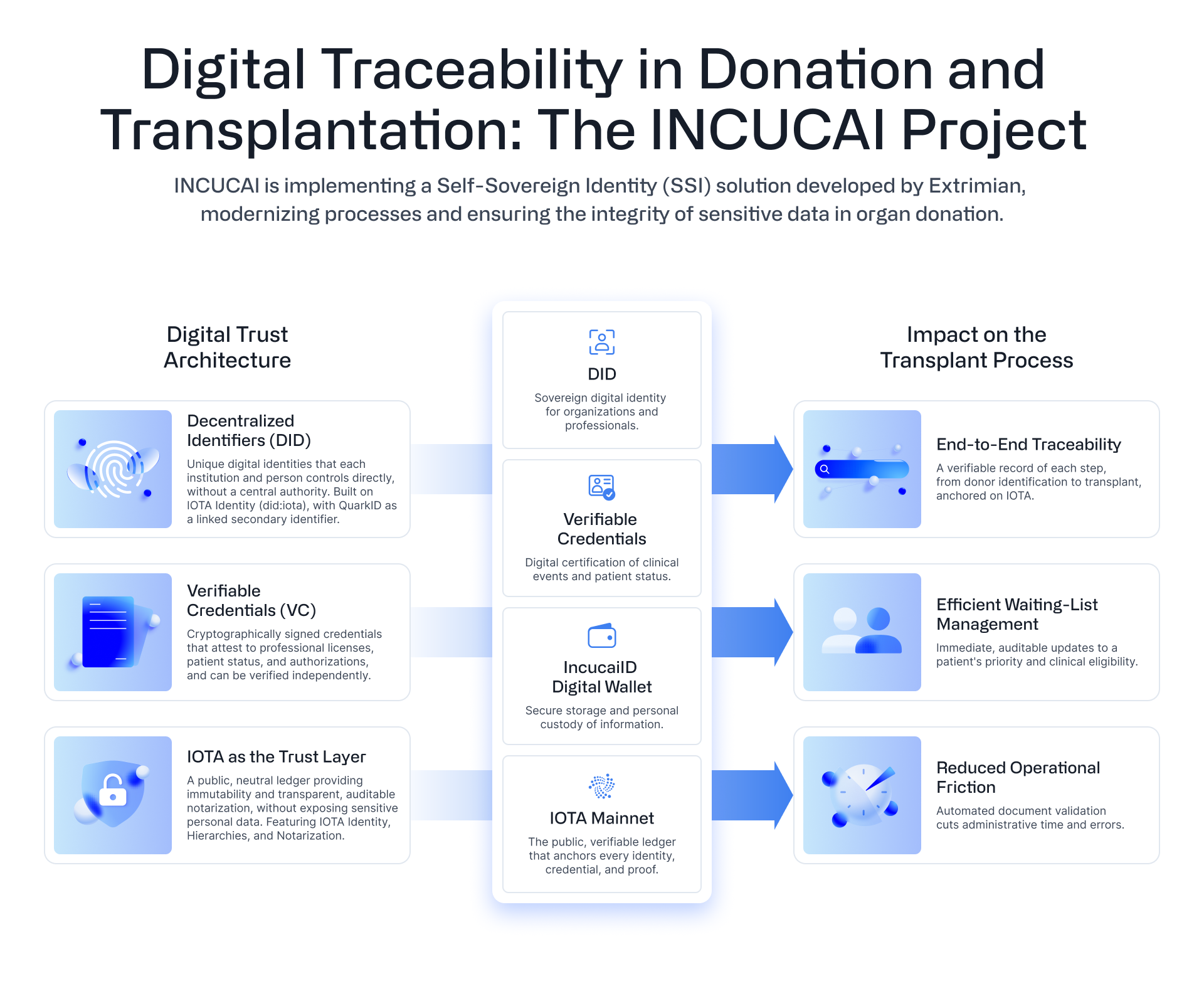
Extrimian’s solution leverages Self-Sovereign Identity (SSI) principles, utilizing the IOTA network as a neutral, decentralized foundation. The architecture ensures that institutional identities and the cryptographic integrity of documents can be independently checked by authorized stakeholders without relying on proprietary intermediaries.
Critically, the system is designed with rigorous privacy safeguards. Patient-identifiable information is never stored on the public blockchain. Instead, the ledger anchors only cryptographic proofs—mathematical hashes—of documents and specific workflow milestones. This mechanism guarantees absolute data integrity and immutability while shielding the deeply sensitive medical histories of donors, patients, and grieving families. Doctors and provincial regulators can cryptographically verify that every procedural step occurred exactly as recorded, while the underlying personal data remains strictly confidential.
Chronology of a National Rollout
The integration of blockchain technology into Argentina’s transplant infrastructure is the culmination of meticulous planning, regulatory updates, and technical deployment.
- Initial Development and Testing: Extrimian and INCUCAI collaborated to design a decentralized identity framework tailored to the rigorous compliance standards of Argentina’s healthcare sector, utilizing open W3C specifications for verifiable credentials.
- June 10, 2026: The infrastructure officially went live on the IOTA Mainnet, allowing decentralized identifiers (DIDs) and document notarization proofs to be independently audited via public explorers.
- Resolution 199/2026: Published in the national Official Gazette (Boletín Oficial), this legislative decree formally authorized the implementation of electronic signatures across all processes managed through SINTRA (Argentina’s National Procurement and Transplant Information System).
- Mid-2026 Rollout: INCUCAI released IncucaiID, the ecosystem’s official digital wallet application on iOS and Android app stores. Initial implementation focuses heavily on streamlining waiting-list registrations, beginning specifically with heart and lung transplant lists before expanding to other organs and comprehensive SINTRA workflows.
Furthermore, parts of the technical architecture are hosted on ARSAT, Argentina’s state-owned telecommunications infrastructure company, ensuring that critical components of the national system remain under sovereign governmental control while interacting with the global public ledger.
Official Perspectives and Institutional Commitment
The transition toward decentralized public infrastructure has garnered strong support from both governmental and technology leaders, who view the deployment as a practical demonstration of blockchain’s utility in saving lives.
Daniela Hansen Krogh, Director of Information Technology and Information Systems at INCUCAI, emphasized the human element driving the technological upgrade. "Trust is at the heart of every organ donation and transplantation process," Krogh stated. "Our responsibility is to ensure that every decision is supported by reliable, secure, and verifiable information. By incorporating decentralized identity and cryptographic verification into our national systems, we are strengthening the integrity, traceability, and legal certainty of every critical stage, while safeguarding sensitive patient information. This initiative reflects INCUCAI’s ongoing commitment to modernizing Argentina’s transplant system through secure, transparent, and citizen-centered digital innovation."
Extrimian executives echoed these sentiments, highlighting the departure of decentralized tech from speculative theory into practical, life-saving application. Esteban Musso, Professional Services Manager and Partner at Extrimian, noted: "At Extrimian, we believe that trust is the foundation of every digital transformation. By combining open standards with privacy-preserving technologies, we’ve helped build a solution that enhances traceability, security, and interoperability while respecting the privacy of every participant. Projects like this demonstrate that decentralized technologies are no longer a vision for the future—they are delivering tangible value today in critical public services."
From the technology provider’s perspective, Dominik Schiener, Co-Founder and Chairman of the IOTA Foundation, emphasized the broader significance of the deployment. "This is what IOTA’s open technology can do for critical public services at a national scale: real infrastructure, already coordinating decisions that save lives," Schiener remarked.
Implications and Future Outlook
The successful integration of IOTA and Extrimian’s technology into INCUCAI’s workflow offers profound implications for public administration well beyond the borders of Argentina. By replacing legacy paper trails and siloed digital databases with an interoperable, cryptographically secure verification layer, the system drastically reduces the administrative friction that can delay time-sensitive medical procedures.
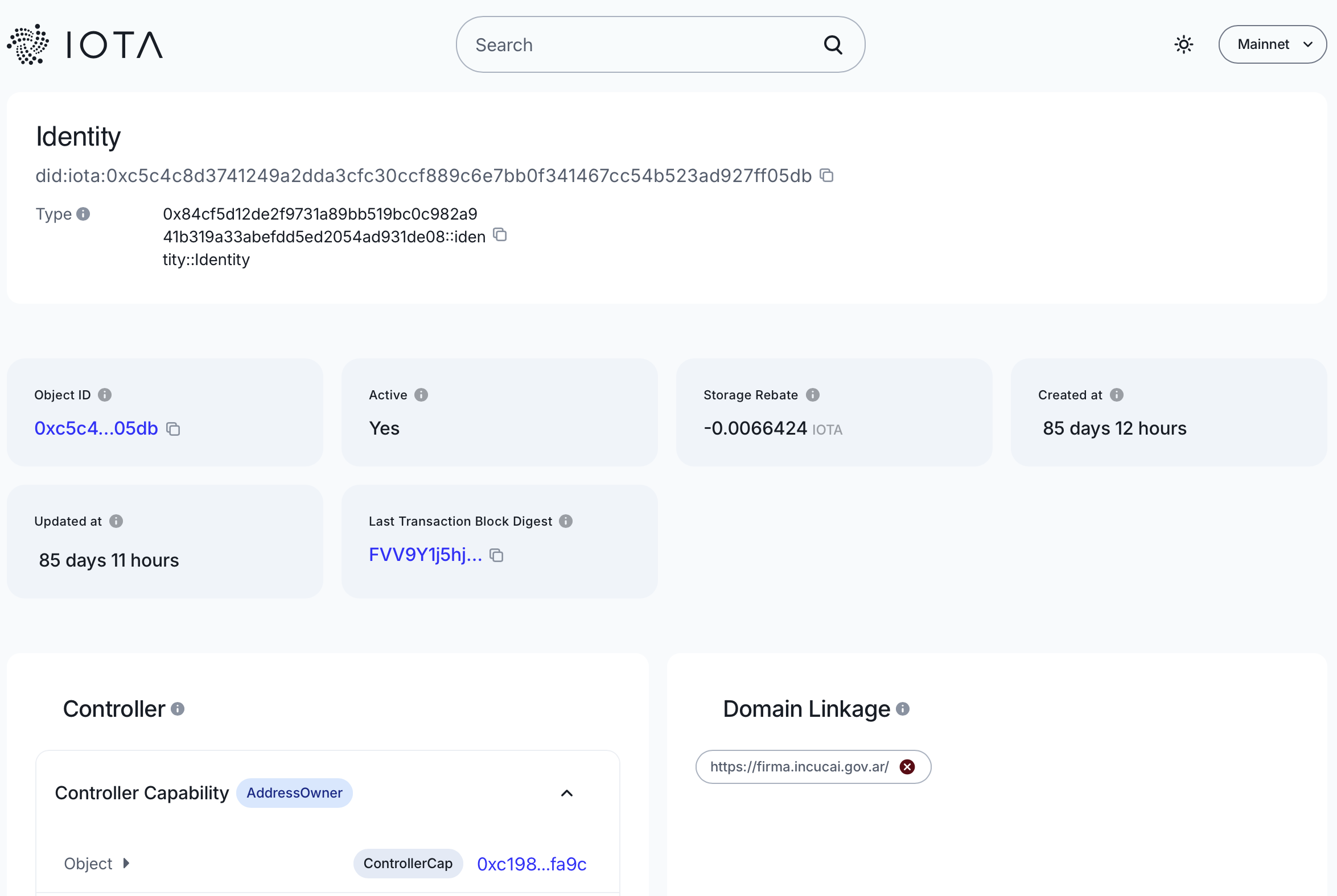
Independent verification by technical auditors has confirmed the operational stability of the deployment: all 24 provincial agency identities successfully resolved on the IOTA Explorer, trust federations mapped accurately to onchain data, and direct network calls validated the accreditation of each participating entity.
As IncucaiID adoption expands among medical professionals and patients, the transition toward a fully paperless, frictionless workflow gathers momentum. By demonstrating that decentralized ledgers can successfully optimize high-consequence administrative processes without compromising data privacy, Argentina has established a compelling blueprint for modernizing critical state infrastructure through transparent, citizen-centric digital innovation.