In the high-stakes environment of organ transplantation, minutes can dictate the boundary between life and death. When a viable organ becomes available, a complex, high-velocity relay begins. A harvested human heart, for instance, remains viable outside the body for only a matter of hours. Within that narrow window, a multitude of moving parts across hospitals, regional agencies, and national coordinators must function in absolute harmony. Every single piece of medical data, patient consent, and logistical authorization must be flawlessly accurate and instantly verifiable. A misplaced paper form, a delayed validation, or a fraudulent signature can abruptly derail a life-saving procedure.
To mitigate these systemic vulnerabilities, Argentina’s national organ donation authority has taken a groundbreaking step. The Instituto Nacional Central Único Coordinador de Ablación e Implante (INCUCAI)—operating in tandem with Latin American decentralized-identity pioneer Extrimian and utilizing the IOTA mainnet—has successfully transitioned its nationwide organ, tissue, and cell transplantation system onto a public, verifiable digital-identity and notarization infrastructure. This deployment marks a monumental shift for public sector administration, proving that decentralized technology can effectively secure and streamline critical, life-saving public services on a national scale.
To understand the magnitude of this technological overhaul, one must examine the intricate bureaucracy governing Argentina’s healthcare logistics. INCUCAI functions as the central national coordinator for all organ procurement and transplantation activities across the country. However, its mandate requires constant, seamless collaboration with 24 distinct jurisdictional procurement agencies—encompassing every Argentine province alongside the Autonomous City of Buenos Aires—as well as an extensive network of public and private hospitals and specialized transplant clinics.
Historically, coordinating life-or-death decisions across this sprawling, decentralized network relied heavily on traditional administrative workflows, legacy databases, and physical paperwork. While rigorous, these conventional systems introduced friction, potential bottlenecks, and vulnerabilities to human error or administrative delay. Ensuring absolute transparency, unassailable data integrity, and rapid cross-jurisdiction communication is a daily operational challenge. Recognizing the urgent need to modernize this digital backbone, INCUCAI sought a robust architecture capable of guaranteeing security without compromising administrative agility or patient privacy.
The Technology Stack: Self-Sovereign Identity and IOTA
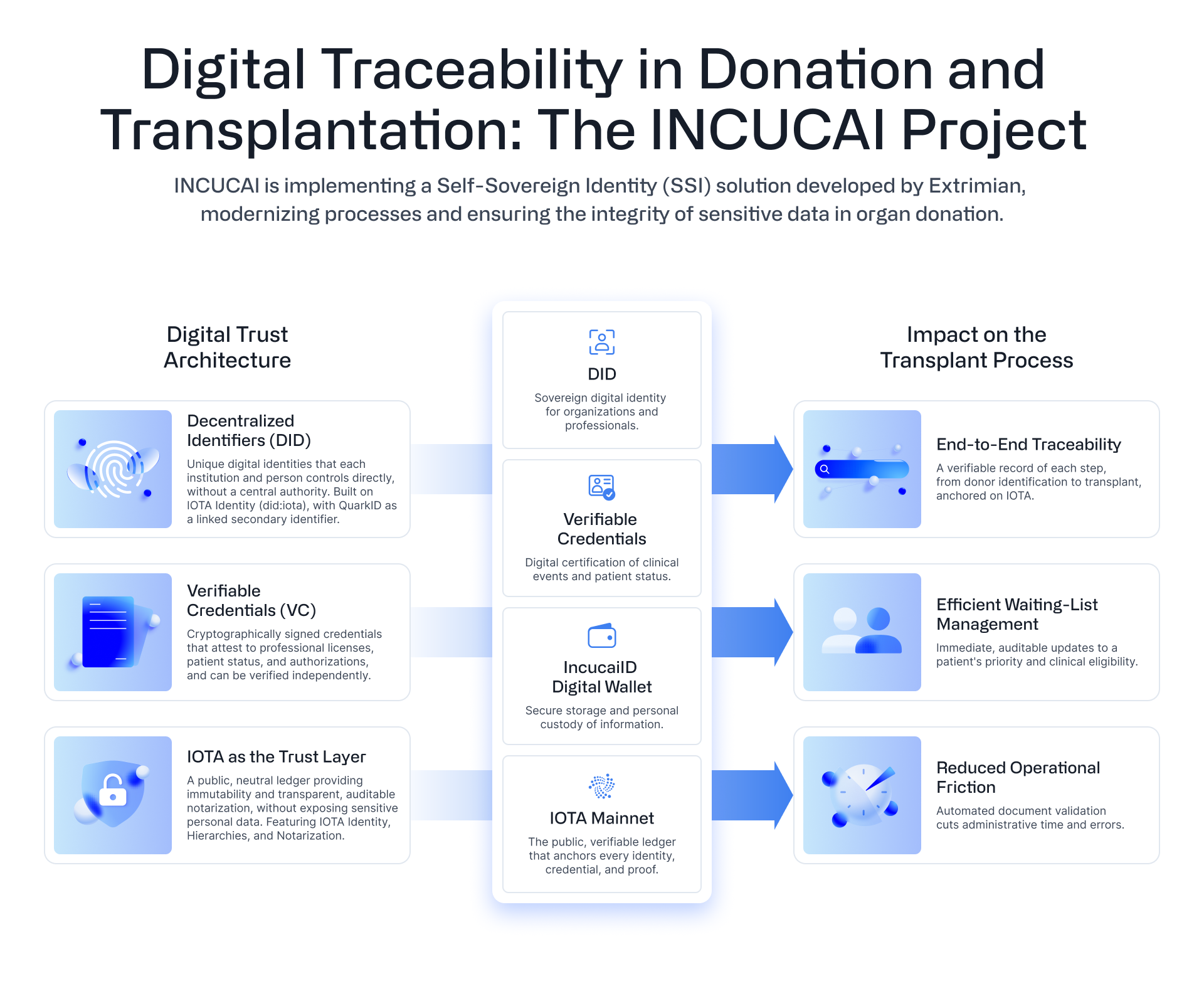
To engineer a solution tailored to these stringent requirements, INCUCAI partnered with Extrimian, a recognized leader in Latin American digital identity systems. Extrimian specializes in Self-Sovereign Identity (SSI) frameworks, a model that empowers individuals and institutions with direct, unmediated control over their digital identities and the specific data they choose to share. The overarching goal of Extrimian’s architecture is to instill absolute transparency and user-centric efficiency into digital interactions spanning healthcare, education, and government administration.
For the underlying public ledger, Extrimian selected IOTA. Functioning as a neutral, scalable, and highly secure foundational layer, IOTA enables institutional identities and document integrity to be verified instantaneously without third-party gatekeepers or restrictive friction.
A vital architectural pillar of the INCUCAI-Extrimian deployment is strict adherence to data privacy regulations and ethical medical standards: zero patient-identifiable information is ever stored directly on the blockchain. Instead, the system anchors only cryptographic proofs—specifically, mathematical hashes of documents and discrete process steps—onto the public ledger. This ingenious cryptographic methodology guarantees complete immutability and tamper-proof verification while shielding the deeply personal and sensitive details of patients and grieving families. Medical professionals, regulatory agencies, and families can independently verify that every step of the transplant authorization protocol occurred precisely as recorded, all while the underlying private data remains strictly confidential.
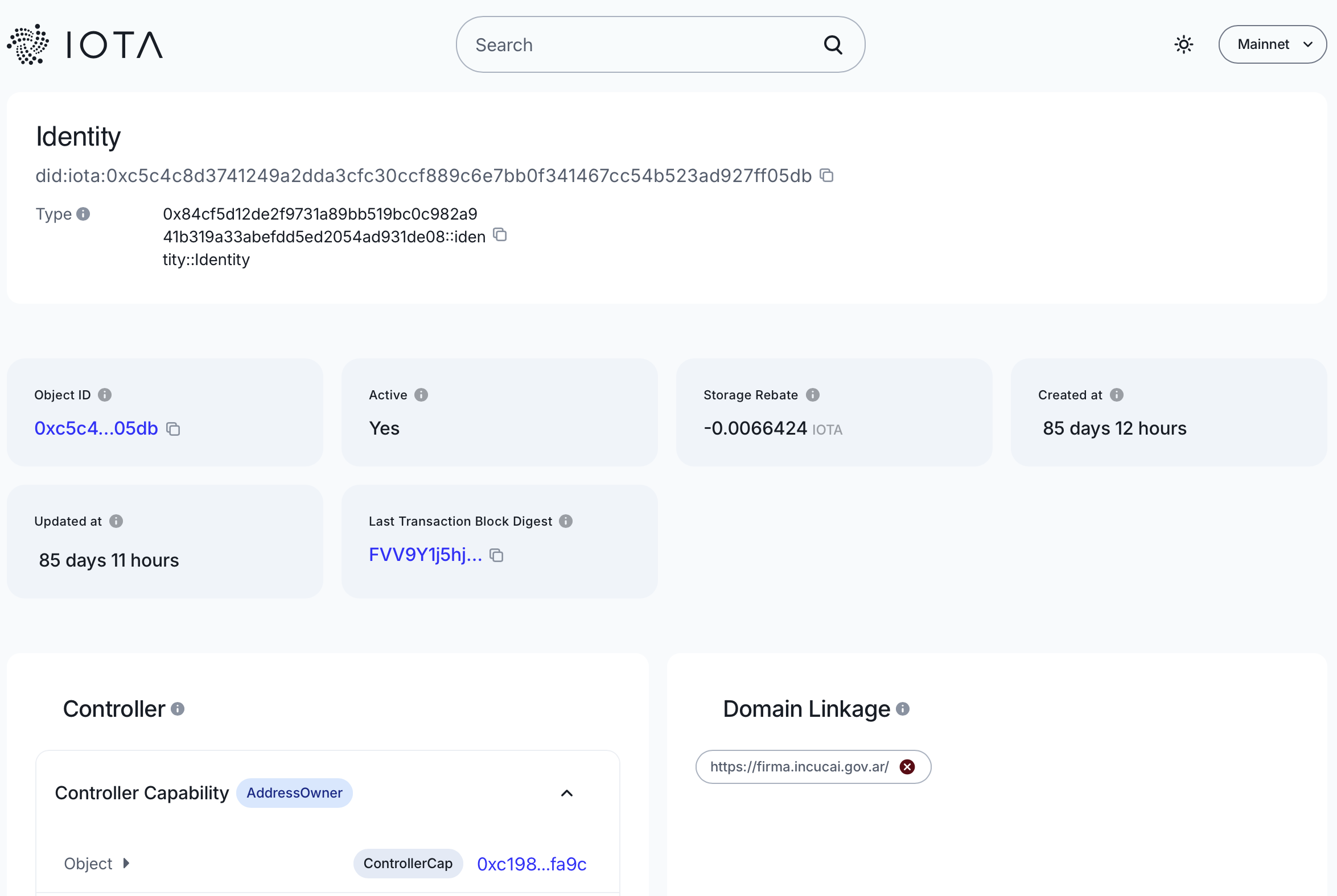
Furthermore, the technological deployment leverages open, verifiable standards. Identities and credentials strictly follow World Wide Web Consortium (W3C) specifications, and INCUCAI’s institutional identity is cryptographically bound to its official government domain. This ensures that any observer can scientifically confirm the identity belongs to the legitimate state institution rather than an impostor. Additionally, critical components of the architecture integrate with ARSAT, Argentina’s state-owned telecommunications and infrastructure company, ensuring that foundational elements remain securely under national jurisdiction.
Chronology of Implementation: From Conception to Resolution 199/2026
The journey toward a fully onchain national transplant system culminated in mid-2026, backed by formal regulatory changes within the Argentine government.
Early Development and Integration: Extrimian and INCUCAI spent months designing, testing, and deploying the decentralized infrastructure, ensuring seamless integration with SINTRA (Sistema Nacional Procuración y Trasplante de la República Argentina), the country’s national procurement and information management system.
June 10, 2026: The decentralized identity and document-signing infrastructure officially went live on the public IOTA Mainnet, allowing institutional identities and cryptographic proofs to be independently verified by external auditors and the public.
June 2026 (Resolution 199/2026): Through the publication of Resolution 199/2026 in the national Official Gazette (Boletín Oficial), INCUCAI formally mandated the implementation of electronic signatures across all donation and transplant processes managed via SINTRA. This administrative decree provided the necessary legal certainty and framework for blockchain-backed evidence to govern institutional workflows.
Mid-July 2026: Public auditing confirmed the robustness of the system. Independent checks verified that all 24 provincial identities resolved correctly on the IOTA Explorer, matching the established trust federation and confirming that the entities controlling each identity were properly accredited.
The Role of IncucaiID and the Paperless Workflow
At the heart of the user-facing deployment is IncucaiID, the ecosystem’s official decentralized wallet application, available for download on major mobile platforms including the Apple App Store and Google Play.
Through IncucaiID, registered patients, accredited healthcare professionals, and authorized administrative personnel receive verifiable digital credentials. Users can securely prove their identity and electronically sign legal and medical documents tied to the donation and transplant lifecycle. Every interaction is cryptographically secured, timestamped, and immutably recorded to facilitate future audits without exposing private medical histories.
The rollout is intentionally phased. Initial implementation focuses heavily on the waiting-list registration workflows, beginning specifically with heart and lung transplant lists before systematically scaling to cover all remaining organ categories. Over time, the framework will absorb the entirety of SINTRA’s administrative processes, successfully transitioning Argentina’s national transplant network into a fully digital, paperless ecosystem that eliminates the historical delays associated with physical document transport and manual provincial gatekeeping.
Official Statements and Leadership Perspectives
The successful realization of this national-scale blockchain integration has drawn praise from technology leaders and healthcare administrators alike, underscoring its profound implications for public sector modernization.
Daniela Hansen Krogh, Director of Information Technology and Information Systems at INCUCAI, emphasized the foundational role of trust in medical administration:
"Trust is at the heart of every organ donation and transplantation process. Our responsibility is to ensure that every decision is supported by reliable, secure, and verifiable information. By incorporating decentralized identity and cryptographic verification into our national systems, we are strengthening the integrity, traceability, and legal certainty of every critical stage, while safeguarding sensitive patient information. This initiative reflects INCUCAI’s ongoing commitment to modernizing Argentina’s transplant system through secure, transparent, and citizen-centered digital innovation."
Echoing this sentiment, Esteban Musso, Professional Services Manager and Partner at Extrimian, pointed to the practical viability of decentralized architecture in modern governance:
"At Extrimian, we believe that trust is the foundation of every digital transformation. By combining open standards with privacy-preserving technologies, we’ve helped build a solution that enhances traceability, security, and interoperability while respecting the privacy of every participant. Projects like this demonstrate that decentralized technologies are no longer a vision for the future—they are delivering tangible value today in critical public services."
Dominik Schiener, Co-Founder and Chairman of the IOTA Foundation, highlighted the broader utility of open ledger technology:
"This is what IOTA’s open technology can do for critical public services at national scale: real infrastructure, already coordinating decisions that save lives."
Implications and Future Outlook
The integration of IOTA and Extrimian’s infrastructure into INCUCAI’s daily operations serves as a watershed moment for the application of distributed ledger technology (DLT) in government institutions. For decades, public sector blockchain initiatives have struggled to move past the conceptual or pilot-project phase, often criticized as solutions searching for problems.
By contrast, the Argentine model addresses a hyper-specific, high-stakes logistical challenge where immutability, cryptographic verification, and absolute data integrity provide undeniable operational value. By eliminating paperwork, securing inter-provincial communication, and safeguarding patient privacy through zero-knowledge principles, Argentina has established a blueprint for public administration modernization.
As other nations observe the successful deployment of Resolution 199/2026 and the widespread adoption of tools like IncucaiID, the paradigm for institutional trust is evolving. Verifiable trust is rapidly shifting from an idealistic technological theory into core public infrastructure—proving that when deployed thoughtfully, decentralized systems can actively assist in safeguarding human life.