In the high-stakes arena of organ transplantation, every single second counts. When a donor heart becomes available, a tightly compressed window of viability—often lasting only a few hours—dictates the pace of operations. Dozens of medical professionals, provincial coordinators, institutional leaders, and administrative personnel must act in absolute synchrony. Every medical record, authorization, and consent form must be unimpeachably accurate the very first time. In this critical environment, a misplaced document, a delayed verification, or a forged signature can carry irreversible consequences.
To mitigate these systemic risks and safeguard the integrity of one of the nation’s most vital humanitarian efforts, Argentina’s national organ donation authority has taken a groundbreaking leap. The Instituto Nacional Central Único Coordinador de Ablación e Implante (INCUCAI), operating in tandem with Latin American decentralized identity specialist Extrimian and the public ledger technology of IOTA, has successfully integrated Argentina’s entire national transplant network onto a live, publicly verifiable decentralized identity and digital notarization system.
This technological overhaul anchors the administrative backbone of 24 provincial agencies, the Autonomous City of Buenos Aires, and hundreds of public and private hospitals onto the IOTA mainnet. By leveraging self-sovereign identity (SSI) frameworks, open standards, and cryptographic proofs, the initiative establishes a tamper-proof digital infrastructure designed to eliminate administrative friction while preserving the strict confidentiality of patients and grieving families.
The Bureaucratic and Logistical Challenge of National Transplants
INCUCAI serves as the central governing body overseeing the allocation of organs, tissues, and cells across Argentina, managing the national waiting list in close coordination with 24 jurisdictional procurement agencies. The logistical complexity of orchestrating life-or-death decisions across a geographically expansive nation cannot be overstated. Historically, the pipeline relied on a combination of centralized databases and physical paperwork, systems that, while functional, exposed vulnerabilities in traceability, inter-agency communication, and auditability.
Recognizing the urgent need for modernization without compromising security, INCUCAI partnered with Extrimian, a firm renowned for engineering decentralized digital identity solutions across health, education, and government sectors. Extrimian utilizes self-sovereign identity architectures to grant individuals and institutions direct ownership and control over their digital credentials. For the underlying public network, Extrimian selected IOTA—a scalable, fee-efficient, and neutral distributed ledger that allows institutional identities and document integrity to be validated autonomously, removing single points of failure and third-party gatekeepers.
The operational architecture of this deployment is meticulously designed to protect sensitive data. At no point are patient-identifiable details or private medical records stored on the public blockchain. Instead, only cryptographic hashes—unique mathematical fingerprints of signed documents and procedural milestones—are anchored to the IOTA ledger. This guarantees absolute immutability and tamper resistance while ensuring that the profound privacy of patients and donors remains entirely uncompromised. Doctors, auditors, and regulatory bodies can independently verify that every step of a transplantation protocol occurred exactly as recorded, without ever exposing the underlying personal information.
Chronology of Implementation and Resolution 199/2026
The integration of blockchain-backed verification into Argentina’s medical infrastructure represents the culmination of years of digital strategy and regulatory adaptation. The foundational development phase saw Extrimian and INCUCAI map out the complex legal and technical requirements of the nation’s SINTRA (National Procurement and Transplant Information System) framework.
By June 2026, the digital architecture reached a critical milestone with its official activation on the IOTA Mainnet. This deployment coincided with a major regulatory shift marked by Resolution 199/2026, published in the national Official Gazette (Boletín Oficial). The resolution authorized the formal implementation of electronic signatures across all donation and transplant processes managed via SINTRA and its associated institutional networks.
The roll-out plan follows a carefully staged methodology. Implementation commenced with the waiting-list registration workflows, prioritizing high-acuity categories such as heart and lung lists. Over subsequent phases, the system is scheduled to expand to cover remaining organ lists and eventually encompass the entirety of SINTRA’s administrative documentation.
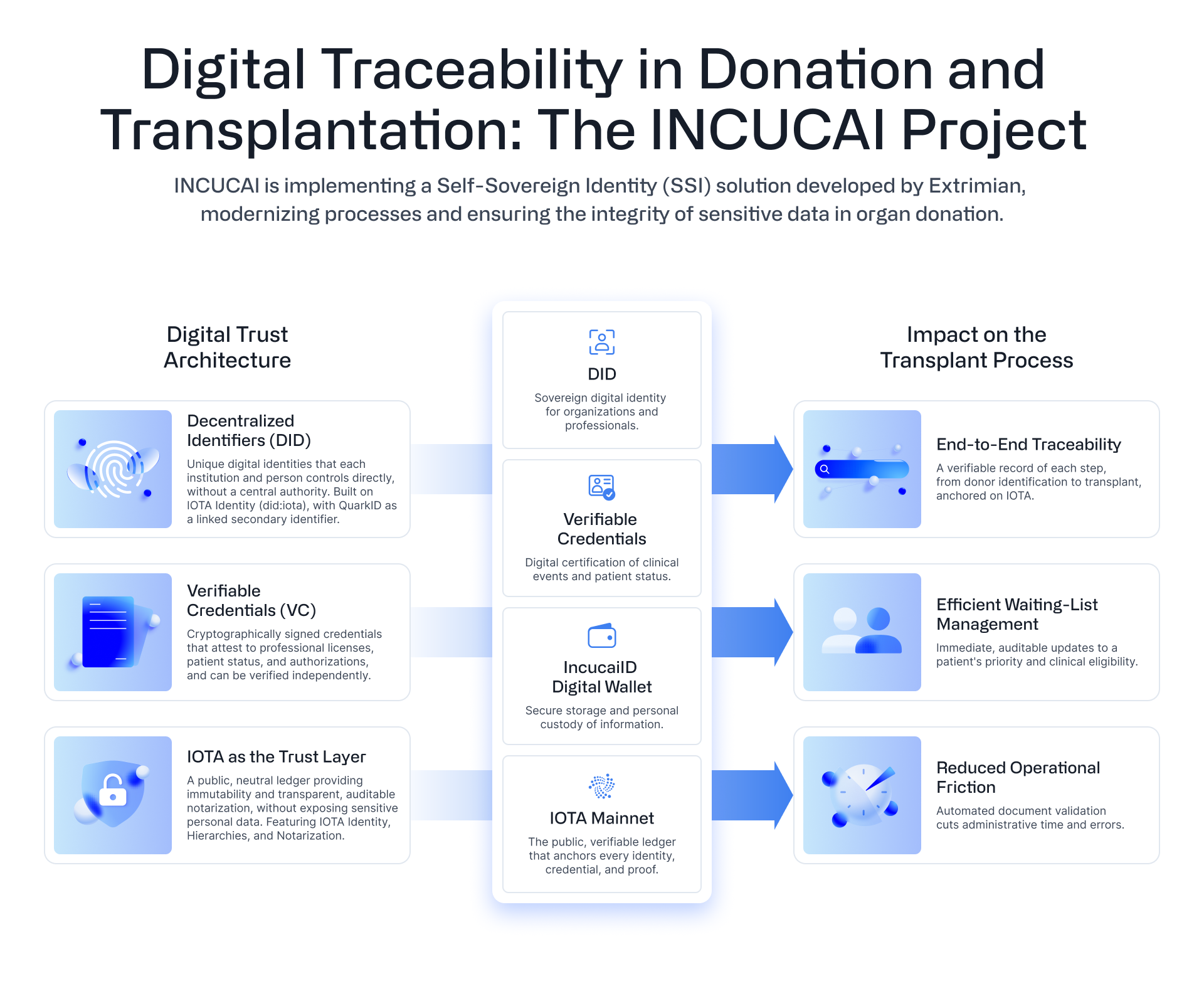
To facilitate widespread participation, the ecosystem introduced "IncucaiID," a dedicated mobile wallet application available on major app stores. Through IncucaiID, authorized healthcare professionals, patients, and administrative personnel receive W3C-compliant verifiable credentials. Users can authenticate their identities and apply legally binding electronic signatures to documents tied to the donation process. Every transaction is cryptographically secured, allowing for seamless post-hoc auditing while shifting the national transplant network toward a streamlined, paperless paradigm.
Technological Architecture and National Sovereignty
The resilience of the INCUCAI-Extrimian deployment relies on a multi-layered technological stack that marries global cryptographic standards with national infrastructure control.
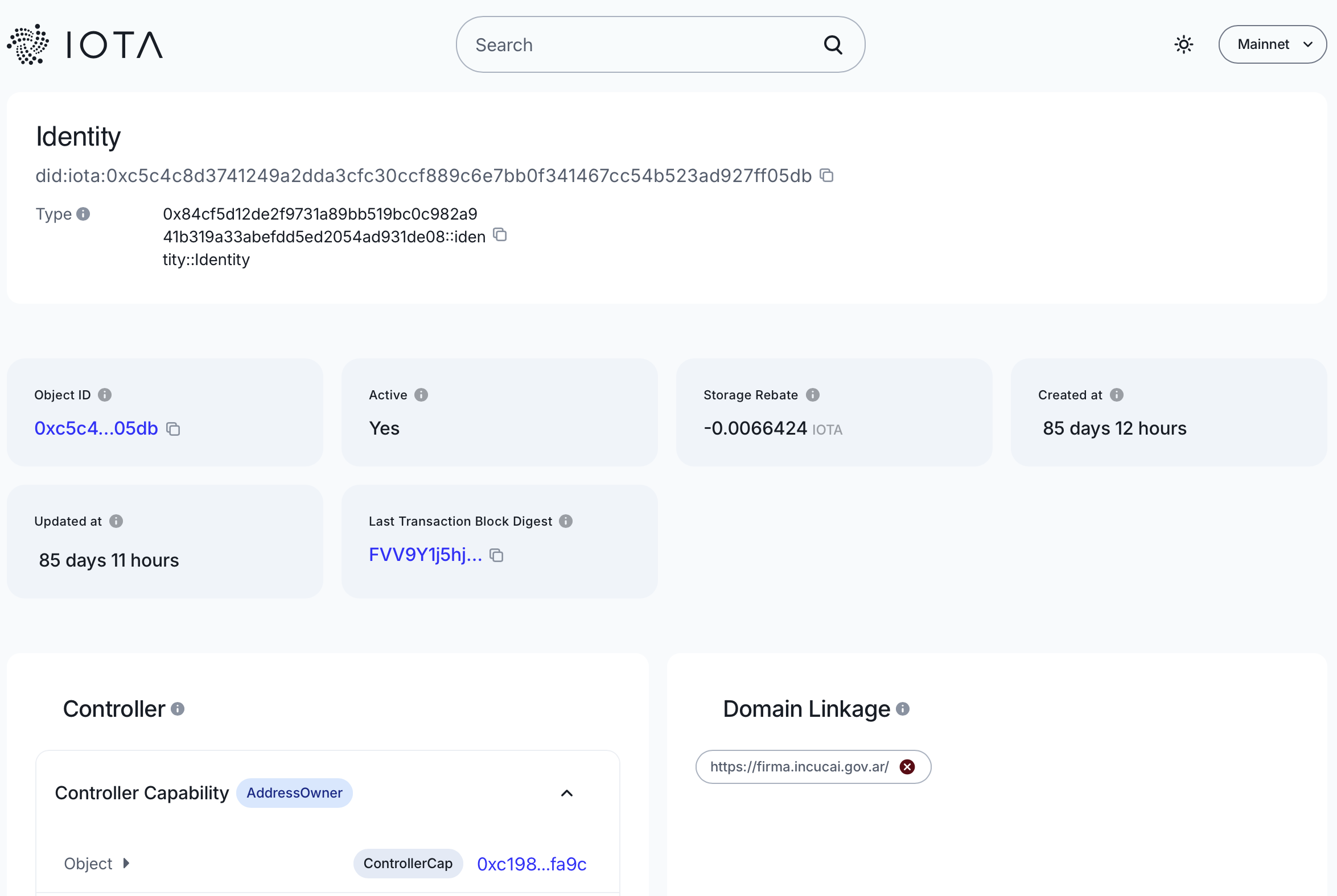
At the core of the system are decentralized identifiers (did:iota) adhering to World Wide Web Consortium (W3C) specifications. INCUCAI’s institutional identity is cryptographically linked directly to its official government domain (firma.incucai.gov.ar), enabling any external observer or auditor to confirm that the entity interacting with the network is the legitimate state authority rather than a malicious actor. Furthermore, critical components of the node and verification infrastructure operate on ARSAT, Argentina’s state-owned telecommunications and satellite solutions company. This integration ensures that the foundational data layers remain anchored within national jurisdiction.
Adhering to the blockchain ethos of "don’t trust, verify," independent technical evaluations conducted by the IOTA Foundation confirmed the integrity of the deployment. By querying public endpoints and the IOTA Explorer, engineers verified that all 24 provincial institutional identities resolved correctly, trust federations matched onchain data, and the root authority address—interacting via nominal transaction gas fees—consistently processed document notarization hashes.
Official Statements and Institutional Perspectives
The adoption of decentralized technologies for national healthcare governance has drawn praise from key stakeholders across the public and private sectors, emphasizing a shared commitment to transparency and patient welfare.
Daniela Hansen Krogh, Director of Information Technology and Information Systems at INCUCAI, underscored the foundational role of trust in medical logistics: "Trust is at the heart of every organ donation and transplantation process. Our responsibility is to ensure that every decision is supported by reliable, secure, and verifiable information. By incorporating decentralized identity and cryptographic verification into our national systems, we are strengthening the integrity, traceability, and legal certainty of every critical stage, while safeguarding sensitive patient information. This initiative reflects INCUCAI’s ongoing commitment to modernizing Argentina’s transplant system through secure, transparent, and citizen-centered digital innovation."
Echoing this sentiment, Esteban Musso, Professional Services Manager and Partner at Extrimian, highlighted the real-world utility of decentralized systems: "At Extrimian, we believe that trust is the foundation of every digital transformation. By combining open standards with privacy-preserving technologies, we’ve helped build a solution that enhances traceability, security, and interoperability while respecting the privacy of every participant. Projects like this demonstrate that decentralized technologies are no longer a vision for the future—they are delivering tangible value today in critical public services."
Dominik Schiener, Co-Founder and Chairman of the IOTA Foundation, pointed to the broader significance of deploying public ledger infrastructure for humanitarian applications: "This is what IOTA’s open technology can do for critical public services at national scale: real infrastructure, already coordinating decisions that save lives."
Implications and Future Outlook
The successful migration of Argentina’s transplant coordination system to the IOTA mainnet marks a watershed moment for the practical application of decentralized ledger technology in public administration. For decades, blockchain initiatives have frequently been categorized as experimental or theoretical. However, the INCUCAI-Extrimian deployment demonstrates that self-sovereign identity and cryptographic notarization can be seamlessly integrated into high-stakes, mission-critical government workflows.
By enhancing auditability, eliminating administrative bottlenecks, and cementing legal certainty through electronic signatures, Argentina has established a robust template for institutional transparency. As this paperless workflow expands across all provincial jurisdictions and medical specialties, it offers a compelling blueprint for other nations seeking to modernize complex public services without sacrificing data privacy or centralization of trust. Through the convergence of state-backed infrastructure and neutral public ledgers, Argentina’s transplant system has redefined the standard for how technology can safeguard human life.