In the delicate ecosystem of organ donation and transplantation, time is measured not merely in hours, but in fleeting minutes. When a human heart becomes available, a high-stakes, meticulously choreographed countdown begins. A viable heart remains operational outside the human body for only a few brief hours. Within that narrow window, a vast network of actors—spanning emergency rooms, regional hospitals, provincial agencies, and national coordinators—must execute their duties in absolute synchronization. Every medical record, authorization, and expression of consent must be pristine, unassailable, and verified instantly. In this high-pressure environment, a misplaced form, an unverified signature, or a bureaucratic delay is not just an administrative hurdle; it is a matter of life and death.
To eradicate these vulnerabilities and streamline a critical public service, Argentina’s national organ, tissue, and cell transplantation authority has taken a monumental step forward. The Instituto Nacional Central Único Coordinador de Ablación e Implante (INCUCAI), operating in partnership with Latin American decentralized identity firm Extrimian and powered by the IOTA blockchain mainnet, has officially migrated its national transplant infrastructure onto a live, publicly verifiable digital-identity framework. This deployment marks a watershed moment for public sector digital transformation, proving that distributed ledger technology can move beyond financial speculation to anchor critical, life-saving government workflows.
The Anatomy of Argentina’s Transplant Network and Its Vulnerabilities
To understand the magnitude of this technological overhaul, one must examine the complexity of Argentina’s medical architecture. INCUCAI serves as the central administrative body overseeing the national waiting list, policy enforcement, and organ allocation. However, it does not operate in a vacuum. It coordinates closely with 24 distinct jurisdictional procurement agencies—encompassing every Argentine province alongside the Autonomous City of Buenos Aires—as well as an expansive network of public and private hospitals and transplant centers.
Historically, coordinating life-or-death decisions across this sprawling national footprint relied heavily on legacy databases, paper trails, and fragmented verification processes. While Argentina’s National Procurement and Transplant Information System (SINTRA) digitized much of the administrative workload, the system remained vulnerable to traditional cybersecurity challenges, including document tampering, identity spoofing, and the friction associated with cross-jurisdictional verification.
Recognizing the urgent need for a tamper-proof, highly secure digital backbone, INCUCAI sought a modern architectural solution that could guarantee absolute integrity without compromising the strict confidentiality required in medical environments. The mandate was clear: establish an immutable audit trail for every authorization and document signing procedure while ensuring that patient privacy remains fiercely protected.
The Technological Architecture: How IOTA and Extrimian Built the Bridge
The solution to INCUCAI’s coordination challenge arrived through a strategic collaboration with Extrimian, a regional pioneer in decentralized digital identity (SSI). Extrimian specializes in self-sovereign identity models, which empower individuals and institutions with absolute control over their digital credentials and the data they choose to share. To provide the neutral, scalable, and cost-efficient public layer required for a national-scale deployment, Extrimian selected the IOTA mainnet.
The core architecture relies on cutting-edge cryptographic principles. Crucially, no patient-identifiable information (PII) or sensitive medical history is ever stored on the blockchain ledger. Instead, the system anchors only cryptographic proofs—specifically, secure hashes of documents and process steps—directly to the IOTA mainnet. This methodology guarantees absolute data integrity and immutability while shielding the deeply personal and painful details entrusted to medical professionals during times of grief and crisis.
Doctors, regional agencies, and families can mathematically confirm that every procedural step occurred exactly as recorded, while the underlying data remains strictly private and secure. Furthermore, the deployment incorporates elements of Argentina’s state-owned infrastructure provider, ARSAT, ensuring that critical physical and network components remain under domestic sovereign control.
The technical foundation utilizes several advanced building blocks:
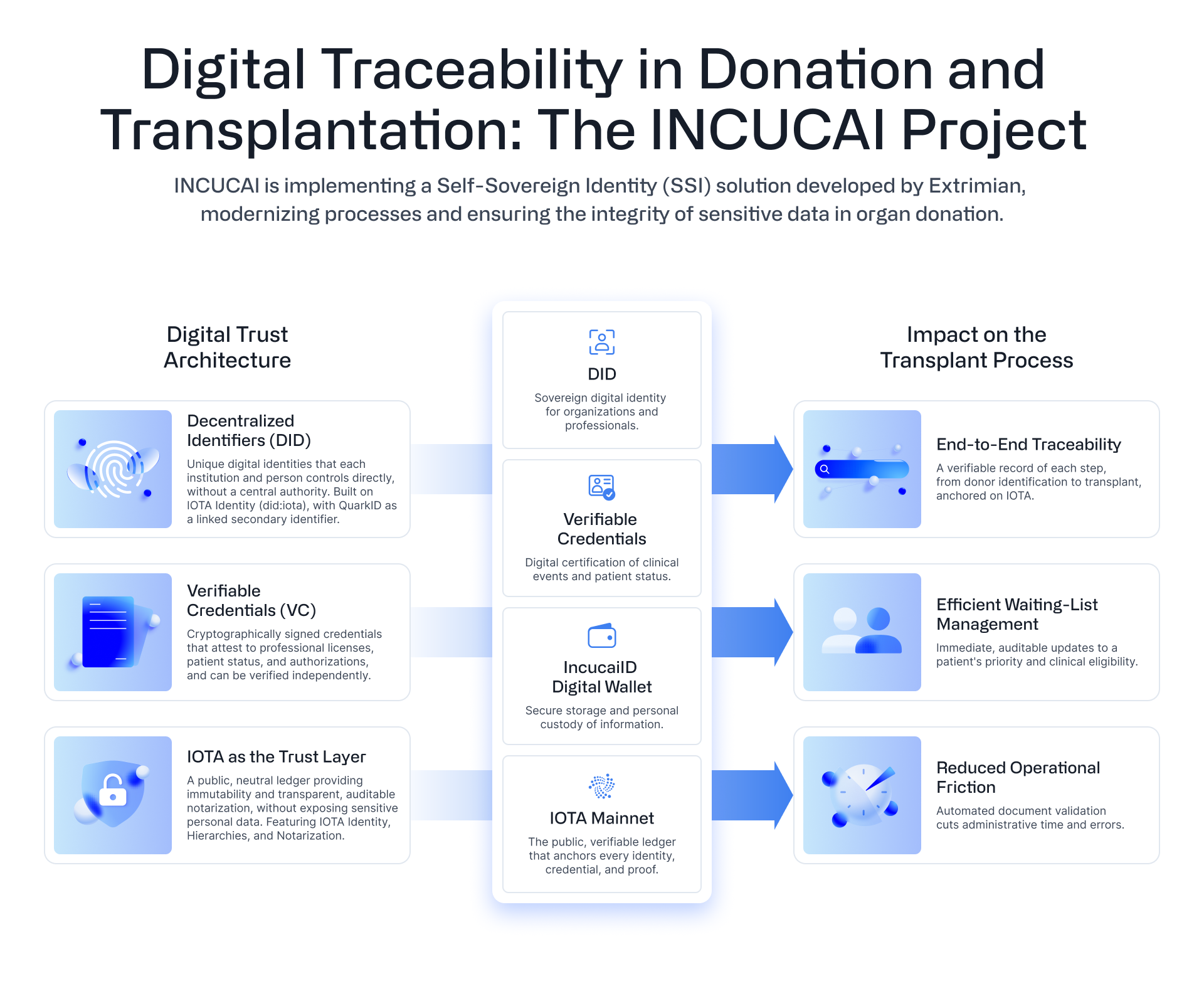
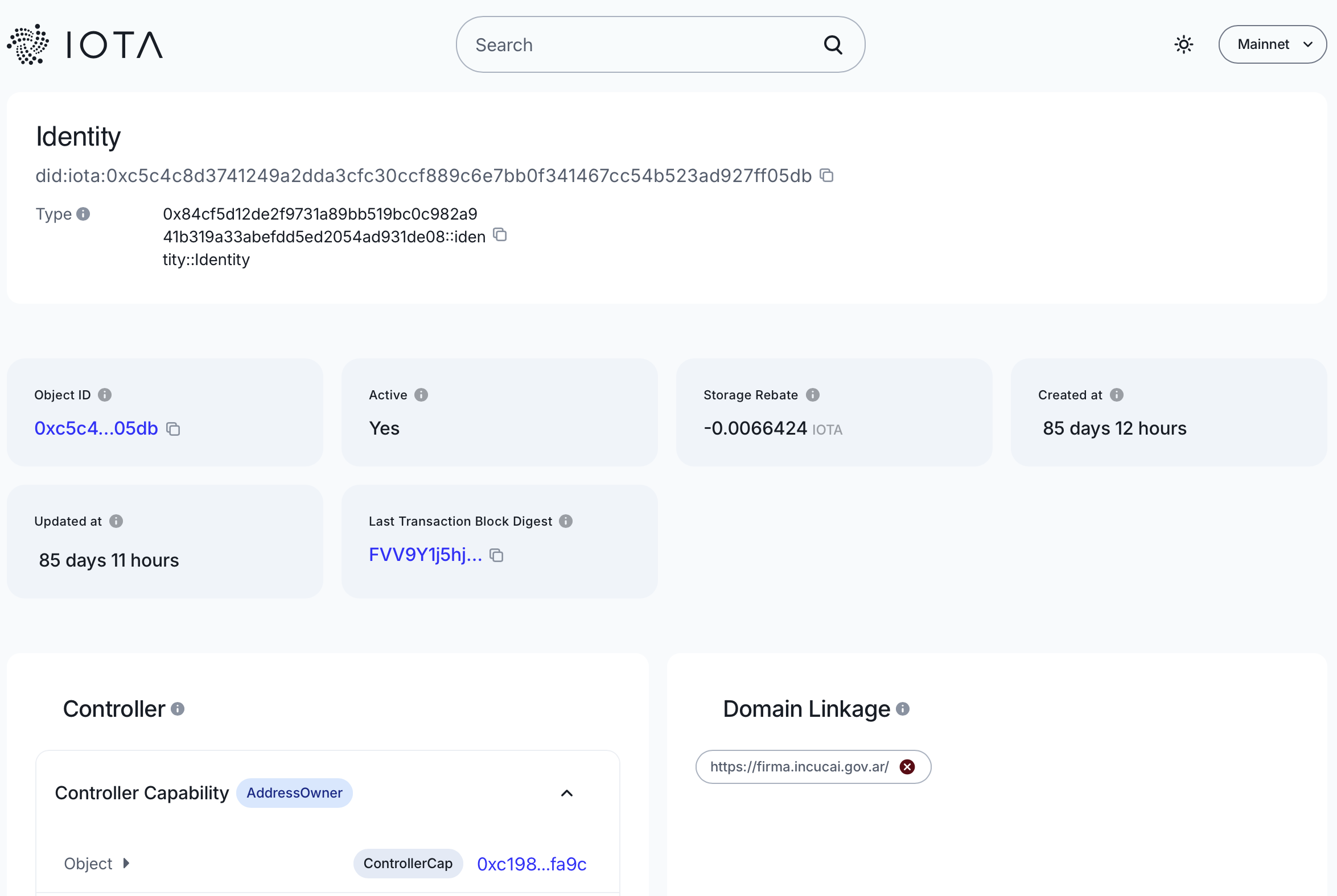
- W3C Decentralized Identifiers (DIDs): Institutional identities follow World Wide Web Consortium standards. INCUCAI’s onchain identity is cryptographically bound to its official government domain (
firma.incucai.gov.ar), enabling anyone to verify that an incoming document originates from the genuine national authority rather than an impostor. - Verifiable Credentials: Standardized digital certificates that allow individuals and medical staff to prove their professional accreditation or consent status securely.
- Decentralized Trust Registries: A federated architecture that allows all 24 provincial agencies to validate identities and signatures across state boundaries without relying on a centralized, single point of failure.
Independent verification of the system has reinforced its credibility. Exercising the core blockchain ethos of "don’t trust, verify," external technical auditors and the IOTA Foundation independently evaluated public endpoints and the IOTA Explorer. All 24 provincial identities resolved accurately, all cryptographic explorer links matched, and direct onchain calls confirmed that the entities controlling each identity were fully accredited within the federal trust structure.
Chronology of Implementation and Resolution 199/2026
The path to a fully onchain transplant system culminated in mid-2026, following months of rigorous development, testing, and regulatory alignment.
- Early Development Phase: Extrimian and INCUCAI architected the decentralized trust framework, integrating W3C-compliant decentralized identifiers with SINTRA’s existing backend architecture while routing notarization layers through the IOTA mainnet.
- June 10, 2026: The decentralized identity and notarization system officially went live on the IOTA Mainnet, making institutional identities and transactional proofs independently verifiable by the public.
- Mid-June 2026 (Resolution 199/2026): Through Resolution 199/2026, published officially in the national Boletín Oficial, INCUCAI mandated the nationwide rollout of electronic signatures across all processes managed via SINTRA. This administrative decree provided the necessary legal certainty to transition high-value medical workflows into blockchain-backed executions.
- Launch of IncucaiID: To facilitate user interaction, the ecosystem released IncucaiID, an official mobile wallet application available on both the Apple App Store and Google Play. Through this application, patients, medical practitioners, and authorized officials receive verifiable credentials, authenticate their identities, and sign regulatory documents tied to organ harvesting and transplantation.
The rollout has been designed with operational resilience in mind, beginning initially with the national waiting lists for heart and lung transplants. Subsequent phases will systematically integrate remaining organ categories and expand across all ancillary SINTRA workflows, ultimately driving toward a completely paperless, frictionless national system.
Official Perspectives: Leadership Endorsements
The deployment has drawn praise from government and technology leaders alike, underscoring the convergence of public sector governance and next-generation cryptographic infrastructure.
Daniela Hansen Krogh, Director of Information Technology and Information Systems at INCUCAI, emphasized the human element underpinning the technical upgrade: "Trust is at the heart of every organ donation and transplantation process. Our responsibility is to ensure that every decision is supported by reliable, secure, and verifiable information. By incorporating decentralized identity and cryptographic verification into our national systems, we are strengthening the integrity, traceability, and legal certainty of every critical stage, while safeguarding sensitive patient information. This initiative reflects INCUCAI’s ongoing commitment to modernizing Argentina’s transplant system through secure, transparent, and citizen-centered digital innovation."
Echoing this sentiment, Esteban Musso, Professional Services Manager and Partner at Extrimian, pointed to the tangible real-world application of the technology: "At Extrimian, we believe that trust is the foundation of every digital transformation. By combining open standards with privacy-preserving technologies, we’ve helped build a solution that enhances traceability, security, and interoperability while respecting the privacy of every participant. Projects like this demonstrate that decentralized technologies are no longer a vision for the future—they are delivering tangible value today in critical public services."
Dominik Schiener, Co-Founder and Chairman of the IOTA Foundation, framed the milestone within the broader narrative of blockchain utility: "This is what IOTA’s open technology can do for critical public services at national scale: real infrastructure, already coordinating decisions that save lives."
Implications and Broader Impact on Public Administration
The integration of IOTA and Extrimian into Argentina’s national transplant framework carries profound implications for the future of public administration, both regionally and globally. For decades, governments seeking to modernize have oscillated between vulnerable centralized databases and costly, proprietary enterprise software solutions. The INCUCAI deployment presents a third, highly viable paradigm: leveraging public, neutral, decentralized ledgers as trust anchors while maintaining localized database sovereignty and stringent data privacy protections.
By eliminating manual paperwork, securing institutional communications against forgery, and providing a unified cryptographic audit trail across 24 distinct provincial jurisdictions, Argentina has dramatically reduced administrative friction during emergency scenarios. Furthermore, the use of open standards ensures that the architecture is interoperable and future-proof.
As governments worldwide grapple with issues of institutional trust, cyber resilience, and bureaucratic inefficiency, the Argentine model offers a blueprint for how decentralized identity can be deployed responsibly in life-critical sectors. By anchoring administrative accountability to an immutable ledger, INCUCAI has not only optimized the mechanics of organ procurement—it has redefined how digital trust can be engineered into the very fabric of public health.