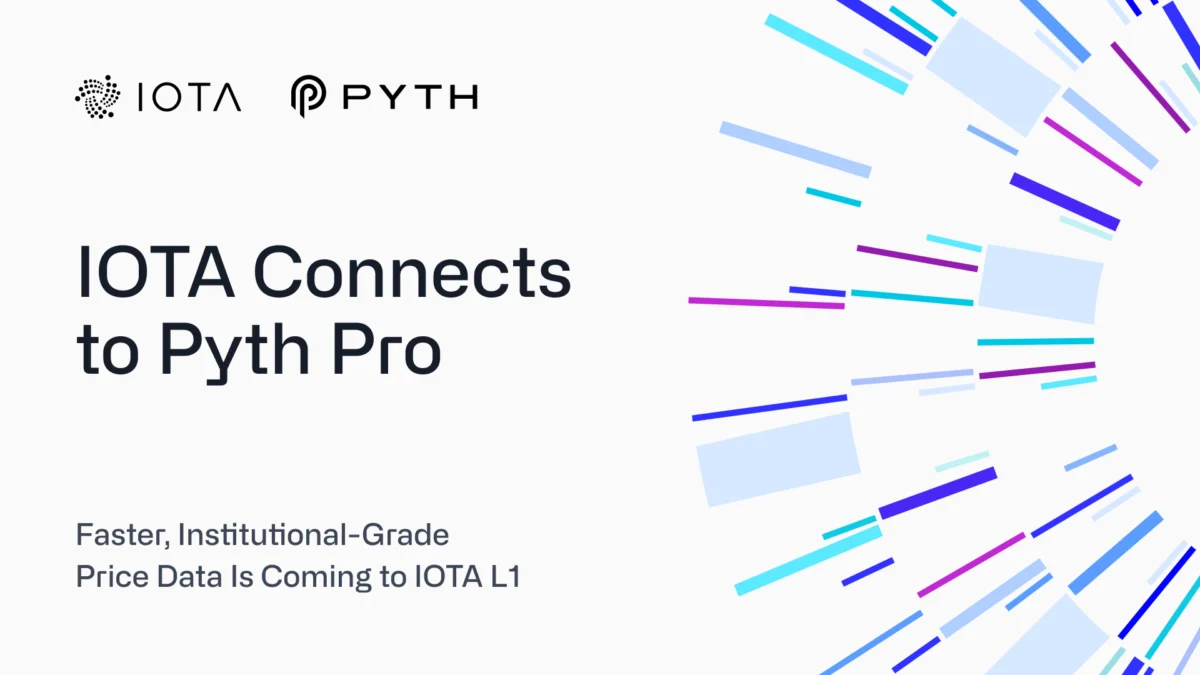
The IOTA Layer-1 blockchain has officially completed its integration with Pyth Pro, marking a significant technological leap forward for developers building decentralized applications (dApps) within its ecosystem. This strategic integration transitions IOTA from the legacy Pythnet architecture to Pyth’s next-generation institutional-grade price feed infrastructure. By adopting Pyth Pro, IOTA developers gain access to substantially reduced latency, enhanced network reliability, and a vast repository comprising more than 3,000 real-time price feeds spanning traditional equities, futures, exchange-traded funds (ETFs), commodities, foreign exchange, cryptocurrencies, and fixed-income assets.
This infrastructure overhaul is not an isolated development for the IOTA network. Rather, it forms a critical component of a sweeping, network-wide transition initiated by the Pyth decentralized oracle network. As decentralized finance (DeFi) matures and increasingly intersects with traditional financial markets, the demand for ultra-low latency, cryptographically secure, and diverse data feeds has reached unprecedented levels. The migration addresses these evolving industry demands by overhauling how decentralized applications consume external market data, paving the way for sophisticated financial products that require institutional-grade precision.
The Evolution of Decentralized Oracles: From Pythnet to Pyth Pro
To understand the magnitude of the recent IOTA integration, it is essential to examine the historical trajectory of the Pyth Network. Since its inception, Pyth has established itself as a cornerstone of the multi-chain decentralized finance ecosystem. Unlike traditional oracle solutions that rely on aggregated third-party scrapers, Pyth sources its data directly from primary market participants—including major global exchanges, market makers, and institutional trading firms.
Historically, these high-frequency, cryptographically verified price feeds—refreshed approximately once every second—were delivered to secondary blockchains via Pythnet, a specialized appchain built on Solana’s underlying technology, alongside the Wormhole messaging bridge. While Pythnet successfully democratized access to institutional data across numerous Layer-1 and Layer-2 networks, it presented inherent scalability and economic limitations. As data demands surged and the network sought to bridge the gap between decentralized protocols and institutional finance, the limitations of the legacy infrastructure became apparent.
In response, the Pyth Network architecture underwent a fundamental redesign, culminating in the launch of Pyth Pro. This modern framework transitions the network’s center of gravity toward a commercial, revenue-based economic model designed to ensure the long-term sustainability of high-frequency data distribution. Pyth Pro consolidates thousands of distinct price feeds into a unified distribution network, delivering data through standard, highly optimized application programming interfaces (APIs). This structural shift allows traditional financial institutions and advanced DeFi protocols alike to consume institutional-grade data with the speed and reliability required for mission-critical trading operations.
Understanding Pyth Pro and Its Institutional Tier
The implementation of Pyth Pro on IOTA introduces a vastly expanded data catalog and superior performance metrics compared to its predecessor. Under the legacy Pythnet model, developers primarily accessed crypto-native price feeds and a limited selection of macroeconomic indicators. Pyth Pro dramatically broadens this scope by integrating comprehensive coverage across multiple traditional and digital asset classes.
The platform now standardizes over 3,000 price feeds, categorized into:
- Equities: Real-time valuation metrics for leading global stocks and corporate equities.
- Futures: Continuous pricing data for major commodity and financial futures contracts.
- Exchange-Traded Funds (ETFs): Up-to-the-second tracking of prominent institutional investment funds.
- Commodities: Spot and derivative pricing for precious metals, energy markets, and agricultural products.
- Foreign Exchange (FX): Comprehensive currency pair valuations supporting global forex trading desks.
- Cryptocurrencies: Deep liquidity and spot pricing data across hundreds of digital assets.
- Fixed Income: Yield curves and debt instrument valuations bridging traditional bond markets with blockchain infrastructure.
For IOTA developers, this expansive catalog unlocks entirely new categories of decentralized applications. While early-stage IOTA dApps were predominantly confined to basic token swaps and rudimentary lending pools, the arrival of Pyth Pro enables the creation of sophisticated financial instruments. Decentralized exchanges (DEXs), perpetual swap platforms, synthetic asset protocols, and automated market makers (AMMs) operating on IOTA can now execute complex liquidations and pricing calculations with the exact fidelity demanded by institutional market participants.
Furthermore, the transition to Pyth Pro addresses the stringent performance benchmarks expected by institutional trading desks. Financial institutions evaluating blockchain deployment cannot tolerate the latency spikes or oracle manipulation vulnerabilities that historically plagued early DeFi protocols. By providing sub-second updates backed by cryptographically secure first-party data sources, Pyth Pro mitigates flash loan vulnerabilities and price manipulation vectors, establishing a robust foundation for institutional capital inflow.
Chronology and Migration Timeline for Developers
The integration of Pyth Pro onto the IOTA Layer-1 network is part of a strict, mandatory migration schedule dictated by the Pyth Network core team. Because the underlying architecture of Pythnet is being systematically phased out, all developers currently utilizing Pyth Core price feeds must update their smart contracts and integration pipelines to comply with the new infrastructure standards.
The timeline for this network-wide transition features a critical operational deadline:
- Initial Infrastructure Rollout: The Pyth Network foundation announced the sunsetting of Pythnet, shifting strategic focus toward the Pyth Pro framework and its associated subscription-based economic architecture.
- IOTA L1 Integration Phase: Core developers and infrastructure providers deployed the necessary bridging and smart contract interfaces to connect the IOTA Layer-1 network directly to the Pyth Pro distribution network.
- Developer Notification Period: Documentation and migration guides were distributed across the IOTA developer ecosystem, outlining the necessary code adjustments for transitioning existing dApps from legacy feeds to the new institutional endpoints.
- The August 18 Deadline: Pyth Network has established a definitive cutoff date of August 18 for developers utilizing Pyth Core feeds. Any decentralized application, smart contract, or oracle consumer that fails to migrate its codebase to the new Pyth Pro infrastructure by this specific date will experience a complete cessation of price feed updates, potentially halting dependent financial operations.
This mandatory migration underscores the commercial and technical evolution of decentralized oracles. Whereas early oracle services frequently relied on subsidized, free-tier data models to bootstrap network adoption, the maturation of the blockchain industry necessitates sustainable, revenue-backed frameworks. The shift to Pyth Pro ensures that data publishers—the institutional financial firms generating the raw pricing metrics—receive fair compensation, thereby guaranteeing the long-term economic security and reliability of the data feeds powering the IOTA ecosystem.
Strategic Implications for the IOTA Ecosystem
The successful integration of Pyth Pro represents a pivotal milestone in IOTA’s broader strategic evolution. Historically recognized for its unique Directed Acyclic Graph (DAG) architecture—which eliminated transaction fees and enabled high scalability—IOTA has steadily expanded its utility into the realm of enterprise solutions, institutional finance, and decentralized applications.
However, attracting institutional liquidity and high-volume trading volume requires more than high throughput and feeless transactions; it demands robust, trustworthy financial infrastructure. Oracles serve as the vital bridge between external economic reality and on-chain execution. Without reliable price feeds, even the most advanced Layer-1 blockchain remains isolated from global financial markets. By embedding Pyth Pro directly into its Layer-1 architecture, IOTA effectively resolves this connectivity challenge, positioning its developer community to compete directly with leading multi-chain DeFi hubs.
The implications of this upgrade extend across several key pillars of ecosystem growth:
Bridging Decentralized Finance and Traditional Finance (TradFi)
The convergence of traditional financial markets and decentralized ledgers represents one of the most significant macro trends in modern fintech. Institutional asset managers, hedge funds, and corporate treasuries are actively exploring blockchain rails for asset issuance, settlement, and yield generation. However, these entities operate under strict regulatory and operational mandates that require institutional-grade data quality. Pyth Pro’s inclusion of fixed income, equities, and FX feeds—delivered via standard APIs familiar to traditional financial engineers—lowers the barrier to entry for TradFi institutions seeking to deploy capital within the IOTA ecosystem.
Real-World Asset (RWA) Tokenization
Real-world asset tokenization has emerged as a dominant narrative within the digital asset economy, encompassing everything from tokenized real estate and government bonds to physical commodities and intellectual property. Successful RWA protocols rely entirely on accurate, tamper-proof external pricing data to maintain stable valuations, calculate collateral ratios, and execute automated liquidations. The vast asset coverage provided by Pyth Pro equips IOTA developers with the necessary pricing infrastructure to support complex RWA lending markets and tokenized investment portfolios.
Developer Empowerment and Product Sophistication
For independent developers building on IOTA, the upgrade removes previous technical bottlenecks associated with oracle latency and data availability. Building high-frequency trading platforms or advanced derivatives protocols previously required complex workarounds or reliance on centralized price aggregators that introduced single points of failure. With direct access to over 3,000 institutional-grade feeds backed by cryptographically verifiable publisher signatures, IOTA developers can innovate with confidence, knowing their applications are anchored by industry-leading security standards.
Economic and Operational Realities of the Transition
While the technical advantages of Pyth Pro are substantial, the transition marks a philosophical and economic shift for the decentralized oracle landscape. Moving away from the legacy, free-tier model toward a subscription-based, commercial framework introduces new economic considerations for application developers.
In the traditional Pythnet configuration, data consumption was often heavily subsidized to encourage early network participation. Under the Pyth Pro economic model, sustainability is maintained through transparent, tiered subscription pricing designed to reflect the true operational costs of aggregating and distributing high-frequency institutional data. While this structure ensures that data publishers remain adequately compensated—thereby incentivizing the continued provision of accurate, primary-source market metrics—it also requires dApp developers and project foundations on IOTA to account for oracle data consumption within their ongoing operational expenditures.
Industry analysts note that this maturation is both necessary and inevitable. As decentralized finance transitions from an experimental sandbox into a multi-billion-dollar global financial infrastructure, reliance on subsidized or unsustainable public goods models presents long-term systemic risks. By adopting commercial standards championed by Pyth Pro, IOTA aligns itself with institutional expectations of accountability, economic sustainability, and enterprise-grade reliability.
Conclusion and Outlook
The integration of Pyth Pro onto the IOTA Layer-1 network cements a vital partnership between a foundational distributed ledger and a premier institutional oracle network. By replacing legacy infrastructure with ultra-low latency, comprehensive multi-asset price feeds, IOTA has significantly enhanced the technical capabilities of its developer ecosystem.
As the August 18 migration deadline approaches, the immediate focus for IOTA developers remains centered on updating smart contract architectures to maintain uninterrupted access to critical market data. Beyond this operational milestone, however, the integration opens a transformative chapter for the network. Armed with institutional-grade data spanning equities, commodities, foreign exchange, and digital assets, IOTA is uniquely positioned to capture the next wave of crypto adoption—one defined by the seamless convergence of decentralized technology and traditional financial markets.