The decentralized finance landscape on Ethereum Mainnet reached a significant milestone this week with the official activation of multicollateral margin on Synthetix, introducing Ether (ETH) as the platform’s inaugural non-stablecoin collateral option. For the first time in the history of the Ethereum network, traders can utilize native ETH directly as margin to execute and manage perpetual futures contracts (perps) on Layer 1 without needing to liquidate their underlying asset holdings.
This architectural deployment marks a major evolution for Synthetix Perps, transforming how capital is utilized across decentralized derivatives exchanges. By allowing users to deposit ETH into a unified multicollateral margin account, Synthetix has bridged the gap between long-term holding strategies and active derivatives trading. Traders no longer face the dilemma of choosing between maintaining exposure to an asset they are bullish on and opening leveraged trading positions. Instead, both functions can operate simultaneously within a single, unified framework that settles directly on the Ethereum blockchain.
Background Context and the Evolution of DeFi Margin Systems
Since the inception of decentralized perpetual exchanges, margin accounts have predominantly relied on stablecoins—most notably USDT and USDC—as the fundamental unit of account and settlement. While stablecoins provide a predictable baseline for calculating profit and loss (PnL), liquidation thresholds, and funding payments, they impose a structural inefficiency on crypto-native traders. To trade perpetual contracts using native digital assets like ETH or Bitcoin, users historically had to sell a portion of their holdings for stablecoins, thereby incurring taxable events, missing out on organic asset appreciation, and introducing friction into their trading workflows.
Synthetix’s introduction of native ETH margin directly addresses this friction. Operating as a decentralized liquidity layer and derivatives protocol native to Ethereum Mainnet, Synthetix is uniquely positioned to leverage the security and liquidity of the L1 ecosystem. Because all trades on Synthetix live and settle directly on Ethereum Mainnet, enabling the network’s native asset as collateral aligns the protocol’s mechanics with its foundational infrastructure.
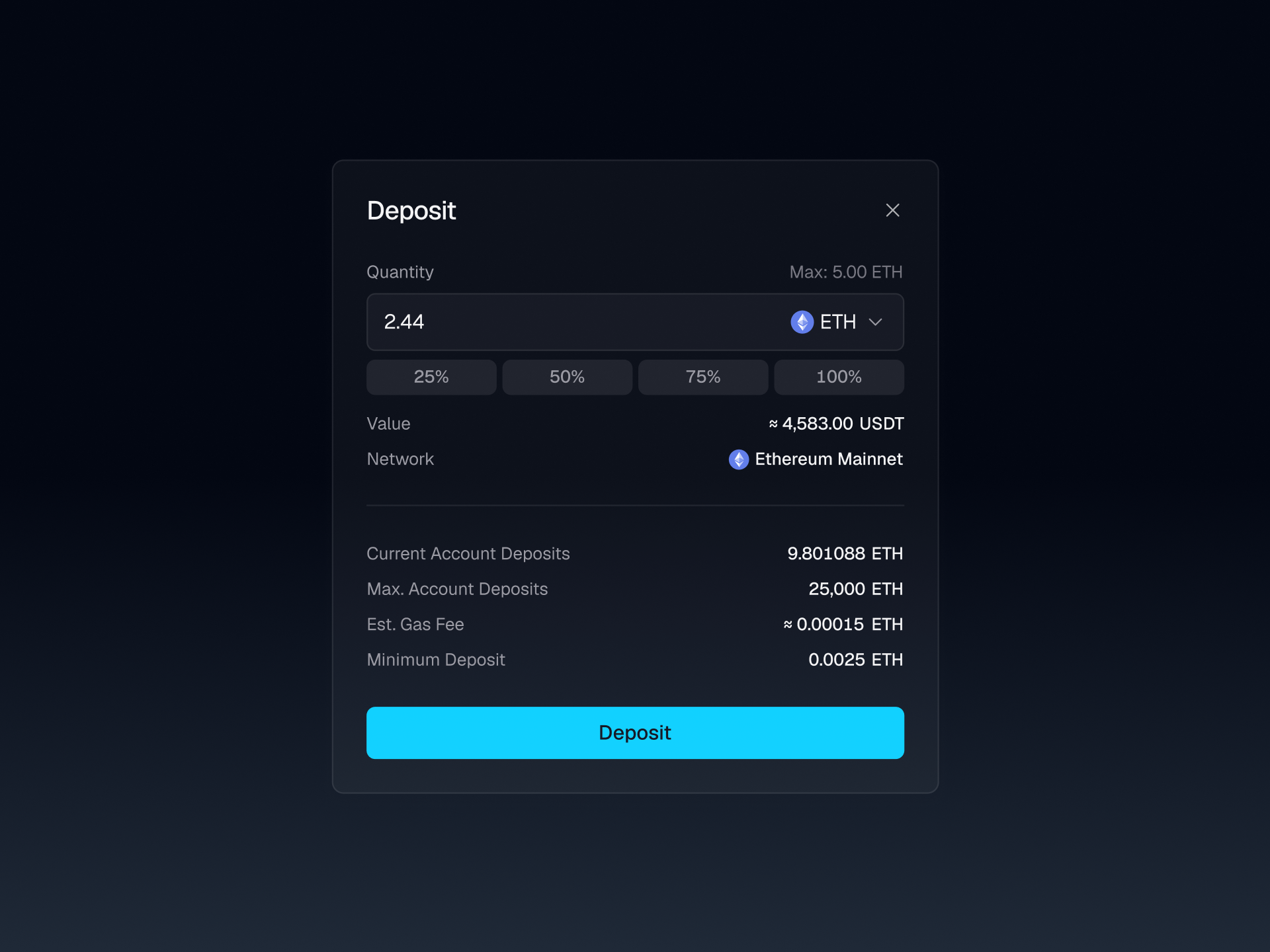
The implementation process has been designed to balance capital efficiency with risk management. When a user deposits ETH into their Synthetix multicollateral account, the protocol evaluates the asset using its live index price, adjusted by a predefined risk discount known as a "haircut." This calculation yields the user’s effective Collateral Value, determining the exact margin backing their positions.
Smarter Capital Efficiency and Enhanced Basis Trading Strategies
The deployment of a unified multicollateral account architecture allows ETH and stablecoins such as USDT to work in tandem. Rather than isolating collateral into rigid silos, Synthetix’s system pools the combined value of all deposited assets to back every open position across any supported market.
This unified approach unlocks significant capital efficiency, most notably for delta-neutral strategies such as basis trading—a cornerstone of professional trading in both traditional finance and decentralized markets. Previously, executing a basis trade required complex maneuvers across multiple platforms or liquidity pools to balance spot holdings against short perpetual positions. With native ETH multicollateral margin, traders can deposit ETH directly as collateral and concurrently open a short ETH perpetual position of equivalent size.
In this configuration, the physical collateral value and the short position’s PnL move inversely against one another, effectively neutralizing directional price risk while allowing the trader to collect ongoing funding rate payments. By streamlining this process, Synthetix aims to attract institutional-grade arbitrageurs whose activity keeps perpetual funding rates closely aligned with spot prices. Consequently, this increased trading efficiency benefits all participants on the exchange by fostering tighter, more competitive market spreads.
Operational Mechanics, Risk Management, and Account Health
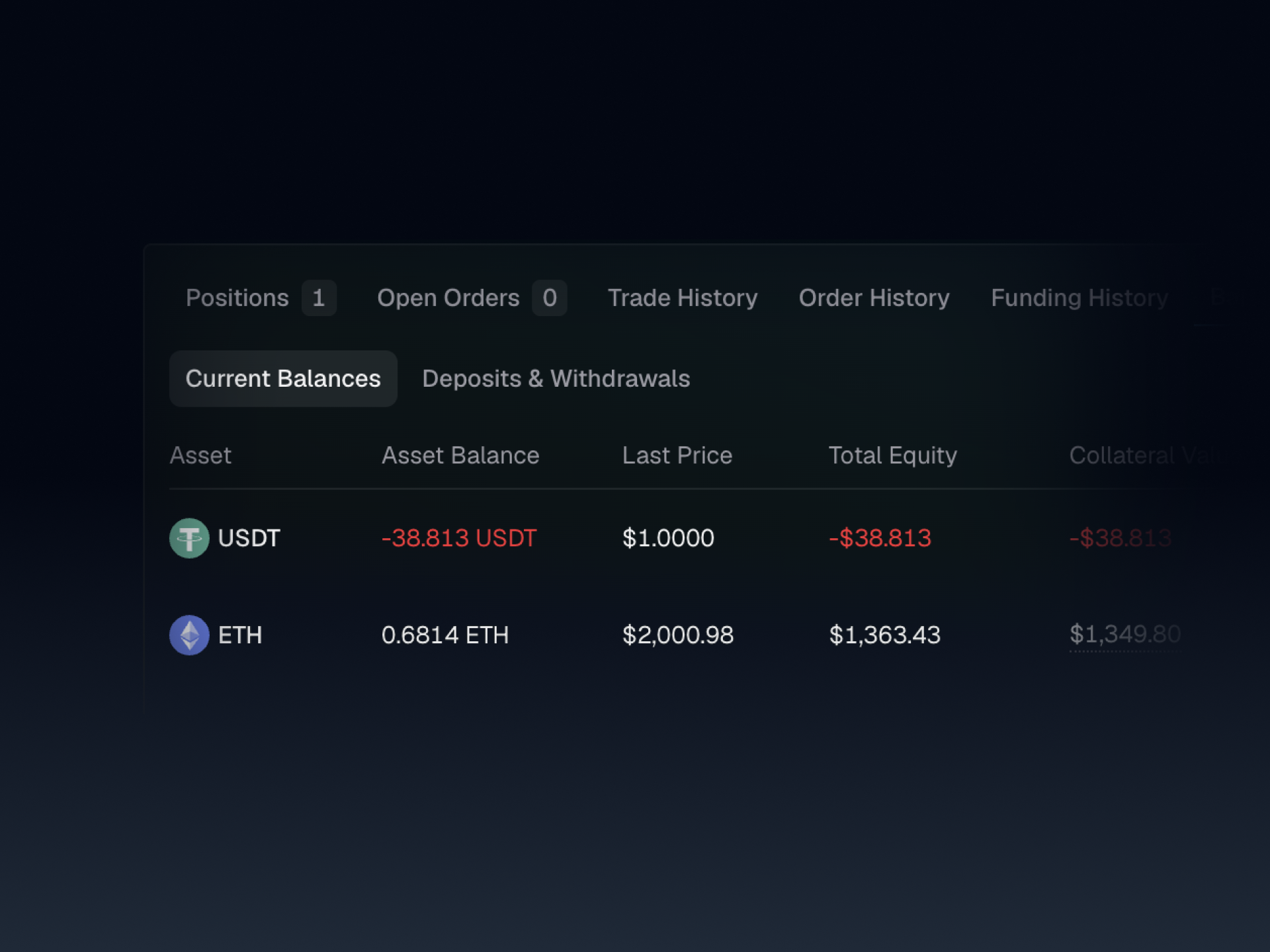
While ETH serves as the underlying collateral backing the account, Synthetix Perps continue to utilize USDT for position settlement. This means that trading fees, funding payments, and realized PnL are denominated and paid in USDT.
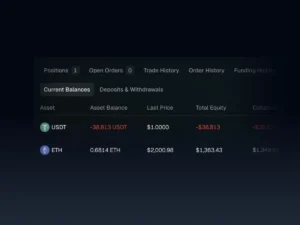
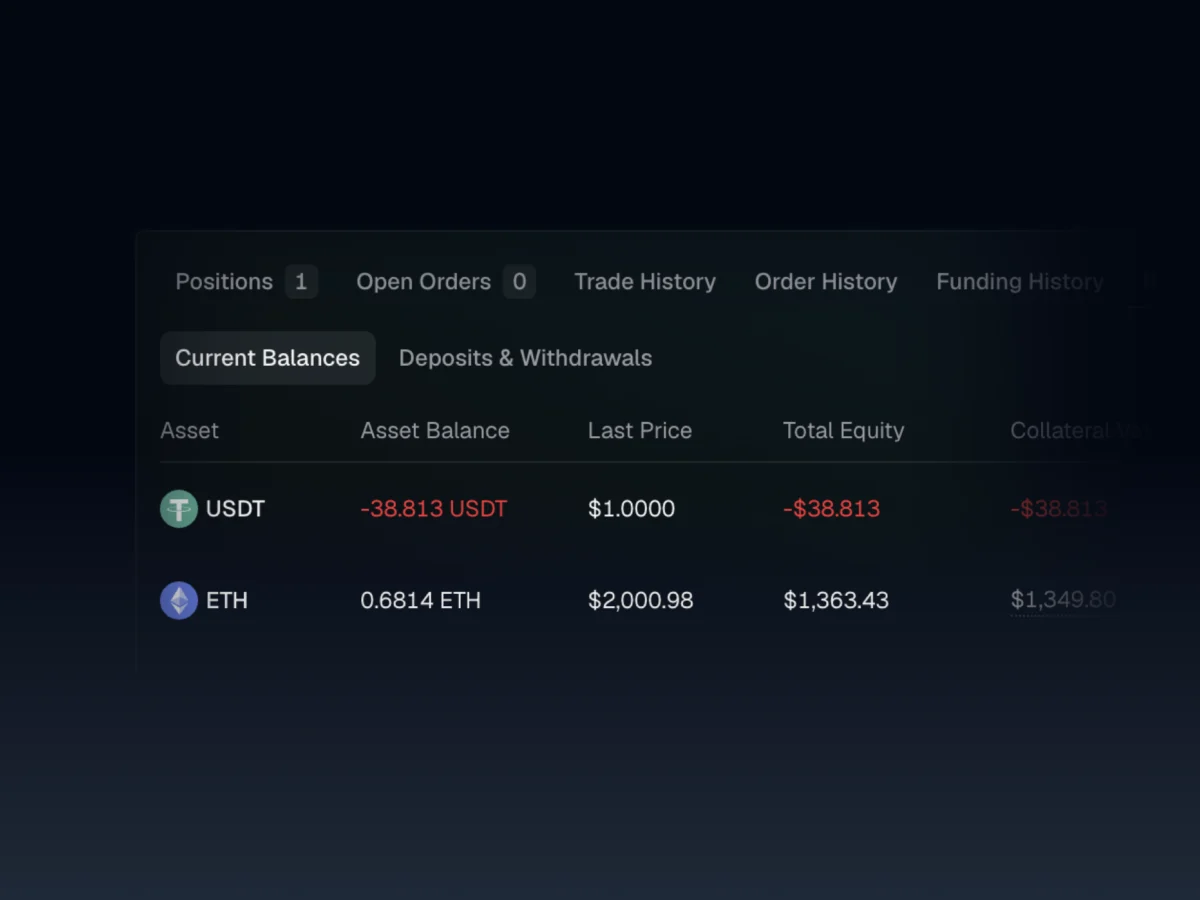
For traders utilizing ETH collateral without holding an active USDT balance, the system permits the USDT balance to enter a negative state while positions remain open—a deliberate feature supported by the underlying ETH collateral. Users retain the flexibility to clear this negative balance at any time by utilizing the protocol’s integrated swap functionality to convert a portion of their deposited ETH directly into USDT within their account interface.
Risk management parameters have been carefully calibrated to account for the price volatility of non-stablecoin collateral. Because ETH is marked to market against its live index price, a downward movement in the price of Ether will reduce the overall account margin, even if the open perpetual positions experience no valuation changes. Synthetix advises traders to monitor their collateral valuation closely and maintain an adequate buffer above minimum margin requirements. To protect the protocol against insolvency, the system includes an automated safety mechanism: if a user’s USDT debt exceeds allowed structural limits, the protocol can automatically liquidate a portion of the deposited ETH to cover the deficit and restore account solvency. Comprehensive guidelines detailing haircuts, withdrawal rules, and account health metrics are publicly documented in the official Synthetix developer portal.
Tapping into Multi-Billion-Dollar Liquidity Pools
Industry analysts have highlighted the broader implications of introducing native ETH collateral to an Ethereum Mainnet perpetual decentralized exchange (DEX). By opening its infrastructure to native ETH, Synthetix gains direct access to a multi-billion-dollar pool of idle capital locked within the Ethereum ecosystem. With well over $100 billion in circulating ETH residing on Layer 1, the addressable market for native derivatives margin is substantial.
Synthetix leadership and core contributors view this release as a foundational step toward an ambitious long-term objective: capturing a meaningful share of the broader crypto derivatives market. Observers note that if decentralized perpetual exchanges can secure even a modest percentage of average monthly derivatives volume currently dominated by centralized platforms, it could trigger a virtuous cycle of liquidity, fee generation, and network activity across the entire Ethereum DeFi stack. Increased trading volume enhances protocol revenue, deepens liquidity pools, and reinforces the composability that underpins decentralized finance applications.
Future Roadmap and Expansion of Collateral Types
While Ether represents the first non-USDT asset integrated into the Synthetix multicollateral margin framework, the protocol’s underlying infrastructure has been architected with modular scalability in mind. Development teams have confirmed that additional collateral types are already in the pipeline, including various yield-bearing assets designed to maximize capital productivity for active traders.
This expansion aligns with Synthetix’s broader strategy to cement Ethereum Mainnet as the premier execution venue for professional-grade perpetual trading. By continuously refining its margin engines and expanding asset support, the protocol seeks to offer a comprehensive, unified trading experience that rivals the efficiency of traditional centralized exchanges while preserving the non-custodial, censorship-resistant properties inherent to decentralized finance.
Traders looking to utilize the new functionality can access the updated deposit interface directly through the Synthetix platform, where minimum deposit thresholds, account caps, and asset-specific limits are clearly displayed. As the protocol rolls out subsequent updates, further disclosures regarding upcoming collateral integrations and advanced trading features will be made available through official documentation channels and community communication portals.