The official rollout of protocol version 24 on the IOTA Mainnet marks a significant milestone in distributed ledger technology, introducing the Starfish consensus mechanism to a production environment. Following last week’s broad overview of the Starfish mainnet launch, deeper technical insights from Sebastian Mueller of the IOTA Foundation’s Research team have shed light on the sophisticated design decisions, synchronization mechanics, and initial mainnet performance metrics underpinning the upgrade. While mainstream release notes focus on software version numbers and operational readiness, the research-level implementation of Starfish addresses fundamental architectural hurdles in Directed Acyclic Graph (DAG)-based Byzantine Fault Tolerant (BFT) consensus systems—specifically, the challenge of data dissemination.
Reimagining Consensus as a Synchronization Problem
Traditionally, consensus in decentralized networks is framed predominantly as an agreement problem. In this classical model, a designated group of validators must reach a unified consensus regarding a single, immutable history of events, even when underlying network messages experience arbitrary delays or when a subset of participants act maliciously under Byzantine threat models. While this foundational framing is fundamentally correct, it overlooks a critical operational constraint: a validator cannot vote on a block it has never observed, cannot certify data it lacks the capacity to reconstruct, and cannot drive network progress if necessary information consistently arrives late.
Beneath the overarching agreement problem lies an equally vital synchronization problem—namely, ensuring the right information reaches the right network nodes with minimal latency. Prior DAG-based protocols often treated data dissemination as mere plumbing, a background utility handled by a separate broadcast layer. Starfish, however, integrates dissemination directly into the protocol design. In a DAG framework, the structure serves as a dynamic record of mutual knowledge. Each newly minted block explicitly references earlier blocks observed by the validator. When multiple validators converge on the same references, the network reaches a state of shared awareness, while missing references immediately expose gaps in the synchronization structure.
To tackle the inherent tension between push and pull communication strategies, Starfish adopts the paradigm of cordial dissemination, as formalized by the academic literature surrounding Cordial Miners (Keidar, Naor, and Shapiro, DISC 2023). Under a pure pull architecture, validators request missing blocks only after identifying a deficit. While bandwidth-efficient, pull mechanisms introduce severe latency penalties via repeated request-response round trips, often exacerbating network congestion under heavy load as lagging validators issue frantic requests and fast validators deplete resources answering them. Conversely, proactive push mechanisms drastically reduce latency by distributing data before it is explicitly requested, but naive implementations cause bandwidth consumption to scale unsustainably with validator set size. Starfish resolves this tension through architectural decoupling and advanced coding schemes.
Architectural Innovations: Metadata Separation and Erasure Coding
To mitigate the bandwidth penalties of proactive push architectures while preserving low-latency performance, Starfish introduces two foundational design modifications: the separation of consensus metadata from transaction payloads, and the implementation of Reed-Solomon erasure coding.
In traditional DAG architectures, heavy transaction payloads travel tightly coupled along the consensus critical path. This design functions adequately in small-scale test environments but degrades rapidly as network throughput scales. Starfish keeps the consensus path exceptionally lightweight. Block headers exclusively carry consensus-critical data—such as structural references, voting records, acknowledgments, timestamps, and cryptographic commitments—while transaction payloads are handled independently. This allows validators to push lightweight headers aggressively across the network without flooding peers with massive payload volumes.
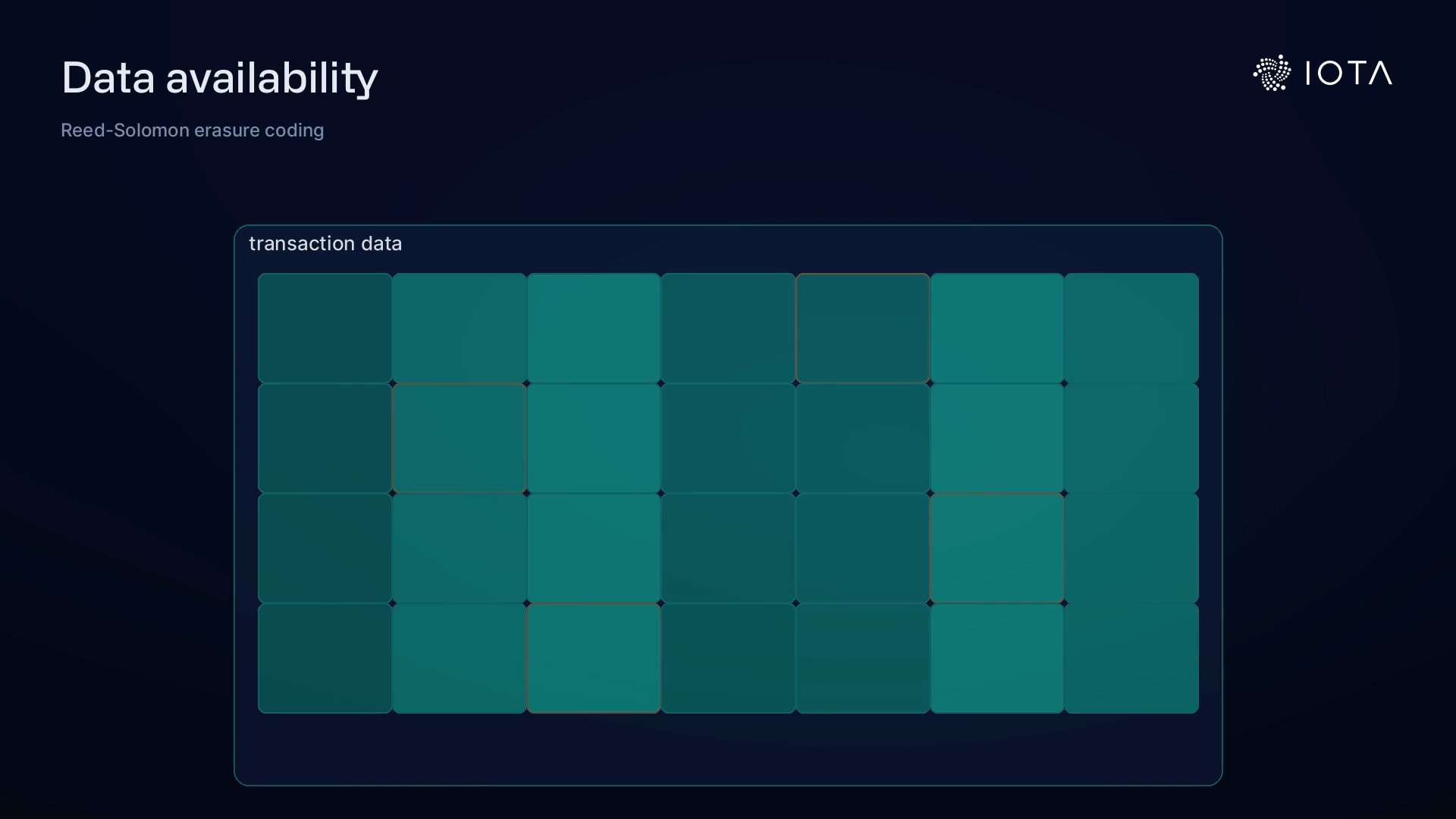
Simultaneously, Starfish leverages Reed-Solomon encoding to manage data availability efficiently, functioning on principles similar to error correction in optical media or QR codes. Transaction data within a block is systematically partitioned into distinct fragments—allocated one per validator—incorporating sufficient redundancy to allow full payload reconstruction from a small fraction of valid fragments. Crucially, the protocol requires only $f+1$ valid fragments for complete reconstruction, where $f$ represents the maximum number of Byzantine validators the system can tolerate.
This mechanism facilitates the generation of Data Availability Certificates (DACs) natively within the DAG. As validators verify payloads, they acknowledge availability within their block headers. Once $f+1$ such acknowledgments accumulate within the causal history of a committed block, the network mathematically guarantees data recoverability without requiring a separate, bolted-on availability protocol phase. Consequently, data availability and transactional ordering evolve concurrently as organic properties of graph growth.
Addressing Liveness and the Push Pacemaker
Early uncertified DAG protocols gained prominence by eliminating per-block quorum certificates, successfully achieving minimal transaction latency in controlled settings. However, recent academic scrutiny revealed vulnerabilities in uncertified architectures, notably desynchronization attacks capable of stalling leader commitments even after underlying network conditions return to nominal synchronization. These vulnerabilities typically arise when honest parties advance through protocol rounds without generating their own local blocks, leaving structural gaps within the DAG that undermine the cryptographic requirements needed to commit leaders.
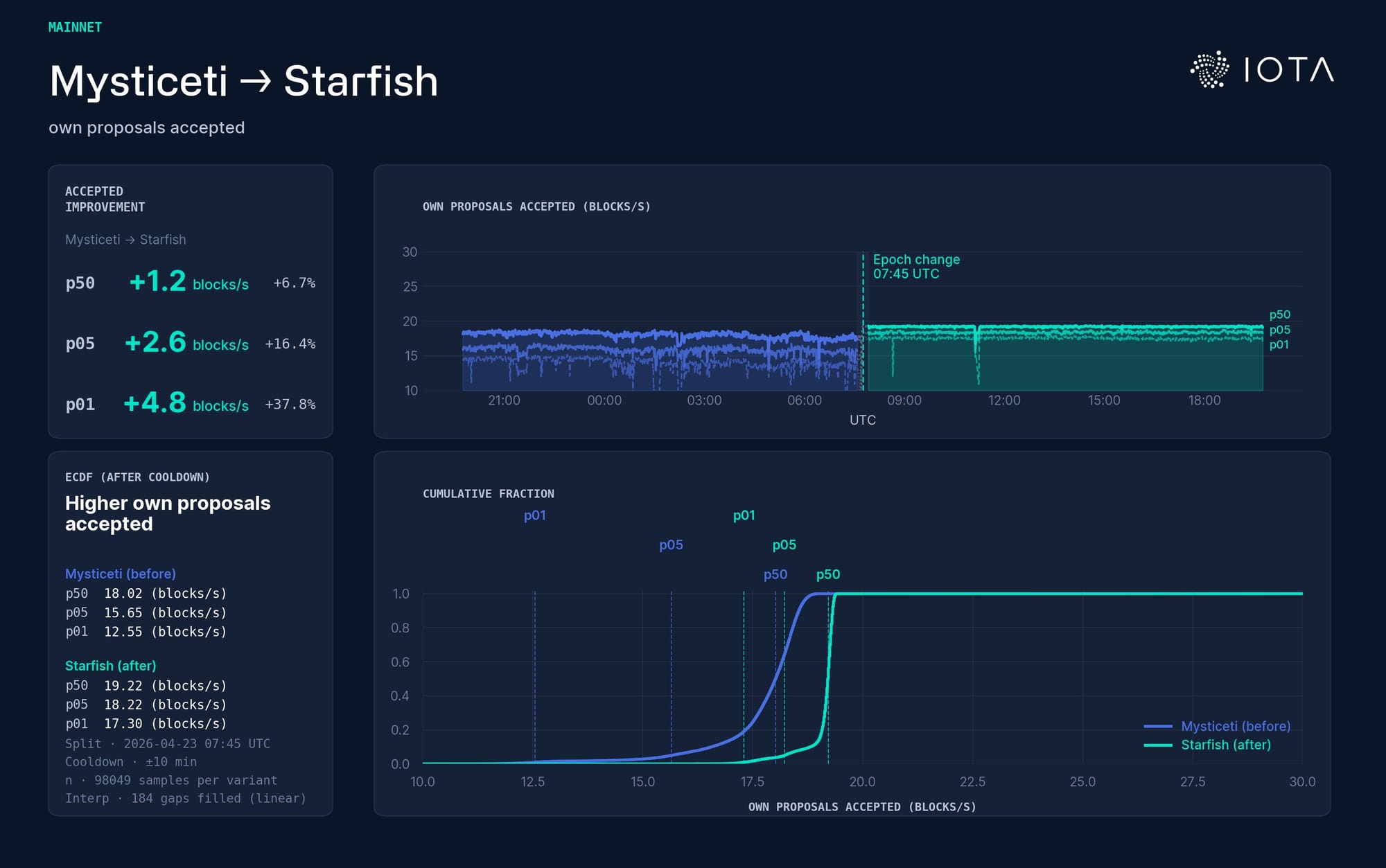
To neutralize this vulnerability, Starfish implements a Push Pacemaker. Under this protocol rule, network advancement requires active participation; a validator cannot progress to subsequent rounds without first proposing its own block. Lagging participants catch up upon observing a quorum of current-round blocks from peers. This architectural constraint prevents validators from drifting ahead of the consensus rhythm without contributing the structural building blocks essential for subsequent voting and certification, thereby preserving overall DAG health and protocol liveness under stress.
Evaluating Performance: Prioritizing Variance Reduction Over Averages
In the broader blockchain industry, consensus performance is frequently evaluated through narrow metrics such as peak theoretical throughput and median latency. However, industrial engineering disciplines—exemplified by statistical process control, Six Sigma methodologies, and Shewhart quality charts—have long established that true system reliability is governed by variance reduction rather than average performance. A robust manufacturing or computational pipeline is defined by its ability to maintain predictable output bands during operational disturbances rather than simply posting high nominal averages.
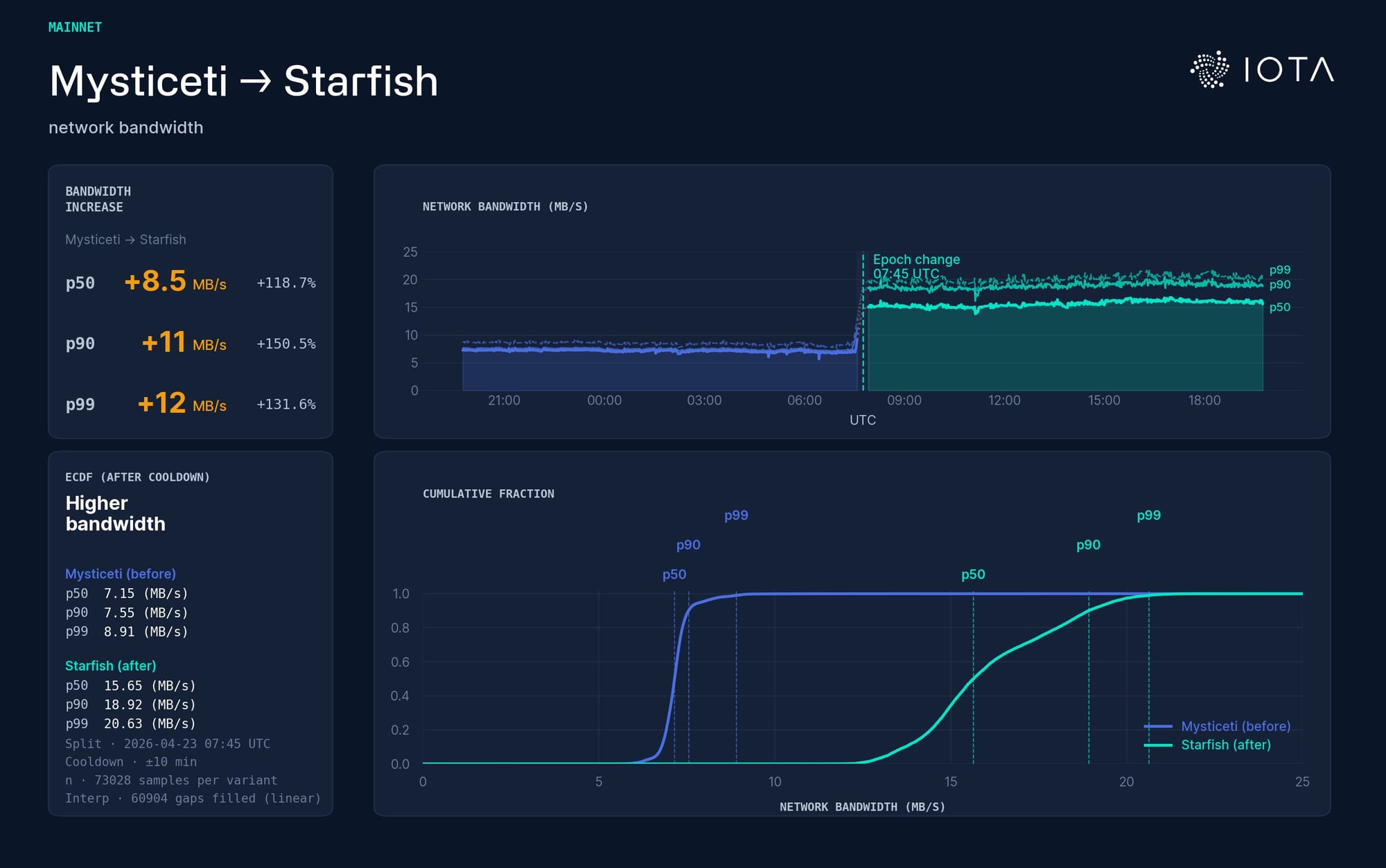
Distributed ledger technologies have historically lagged in adopting comprehensive variance reporting, frequently obscuring tail latency, jitter under load, and recovery distributions behind aggregate statistics. Starfish’s architectural refinements were explicitly engineered to compress performance distributions and eliminate long-tail latency spikes.
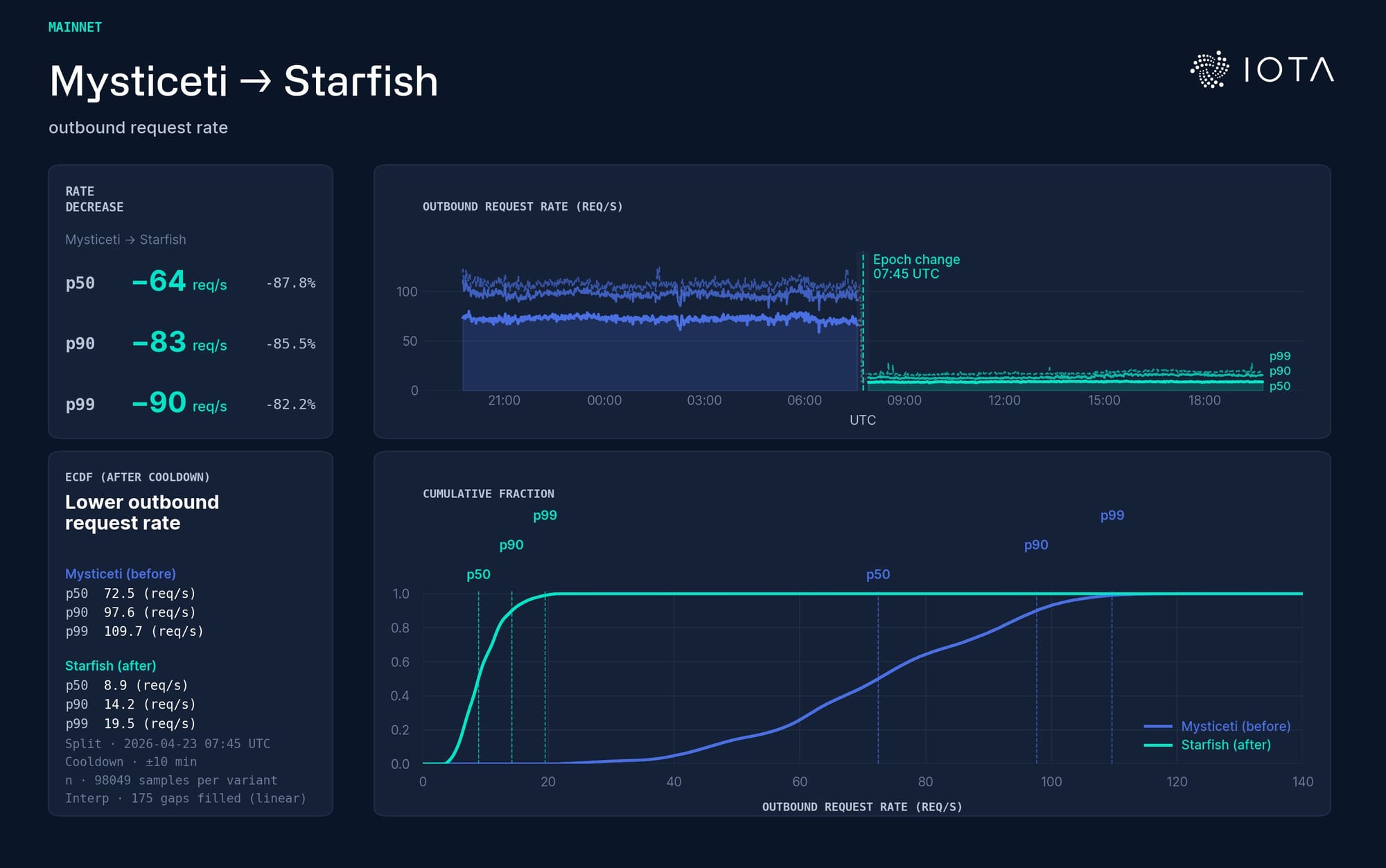
Comparative mainnet telemetry contrasts Starfish against earlier uncertified iterations like Mysticeti. While the inclusion of an initial data availability step slightly elevates median transaction latency under optimal conditions, the reduction in tail latency is profound. Specifically, observational telemetry indicates that the 99th percentile (p99) commit latency improves dramatically from approximately 486 milliseconds down to 312 milliseconds. Furthermore, outbound request rates—acting as a proxy for network synchronization friction—drop by roughly an order of magnitude, signaling that validators spend significantly less time executing recovery routines along the critical path.
By prioritizing tighter latency distributions and predictable behavior during network stress, the IOTA Foundation has positioned Starfish to deliver resilient, production-grade performance tailored to real-world operational complexities.
Historical Continuity and Real-World Implications
The philosophical underpinnings of Starfish reflect a distinct lineage within IOTA’s historical architecture. The original IOTA Tangle relied on a cooperative consensus model wherein every new transaction actively approved preceding entries, embedding the foundational principle that network participation directly contributes to ledger expansion. Starfish translates this cooperative intuition into a rigorous, Byzantine Fault Tolerant paradigm suitable for enterprise and institutional deployment. Rather than viewing dissemination as a secondary implementation detail or assuming synchronization as a trivial background condition, Starfish integrates data availability directly into the core consensus mechanism.
The successful transition of Starfish from theoretical research papers and isolated testnets to a live production mainnet demonstrates the protocol’s viability in heterogeneous, geographically distributed operational environments. Real-world validator networks routinely encounter hardware variance, fluctuating link qualities, transient delays, and localized faults. By explicitly engineering for fault tolerance, liveness preservation, and variance suppression, the Starfish consensus upgrade establishes a new operational baseline for decentralized ledger reliability, proving that robust engineering must account for the unpredictable realities of global network infrastructure.