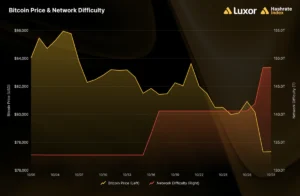
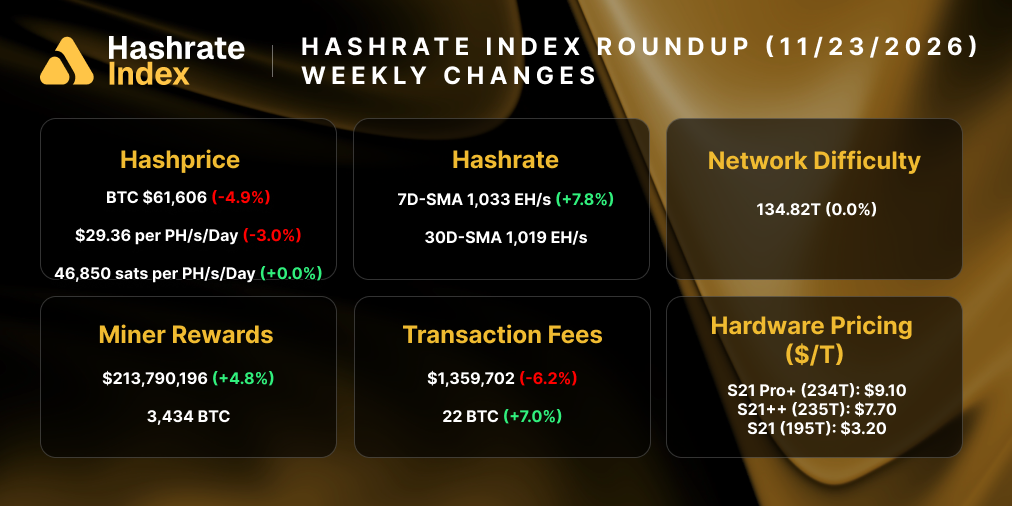
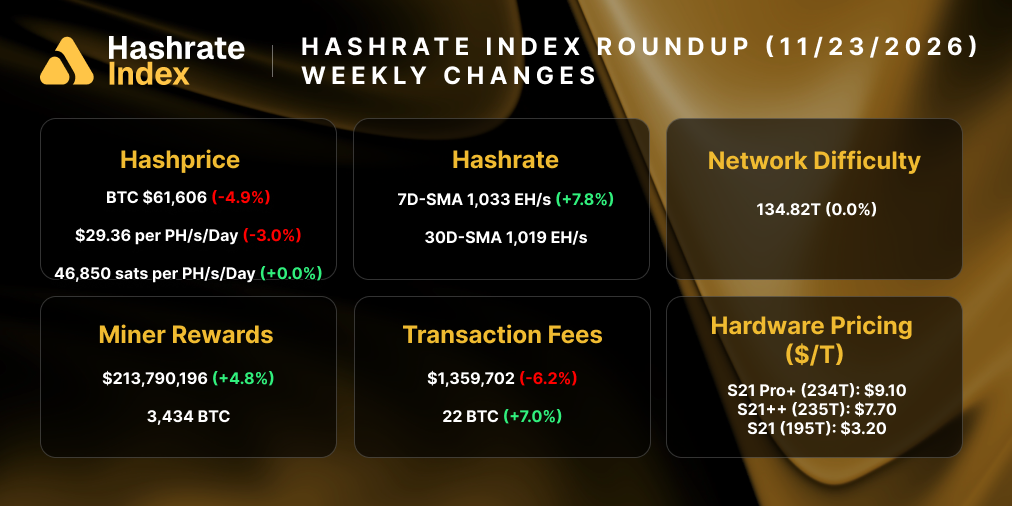
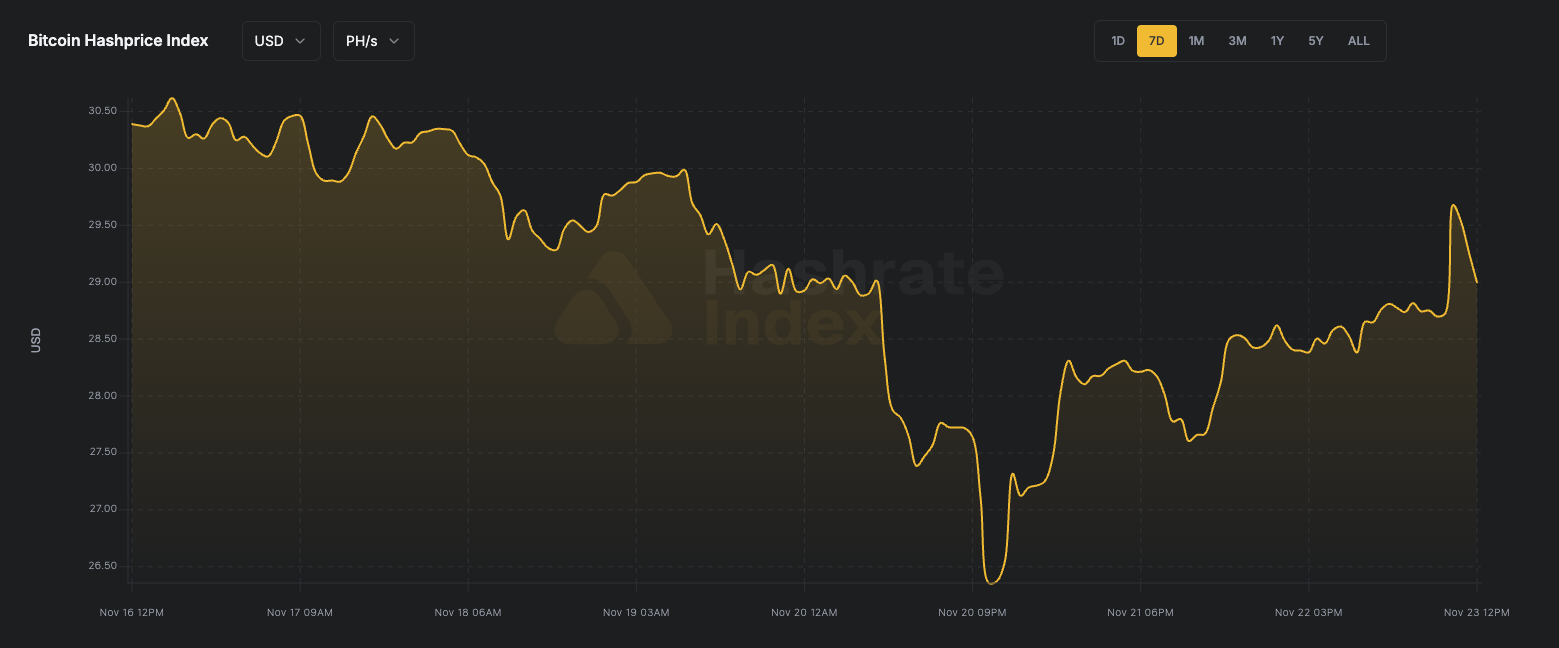
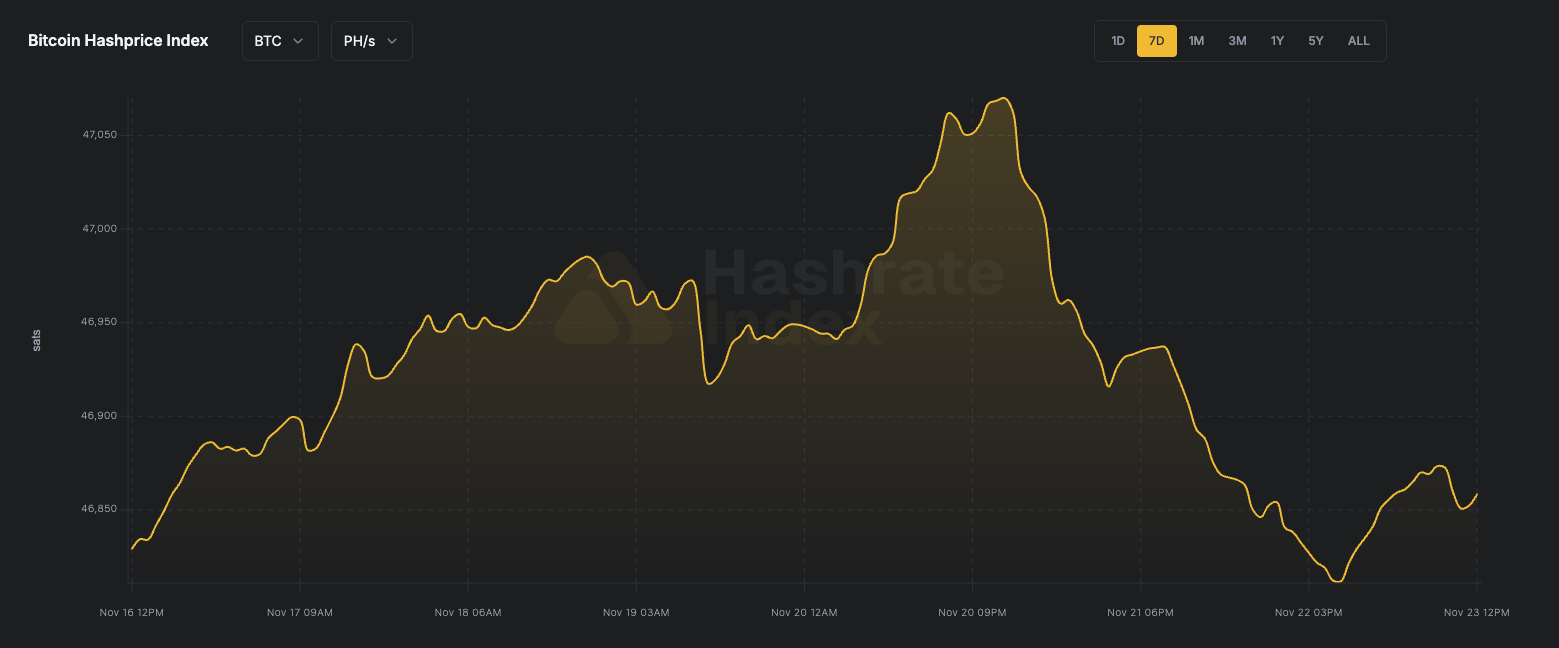
The landscape of the Bitcoin mining industry faced significant downward pressure during the week ending November 23, 2026, as market volatility impacted both asset prices and operational profitability. Following a week characterized by a 4.9% decline in the price of Bitcoin, which shifted from approximately $64,760 to $61,606, mining operations are navigating a tightening economic environment. This contraction in the underlying asset price, coupled with a notable surge in network hashrate, has compressed margins for miners globally, leading to a 3.0% decline in USD-denominated hashprice, which currently sits at $29.36 per PH/s/Day.
Operational Metrics and Network Performance
As of November 23, 2026, the Bitcoin network has experienced a significant escalation in computational intensity. The 7-day simple moving average (SMA) of the network hashrate climbed by 7.8%, rising from 959 EH/s to 1,033 EH/s. This uptick in aggregate processing power suggests that, despite compressed margins, large-scale mining operations continue to deploy new hardware and optimize existing fleets. The 30-day SMA, now resting at 1,019 EH/s, confirms a sustained trend of expansion within the infrastructure layer of the network.
This increase in competition for block rewards occurred against a backdrop of a static difficulty level. The most recent network difficulty adjustment, executed on November 14, 2026, saw a decrease of 9.1% to 134.82T, providing a temporary reprieve for miners. However, market observers are already bracing for a correction. With the next difficulty adjustment estimated for November 26, 2026, projections currently point toward a 9.5% increase. If realized, this shift will likely further exacerbate the current compression in mining profitability, as the cost to secure each unit of hashrate rises.
Revenue Streams and Transaction Economics
Mining profitability is bifurcated into two primary components: the fixed block subsidy and variable transaction fees. During this seven-day observation period, miners successfully mined approximately 3,434 BTC, representing a gross revenue of roughly $214 million. Of this total, transaction fees contributed a relatively modest 22 BTC—approximately $1.36 million—accounting for just 0.64% of total block rewards.
The contribution of transaction fees has been on a downward trajectory, with an average of 0.0201 BTC per block per day, marking a 12.2% decline compared to the previous week’s average of 0.0229 BTC. This reduction highlights a broader trend in transaction volume and block congestion, suggesting that current network demand is not providing the fee-based "cushion" that miners often rely on when the price of Bitcoin underperforms.
Market Sentiment and Mining Equities
The equity markets reflected the broader industry malaise, with the majority of publicly traded Bitcoin mining companies experiencing downward valuation shifts. Of the 18 mining stocks tracked, 15 recorded losses over the week, with a median decline of 7.6%. The divergence in performance was notable; while FUFU saw a gain of 14.1%, others such as BTDR faced significant sell-offs, dropping 24.2%.
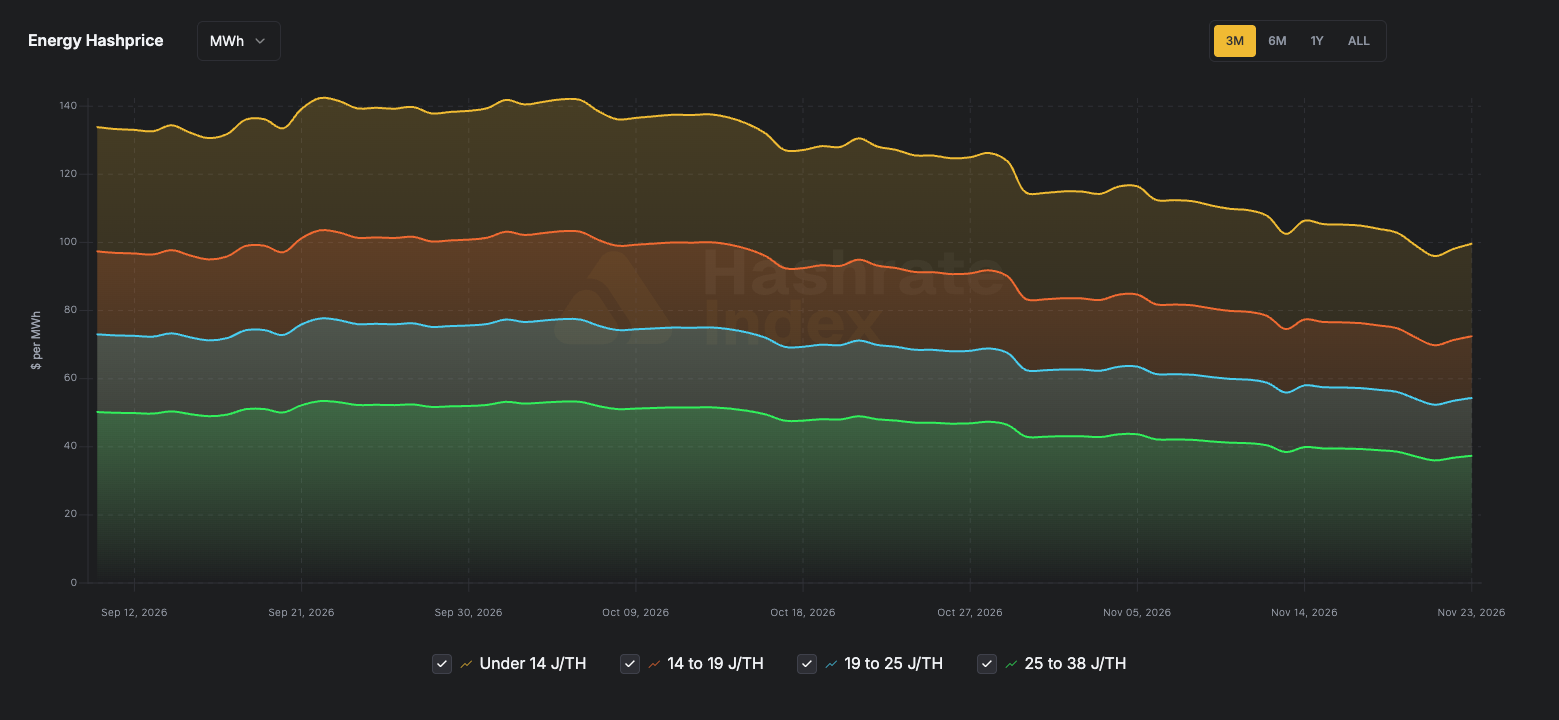
The correlation between Bitcoin’s spot price and mining equities remains high, as investors weigh the impact of higher energy costs against declining hashprices. Companies with high-efficiency fleets, particularly those deploying S21 series hardware, are better positioned to weather the current sub-$30 hashprice environment. However, for firms operating older-generation equipment, the current hashprice of $29 per PH/s/Day is approaching or falling below breakeven thresholds, necessitating the adoption of optimized firmware solutions, such as LuxOS, to improve energy efficiency and maintain operational viability.
Contextual Analysis: The Hashrate Forward Curve
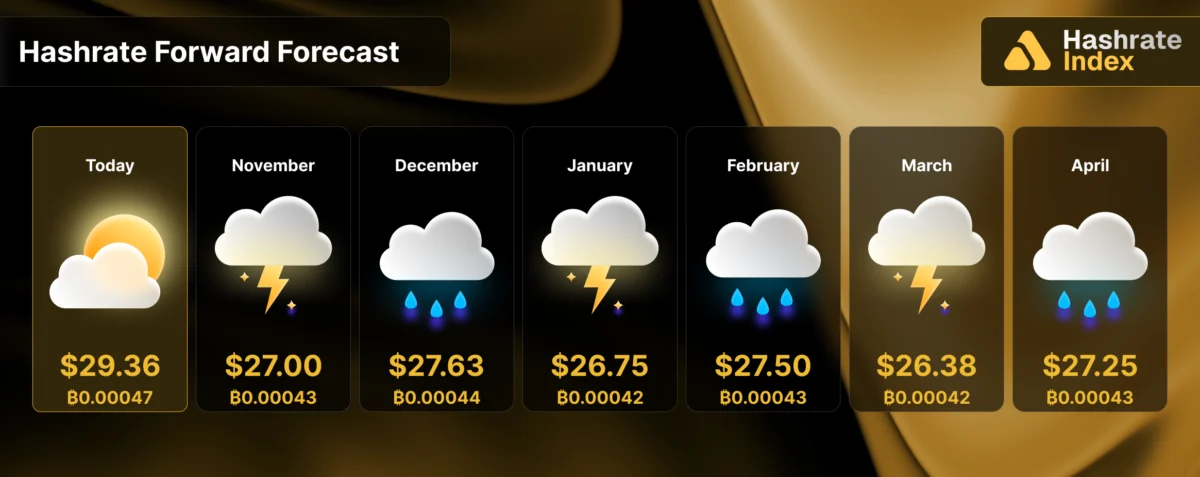
Looking toward the immediate future, the Luxor Hashrate Forward Market offers insight into institutional expectations for the sector. The forward curve is currently pricing in an average hashprice of $27.08—or 0.00043 BTC—over the next six months, spanning November 2026 through April 2027. This pricing indicates that the market anticipates continued margin pressure, likely driven by the persistent trend of hashrate growth outpacing price appreciation.
The implications for the industry are clear: 2026 is a year defined by an "efficiency arms race." With the network hashrate crossing the 1,000 EH/s threshold, the barriers to entry for unoptimized or legacy-hardware-dependent operations have become increasingly prohibitive. The current environment favors entities with low-cost power purchase agreements (PPAs) and the capital expenditure budget to acquire the latest generation of application-specific integrated circuits (ASICs).
Broader Industry Implications
The 29.5% year-to-date decline in Bitcoin’s performance has forced a strategic pivot across the mining sector. Many firms are diversifying their revenue streams, moving into high-performance computing (HPC) and artificial intelligence (AI) data center hosting to offset the volatility of mining revenues. By leveraging their existing infrastructure—specifically their grid-scale power access and cooling capabilities—these miners are attempting to transition from pure-play Bitcoin producers to broad-spectrum digital infrastructure providers.
As the industry approaches the next difficulty adjustment on November 26, the primary concern for stakeholders is the "breakeven point." If the price of Bitcoin fails to recover, and the difficulty continues its projected upward climb, the industry may see a wave of voluntary decommissioning of less efficient fleets. This would, in theory, cause a natural correction in hashrate, lowering difficulty and eventually stabilizing the hashprice for the remaining, more efficient participants.
Ultimately, the week ending November 23, 2026, serves as a reminder of the cyclical nature of Bitcoin mining. The interplay between the fixed, algorithmic nature of the protocol’s difficulty adjustments and the fluid, market-driven price of the asset creates a continuous feedback loop. For the industry, the challenge remains unchanged: balancing the relentless pursuit of more hashrate with the harsh realities of electricity costs and asset price volatility. As firms look toward the first quarter of 2027, the focus will remain on technological efficiency as the primary lever for survival in an increasingly competitive global network.