In the intricate, high-stakes ecosystem of organ transplantation, time is a merciless adversary. When a viable organ becomes available, a race against the clock begins immediately. A human heart, for instance, remains viable outside the body for only a matter of hours. Within this narrow window, a complex network of medical professionals, provincial coordinators, and national authorities must operate in absolute synchronicity. Every consent form, medical evaluation, and transit authorization must be executed with flawless accuracy and verified instantly. A single misplaced document, an unverified credential, or a disputed signature can rupture the chain of custody, resulting in the tragic loss of a potential life-saving gift.
Recognizing the vulnerabilities inherent in legacy administrative frameworks, Argentina’s national organ authority has taken a monumental step toward modernizing its operations. The Instituto Nacional Central Único Coordinador de Ablación e Implante (INCUCAI), in partnership with Latin American decentralized identity pioneer Extrimian and utilizing the enterprise-grade IOTA mainnet, has successfully integrated a live, publicly verifiable digital identity and document-signing system across its entire national network. This sweeping technological overhaul encompasses INCUCAI and all 24 of the country’s provincial procurement agencies—spanning every province alongside the Autonomous City of Buenos Aires—as well as the network of public and private hospitals that form the backbone of Argentina’s medical infrastructure.
Navigating the Challenges of a National Health Network
As the central governing body overseeing the national waiting list and coordinating donation activities, INCUCAI faces a daily logistical and bureaucratic challenge. The orchestration of life-and-death decisions across decentralized provincial agencies demands a rare combination of absolute security, speed, and transparency. Historically, this meant relying on paper-heavy workflows, manual handoffs, and localized databases that, while functional, lacked a unified, tamper-proof audit trail capable of instantly bridging different jurisdictions without administrative friction.
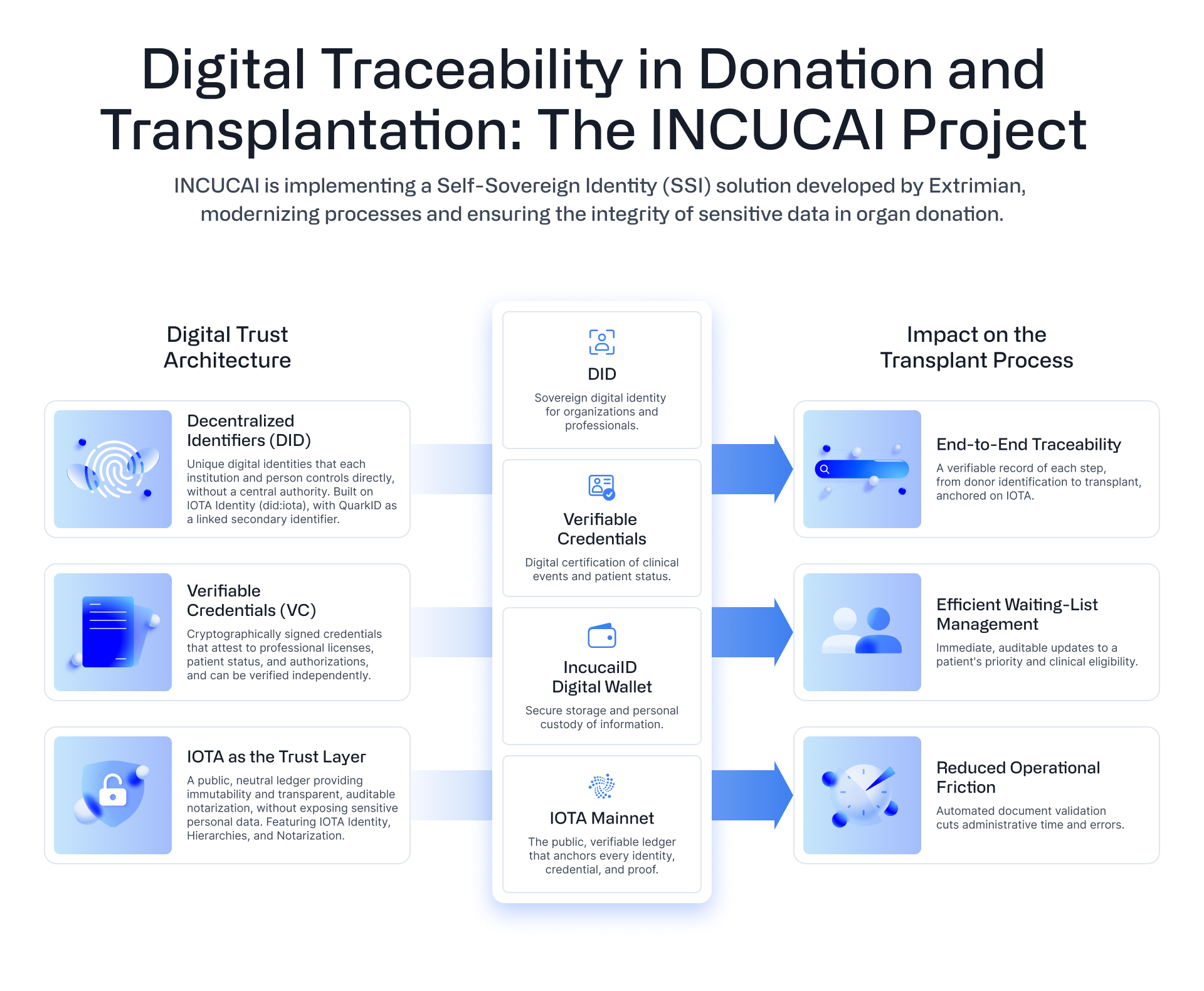
To solve this, INCUCAI turned to Extrimian, a specialized firm focused on self-sovereign identity (SSI) models. SSI fundamentally transforms how organizations and individuals interact by granting them direct, cryptographic control over their digital identities and the specific data they choose to share. By implementing Extrimian’s architecture, INCUCAI sought to establish a transparent, highly efficient, and citizen-centric framework for public administration.
The underlying public ledger powering this infrastructure is IOTA. Chosen for its neutral, scalable, and cost-efficient architecture, IOTA acts as a foundational verification layer. It allows institutional identities and document integrity to be authenticated directly onchain without relying on centralized intermediaries or proprietary gatekeepers.
Architectural Integrity and the Privacy Imperative
A paramount concern in any healthcare-related blockchain deployment is the absolute protection of sensitive patient data. In the case of INCUCAI’s deployment, privacy is preserved by design. No personally identifiable information (PII) or raw medical records are ever stored on the public ledger.
Instead, the system utilizes cryptographic proofs, or secure hashes, of documents and procedural steps. These hashes are anchored directly to the IOTA mainnet, providing an immutable record that a specific event occurred at a precise moment, and that the associated documents have not been altered since they were signed.
This cryptographic separation ensures that the deeply personal and painful details entrusted by patients and grieving families during moments of crisis remain strictly confidential. Meanwhile, authorized doctors, provincial agencies, and legal auditors can independently confirm that every step of the procurement and transplantation workflow transpired exactly as recorded, maintaining total institutional accountability.
Chronology of Reform and Official Adoption
The path toward a fully modernized, onchain transplant ecosystem represents the culmination of rigorous development, technical audits, and regulatory evolution.
Pre-2026: INCUCAI and Extrimian conceptualize and develop the decentralized identity infrastructure, integrating W3C-compliant decentralized identifiers (DIDs) with Argentina’s state-owned ARSAT infrastructure to maintain national sovereignty over critical components.
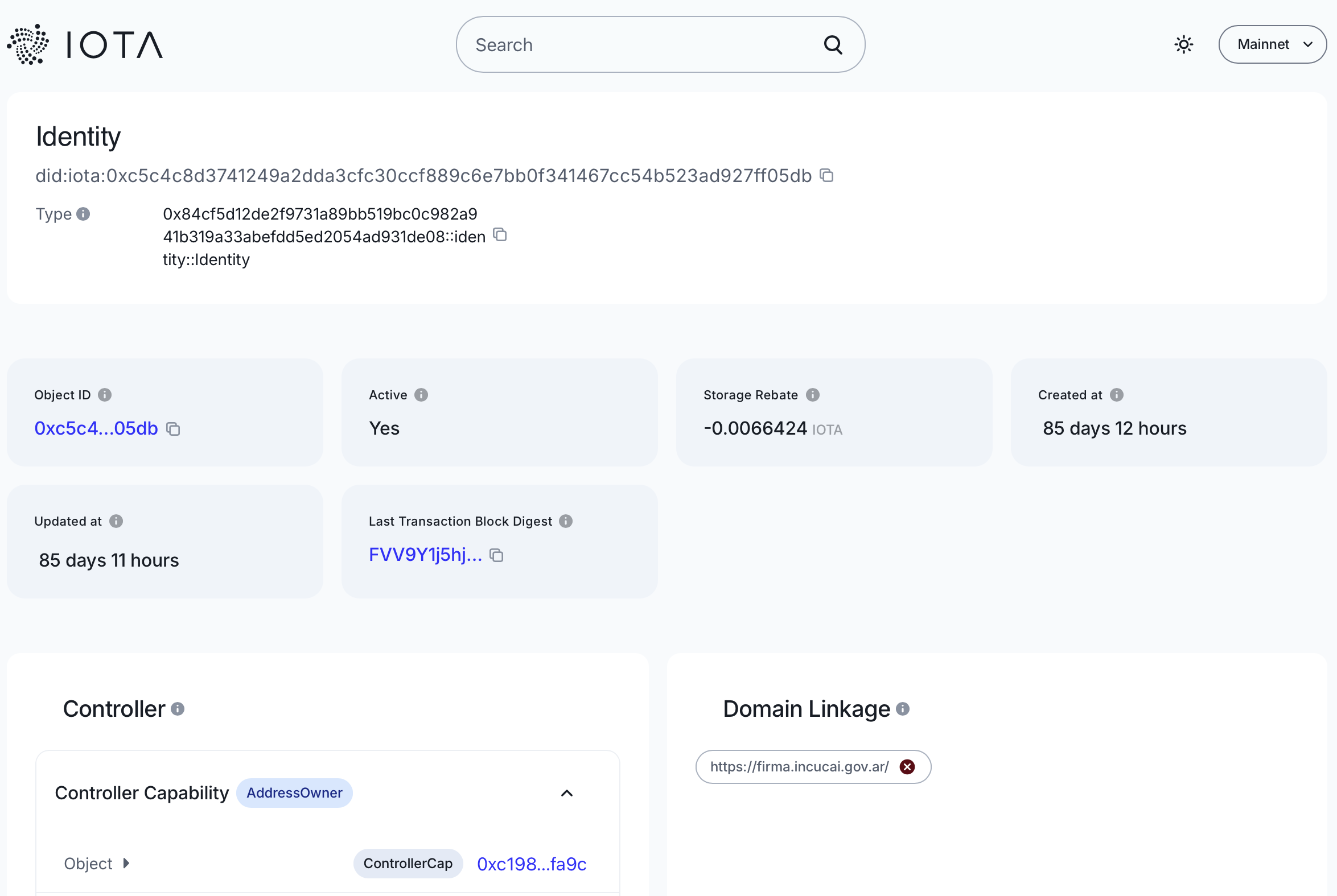
June 10, 2026: The decentralized identity and notarization architecture officially goes live on the IOTA Mainnet, allowing independent verification of institutional credentials by external observers via public explorers.
Mid-June 2026: The regulatory framework catches up with technical capability through the publication of Resolution 199/2026 in the Argentine Official Gazette (Boletín Oficial). This landmark decree mandates the rollout of electronic signatures across every process managed via SINTRA—Argentina’s National Procurement and Transplant Information System.
June 18, 2026: Extrimian publicly acknowledges the deployment, emphasizing the profound real-world impact of blockchain-backed administrative upgrades on critical public services.
July 14, 2026: Technical audits confirm that all 24 provincial institutional identities successfully resolve on the IOTA mainnet, with active domain linkages pointing directly to official government signing portals, such as firma.incucai.gov.ar.
The Technology Stack in Action
The operational core of this deployment relies on several key technological components. The ecosystem leverages IncucaiID, an official digital wallet available for download on major mobile platforms, including the App Store and Google Play. Through IncucaiID, registered patients, healthcare practitioners, and administrative personnel receive cryptographically secure verifiable credentials.
When a donation or transplant workflow is initiated, users employ the wallet to prove their authorization and electronically sign documents tied to the procedure. These interactions are recorded on the IOTA ledger through lightweight transactions—costing minimal gas fees per document notarization—which permanently anchor the cryptographic proof of the signature.
The implementation is rolling out methodically, starting with the national waiting list registration process for heart and lung transplants. Subsequent phases will systematically integrate remaining organ lists and expand into the broader administrative workflows housed within SINTRA. The ultimate objective is a fully paperless, frictionless environment that eliminates the physical transport of documents and the delays associated with manual, cross-provincial bureaucracy.
Official Perspectives and Institutional Leadership
The successful deployment of Argentina’s onchain transplant system has drawn praise from both public sector leaders and technology architects, highlighting the practical utility of decentralized systems in solving complex real-world problems.
Daniela Hansen Krogh, Director of Information Technology and Information Systems at INCUCAI, emphasized the foundational role of trust in medical administration:
"Trust is at the heart of every organ donation and transplantation process. Our responsibility is to ensure that every decision is supported by reliable, secure, and verifiable information. By incorporating decentralized identity and cryptographic verification into our national systems, we are strengthening the integrity, traceability, and legal certainty of every critical stage, while safeguarding sensitive patient information. This initiative reflects INCUCAI’s ongoing commitment to modernizing Argentina’s transplant system through secure, transparent, and citizen-centered digital innovation."
Echoing these sentiments, Esteban Musso, Professional Services Manager and Partner at Extrimian, pointed to the broader significance of the project for enterprise and governmental blockchain adoption:
"At Extrimian, we believe that trust is the foundation of every digital transformation. By combining open standards with privacy-preserving technologies, we’ve helped build a solution that enhances traceability, security, and interoperability while respecting the privacy of every participant. Projects like this demonstrate that decentralized technologies are no longer a vision for the future—they are delivering tangible value today in critical public services."
Dominik Schiener, Co-Founder and Chairman of the IOTA Foundation, summarized the achievement from an infrastructure perspective, noting:
"This is what IOTA’s open technology can do for critical public services at national scale: real infrastructure, already coordinating decisions that save lives."
Broader Implications and Future Outlook
The integration of decentralized identity and blockchain notarization into Argentina’s national health apparatus serves as a compelling case study for governments worldwide. For decades, public sector modernization has often meant migrating from paper to centralized digital databases—systems that, while faster, remain vulnerable to administrative siloes, internal tampering, and single points of failure.
By adopting a self-sovereign identity model anchored to a public, neutral ledger like IOTA, INCUCAI has demonstrated that state institutions can achieve unprecedented levels of transparency and security without sacrificing citizen privacy or national sovereignty. Because parts of the architecture run on ARSAT—Argentina’s state-owned telecommunications infrastructure—the system successfully balances decentralized verifiability with domestic regulatory control.
As other Latin American nations and international health organizations monitor the rollout of Resolution 199/2026 and the adoption of IncucaiID, the project stands as proof that decentralized technology has matured past theoretical speculation. In Argentina, onchain infrastructure is no longer merely an experimental financial frontier; it is actively securing the administrative workflows of life-saving medical care.