In the intricate architecture of modern healthcare, few systems operate under constraints as absolute as those governing organ donation and transplantation. When a viable organ becomes available, a race against time begins instantly. A donated human heart, for instance, remains viable outside the body for only a matter of hours. Within this narrow window, a complex network of medical professionals, provincial coordinators, institutional administrators, and national authorities must act in precise sequence. Every medical record, every legal consent form, and every official authorization must be authenticated with absolute precision on the first attempt. In this high-stakes environment, a misplaced document, a fraudulent signature, or a delayed verification can mean the difference between life and death.
Recognizing the critical need for absolute security, transparency, and operational efficiency, Argentina has fundamentally modernized its national organ procurement infrastructure. Through a groundbreaking collaborative effort between the country’s central transplant authority and Latin American decentralized identity pioneers, Argentina has successfully transitioned its national organ, tissue, and cell donation framework onto a live, publicly verifiable blockchain ledger. This digital transformation represents a major milestone in the practical application of decentralized technologies to vital public sector operations, offering a blueprint for governments worldwide seeking to enhance institutional trust and data integrity.
The Operational Scope of Argentina’s National Transplant Authority
At the heart of this transformation is the Instituto Nacional Central Único Coordinador de Ablación e Implante, universally known as INCUCAI. Established to oversee, regulate, and coordinate the allocation of organs and tissues throughout the South American nation, INCUCAI operates as the central administrative engine for the country’s entire transplantation ecosystem. The institution manages the centralized national waiting list, ensuring equitable access and strict adherence to medical allocation priorities.
However, the geographic and administrative scale of Argentina presents unique logistical hurdles. INCUCAI does not operate in a vacuum; it functions in constant coordination with 24 distinct jurisdictional procurement agencies—encompassing every individual province alongside the Autonomous City of Buenos Aires—as well as an extensive network of public and private hospitals and specialized transplant centers. Coordinating life-or-death decisions across these disparate regional entities demands a digital backbone capable of immediate authentication, flawless interoperability, and immutable record-keeping.
To solve this challenge, INCUCAI partnered with Extrimian, a prominent Latin American technology company specializing in decentralized digital identity and self-sovereign identity (SSI) frameworks. Extrimian’s core mission centers on developing infrastructure that grants individuals and institutions direct, cryptographic control over their digital identities and shared data. By bringing transparency and user-centric security to complex interactions across health, education, and government, Extrimian provided the conceptual architecture required to overhaul INCUCAI’s legacy systems.
For the underlying public ledger, Extrimian selected IOTA, a scalable, energy-efficient, and neutral decentralized network. IOTA serves as the foundational verification layer, enabling institutional identities and document integrity proofs to be validated globally without relying on centralized gatekeepers or introducing operational friction.
Chronology of a National Digital Evolution
The integration of decentralized identity and electronic signatures into Argentina’s healthcare infrastructure is the culmination of meticulous planning, legal reform, and technical deployment. The chronology of this transformation highlights the deliberate steps taken by national authorities to ensure regulatory compliance and technical resilience:
Foundational Development (2024–2025): Extrimian and INCUCAI collaborate with the IOTA Foundation to design a privacy-preserving architecture tailored to Argentina’s legal and administrative requirements. The framework is engineered to align with World Wide Web Consortium (W3C) open standards for decentralized identifiers (DIDs) and verifiable credentials.
Infrastructure Integration (Late 2025 – Early 2026): Portions of the decentralized infrastructure are integrated with ARSAT, Argentina’s state-owned telecommunications enterprise. This ensures that critical components of the system remain under national sovereign control while leveraging public blockchain verification layers.
Legal Authorization (June 2026): The regulatory foundation is formally established with the publication of Resolution 199/2026 in the Argentine Official Gazette (Boletín Oficial). This resolution officially authorizes the implementation of electronic signatures across all processes managed by SINTRA, the National Procurement and Transplant Information System.
Mainnet Go-Live (June 10, 2026): The system officially goes live on the IOTA Mainnet. Institutional identities for INCUCAI and all 24 provincial procurement agencies are established onchain, equipped with cryptographically linked domain verifications.
Public Rollout and Wallet Deployment (July 2026): INCUCAI launches IncucaiID, the official ecosystem wallet application available on major mobile platforms. Implementation commences with heart and lung transplant waiting-list registrations, setting the stage for a fully paperless, blockchain-secured workflow across all national transplant categories.
Architectural Design and Privacy-First Engineering
A primary concern when introducing distributed ledger technology to healthcare is the protection of sensitive patient data. Medical records, genetic profiles, and personal histories are among the most private information entrusted to any institution. To address this, the Extrimian-IOTA architecture was designed from the ground up to adhere to strict data minimization and privacy principles.
Crucially, no patient-identifiable information or raw medical records are ever stored on the blockchain. Instead, the system utilizes cryptographic hashes—mathematical fingerprints generated from official documents and process steps—which are permanently anchored to the IOTA ledger. This mechanism guarantees absolute document integrity and chronological proof without exposing any underlying personal data.
Through this approach, doctors, regional agencies, and families can independently cryptographically verify that every authorization, medical check, and administrative step occurred exactly as recorded. Meanwhile, the sensitive details of patients and grieving families remain strictly confidential.
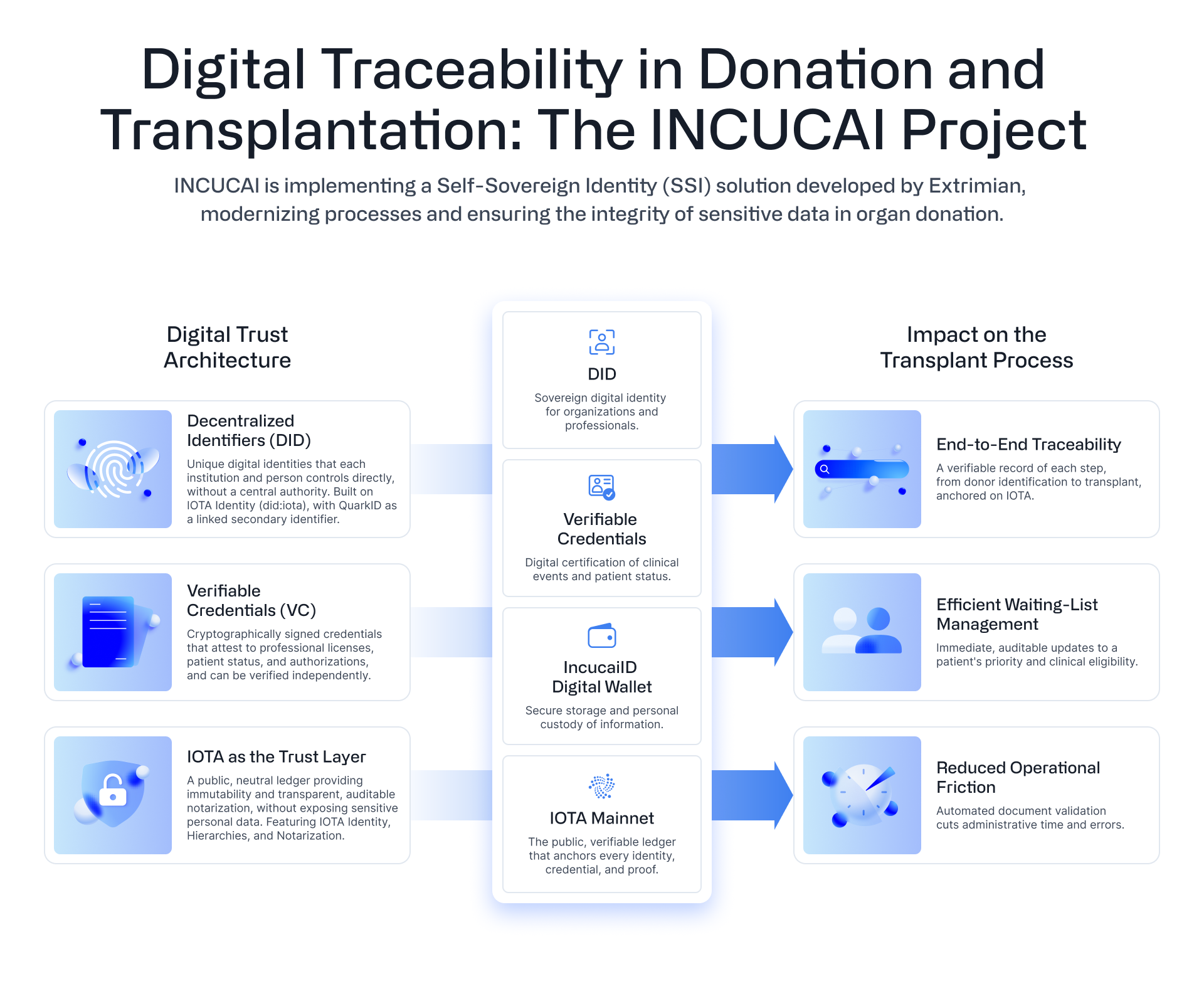
The technical deployment relies heavily on several key components of the IOTA ecosystem:
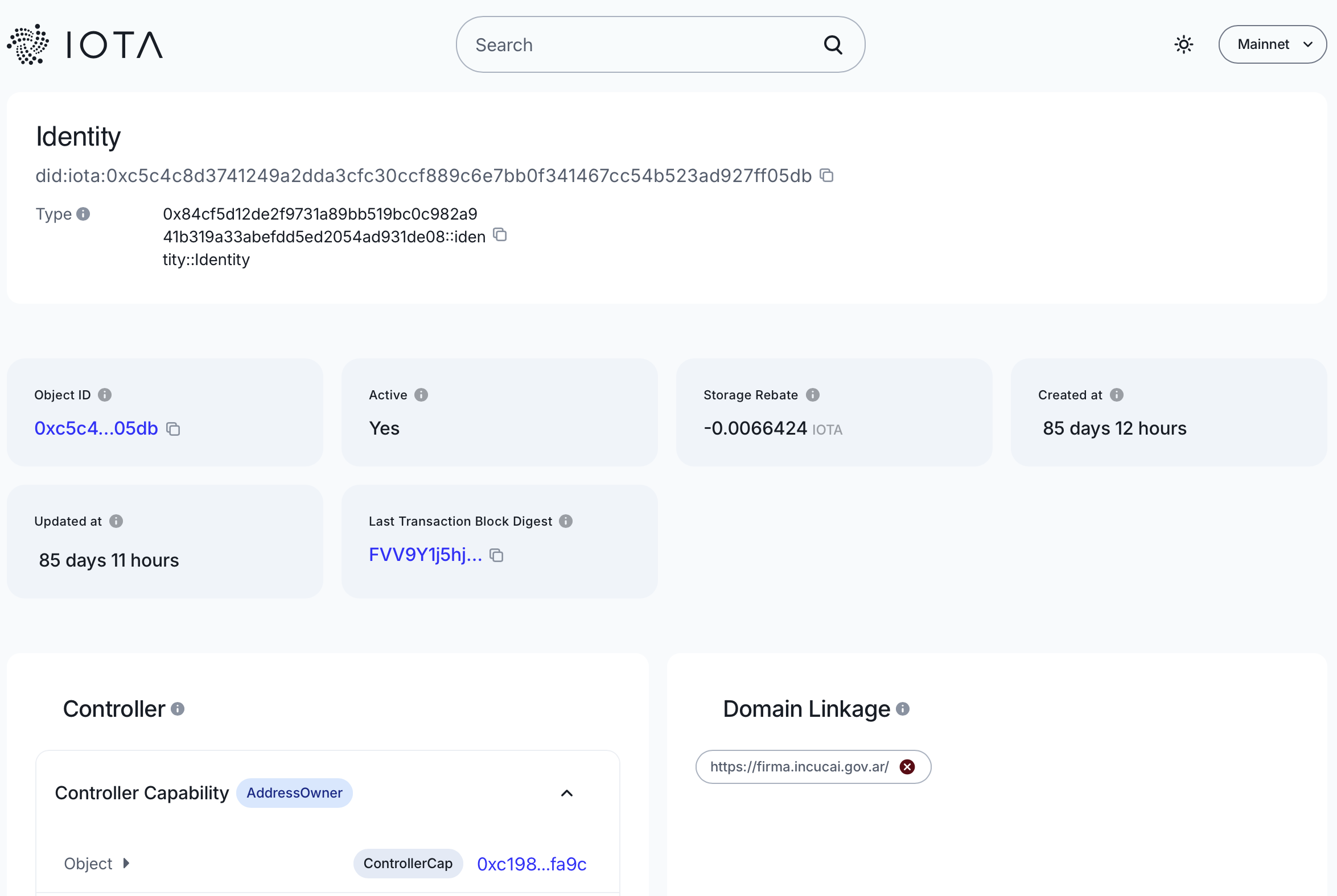
Decentralized Identifiers (DIDs): W3C-compliant identifiers that give INCUCAI and its 24 provincial agencies sovereign digital identities. INCUCAI’s root identity is cryptographically linked to its official government domain (firma.incucai.gov.ar), enabling anyone to confirm that an entity is genuinely accredited by the state rather than an impostor.
Verifiable Credentials: Tamper-proof, cryptographically signed digital documents issued to authorized participants, healthcare professionals, and patients via the IncucaiID mobile wallet.
Onchain Anchoring: Micro-transactions on the IOTA Mainnet (costing fractional amounts of IOTA in network gas fees) that permanently timestamp and notarize document hashes, creating an immutable audit trail.
To ensure total transparency, the IOTA Foundation conducted independent verifications of the deployment using only public endpoints and the IOTA Explorer. Independent audits confirmed that all 24 provincial identities resolved correctly, their respective trust federations matched onchain data, and the entities controlling each identity possessed the precise accreditation required by the state.
Official Statements and Institutional Perspectives
The successful deployment of this infrastructure has drawn praise from technology leaders and healthcare administrators alike, highlighting the tangible utility of decentralized systems in real-world public administration.
Daniela Hansen Krogh, Director of Information Technology and Information Systems at INCUCAI, emphasized the foundational role of trust in organ donation:
"Trust is at the heart of every organ donation and transplantation process. Our responsibility is to ensure that every decision is supported by reliable, secure, and verifiable information. By incorporating decentralized identity and cryptographic verification into our national systems, we are strengthening the integrity, traceability, and legal certainty of every critical stage, while safeguarding sensitive patient information. This initiative reflects INCUCAI’s ongoing commitment to modernizing Argentina’s transplant system through secure, transparent, and citizen-centered digital innovation."
Esteban Musso, Professional Services Manager and Partner at Extrimian, pointed to the broader significance of the project for enterprise and government adoption of blockchain technology:
"At Extrimian, we believe that trust is the foundation of every digital transformation. By combining open standards with privacy-preserving technologies, we’ve helped build a solution that enhances traceability, security, and interoperability while respecting the privacy of every participant. Projects like this demonstrate that decentralized technologies are no longer a vision for the future—they are delivering tangible value today in critical public services."
Dominik Schiener, Co-Founder and Chairman of the IOTA Foundation, underscored the societal impact of deploying public ledger infrastructure at a national scale:
"This is what IOTA’s open technology can do for critical public services at national scale: real infrastructure, already coordinating decisions that save lives."
Implications and Future Outlook
The integration of blockchain-backed electronic signatures and decentralized identity into Argentina’s transplant network establishes a powerful precedent for digital governance. By eliminating reliance on physical paperwork, manual provincial handoffs, and centralized databases prone to single points of failure, INCUCAI has created a resilient, paperless workflow.
As the implementation expands from initial heart and lung registry lists to encompass all remaining organ categories and institutional processes within SINTRA, the system is expected to drastically reduce administrative friction and response times. Furthermore, by embedding verifiable trust at the source using open W3C standards and sovereign national infrastructure hosted in part on ARSAT, Argentina has future-proofed its national health administration against fraud, data tampering, and bureaucratic delay.
Ultimately, the collaboration between INCUCAI, Extrimian, and IOTA demonstrates that decentralized ledger technology has evolved past theoretical speculation. In Argentina, it is actively operating as critical public infrastructure—safeguarding privacy, ensuring legal certainty, and streamlining the complex choreography required to save human lives.