In the high-stakes environment of organ transplantation, minutes can dictate the boundary between life and death. When a viable organ becomes available, a complex, high-pressure orchestration begins. Medical teams, provincial coordinators, and national oversight authorities must synchronize their actions across vast geographic distances within a severely restricted timeframe. For instance, a human heart remains viable for transplantation for only a few hours once removed from a donor. Within this narrow window, dozens of critical administrative and medical steps—ranging from cross-matching recipient profiles to verifying formal medical consent—must be executed flawlessly. A single misplaced document, a disputed signature, or a fraudulent verification can severely delay the process, jeopardizing the recipient’s life and undermining public confidence in a delicate medical network.
To eliminate these vulnerabilities, Argentina has officially integrated its national organ, tissue, and cell donation authority onto a public, decentralized digital-identity framework. Through a strategic collaboration between the Latin American decentralized-identity pioneer Extrimian and the distributed ledger technology provider IOTA, the Instituto Nacional Central Único Coordinador de Ablación e Implante (INCUCAI) has successfully deployed a live, publicly verifiable onchain infrastructure. The initiative marks a monumental shift in how national health systems can leverage blockchain-based architecture to secure life-saving logistics without compromising patient privacy.
The Scale and Structure of Argentina’s National Transplant Network
INCUCAI operates as the central regulatory and coordinating body for organ procurement and transplantation across the Argentine Republic. The institution manages the centralized national waiting list and coordinates closely with 24 jurisdictional procurement agencies—encompassing all 23 provinces alongside the Autonomous City of Buenos Aires—as well as a sprawling network of public and private hospitals and specialized transplant centers.
Managing the myriad moving parts of this national apparatus has historically relied on centralized databases and paper-backed verification workflows. While effective, traditional digital architectures present inherent vulnerabilities, including susceptibility to single points of failure, administrative friction, and the arduous task of verifying document authenticity across multiple provincial jurisdictions. Recognizing the need for a more resilient digital backbone, INCUCAI sought out technology capable of providing absolute transparency, cryptographic immutability, and seamless interoperability.
Enter Extrimian, a technology company specializing in self-sovereign identity (SSI) systems designed to give individuals and organizations direct cryptographic control over their digital credentials and data sharing. To build out the public, neutral network required for a national-scale deployment, Extrimian selected IOTA. As an enterprise-grade distributed ledger, IOTA offers a scalable, feeless, or low-cost infrastructure capable of anchoring institutional identities and document hashes directly to the mainnet without exposing sensitive underlying data.
A Chronology of Modernization: From Concept to National Adoption
The integration of Argentina’s transplant registry onto the IOTA mainnet represents the culmination of extensive technological development and regulatory reform. The timeline of this transformation highlights the methodical approach taken by both public agencies and private technology partners:
- Early Development Phase: Extrimian and INCUCAI design the technical architecture, utilizing W3C-compliant decentralized identifiers (DIDs) and verifiable credentials to map the institutional hierarchy of INCUCAI and its 24 provincial procurement agencies.
- Infrastructure Integration: The architecture incorporates elements of ARSAT, Argentina’s state-owned telecommunications infrastructure company, ensuring that critical components of the system remain under sovereign national control.
- June 10, 2026: The decentralized identity and notarization system officially goes live on the IOTA Mainnet, allowing independent verification of institutional credentials by external parties via public block explorers.
- June 2026 (Resolution 199/2026): Published in the national Official Gazette (Boletín Oficial), INCUCAI officially adopts Resolution 199/2026, authorizing the mandatory implementation of electronic signatures across all processes managed through SINTRA (Argentina’s National Procurement and Transplant Information System) and its associated institutional frameworks.
- Mid-2026 Rollout: The official ecosystem wallet, designated as IncucaiID, is launched on major mobile application platforms, including the Apple App Store and Google Play, empowering patients, medical professionals, and administrative authorities to securely manage verifiable credentials. Initial adoption focuses on heart and lung waiting-list registries before scaling to other organ categories.
Privacy-First Architecture: Cryptographic Proofs Over Raw Data
A primary concern when integrating healthcare systems with distributed ledger technology is the preservation of patient privacy. Medical records and organ transplant details comprise some of the most sensitive, confidential information entrusted to institutions by patients and grieving families.
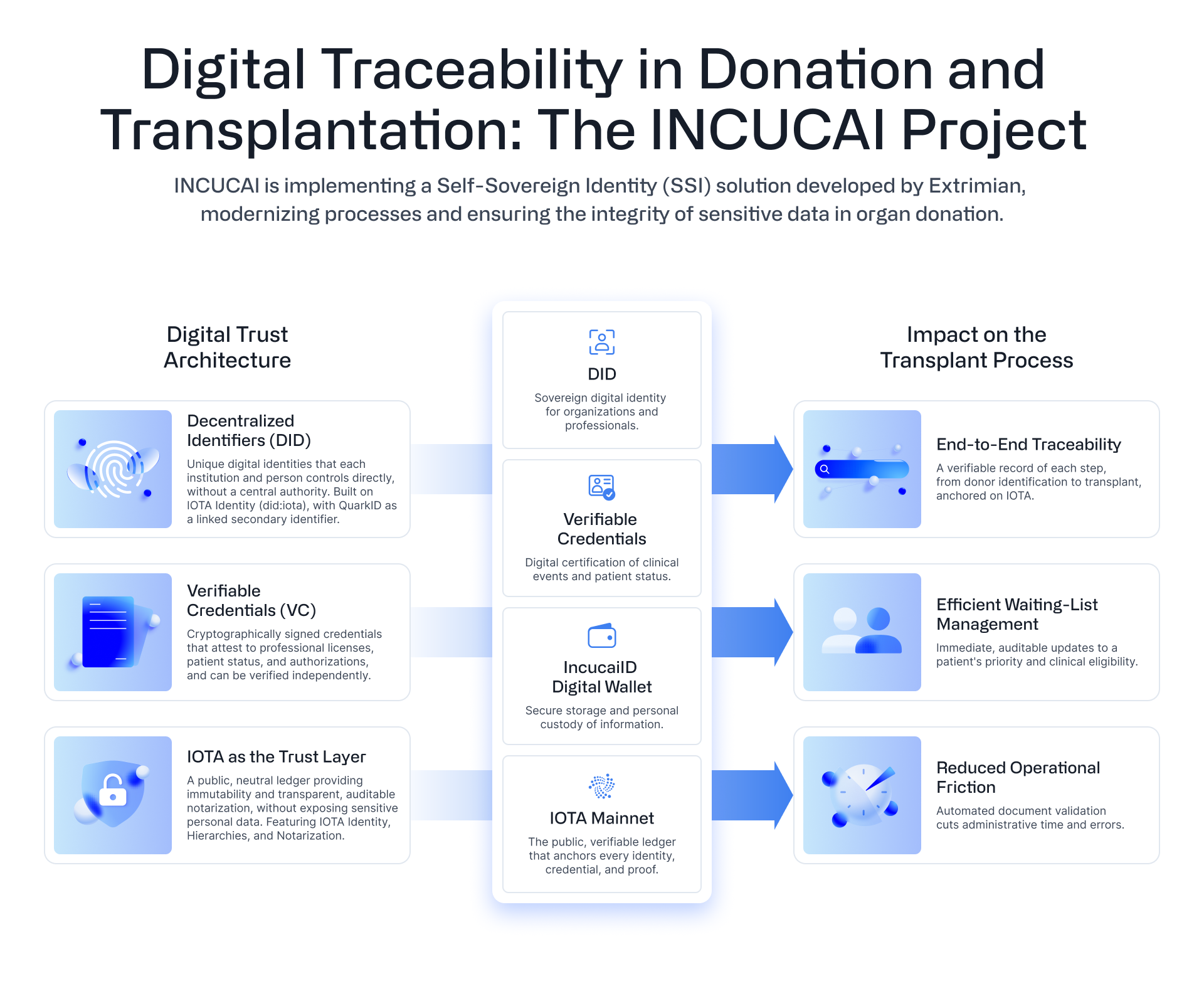
To address privacy concerns without sacrificing transparency, the Extrimian-IOTA solution employs a strict zero-knowledge philosophy regarding onchain data storage. At no point is patient-identifiable information (PII) or raw medical data stored on the public ledger. Instead, the system utilizes cryptographic hashes—unique, irreversible alphanumeric strings generated from documents and process steps—which are permanently anchored to the IOTA mainnet.
This cryptographic anchoring ensures tamper-proof document signing. If a single character within a critical transplant authorization form is altered after signature, the resulting hash changes entirely, immediately flagging the discrepancy. Consequently, doctors, provincial oversight agencies, and families can independently cryptographically confirm that every regulatory and medical step occurred precisely as recorded, while the underlying personal data remains strictly confidential and offchain.
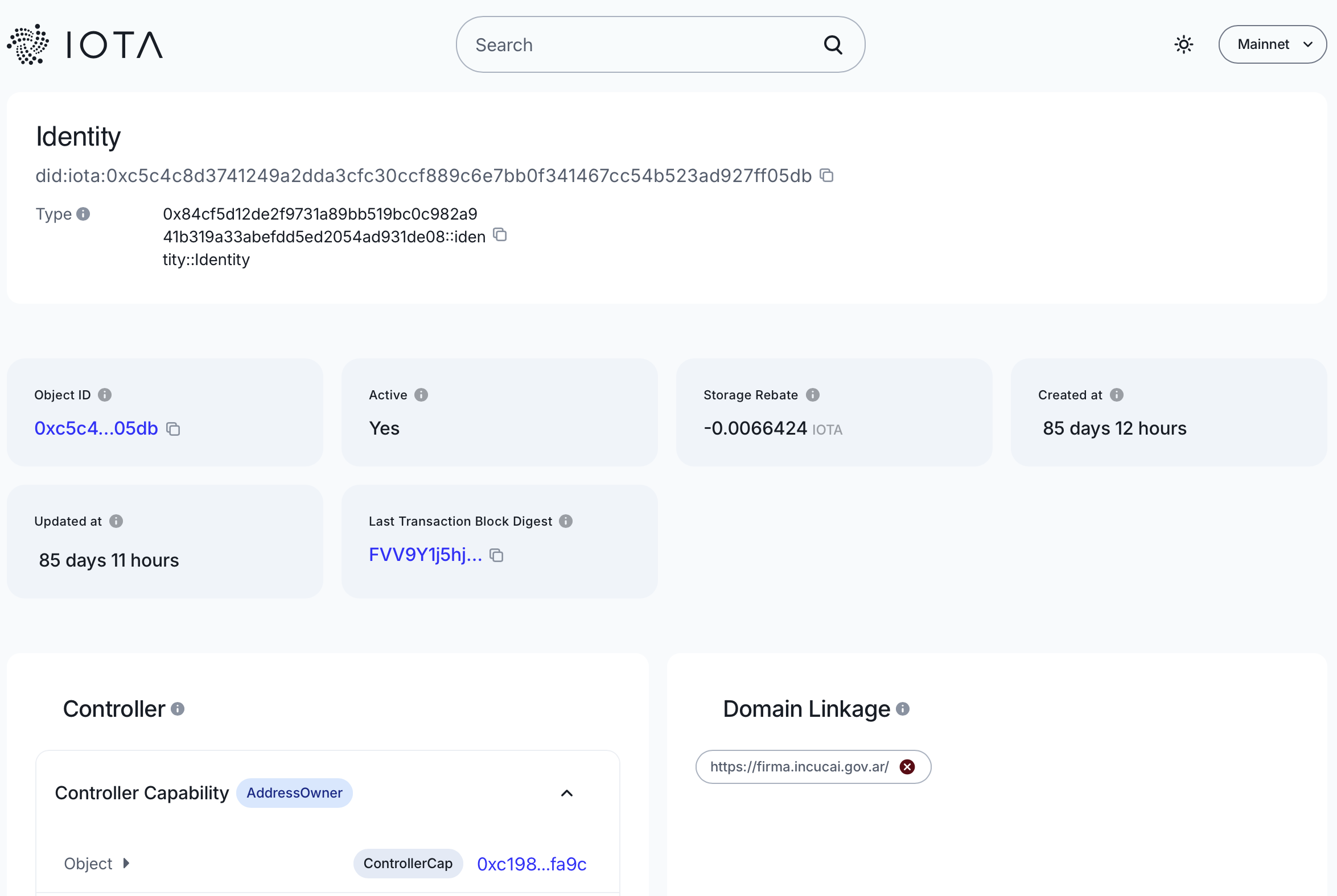
Furthermore, the system leverages open standards. All digital identities and credentials adhere strictly to World Wide Web Consortium (W3C) specifications. INCUCAI’s institutional identity is cryptographically linked to its official government domain (firma.incucai.gov.ar), allowing any stakeholder to confirm that an entity interacting with the system belongs to the genuine government authority rather than a malicious actor. Part of the network infrastructure operates domestically on ARSAT servers, reinforcing national technological sovereignty.
Official Statements and Institutional Perspectives
The successful deployment of Argentina’s onchain transplant system has drawn praise from technology leaders and healthcare administrators alike, underscoring the practical utility of decentralized networks in high-impact public sectors.
Daniela Hansen Krogh, Director of Information Technology and Information Systems at INCUCAI, emphasized the foundational role of trust in medical transplantation:
"Trust is at the heart of every organ donation and transplantation process. Our responsibility is to ensure that every decision is supported by reliable, secure, and verifiable information. By incorporating decentralized identity and cryptographic verification into our national systems, we are strengthening the integrity, traceability, and legal certainty of every critical stage, while safeguarding sensitive patient information. This initiative reflects INCUCAI’s ongoing commitment to modernizing Argentina’s transplant system through secure, transparent, and citizen-centered digital innovation."
Esteban Musso, Professional Services Manager and Partner at Extrimian, highlighted the real-world maturation of decentralized technologies:
"At Extrimian, we believe that trust is the foundation of every digital transformation. By combining open standards with privacy-preserving technologies, we’ve helped build a solution that enhances traceability, security, and interoperability while respecting the privacy of every participant. Projects like this demonstrate that decentralized technologies are no longer a vision for the future—they are delivering tangible value today in critical public services."
Echoing these sentiments, Dominik Schiener, Co-Founder and Chairman of the IOTA Foundation, pointed to the broader implications for public infrastructure:
"This is what IOTA’s open technology can do for critical public services at national scale: real infrastructure, already coordinating decisions that save lives."
Implications and Future Outlook for Public Sector Blockchain
The integration of INCUCAI and Extrimian’s framework establishes a compelling precedent for the digitalization of government services across Latin America and the global stage. For decades, public sector blockchain initiatives have frequently been criticized as theoretical experiments or solutions searching for problems. However, the Argentine transplant model demonstrates how distributed ledgers can solve acute, real-world administrative bottlenecks—specifically, multi-agency coordination, document forgery prevention, and verifiable audit trails.
By transitioning from manual, paper-heavy workflows to a streamlined, paperless digital environment governed by electronic signatures and sovereign wallets (IncucaiID), INCUCAI is drastically reducing administrative friction. As the rollout expands from initial heart and lung registries to encompass all remaining organ waiting lists and broader SINTRA operations, the system is expected to serve as a blueprint for other government agencies seeking to modernize healthcare logistics, civil registries, and credential issuance.
In an ecosystem where systemic delays can carry irreversible consequences, the marriage of decentralized identity standards and scalable distributed ledgers provides a robust foundation for institutional accountability. By embedding verifiable trust directly at the source, Argentina has positioned its national health infrastructure at the forefront of digital innovation, proving that cryptographic security can directly support and safeguard human life.