In an era where modern supply chains span continents, clinical trials involve dozens of independent medical facilities, and regulatory compliance demands rigorous oversight, the integrity of business data is more critical than ever. Yet, enterprise records remain notoriously fragmented. Dispersed across isolated databases, internal spreadsheets, local server logs, and manual paperwork, everyday business workflows generate vast amounts of data that are fundamentally vulnerable to alteration, backfilling, and administrative manipulation. When disputes arise between business partners, auditors, or legal authorities, establishing a single source of truth often requires costly reconciliations of conflicting, siloed logs.
To address this systemic vulnerability, the IOTA Foundation has officially launched IOTA Audit Trails, an open-source solution built as part of the broader IOTA Notarization toolkit. Designed to bridge the trust gap across organizational boundaries, the new framework anchors governed, sequentially ordered histories directly onto a shared, tamper-resistant ledger layer. Rather than forcing organizations to overhaul their existing internal database architectures or expose proprietary, sensitive source documents on a public blockchain, IOTA Audit Trails provides a secure cryptographic mechanism to log essential operational proofs, data hashes, and metadata. By leveraging this system, developers, enterprises, and regulators can independently verify who performed a specific action, exactly when it occurred, and under what granted permissions, all without relying on the unilateral word of a central database administrator.
The Architectural Challenge of Fragmented Enterprise Records
To understand the necessity of ledger-anchored audit trails, one must examine the limitations of conventional enterprise record-keeping. Traditionally, internal audit logs and transactional records are designed primarily for internal visibility. They serve well when an organization needs to investigate a localized security incident or satisfy domestic reporting obligations under the direct control of a single IT department. However, this centralized trust model fractures entirely the moment a business process crosses organizational borders.
Consider a multi-party international trade shipment. A manufacturer in Asia produces a component, a shipping conglomerate transports it across the ocean, a customs brokerage firm inspects the cargo upon arrival, and a domestic distributor receives the final product. Each of these entities maintains its own proprietary database. If a discrepancy arises regarding the condition of the goods or the timing of customs clearances, verifying the authenticity of the records requires trusting exported reports or granting external auditors direct access to internal database tables—a practice fraught with security risks and privacy concerns.
Without a neutral, immutable reference point, external parties such as regulatory bodies, insurance providers, downstream corporate customers, and supply chain partners are forced to rely on secondary attestations. This lack of interoperable verification breeds inefficiency, increases compliance overhead, and leaves multi-party workflows vulnerable to disputes, data tampering, and human error. IOTA Audit Trails eliminates this friction by moving beyond simple record notarization into the realm of structured, rule-governed historical ledgers.
From Individual Proofs to Governed On-Chain Histories
The launch of IOTA Audit Trails represents a significant evolutionary step beyond the foundational capabilities of IOTA Notarization. While standard notarization allows developers to anchor isolated data points and file hashes to the IOTA ledger to prove that a specific document existed at a specific point in time, it does not inherently capture the sequential relationship between multiple operational events, nor does it enforce complex governance rules.
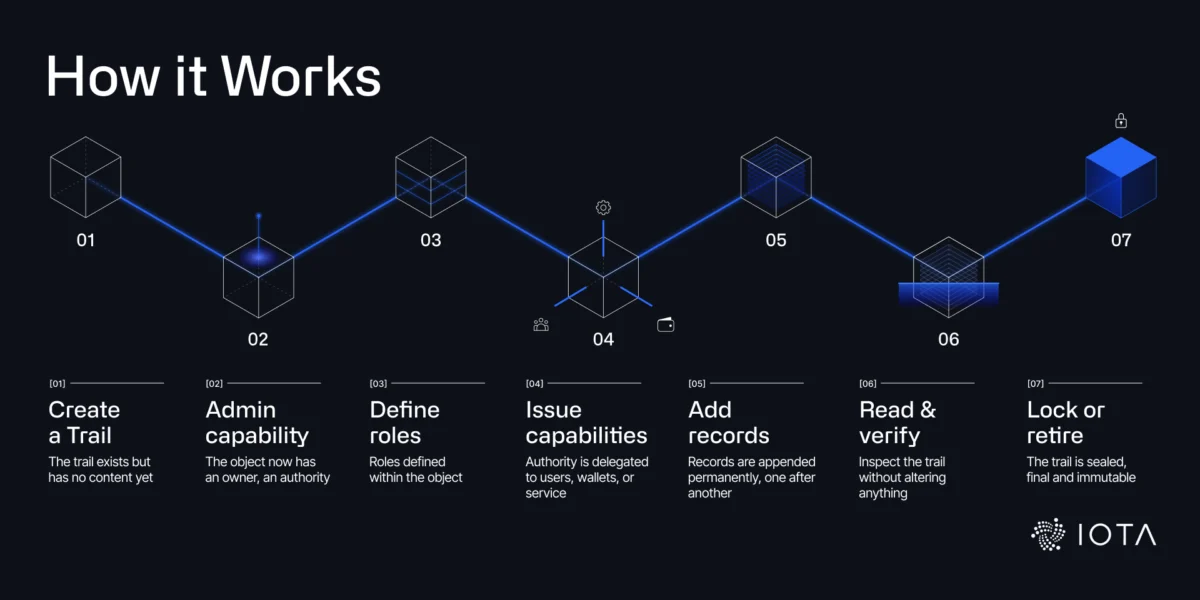
An IOTA Audit Trail, by contrast, is structured as a shared, on-chain object that stores records in a strict chronological sequence. Each individual entry within the trail can encapsulate text or binary payloads, optional cryptographic metadata, and categorization tags. Crucially, the trail object itself maintains immutable creation metadata alongside updatable operational configurations, locking mechanisms, role definitions, capabilities, and tag-specific validation rules.
This multi-dimensional architecture ensures that the system answers not only the basic verification question—has this data been altered?—but also complex governance inquiries: Who authorized this record? Was it appended in the correct sequence? Did the submitting wallet possess the required operational role at the exact timestamp of submission?
Granular Access Control and Lifecycle Governance
In enterprise environments, operational responsibilities are rarely monolithic. A manufacturing plant manager, an external quality auditor, a compliance officer, and an automated Internet of Things (IoT) sensor array each play distinct roles within a workflow, requiring vastly different levels of access and authorization.
IOTA Audit Trails addresses this operational reality through robust, role-based access control (RBAC) mechanisms embedded directly within its framework. Rather than requiring developers to engineer custom smart contract logic for every unique corporate compliance workflow, the system provides out-of-the-box support for role definition and capability delegation.
Under this model, administrative roles are defined at the inception of the audit trail. Capabilities—representing specific permissions to write, update, tag, or lock records—can then be securely delegated to specific cryptographic wallets, backend microservices, or authorized enterprise users. For instance, a supply chain deployment can be configured so that only certified manufacturing nodes can append lifecycle production events, while external regulatory auditors are granted read-only viewing capabilities to inspect the sequence without holding any write privileges. Furthermore, lifecycle rules allow trails to be permanently locked once a workflow reaches completion, preventing any further modifications and ensuring permanent archiving compliance.
Balancing Public Ledger Integrity with Enterprise Data Privacy

A critical consideration in the deployment of blockchain-based enterprise solutions is data privacy. Because IOTA Audit Trails operates on top of the public IOTA ledger, all transactions and data structures written directly to the chain are publicly readable. For enterprises handling proprietary trade secrets, personally identifiable information (PII), or confidential medical records, exposing raw source data on a public ledger is a non-starter.
To resolve this tension, IOTA Audit Trails enforces a strict architectural separation between on-chain integrity proofs and off-chain data storage. Organizations are advised to store their sensitive source documents, confidential reports, and heavy payloads securely within private off-chain data stores or encrypted databases. Only cryptographic hashes, non-sensitive metadata, operational references, and structural proofs are written to the public audit trail.
This hybrid approach provides the best of both worlds. The public ledger guarantees the immutability, temporal order, and availability of the audit proofs, while the enterprise retains absolute control over the confidentiality and encryption of its underlying source material. Verifiers can independently validate that an off-chain document matches its registered hash on the ledger without ever gaining access to the underlying sensitive file content.
Comprehensive Developer Tooling and Ecosystem Integration
To facilitate rapid adoption and seamless integration into existing enterprise infrastructures, the IOTA Foundation has released Audit Trails as an alpha-ready toolkit equipped with three distinct integration pathways:
- Move Package: A robust smart contract framework deployed directly on-chain to handle state verification, role enforcement, and sequence ordering natively.
- Rust SDK: A high-performance, typed software development kit designed for enterprise backend systems, cloud microservices, and heavy-duty data processing pipelines.
- WebAssembly (WASM) Bindings: Tailored JavaScript and TypeScript bindings that enable web applications, frontend dashboards, and Node.js environments to interact effortlessly with audit trails.
Additionally, the official IOTA repository provides fully documented, ready-to-run code examples illustrating real-world use cases, including customs clearance procedures, pharmaceutical clinical trial tracking, and digital product passport implementations. To maximize flexibility, transaction construction has been intentionally decoupled from transaction submission. This architectural choice allows developers to integrate IOTA Audit Trails seamlessly into their preferred wallet interfaces, proprietary signing mechanisms, or automated gas station workflows, minimizing friction for non-crypto-native enterprise users.
Real-World Industry Applications and Strategic Implications
The introduction of shared, verifiable audit trails has profound implications across multiple data-sensitive industries where cross-organizational trust is paramount.
Supply Chains and Digital Product Passports (DPPs): As global sustainability regulations tighten—particularly within the European Union—manufacturers are increasingly required to provide verifiable proofs of a product’s lifecycle, material composition, and carbon footprint. With IOTA Audit Trails, producers, transporters, recyclers, and regulatory bodies can contribute cryptographically signed lifecycle events to a unified digital passport, ensuring absolute transparency from factory floor to end-of-life recycling.
Clinical Trials and Healthcare: Pharmaceutical research involves strict regulatory oversight by agencies such as the U.S. Food and Drug Administration (FDA). By anchoring clinical trial event logs and data integrity proofs to an ordered audit trail, research institutions can guarantee that trial data has not been backfilled or selectively altered, thereby accelerating regulatory approval timelines and bolstering scientific credibility.
Customs and Cross-Border Trade: International shipping workflows involve complex handoffs between freight forwarders, port authorities, customs officials, and insurance underwriters. IOTA Audit Trails enables these disparate entities to coordinate inspection steps and compliance declarations through a shared, tamper-proof historical record, drastically reducing administrative delays and fraudulent cargo claims.
IoT and Automated Industrial Systems: In modern industrial automation, connected sensors and autonomous machinery generate continuous streams of operational data. Utilizing IOTA Audit Trails, industrial operators can securely log critical machine events, maintenance actions, and sensor attestations, creating an undeniable provenance trail for predictive maintenance and legal liability assessments.
Path to Production and Future Outlook
The release of IOTA Audit Trails marks a significant milestone in the maturation of enterprise-grade distributed ledger technology. By shifting the focus from speculative financial assets to practical, verifiable operational infrastructure, IOTA provides organizations with the tools necessary to eliminate trust deficits in multi-party workflows.
The alpha release is available immediately for development teams, system architects, and enterprise technology evaluators. Organizations are encouraged to model their initial audit trails, experiment with the Rust SDK and Move packages, and deploy test implementations on the IOTA Testnet. As developers transition from experimentation to production, these robust tooling packages will allow businesses to replace fragile, siloed database reconciliations with transparent, cryptographically secure shared histories.
As digital transformation accelerates across global enterprise sectors, the ability to prove who did what, when, and under what authority will no longer be merely an internal compliance checkbox—it will be a foundational requirement for doing business. Through IOTA Audit Trails, the foundation has laid the groundwork for a more accountable, transparent, and interoperable digital economy.