The IOTA Foundation has officially launched the alpha release of IOTA Audit Trails, a new open-source solution designed to enhance trust and verifiability in business processes by anchoring ordered histories on a tamper-resistant ledger. This innovative tool, integrated within the IOTA Notarization toolkit, aims to address the inherent trust issues arising from fragmented data storage across traditional databases and spreadsheets. By providing a shared, immutable record, IOTA Audit Trails enables independent verification of every event, its authority, and its timestamp, fostering greater transparency and accountability across organizational boundaries. The alpha release is accessible via a Move package for smart contract development, a Rust SDK for backend integrations, and WebAssembly bindings for JavaScript and TypeScript applications, signaling a significant step towards enterprise-grade decentralized solutions.
The genesis of IOTA Audit Trails stems from a fundamental challenge faced by modern businesses: the disaggregated nature of critical operational data. Whether tracking a product’s journey through a complex supply chain, monitoring events in a clinical trial, managing approvals in a customs workflow, or documenting evidence for compliance reviews, records are often scattered. This fragmentation leads to a precarious reliance on trust, as data can be susceptible to alteration, deletion, or differing interpretations across disparate systems. Access controls are typically siloed within individual applications, leaving external stakeholders with little recourse but to trust exported reports rather than verifying the underlying data integrity themselves.
IOTA Audit Trails directly confronts this trust deficit. It establishes a shared, tamper-resistant ledger layer that acts as a single source of truth for the essential metadata and proofs of business events. Crucially, the solution is designed to complement existing private business systems rather than replace them, and it avoids the need to expose sensitive documents directly on-chain. Instead, it facilitates the anchoring of events, cryptographic hashes, metadata, and operational proofs in a structured, verifiable manner. This allows organizations to establish a clear record of who performed what action, when, and under which defined permissions, significantly bolstering the integrity of their operational histories.
The Imperative of Trustworthy Audit Trails in Inter-Organizational Workflows
The limitations of traditional audit systems become starkly apparent when workflows extend beyond the confines of a single organization. While many internal audit systems are adept at facilitating incident investigations and meeting reporting obligations within a controlled environment, their reliance on central administrators, single databases, or trusted exports falters when external parties – such as regulators, partners, insurers, customers, or downstream systems – require independent verification. These external entities need to ascertain not just the existence of a record, but its timely addition, the authenticity of the actor, and the legitimacy of the authority under which it was created.
IOTA Audit Trails addresses this by making verification explicit and accessible. The system introduces a robust framework for defining roles and delegating capabilities to specific wallets or services. Records are then immutably written to an ordered on-chain history. This architecture empowers verifiers to inspect the trail’s state and the sequence of records directly through read-only clients, without requiring any write permissions. This granular control and transparent accessibility are pivotal for building trust in environments where data sharing and cross-organizational collaboration are paramount. The ability for any authorized external party to independently validate the provenance and integrity of records fundamentally shifts the paradigm of trust from a reliance on intermediaries to verifiable on-chain data.
Navigating Data Visibility and Privacy with On-Chain Anchoring
A core consideration in the design of IOTA Audit Trails is the balance between data visibility and privacy, particularly given its deployment on the public IOTA ledger. The IOTA Foundation emphasizes that all data anchored on the public ledger should be treated as publicly readable. Consequently, for sensitive information such as proprietary documents, personal data, confidential reports, or medical records, the recommended approach is to store the original content off-chain. Applications should then anchor only cryptographic hashes, unique identifiers, or non-sensitive metadata to the audit trail.
This strategy ensures that the integrity, order, and existence of sensitive data can be verifiably attested without exposing the confidential source material to the public. The public ledger provides the foundational layers of integrity and availability, while robust application design remains essential for managing privacy, encryption, and controlled access to the underlying off-chain data. This distributed approach to data management allows organizations to leverage the immutable nature of blockchain technology for verification purposes while maintaining stringent control over sensitive information, a critical requirement for many regulated industries.
From Singular Proofs to Comprehensive, Governed Histories
IOTA Audit Trails builds upon the capabilities of IOTA Notarization, which already allows developers to anchor individual records onto the IOTA ledger. Audit Trails extends this functionality by evolving from single notarized objects to comprehensive, ordered record histories imbued with built-in governance mechanisms.
An audit trail, in this context, is a shared on-chain object that meticulously stores records in a chronological sequence. Each record can encapsulate text or binary data, accompanied by optional metadata and a tag. Beyond the records themselves, the trail also preserves immutable creation metadata, allows for updatable operational metadata, and defines locking configurations, roles, capabilities, and tag rules. This rich structure makes Audit Trails invaluable for scenarios where the critical questions extend beyond mere data modification detection. They enable an understanding of "who added this record, under which role, in what order, and according to which lifecycle rules?" This comprehensive historical context is vital for detailed analysis, regulatory compliance, and dispute resolution.
Defining Authority: Who Can Do What, and When
The architecture of IOTA Audit Trails is explicitly designed to accommodate environments with diverse actors and varying levels of responsibility. For instance, in a manufacturing context, one entity might be responsible for writing lifecycle events, while an auditor might be tasked with inspecting records. A compliance officer could manage retention policies, and a system operator might oversee tag management or metadata updates.
The solution facilitates this separation of duties through a sophisticated role-based access control (RBAC) system. This system allows for the definition of specific roles, each with a defined set of permissions. Capabilities are then assigned to these roles, enabling granular control over actions such as creating trails, adding records, updating metadata, or managing roles. By effectively modeling practical governance without necessitating the development of custom smart contracts for every unique audit workflow, IOTA Audit Trails offers a flexible and scalable solution for complex organizational structures.

The Lifecycle of an Audit Trail: From Inception to Immutable Lock
The practical implementation of IOTA Audit Trails is designed to be intuitive for developers. They can create and manage audit trails directly using the provided Rust SDK, WebAssembly bindings, or the Move package.
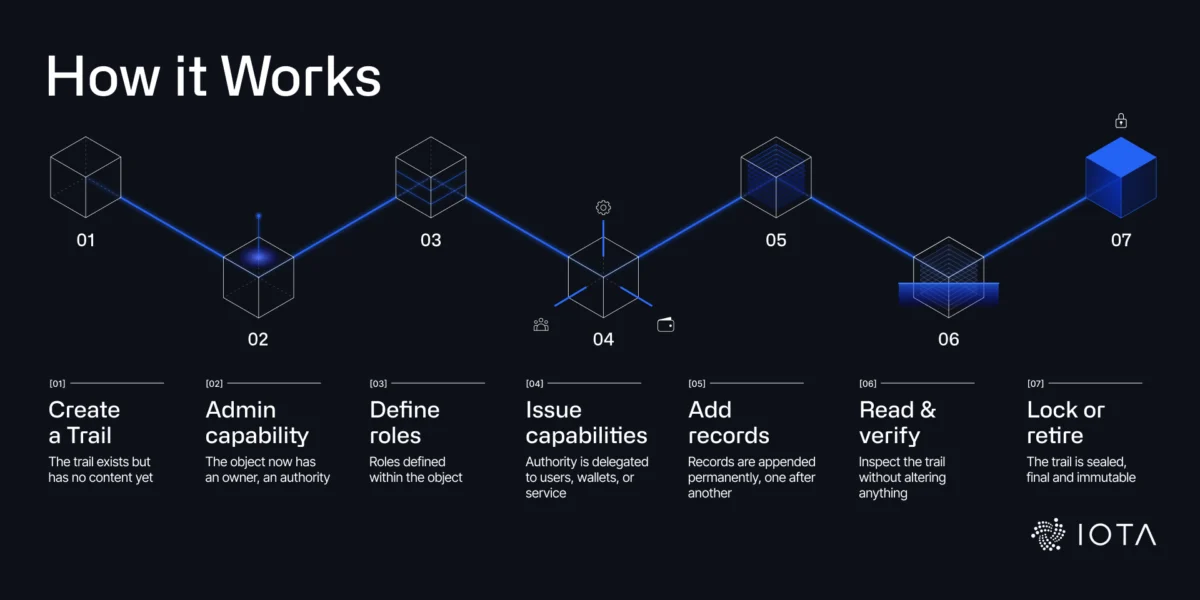
A typical workflow involves several key stages:
- Trail Creation: An authorized entity initiates the creation of an audit trail, defining its initial configuration, including any foundational roles and permissions.
- Record Anchoring: Authorized actors append new records to the trail. Each record is timestamped and cryptographically linked to the previous one, forming an immutable chain. This can include hashes of off-chain data, operational status updates, or event logs.
- Metadata Updates: Designated roles can update operational metadata associated with the trail or specific records, providing context or status changes without altering the historical record itself.
- Role and Capability Management: Administrators can modify roles and capabilities over time, reflecting changes in organizational structure or responsibilities, adhering to predefined governance rules.
- Trail Locking: At a predetermined point, or upon meeting specific conditions, an audit trail can be "locked." This action renders the trail immutable, preventing any further modifications and permanently preserving the historical record. This is a critical step for archival purposes and for establishing a final, verifiable state.
This structured process empowers developers to implement a reusable pattern for constructing append-oriented histories that incorporate explicit authority and lifecycle controls, ensuring data integrity and auditable provenance throughout its existence.
Comprehensive Developer Tooling for Seamless Integration
The IOTA Audit Trails solution is delivered as an integral part of the IOTA Notarization toolkit, offering developers three distinct integration paths to suit various project needs. For on-chain contract logic, a Move package is available, allowing for the implementation of audit trail functionalities directly within smart contracts. Backend integrations are facilitated by a typed Rust SDK, providing robust and efficient tools for managing audit trails from server-side applications. For front-end applications and JavaScript-centric development environments, WebAssembly bindings offer seamless integration for JavaScript and TypeScript projects.
The repository further enriches the developer experience with ready-to-run examples. These examples cover diverse use cases such as customs clearance, clinical trial event tracking, and the management of digital product passports, providing practical blueprints for implementation. A key design principle is the separation of transaction construction from submission. This architectural choice allows developers the flexibility to integrate IOTA Audit Trails into their existing wallet infrastructure, custom signing processes, or established "gas station" workflows, ensuring a smooth adoption process.
The Transformative Power of Shared Verification Across Industries
IOTA Audit Trails is a versatile, general-purpose solution designed to benefit any workflow demanding a verifiable and ordered history. Its impact is particularly pronounced in industries where records frequently traverse organizational boundaries, carry significant regulatory weight, or necessitate verification by parties external to the originating system.
In supply chains and the burgeoning field of digital product passports, manufacturers can meticulously record lifecycle events, maintenance updates, inspections, and certifications. This creates an unbroken, verifiable chain of custody for components, tracing their journey from initial production through to their final use. For legal and compliance teams, the solution enables the construction of verifiable histories for critical documents such as approvals, filings, contracts, and other regulated operational records, significantly streamlining compliance audits and risk management.
Customs and trade workflows stand to gain immensely from the ability to coordinate clearance steps, inspections, and declarations across multiple parties, with role-scoped updates ensuring transparency and accountability throughout the process. Furthermore, IoT and automation systems can leverage audit trails to record machine events, sensor attestations, maintenance actions, or system state changes with irrefutable provenance.
Across all these sectors, the core value proposition of IOTA Audit Trails lies in the establishment of shared verification. Instead of relying on the laborious and error-prone process of reconciling disparate logs after the fact, each participant can confidently rely on the same, consistent, and immutable ordered history. This shared understanding fosters collaboration, reduces disputes, and accelerates decision-making.
Embarking on the Audit Trails Journey
For organizations eager to explore the capabilities of IOTA Audit Trails, a suite of resources is readily available to facilitate the learning and adoption process. These include:
- Comprehensive Documentation: Detailed guides and API references are provided to assist developers in understanding the intricacies of the solution.
- Interactive Examples: The ready-to-run examples, covering diverse industry use cases, offer practical demonstrations of how to implement and utilize audit trails.
- Developer Community Support: The IOTA builder community provides a platform for developers to ask questions, share insights, and collaborate on projects.
- Access to Testnet and Mainnet: The solution is available for experimentation on the IOTA Testnet, allowing teams to validate their architectures and refine their implementations. As they move towards production readiness, deployment on the IOTA Mainnet offers a robust and secure environment.
The release of IOTA Audit Trails as an alpha signifies a commitment to iterative development and community feedback. It invites teams to experiment, validate architectural concepts, and contribute to the ongoing refinement of this critical enterprise tool.
In conclusion, the trustworthiness of audit logs has historically been contingent upon the integrity of the underlying system. When that system is a monolithic database or a centralized administrator, trust often fails to propagate effectively across organizational divides. IOTA Audit Trails fundamentally alters this dynamic by transforming discrete record histories into shared, verifiable objects. Any authorized party, irrespective of their position within a workflow, can now independently inspect these histories, fostering an unprecedented level of transparency and accountability. The foundation is laid for a future where verifiable, immutable, and collaboratively accessible audit trails become the standard for critical business processes, driving efficiency, trust, and innovation across industries. The IOTA Foundation encourages developers to run the provided examples, model their first audit trails, and rigorously test their own records, roles, and governance rules, anticipating a wave of innovative applications built upon this powerful new capability.