The landscape of cryptocurrency mining underwent a historic paradigm shift following the completion of the Ethereum network’s long-anticipated transition to a Proof-of-Stake (PoS) consensus mechanism, widely known as the Merge. By eliminating the need for energy-intensive computational power to validate transactions and secure the blockchain, this architectural upgrade immediately rendered redundant the vast infrastructure of graphics processing units (GPUs) that had historically powered the world’s second-largest cryptocurrency. Consequently, a massive influx of displaced miners redirected their computational power—known as hashrate—toward alternative Proof-of-Work (PoS-free) altcoins. This sudden migration triggered unprecedented difficulty spikes across smaller networks, plunging mining profitability into deeply negative territory and leaving the future of GPU-based mining facing an existential crisis.
The Mechanics of the Migration and the Difficulty Explosion
To understand the severity of the current downturn, one must examine the fundamental economics of Proof-of-Work blockchains. Unlike Bitcoin, which relies primarily on specialized Application-Specific Integrated Circuits (ASICs), the vast majority of secondary PoW cryptocurrencies—such as Ethereum Classic (ETC), Ravencoin (RVN), and Ergo (ERG)—were historically mined using consumer-grade and enterprise graphics cards. Before the Merge, the combined hashrate of these alternative networks was a mere fraction of Ethereum’s immense computational footprint.
When the Ethereum network officially severed ties with its miner base, hundreds of thousands of active GPU rigs were left without a revenue source. While a segment of the mining community chose to liquidate their hardware assets on secondary markets to recoup capital, a significant majority redirected their rigs toward the remaining GPU-mineable chains.
This mass migration collided directly with the automated self-regulating mechanisms inherent to blockchain architectures. Proof-of-Work networks utilize a difficulty adjustment algorithm designed to maintain a relatively constant rate of block production regardless of fluctuations in network participation. As hashrate increases, the network automatically raises the mathematical difficulty required to mine a block. The sudden, exponential surge of former Ethereum miners entering these smaller ecosystems caused a corresponding explosion in mining difficulty. Because the reward pools for these alternative coins remained fixed while the competition to solve blocks multiplied exponentially, individual miners found their daily yields severely diluted.

Financial Realities: Examining the Data from WhatToMine
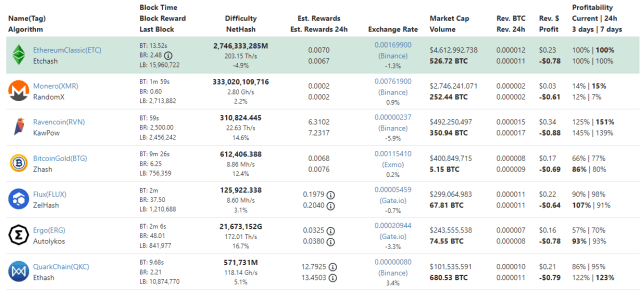
Data compiled from prominent crypto mining profitability calculators, including WhatToMine, illustrates the catastrophic financial reality facing GPU miners in the post-Merge era. An analysis of the market capitalization leaders among remaining Proof-of-Work tokens reveals a complete absence of positive profit margins across the board.
For Ethereum Classic, which emerged immediately following the Merge as the primary destination for displaced GPU miners, hourly returns plummeted into the red. Calculations based on standard operational parameters—assuming an average residential electricity cost of $0.10 per kilowatt-hour (kWh) and utilizing the combined processing power of a standard three-GPU rig equipped with AMD RX 480 cards—yielded a net return of approximately -$0.78 per hour. Even for operators utilizing top-tier, enterprise-grade hardware such as the Nvidia RTX 3090 Ti, efficiency metrics failed to offset rising operational expenditures, with hourly profits stagnating between -$0.50 and -$0.60 depending on local energy tariffs.
When factoring in facility overhead, cooling requirements, and hardware depreciation, the operational cost of running a GPU rig quickly surpasses the fiat value of the block rewards and transaction fees earned. For independent miners operating in regions with moderate to high electricity costs, continuing to power mining equipment has become a liability rather than an income-generating enterprise.
The Chronology of the Transition
The events leading up to this current profitability crisis are the result of years of development, testing, and community deliberation within the Ethereum ecosystem.

The conceptual groundwork for the transition away from Proof-of-Work began nearly with the inception of Ethereum itself, driven by concerns regarding the network’s massive carbon footprint and scalability limitations. The timeline accelerated significantly through the deployment of the Beacon Chain in December 2020, which established the parallel Proof-of-Stake infrastructure.
Throughout 2021 and early 2022, developers executed a series of testnet dry runs, culminating in successful merges on the Ropsten, Sepolia, and Goerli test networks. Despite minor delays caused by client software readiness, the core developers finalized the target block height for the mainnet transition in August 2022. On September 15, 2022, the Paris upgrade executed successfully at terminal total difficulty (TTD) 58750000000000000000000, officially concluding Ethereum’s PoW era. Within hours of the transition, the global hashrate supporting Ethereum dropped to zero, setting off the immediate migration wave toward alternative networks and the subsequent difficulty shocks observed across the broader altcoin market.
Industry Reactions and Stakeholder Perspectives
Reactions from across the digital asset industry have underscored a deep ideological and economic divide between proponents of Proof-of-Stake and the traditionalist mining community.
Representatives from major mining pools and hardware manufacturers expressed immediate concern over the lack of market depth among alternative PoW assets. Industry analysts had long warned that no single secondary cryptocurrency possessed the market capitalization or transaction volume necessary to absorb the massive surplus of hashpower previously dedicated to Ethereum. While forks such as Ethereum Classic (ETC) experienced temporary surges in price and network activity immediately preceding and following the Merge, the underlying economic fundamentals could not sustain the sudden influx of computational resources.
Conversely, environmental advocates and institutional stakeholders lauded the Merge as a monumental achievement for the cryptocurrency sector. By reducing global electricity consumption virtually overnight by an estimated 0.2% to 0.4%, the network effectively neutralized the primary criticism lobbied against digital assets by regulators, traditional financial institutions, and ESG (Environmental, Social, and Governance) focused investors. Ethereum developers emphasized that the successful execution of the upgrade paves the way for future scalability enhancements, such as sharding, which would have been significantly more complex to implement under the legacy mining model.
Broader Economic Implications and the Future of GPU Mining
The immediate fallout of the Merge extends far beyond individual mining balance sheets, carrying significant implications for hardware manufacturers, global energy markets, and the broader altcoin economy.
For hardware manufacturers such as Nvidia and Advanced Micro Devices (AMD), the sudden cessation of industrial-scale GPU purchases for crypto mining coincides with a broader cooling in consumer electronics demand. The secondary market has experienced a sudden supply glut, with used graphics cards flooding online marketplaces at heavily discounted prices as former miners liquidate inventory to pay off debts or transition to alternative business models. This influx of cheap, heavily used hardware poses short-term pricing challenges for retail GPU sales, though it may ultimately benefit budget-conscious gamers and artificial intelligence researchers seeking cost-effective computational power.
From an energy perspective, the shift has resulted in a localized reduction in industrial power consumption, particularly in regions with historically low electricity tariffs that had previously attracted large-scale mining operations. Miners unable to secure sub-economic power contracts have been forced to shutter operations indefinitely, leading to a permanent contraction of the global crypto-mining footprint.
Looking forward, the long-term viability of graphics card-based mining remains highly uncertain. Industry observers note that for GPU mining to recover its historical profitability, either a substantial contraction in global hashrate must occur—meaning more miners must permanently exit the market—or a new generation of high-valuation, GPU-mineable cryptocurrencies must emerge to absorb the excess capacity. Until such structural market shifts materialize, the era of accessible, profitable home-based and enterprise GPU mining appears to have reached a definitive, sobering conclusion.