The landscape of professional Zcash mining is undergoing a significant technical shift as Luxor Technologies announces the expansion of its LuxOS firmware to include the Antminer Z15 Pro. This development marks the first time the company has extended its optimization software—previously restricted to the Bitcoin (SHA-256) ecosystem—to Equihash-based hardware. With Zcash (ZEC) currently trading near the $1,200 threshold and the network’s total hashrate hovering around 31 GSol/s, the introduction of customizable firmware offers operators a new mechanism to navigate fluctuating profitability metrics in an increasingly competitive environment.
A New Frontier for Equihash Optimization
For years, the Antminer Z15 Pro has served as a staple in Zcash mining operations, arriving from the factory as a "black box" unit. Standard firmware limits these devices to a fixed performance ceiling of approximately 840 KSol/s, offering owners little flexibility to adjust for varying power costs or cooling infrastructure. Luxor’s integration of LuxOS into this hardware fundamentally alters this dynamic, shifting the Z15 Pro from a rigid, manufacturer-locked device into a granularly tunable asset.
The software suite introduces advanced features that were previously unavailable to Z15 Pro operators, including per-chip monitoring, health scoring, and dynamic voltage and frequency control. By allowing operators to recalibrate their machines based on specific site conditions, Luxor aims to capture the "untapped" potential that stock firmware fails to address. This is particularly significant for large-scale mining fleets, where even marginal improvements in efficiency or output can lead to substantial differences in quarterly earnings.
Chronology and Technical Benchmarking
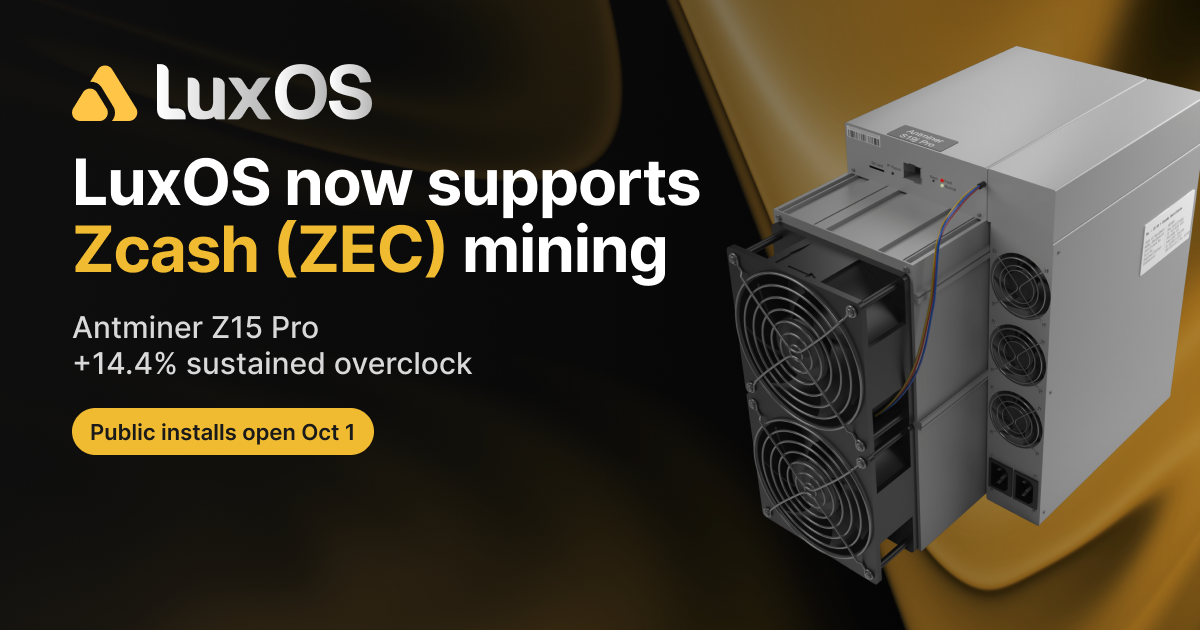
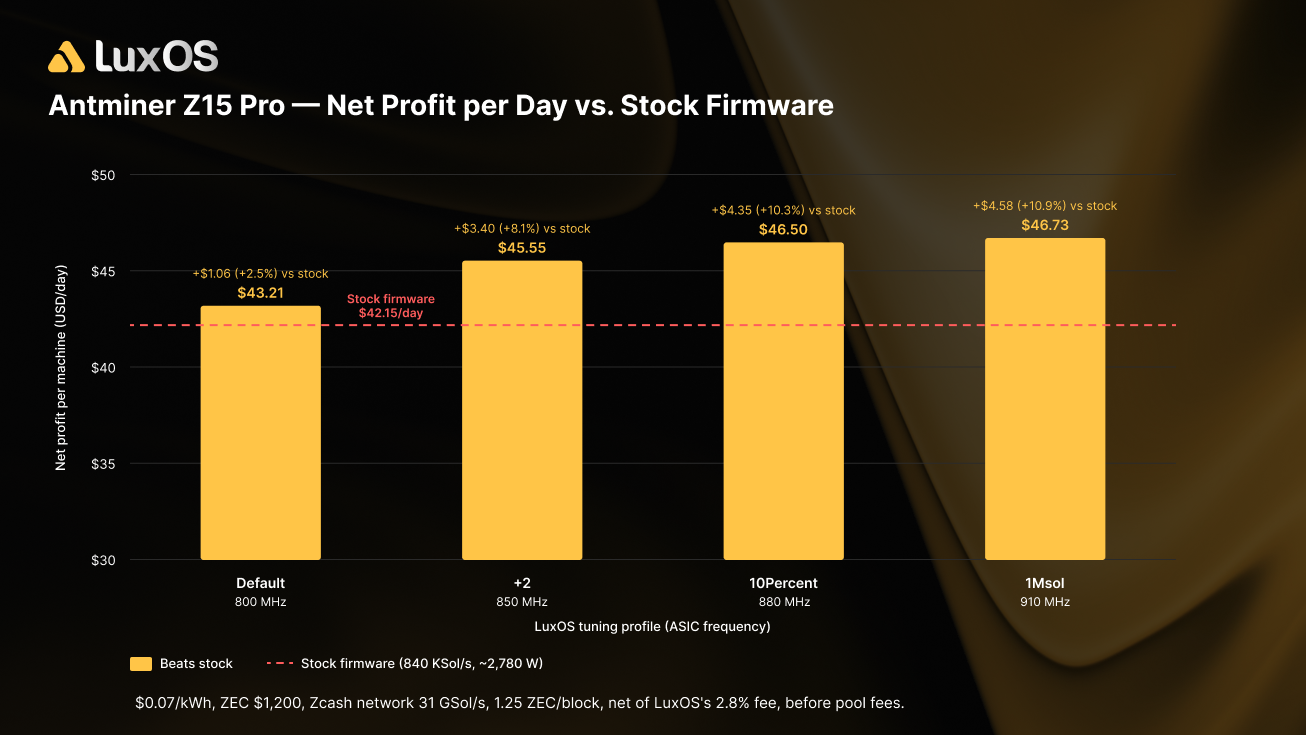
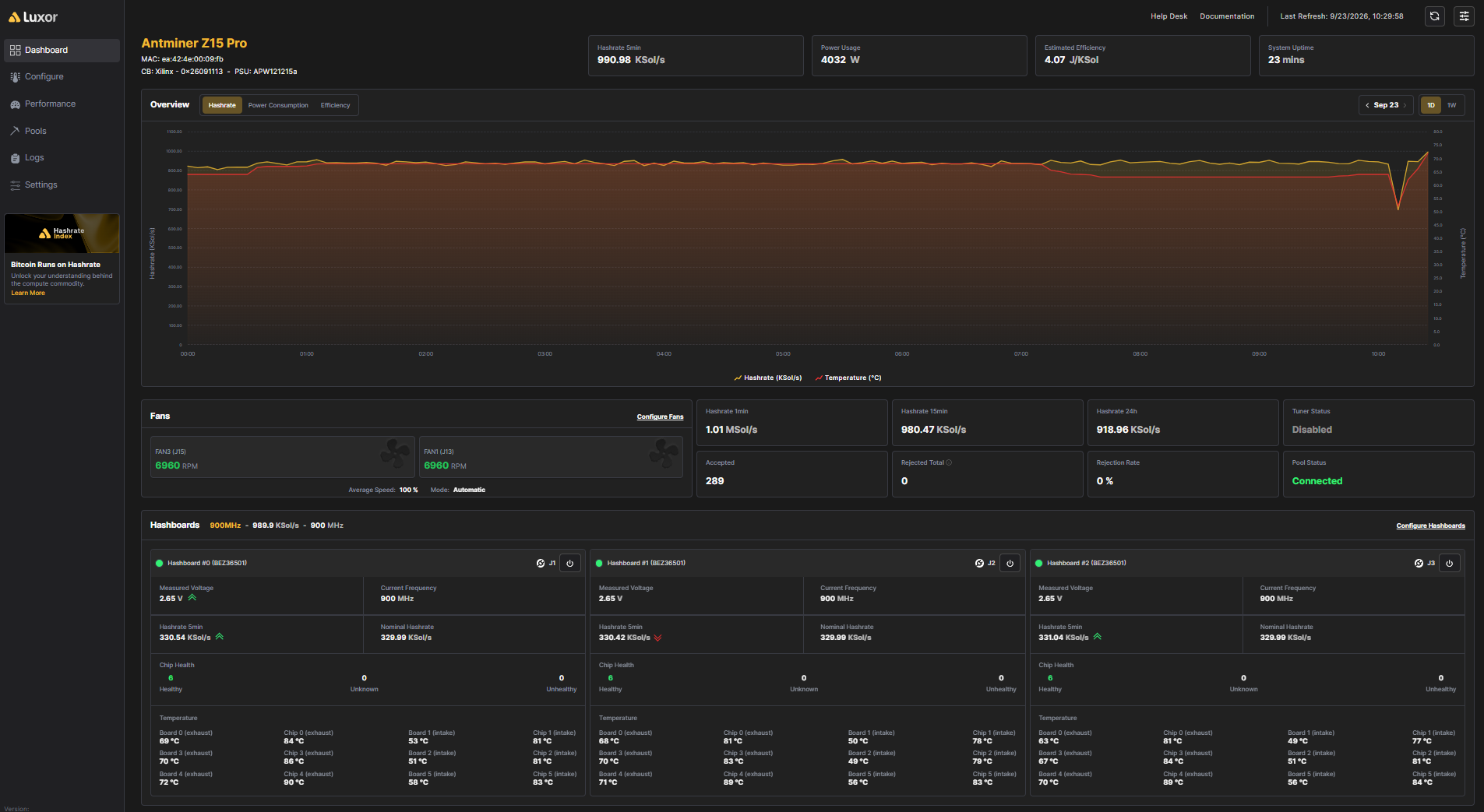
The transition to supported Equihash firmware began in earnest with extensive internal testing. On September 23, 2026, technicians at Luxor completed performance evaluations on a pilot Z15 Pro unit. The results highlighted a stark contrast between factory-standard operations and the optimized firmware. While the stock Z15 Pro consumes roughly 2,780 W to produce 840 KSol/s, the test unit running LuxOS achieved a sustained hashrate of 961 KSol/s—a significant increase in raw output.
This performance gain does not come without cost, as the increased hashrate requires a higher power draw, measured at approximately 4,032 W. However, in regions where electricity costs are optimized, the trade-off favors the higher output. Luxor has confirmed that public installations for this firmware will commence on October 1, 2026. This rollout follows a period of private testing designed to ensure stability and compatibility across varying hardware conditions, including chip quality and thermal management.
Economic Implications for Mining Operators
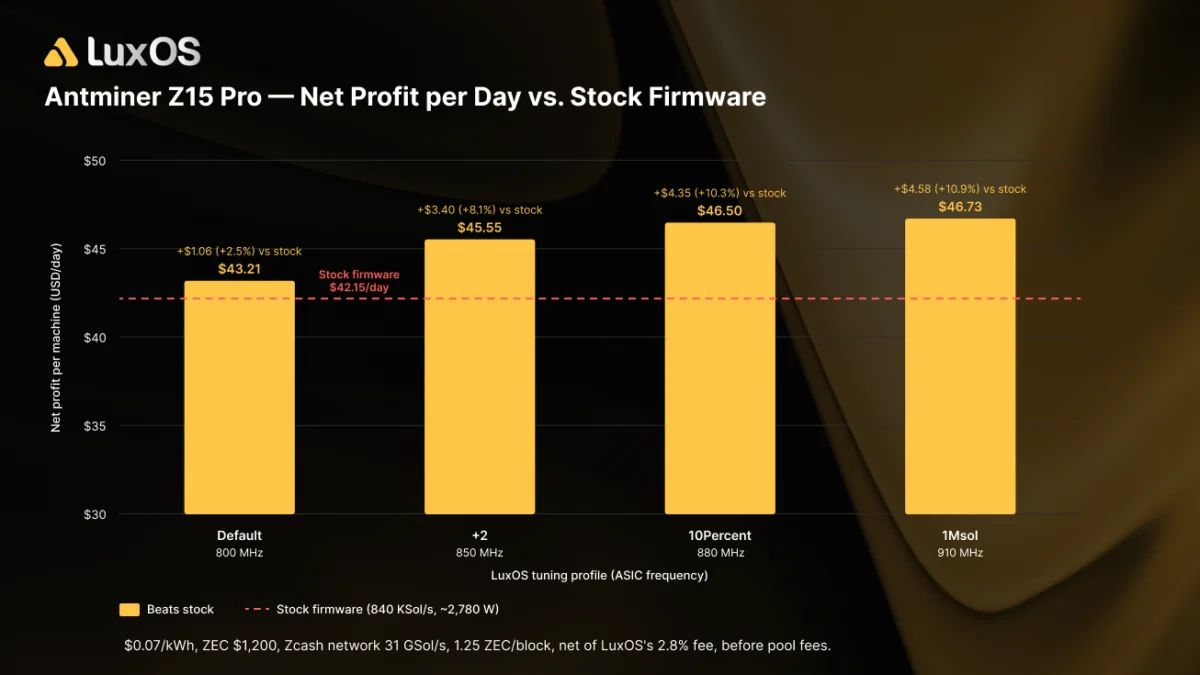
To understand the financial impact, one must evaluate the interplay between ZEC market price, network difficulty, and operational overhead. At a ZEC price of $1,200 and a power cost of $0.07/kWh, the economics favor the LuxOS overclock. Data indicates that a fleet running LuxOS can generate approximately $47 more per day per machine compared to units on stock firmware, even after accounting for the 2.8% fee imposed by Luxor for the use of its proprietary software.
Projecting these figures over a 90-day window reveals a widening gap in profitability. An operator with a standard Z15 Pro fleet might realize earnings of $3,794 per machine over three months under current market conditions. By comparison, an operator utilizing LuxOS on the same machines could realize upwards of $4,223, a surplus of $429 per unit. When extrapolated across large-scale data centers, these gains become a significant factor in capital expenditure recovery. For example, at current prices, the payback period for a Z15 Pro—purchased at approximately $7,475—is reduced from 177 days to 159 days through the implementation of the firmware.
Sensitivity Analysis and Market Variables
The profitability of this optimization is highly sensitive to external variables. The two most critical factors are electricity pricing and the underlying market value of Zcash.
Regarding power costs, the firmware is inherently designed to be gross-margin positive for most grid-connected operators. The "breakeven" point for the overclock occurs at approximately $0.23/kWh. Beyond this rate, the cost of the additional power consumed by the overclocked machine begins to outweigh the revenue generated by the extra hashrate. Below this threshold, however, operators see varying degrees of net gain.
Zcash price volatility also plays a pivotal role. The current breakeven point for the firmware upgrade, in terms of ZEC price, is roughly $370. Should the market price of ZEC fall below this level, the additional power required to maintain the overclock would become a net loss. Furthermore, as the total network hashrate increases, the difficulty of mining blocks also rises, which naturally dilutes the revenue for both stock and optimized machines. While the percentage-based gap in performance remains constant, the absolute dollar value of the gains will fluctuate in tandem with broader market trends.
Strategic Advantages of Firmware Customization
Beyond mere hashrate increases, the deployment of LuxOS introduces professional-grade management tools to the Z15 Pro fleet. The transition from a "black box" architecture to a transparent, data-driven environment allows for:
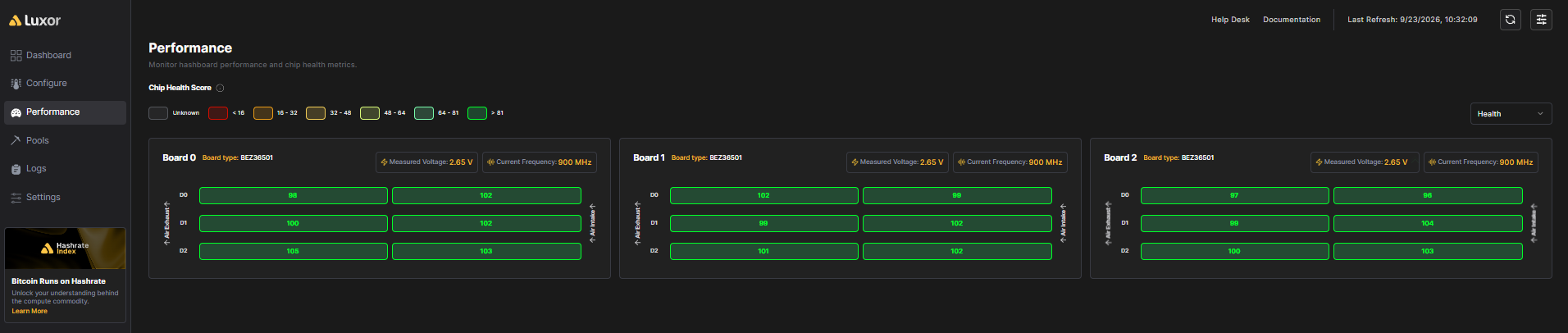
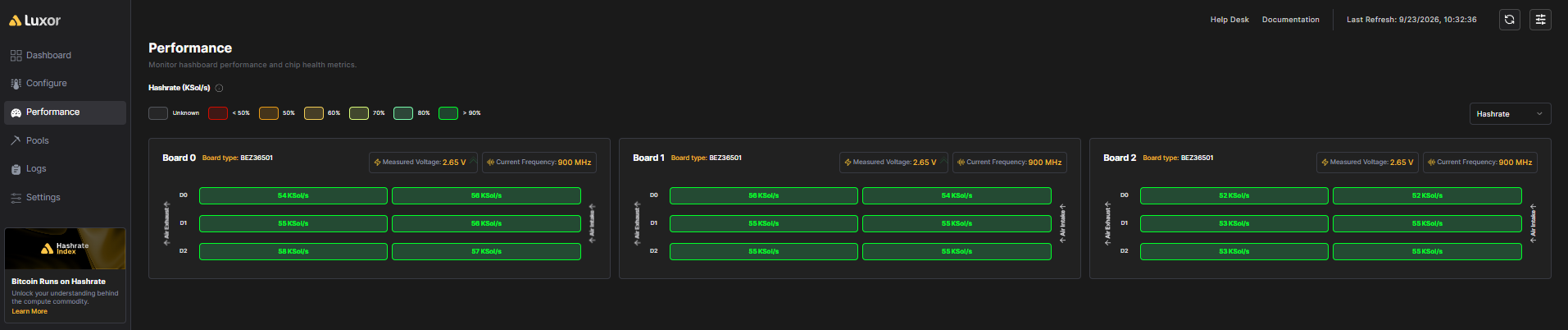
- Granular Health Scoring: Operators can identify underperforming chips or failing hashboards before they lead to total unit failure, minimizing downtime.
- Thermal Management: The ability to tune voltage allows operators in warmer climates to throttle performance to prevent overheating, while those in cold environments can push their machines harder than standard specifications allow.
- Fleet-Wide Monitoring: By centralizing management, data center operators can view the health and output of hundreds or thousands of units through a single dashboard, reducing the labor intensity required for maintenance.
Conclusion and Future Outlook
The introduction of LuxOS to the Antminer Z15 Pro represents a maturation of the Equihash mining sector. By importing the rigorous standards and software-driven efficiencies that have defined the Bitcoin mining industry, Luxor is enabling Zcash miners to operate with greater agility and precision. While the performance gains and increased revenue are significant, the ultimate value of such firmware lies in the control it grants operators over their own infrastructure.
As the industry moves toward a future where power efficiency and hardware longevity are the primary determinants of competitive survival, the shift toward flexible, third-party firmware is likely to accelerate. Luxor’s roadmap includes potential support for other Equihash hardware, suggesting that this move is merely the first step in a broader strategy to optimize the entire Zcash mining ecosystem. For the individual operator or the large-scale mining enterprise, the decision to adopt such technology hinges on a careful analysis of site-specific power costs and long-term price projections for the ZEC token. However, as the data from the September 2026 test cycle shows, for those capable of managing the thermal and power requirements, the firmware offers a clear pathway to enhanced operational performance.