Foundry, the powerhouse operator behind the world’s largest Bitcoin mining pool, has officially announced plans to expand its operational footprint into the privacy-centric cryptocurrency sector. The company is set to launch an institutional-grade Zcash (ZEC) mining pool slated for deployment in April 2026. This strategic initiative is specifically engineered to address and bridge a long-standing infrastructure gap for public companies and institutional entities looking to participate securely and compliantly in Zcash mining operations.
The announcement marks a significant milestone for both Foundry and the broader privacy coin ecosystem. By introducing an enterprise-grade infrastructure to Zcash, Foundry aims to bring the same level of reliability, regulatory compliance, and operational scale to ZEC that it has historically provided to the Bitcoin network through Foundry USA, currently the dominant Bitcoin mining pool by total computational power, or hashrate.
Background and Context of the Expansion
The decision by Foundry to venture into Zcash mining does not happen in a vacuum. Over the past decade, the cryptocurrency landscape has matured significantly, transitioning from a niche technological experiment dominated by retail enthusiasts into an institutional asset class. However, the infrastructure supporting privacy-focused digital assets has frequently lagged behind the rigorous standards required by publicly traded companies, regulated financial institutions, and corporate treasuries.
Zcash, launched in October 2016, occupies a unique position in the digital asset hierarchy. While pioneer cryptocurrencies like Bitcoin and Ethereum offer pseudonymous transparency—where transaction histories and public addresses are permanently recorded on an open ledger—Zcash introduced advanced cryptographic technology known as zero-knowledge proofs (specifically zk-SNARKs). This architecture allows users to execute transactions with absolute privacy regarding the sender, receiver, and transaction amount, while still maintaining consensus integrity on a public blockchain.
For years, this robust privacy feature created a friction point with institutional adoption due to regulatory compliance uncertainties. However, as the industry has evolved, developers and stakeholders have increasingly demonstrated that financial privacy and regulatory transparency can coexist through selective disclosure and compliant infrastructure design. Recognizing this maturation, Foundry has positioned itself to capture the rising institutional interest in privacy-preserving assets.

Chronology of Recent Developments and the Zcash Hashrate Boom
Foundry’s upcoming April 2026 launch arrives on the heels of a remarkable technical resurgence within the Zcash network. Over the past several quarters, the Zcash blockchain has experienced a substantial surge in network hashrate, reflecting renewed miner confidence and heightened computational participation.
Historical data from analytics providers such as BitInfoCharts illustrates the velocity of this growth. In October of the previous year, the total computational power dedicated to securing the Zcash network hovered below 8 Ghash/s. Since then, the network has undergone a dramatic expansion, with the active hashrate climbing steadily to surpass 13 Ghash/s. This upward trajectory indicates that hardware operators are increasingly allocating resources back toward Zcash mining operations, driven by shifting market dynamics, technological upgrades, and anticipated infrastructural improvements.
The timeline for Foundry’s entry involves rigorous preparatory phases leading up to the scheduled April 2026 rollout. Following the initial press release and stakeholder alignment, engineering teams are currently focused on establishing secure, resilient, U.S.-based operational frameworks mirroring the robust architecture utilized by Foundry USA.
Economic Architecture of Zcash
From a foundational standpoint, Zcash shares deep technical roots with Bitcoin. The protocol was originally derived from Bitcoin’s foundational codebase, resulting in identical or parallel macroeconomic principles. Like Bitcoin, Zcash operates on a Proof-of-Work (PoW) consensus mechanism, meaning new tokens are minted and introduced into circulation as rewards given to miners who successfully cryptographically verify and append new blocks to the blockchain.
Furthermore, Zcash enforces a strict maximum supply cap of 21 million tokens, mirroring Bitcoin’s deflationary scarcity model. To control the emission rate, the Zcash protocol incorporates a halving schedule, cutting the block reward in half approximately every four years. This predictable supply schedule has historically served as a core pillar of value retention, attracting long-term investors and capital allocators who favor transparent, programmatic monetary policies.

Official Responses and Industry Reactions
The announcement has generated widespread enthusiasm across the Zcash development community and independent support organizations. Industry leaders have been quick to praise Foundry’s strategic commitment to the ecosystem, viewing it as a validation of Zcash’s technological maturity.
Mike Colyer, Chief Executive Officer of Foundry, emphasized the necessity of bridging the gap between traditional corporate requirements and decentralized mining technology. "Zcash has matured into an institutional-grade asset, but the mining infrastructure supporting it hasn’t kept pace," Colyer stated, underlining the core motivation behind the upcoming pool.
Similarly, Zooko Wilcox, founder of Zcash and Chief Product Officer at Shielded Labs—an independent, Switzerland-based support organization dedicated to the growth of the ZEC ecosystem—welcomed the news with strong endorsement. "We at Shielded Labs are delighted that Foundry—the largest Bitcoin mining pool, and one based in North America—is launching an enterprise-grade Zcash mining pool," Wilcox remarked. The endorsement from a foundational figure like Wilcox highlights the collaborative synergy between major infrastructure providers and core protocol advocates.
Current Market Performance of ZEC
As Foundry prepares its infrastructure for the 2026 launch, the market price of Zcash continues to experience normal volatility characteristic of the broader digital asset markets. At the time of reporting, Zcash is changing hands at approximately $209 per token, reflecting a retracement of more than 11% over the preceding seven-day trading period. Market analysts note that while short-term price fluctuations remain tied to macroeconomic conditions and sector-wide sentiment, fundamental network health metrics—such as the aforementioned surge in hashrate—suggest underlying network strength independent of immediate price action.
Implications and Broader Impact on the Mining Ecosystem
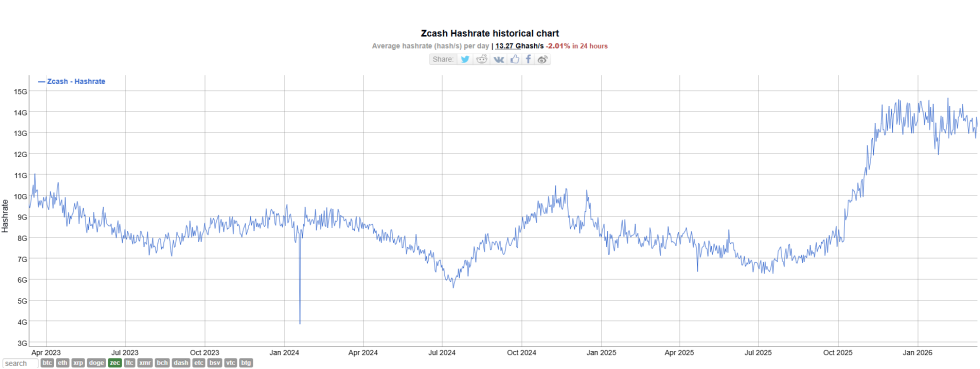
The introduction of an institutional-grade Zcash mining pool by an industry titan like Foundry carries profound implications for the digital asset mining landscape.
First, it provides a trusted, regulatory-compliant gateway for institutional entities, asset managers, and public corporations to directly engage with privacy-preserving networks without compromising on operational security or compliance standards. By utilizing US-based operations, Foundry ensures that participants benefit from jurisdictional clarity and adherence to rigorous corporate governance frameworks.
Second, the move is expected to decentralize and diversify the revenue streams of major mining operations. As profitability margins fluctuate within the Bitcoin mining sector due to rising energy costs and hardware competition, diversification into alternative Proof-of-Work networks like Zcash offers miners a viable hedge.
Finally, Foundry’s entry signals a broader shift in how privacy coins are perceived by the financial mainstream. By actively building enterprise infrastructure for a privacy-focused asset, Foundry helps legitimize the coexistence of transactional privacy and regulatory compliance, potentially paving the way for wider institutional integration across other privacy-centric protocols in the future.