The Middle East and North Africa (MENA) cryptocurrency ecosystem experienced a complex reporting period from July 2025 to June 2026, characterized by cross-border geopolitical pressures, regulatory transitions, and localized economic stresses. Despite a global bear market that halved total crypto market capitalizations worldwide, on-chain economic activity in the MENA region remained remarkably resilient. Total regional volume dipped by a mere 1.4%, moving from $449.6 billion down to $443.3 billion, closely tracking global trends. Out of 24 MENA markets with measurable data, 16 registered positive growth.

However, the flat regional total masked starkly divergent performances between its two largest economies. Türkiye and the United Arab Emirates (UAE)—which together account for 56% of the regional crypto economy—moved in opposite directions, effectively neutralizing each other’s gains and losses. Rather than succumbing solely to macro crypto market declines, the overarching narrative of the MENA crypto landscape was defined by how individual nations responded to layered regional disruptions, including the onset of the Iran conflict on February 28, 2026, sweeping new licensing mandates, and severe internet blackouts.
Chronology of Disruptions and Market Catalysts
The 2026 fiscal year was heavily punctuated by acute geopolitical and regulatory events that directly altered transactional behavior across the region.

January 2026 set an early tone of friction when the Central Bank of the Republic of Türkiye and the Turkish Treasury and Finance Ministry instituted structural controls, followed by the announcement of the Precious Metal Tracking System (KMTS) designed to curb cash purchases of physical gold. This regulatory pivot immediately redirected hundreds of millions of dollars into tokenized gold markets. Simultaneously, January saw the first of two major internet blackouts in Iran, where authorities choked digital access for 20 days following the eruption and suppression of domestic economic protests.
On February 28, 2026, the outbreak of the Iran conflict introduced severe cross-border pressure across every market studied. In Iran, this coincided with an 88-day rolling internet blackout that drastically restricted civilian access to digital infrastructure. In the UAE, Iranian drone and missile strikes directly tested national stability in March 2026, prompting a localized flight toward safe-haven assets.

As spring unfolded, regulatory enforcement matured. Türkiye began formally enforcing its comprehensive licensing regime through the Capital Markets Board (SPK), requiring all Crypto Asset Service Providers (CASPs) to hold institutional-grade licenses. By July 2026, the Turkish government issued new directives for digital precious metals trading, further formalizing the on-chain gold market. Concurrently, Israeli financial watchdogs advanced stricter capital requirements and regulatory frameworks for stablecoins and virtual asset service providers, cementing a regional shift toward tighter integration between digital assets and traditional finance.
Türkiye Transitions Toward Institutional Compliance Amid P2P Expansion
Türkiye retained its position as MENA’s largest crypto economy during the 2026 period, registering a total volume of $144.5 billion—roughly one-third of the entire regional economy. While this figure represents a modest contraction compared to prior years, industry stakeholders emphasize that the drop reflects a structural maturation rather than a market retreat. Activity migrated away from unverified services toward wallet-to-wallet rails, while institutional engagement from traditional banks and licensed platforms deepened.

At the close of the study period, Türkiye implemented a rigorous regulatory regime requiring all CASPs to secure licenses from the SPK, raising operational and compliance standards to mirror traditional financial institutions. Burcu Küükünal, CEO of Turkish exchange Stablex, noted that crypto in the country is successfully integrating into traditional finance rather than operating as a parallel system. Similarly, Fatih Günaydın, General Manager at Işık Digital Asset Technologies, observed that compliance requirements align Turkish firms with international standards, bolstering long-term institutional growth. Salim Karaman, CEO of BtcTurk, highlighted that the market focus has shifted decisively from assessing speculative potential to developing integrated financial services within clear regulatory bounds.
Despite this institutionalization, Türkiye maintained a flourishing grassroots peer-to-peer (P2P) economy. Domestic P2P volume surged fivefold to reach $3.56 billion, making it by far the largest P2P market in the region—nearly three times larger than the rest of MENA combined. This activity was heavily driven by stablecoin adoption, utilized by citizens seeking a stable store of value against persistent Turkish lira inflation.

However, because the Central Bank of the Republic of Türkiye prohibits the use of crypto assets for purchasing real-world goods and services, this multi-billion-dollar P2P volume functions strictly as a dollar-denominated savings and transfer mechanism rather than a medium of exchange within the domestic retail economy.
The Boom in Tokenized Gold Markets
One of the most profound developments in the Turkish market was the explosive growth of tokenized gold. For centuries, physical gold has served as the ultimate traditional store of value for Turkish households, with an estimated 5,000 tons hoarded under mattresses. In 2026, this cultural preference moved decisively on-chain, with trading volumes climbing from virtually zero in previous cycles to nearly $1 billion.

This migration was heavily catalyzed by the government’s introduction of the KMTS framework in January 2026, which banned cash purchases of physical gold bars and jewelry to combat the informal economy and counterfeit goods. Rather than reducing demand, the cash ban pushed investors onto digital rails. Turkish lira-denominated gold trading spiked immediately, hitting $183.9 million in February alone—accounting for 2.51% of the entire lira order book.
Data shows that Turkish lira became the second most popular currency globally for purchasing tokenized gold, trailing only the U.S. dollar, and captured a larger share of trading volume than any other currency with an order book exceeding $100 million. Even after the initial rush subsided following the implementation of the cash ban, trading volumes established a significantly higher baseline floor, prompting the government to issue formal regulatory directives for digital precious metals in July 2026.

The UAE’s Strategic Embrace Drives Institutional Inflows
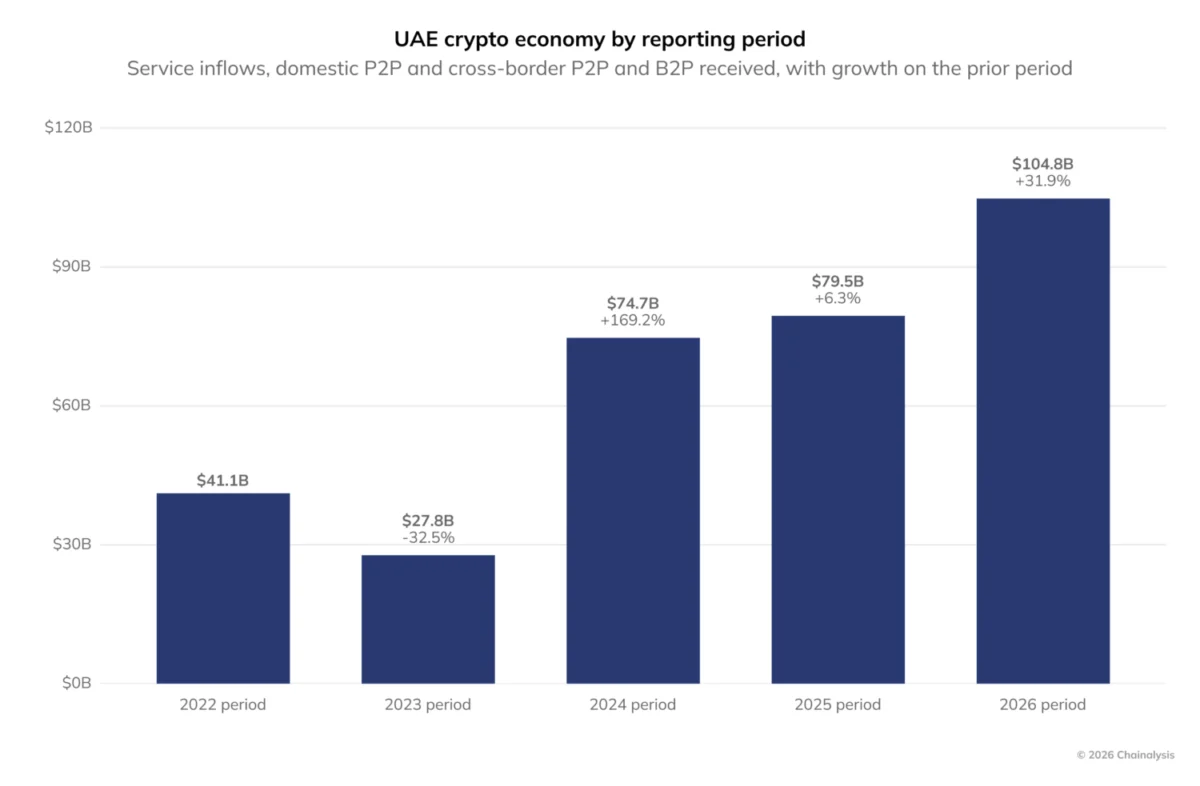
While Türkiye experienced a transitional contraction, the United Arab Emirates capitalized on its proactive regulatory framework to achieve substantial growth. Amid a regional backdrop of geopolitical conflict, the UAE’s crypto economy expanded by 32% to reach $104.8 billion. Excluding the UAE’s performance, the remainder of the MENA crypto economy would have contracted by 8.6% instead of 1.4%.
Henri Arslanian, co-founder of Nine Blocks Capital Management, pointed out that while sectors like tourism and hospitality faced headwinds from regional hostilities, the crypto industry experienced resilient growth. He credited Emirati financial regulators—such as the Virtual Assets Regulatory Authority (VARA) in Dubai, the Financial Services Regulatory Authority (FSRA) in Abu Dhabi, and the Dubai Financial Services Authority (DFSA)—with successfully mitigating career risk for corporate executives entering the digital asset space.

The UAE’s growth was predominantly anchored by its $102.3 billion services sector. Centralized exchange inflows rose 22% to $55 billion, while institutional platforms, including custodians and market-makers, surged 75% to $11.7 billion. Decentralized finance (DeFi) exchanges also recorded over $31 billion in total inflows, representing a 31% year-over-year increase. Furthermore, the UAE’s P2P and cross-border business payments experienced exponential spikes, fueled by large-scale stablecoin transfers exceeding $1 million. Laurent Girouille, Senior Executive Officer at Rain Trading Limited, noted that inquiries have transitioned entirely from retail access toward operational compliance, settlement reconciliation, and treasury management by family offices and institutional intermediaries.
Geopolitical Friction and Safe-Haven Shifts in the UAE
The onset of the Iran conflict in early 2026 influenced investor behavior within the UAE, resulting in a notable divergence between tokenized gold and bitcoin holdings. During the acute phase of the conflict in March 2026, when Emirati territory faced inbound threats, holdings of both bitcoin and tokenized gold surged as investors sought safe-haven assets.

However, as temporary ceasefires fluctuated, market behavior split. While bitcoin holdings subsequently declined as investors liquidated positions during periods of relative calm, the relative share of tokenized gold holders continued to climb steadily. Analysts attribute this stickiness to cultural investment habits, wherein gold is treated as a long-term accumulated savings instrument rather than a short-term trading asset. This mirrored the Turkish experience, proving that when regulated infrastructure supports familiar cultural assets, capital will consistently find compliant digital pathways during times of crisis.
Iran: Grassroots Resilience Amid Blackouts and Conflict
Iran presented a dual reality in 2026: it maintained one of the region’s most active grassroots crypto economies while simultaneously housing illicit networks utilized by the regime and the Islamic Revolutionary Guard Corps (IRGC) to evade international sanctions. Focusing strictly on everyday civilian adoption as a hedge against chronic inflation, blockchain analytics reveal how Iranian citizens navigated severe state-imposed restrictions.

Government-mandated internet blackouts significantly depressed digital activity. During the 20-day blackout in January and the subsequent 88-day blackout following the outbreak of war in late February, Iranian personal wallet transactions dropped sharply—plummeting by roughly 90% and 80%, respectively, during the initial weeks. However, transaction volumes never fell to zero. Over the course of the extended blackouts, citizens increasingly deployed alternative access methods, such as satellite internet infrastructure, successfully bypassing state blocks. By the conclusion of the second blackout, personal bitcoin transactions had rebounded to 75% of baseline levels, surging to nearly double the baseline once restrictions were officially lifted in late May.
Cross-border stablecoin inflows into Iran exhibited a similar pattern. Although initial military escalation triggered a 50% drop in inbound stablecoin transfers, inflows recovered rapidly, frequently surpassing pre-conflict baselines as soon as local participants regained connectivity. This demonstrated the immense persistence of populations operating under severe financial and digital isolation.

Israel’s Crypto Economy Maintains Steady State
In contrast to the volatility seen in Türkiye, the UAE, and Iran, Israel’s crypto economy held a remarkably steady trajectory, expanding by just 0.7% to reach $37.9 billion. It remained one of the few global markets to effectively absorb the bear market drag without significant expansion or contraction.
Activity in Israel remained overwhelmingly retail-driven and centralized around exchange inflows. Data from the 2026 period shows that 98.4% of Israeli service inflows involved transfers under $10,000, though these accounted for only 11% of total value. Conversely, large transfers of $1 million or more comprised 57% of total value, totaling $21.3 billion. Stablecoins continued to capture an increasing share of Israeli service inflows, rising from 48.1% in 2024 to 57.0% in 2026. However, because domestic peer-to-peer velocity remained exceptionally low (1.46 compared to a global average of 9.31), Israeli users primarily utilized stablecoins as a bridge to access offshore trading platforms rather than for internal retail transactions.

Significantly, unlike the UAE or Türkiye, the 2026 Iran conflict produced no visible shock or spike in Israeli crypto activity. According to market experts like Noam Kaplan, partner at KPMG Israel, and Ilan Sterk, CEO of Horizon, the Israeli market had already absorbed its primary behavioral adjustment following the events of October 7, 2023. By 2026, Israeli market participants operated within a mature framework awaiting the implementation of expanding regulatory guidelines concerning stablecoins, token offerings, and capital requirements for virtual asset service providers.
Implications and Outlook for 2027
The 2026 reporting period demonstrated that the MENA cryptocurrency ecosystem is not monolithic, but rather a collection of distinct markets responding dynamically to localized pressures. The UAE has solidified its status as an institutional powerhouse, successfully pulling ahead and narrowing the gap with regional leader Türkiye. Meanwhile, Türkiye’s retail base has permanently entrenched itself in P2P stablecoin and tokenized gold rails, even as institutional entities align with strict new SPK licensing frameworks.

As regulatory perimeters tighten from Dubai to Tel Aviv, and as geopolitical variables continue to test regional stability, the structural shifts witnessed in 2026 are expected to harden into permanent fixtures of the global financial architecture. The trajectory of MENA crypto adoption in 2027 will depend heavily on whether emerging regulatory frameworks begin permitting real-world commercial stablecoin settlements, a move industry experts suggest could unlock unprecedented utility and economic growth across the region.