Chainalysis Linked North Korea to History’s Largest Crypto Heist
The cryptocurrency sector has weathered numerous high-profile security breaches throughout its brief history, but none approach the sheer scale of the financial crime that unfolded on October 29, 2026. At approximately 4:20 p.m. Eastern Time, an unprecedented cyber assault targeted Binance, draining approximately $6.4 billion in digital assets from the exchange’s hot wallets across multiple blockchains. This staggering figure instantly cements the incident not only as the largest cryptocurrency hack in history, but also as one of the single-largest financial thefts of all time.
Blockchain intelligence firm Chainalysis swiftly mobilized its analytical capabilities, tracing the digital footprints left across various decentralized networks. Within hours of the exploit, investigators pieced together on-chain telemetry that pointed unequivocally toward a familiar threat actor: TraderTraitor, a notorious state-sponsored cybercrime collective originating from North Korea. The attack underscores a continuous, escalating threat landscape where sophisticated hackers leverage automated tools, cross-chain manipulation, and mixer protocols to siphon funds, testing the resilience and collaborative defense mechanisms of the global digital asset economy.
Anatomy of an Unprecedented Multi-Chain Exploit
The mechanics of the October 29 breach reveal a high degree of technical sophistication and premeditation. The assault began when funds started evacuating Binance hot wallets simultaneously across several distinct blockchain ecosystems. On the Ethereum network, the attacker utilized an operational wallet previously funded through Tornado Cash—a decentralized cryptocurrency mixer designed to obscure the provenance of funds—to submit valid, cryptographically signed authorizations. These authorizations effectively tricked a Binance hot wallet into executing code deployed by the attacker.

Once the malicious code was active, the attacker invoked the compromised wallet to sweep its accumulated holdings directly into addresses under their exclusive control. Meanwhile, across other targeted blockchains, unauthorized transfers mirrored ordinary signed transactions, masking the malicious extraction as routine network traffic. By the time the dust settled on the initial wave, the aggregate unauthorized transfers reached the unprecedented sum of $6.4 billion USD.
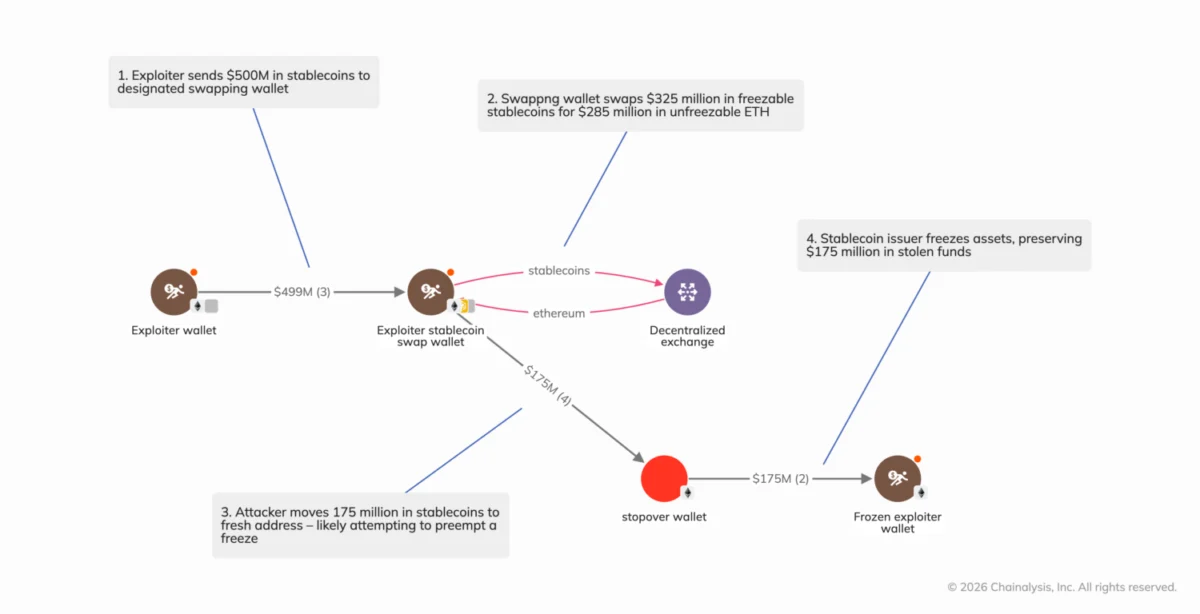
For the perpetrator, executing the heist was only the first phase of a high-stakes operational window. The stolen capital consisted of a diverse mix of unfreezable native tokens like Bitcoin and Ether, alongside billions of dollars denominated in stablecoins such as USDT and USDC. Unlike decentralized base-layer assets, centralized stablecoins carry a crucial vulnerability for hackers: issuers possess the administrative capability to freeze tokens associated with illicit addresses upon request from law enforcement or security partners. Recognizing that a race against time had begun, the attacker sought to convert easily frozen assets into unfreezable cryptocurrencies before industry blacklists could take effect.
The Chronology of the Heist and the Multi-Million Dollar Conversion Race
The chronology of the immediate aftermath highlights a frantic twenty-minute window where the attacker attempted to outpace global regulatory and technical responses. Approximately $500 million in stablecoins was swiftly funneled into an intermediary wallet tasked with swapping freezable assets for non-freezable alternatives. Over a span of roughly twenty minutes, the exploiter successfully converted $325 million in stablecoins into $285 million worth of Ether (ETH).
Ten minutes after completing this swap, the attacker dispatched the remaining $175 million in stablecoins to various stopover wallets, attempting to disperse the capital before freeze protocols could be activated. Despite these calculated efforts, the decentralized finance ecosystem and centralized authorities demonstrated an unprecedented velocity of response. By 5:14 p.m. Eastern Time—less than an hour after the initial breach began—stablecoin issuers started freezing compromised accounts in coordination with industry investigators and global law enforcement agencies.
A Collaborative Industry Defense and the $2.8 Billion Freeze

The response to the Binance breach marked a watershed moment for collective security within the cryptocurrency industry. Rather than relying on isolated security measures, an ad-hoc coalition comprising Chainalysis investigators, law enforcement bodies, stablecoin issuers, and various cryptocurrency exchanges engaged in a synchronized defense. Operating largely in parallel, these entities shared real-time intelligence, proactively distributing investigative leads to identify and quarantine stolen funds before they could be fully laundered into untraceable channels.
As a direct result of this rapid, multi-faceted intervention, approximately $2.8 billion of the stolen $6.4 billion has been successfully frozen as of early November 2026. While the scale of the loss remains monumental, the recovery of nearly half the stolen capital underscores a maturing digital asset economy. It demonstrates that industry participants possess the technical capability to act in unison, establishing a formidable deterrent against even the most well-resourced state-backed threat actors.
Connecting the Dots: The Attribution to North Korea’s TraderTraitor
Attributing sophisticated state-sponsored cyberattacks typically requires exhaustive forensic analysis, yet the clues pointing toward North Korea’s involvement materialized almost immediately. Initial laundering patterns observed by blockchain investigators bore the distinct signatures of previous state-sponsored campaigns. However, the definitive link emerged when Chainalysis analysts tracked funds stolen from Binance directly commingling with capital stolen during a separate exploit against Bitget just one month prior—a breach that had already been formally attributed to North Korean cyber operations.
This direct on-chain convergence provided the empirical proof necessary to confirm the identity of the perpetrator. On October 30 at 12:30 a.m. Eastern Time, Chainalysis publicly attributed the Binance theft to TraderTraitor. This notorious cluster of activity has repeatedly targeted global cryptocurrency exchanges, decentralized finance (DeFi) protocols, and individual investors. For Pyongyang, these state-backed cyber heists serve as a vital mechanism to generate illicit revenue, circumventing crippling international economic sanctions and funding the regime’s strategic priorities.
Advanced Laundering Techniques and the Shift Toward Automation

As the investigation transitioned from immediate containment to long-term tracking, security researchers uncovered novel money laundering methodologies that suggest a high degree of automation. Rather than employing traditional, linear transfer routes to move stolen assets to centralized exchanges or decentralized mixing services, the attackers deployed programmatic scripts to obscure the audit trail.
Thousands of transactions executed within extremely tight timeframes revealed a complex web of circulation. Stolen funds were repeatedly routed back and forth among previously utilized addresses to create intentional confusion on the blockchain ledger. A particularly distinct pattern involved numerous addresses receiving an exact increment of 1 TRX (Tron’s native token) before receiving larger tranches of stolen funds and subsequently forwarding them onward. This consistent programmatic fingerprint indicates that the cybercriminals utilized smart contracts or custom scripts to automate the redistribution of billions of dollars across multiple blockchains simultaneously.
Broader Implications for Cryptocurrency Exchanges and Regulatory Compliance
The Binance breach carries profound implications for the global cryptocurrency architecture. Centralized exchanges, by virtue of holding substantial liquidity pools and managing vast user bases, remain primary targets for sophisticated hacking collectives regardless of their geographic jurisdiction or regulatory standing. The sheer magnitude of a $6.4 billion exploit highlights critical vulnerabilities in hot wallet infrastructure, signaling that traditional perimeter security defenses may be insufficient against advanced, state-sponsored persistent threats.
For compliance teams, risk management personnel, and institutional participants, the incident emphasizes the critical necessity of advanced blockchain analytics tools. Modern compliance frameworks must integrate real-time transaction monitoring, automated address screening, and predictive risk scoring to detect abnormal wallet interactions before funds can cross institutional boundaries. Platforms such as Chainalysis have updated their KYT (Know Your Transaction) and Address Screening products, enabling compliance officers to immediately identify exposure to addresses tied to the TraderTraitor incident.
Looking Ahead: The Ongoing Investigation and Industry Vigilance

As the investigation stretches into the coming weeks and months, cybersecurity experts anticipate that the remaining unfrozen funds will continue to circulate through increasingly complex obfuscation networks. Law enforcement agencies and blockchain analytics firms remain embedded in active tracking operations, working to disrupt further laundering attempts and recover additional assets.
The unprecedented nature of the Binance incident serves as a stark reminder of the persistent asymmetric warfare waged against digital financial infrastructure. While the successful freeze of $2.8 billion demonstrates the efficacy of modern cross-industry collaboration, it also reinforces the reality that vigilance cannot be relaxed. For cryptocurrency exchanges worldwide, the event acts as an urgent catalyst to audit hot wallet security, enhance multi-signature governance structures, and foster deeper operational intelligence sharing. Only through proactive defense, robust regulatory compliance, and unbroken solidarity can the digital asset ecosystem hope to mitigate the ambitions of state-sponsored cybercrime syndicates in the future.