The global cryptocurrency landscape faced a challenging downturn between July 2025 and June 2026, yet Western Europe demonstrated remarkable economic resilience, cementing its status as the second-largest crypto economy worldwide. During this 12-month reporting period, the region’s all-in crypto economy achieved an aggregate valuation of $2.08 trillion. While widespread market contractions hit numerous international jurisdictions, Western Europe managed a modest overall growth rate of 1.2%, placing it alongside Sub-Saharan Africa and Latin America as one of the few regions to record positive performance.

This regional stability was not uniform, however. A shifting mosaic of regulatory milestones, rising institutional investment, mounting sovereign debt anxieties, and a structural pivot toward stablecoins radically reshaped the European digital asset ecosystem. Industry leaders note that the market is graduating from speculative retail experimentation into a mature, foundational financial architecture deeply intertwined with traditional banking systems.
Market Concentration Across Leading European Jurisdictions
The architecture of Western Europe’s crypto economy remains heavily concentrated. Six core markets—the United Kingdom, Germany, France, the Netherlands, Spain, and Switzerland—accounted for approximately two-thirds of the entire regional economy during the reporting period.

The United Kingdom retained its crown as Western Europe’s largest individual crypto market, registering an economy valued at $424.5 billion and capturing roughly 20% of the regional total. As a premier global financial capital boasting sophisticated capital markets, the UK’s digital asset sector has traditionally acted as an extension of its robust financial services industry. Despite its leading position, the UK experienced an 8% contraction in crypto activity over the reporting period, primarily driven by a significant pullback in decentralized exchange (DEX) volumes.
Germany followed as the second-largest market at $288.8 billion, with France securing third place at $215.8 billion. Like the UK, Germany saw a modest economic contraction fueled largely by declining decentralized trading activity, while France’s market remained broadly flat. Conversely, Southern and Alpine nations bucked the contractionary trend; Spain recorded $156.1 billion in crypto economic activity, and Switzerland reached $132.8 billion. Both nations enjoyed positive growth, propelled heavily by heightened activity on centralized exchanges (CEXs). The Netherlands rounded out the top tier with a substantial $207.8 billion economy.

This regional dispersion illustrates a fundamental maturation phase. Industry experts emphasize that traditional financial institutions are no longer viewing blockchain merely as a competing parallel economy, but rather as an advanced technological infrastructure upon which future financial products can be efficiently built.
Regulatory Integration and the Ascendance of the Euro
A primary catalyst for structural change in the European Union has been the rollout and complete enforcement of the Markets in Crypto-Assets (MiCA) regulation. Designed to establish a harmonized legal framework for crypto-asset issuers and service providers across the 27-member bloc, MiCA has largely replaced regulatory uncertainty with long-term investor confidence.

The implementation of MiCA coincided with a notable expansion of the euro’s role in global digital asset trading. According to data from the Bank for International Settlements (BIS), the euro accounted for 28.9% of global foreign exchange (FX) turnover in April 2025. When utilizing an adjusted benchmark of 14.5% to account for one-sided crypto order-book pairs, research shows that euro-denominated trading reached 11.8% of crypto volume across the 33 leading government-issued currencies by the end of the reporting period. This considerable increase brings the euro closer to its traditional FX benchmark, indicating that the currency is increasingly acting as a primary gateway into digital asset markets.
Market participants have widely praised this regulatory harmonization. Executives note that once crypto service providers secure a license under MiCA, they gain valuable passporting rights, allowing them to scale operations seamlessly across multiple EU member states without navigating fragmented national regimes. This regulatory clarity has directly supported the burgeoning institutional adoption observed throughout the continent.

Stablecoin Surge and Sovereign Debt Pressures
While traditional crypto trading volumes experienced mixed results, stablecoin adoption across Western Europe exploded, outpacing global trends by a wide margin. Regional stablecoin holdings surged by 131% between July 2025 and June 2026, easily eclipsing the 52% growth rate recorded globally. This massive expansion elevated Western Europe’s share of global stablecoin balances from 3.4% to 5.1%, with France and Austria leading the charge in 2026.
This hyper-growth has triggered intense policy debates among traditional monetary authorities. In September 2026, the European Central Bank (ECB) and national central banks voiced strong opposition to certain MiCA reserve requirements, arguing that mandating stablecoin issuers to hold up to 60% of their reserves in European commercial bank deposits could expose those institutions to severe systemic liquidity risks during large-scale token redemptions. Despite regulatory caution, financial institutions are aggressively moving forward with regulated euro-backed stablecoins to serve as on-chain cash legs for tokenized assets and programmable business-to-business payments, shielding the continent from excessive reliance on U.S. dollar-denominated stablecoins.

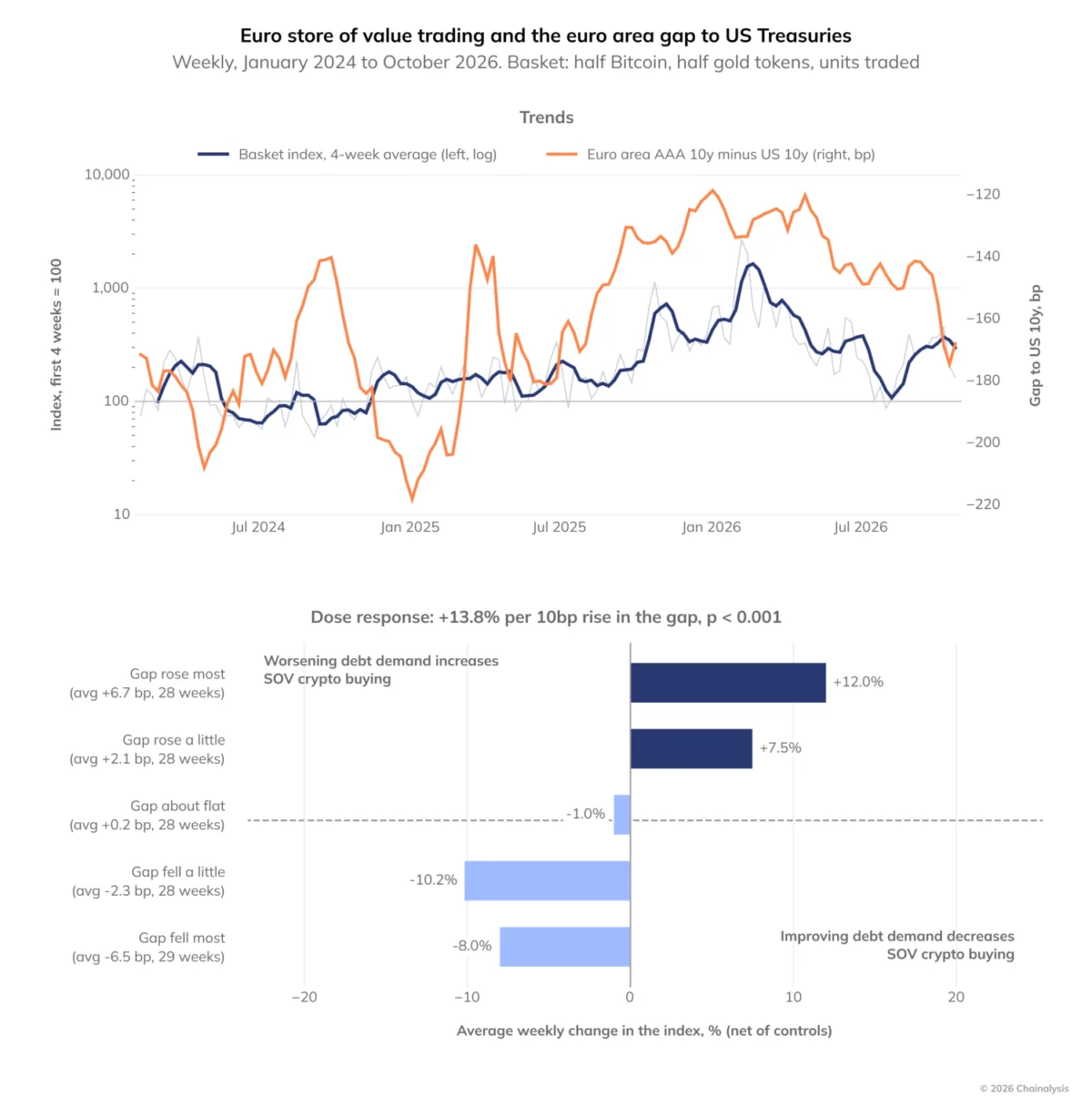
Concurrently, shifting macroeconomic indicators began influencing investor behavior. Rising euro-area government bond yields relative to U.S. yields—spurred by mounting fiscal pressures and public debt concerns in countries like France, where 10-year borrowing costs breached 5.14% in October—coincided with a measurable uptick in euro-denominated trading of Bitcoin and tokenized gold. Empirical data demonstrated a clear correlation: as euro-area bond yields rose relative to U.S. Treasuries, regional trading in alternative store-of-value assets climbed significantly, suggesting that retail and institutional traders were increasingly hedging against sovereign debt and fiscal volatility.
Divergence Between the UK and the European Union
The macroeconomic and regulatory divergence between the United Kingdom and the European Union became sharply pronounced during the 2026 reporting period. While the UK had historically outpaced the rest of Western Europe in crypto growth rates following Brexit, that dynamic reversed. While the UK’s crypto economy contracted by 8%, the EU expanded by 2.2%, and the broader region outside the UK grew by 3.8%.

This divergence is widely attributed to regulatory timelines. While EU providers were finalizing compliance under MiCA to secure pan-European operational rights, the UK pursued its own distinct path. The Financial Conduct Authority (FCA) designated stablecoin payments as a regulatory priority in 2026, and the Bank of England published draft rules for systemic stablecoins, introducing proposed holding limits for individuals.
Despite the overall UK market contraction, the country experienced an unprecedented explosion in domestic stablecoin activity. UK wallet-to-wallet stablecoin transfers skyrocketed from $109 million to $2.09 billion during the 2026 reporting period. The UK captured 60% of the entire region’s domestic transfer value, outpacing the rest of Western Europe combined. Furthermore, retail metrics indicated that 1.03% of eligible UK personal wallets converted at least 80% of their crypto holdings into stablecoins, placing the UK well ahead of continental peers like the Netherlands, Italy, and Germany. This behavioral shift underscores a growing reliance on stablecoins not merely for speculative trading, but as a domestic store of value and medium of exchange.

Self-Custody Trends in France and Pan-European Inflows to Spain
France emerged as a fascinating case study in how political instability, legislative gridlock, and fiscal austerity measures can drive citizens toward alternative financial mechanisms. Amid fierce public debates over national deficits and cost-of-living protests, French users increasingly embraced self-custodied stablecoins. France climbed from 10th place in 2023 to 1st place in Western Europe by 2026 for stablecoin-related withdrawals from centralized exchanges, which accounted for 54.2% of total French service withdrawals.
Simultaneously, the number of French personal wallets holding stablecoins more than tripled from 3,577 in June 2025 to 12,255 in June 2026, with self-custodied stablecoin balances expanding by 192%—dwarfing the stagnant 2% growth observed in traditional French bank deposits over the same timeframe. Analysts attribute this accelerated accumulation directly to periods of acute bond market stress and sovereign debt anxiety.

Meanwhile, Spain cemented its position as a major regional hub for digital asset infrastructure. Inflows to Spanish-registered exchanges from international European users accelerated dramatically, growing by 79.1% during the 2026 period to surpass domestic inflows for the first time. Major source markets like Italy and Portugal recorded staggering triple-digit percentage increases in capital routed to Spanish platforms. Industry executives credit this phenomenon to the lack of consolidated domestic operators in neighboring countries, combined with Spain’s aggressive adaptation to the MiCA regulatory framework, which has allowed established Spanish platforms to capture cross-border market share efficiently.
Implications for the Future of European Finance
The evolution of Western Europe’s crypto economy between 2025 and 2026 marks the definitive transition of digital assets from a fringe speculative asset class into a structurally integrated pillar of mainstream finance. As regulatory frameworks like MiCA mature, institutional participants deepen their engagement, and retail users increasingly adopt stablecoins to navigate fiscal uncertainties, the continent is forging a unique financial identity.

The interplay between traditional banking stability, sovereign debt pressures, and decentralized technological infrastructure will dictate the next chapter of European economic history. Moving forward, the resilience and long-term trajectory of the region’s crypto ecosystem will hinge entirely on the ability of policymakers, regulators, and financial institutions to harmonize consumer protection with continuous technological innovation.