Early in the morning hours of November 2, a devastating cyberattack struck Mercado Bitcoin, Brazil’s largest cryptocurrency exchange, resulting in the unauthorized outflow of approximately $49 million in digital assets. The incident, which unfolded rapidly across multiple blockchain networks, triggered an immediate, multinational emergency response led by the exchange and blockchain intelligence firm Chainalysis. Within hours of the breach, a coordinated digital war room comprising investigators across three continents mobilized to track the stolen funds, collaborate with global law enforcement agencies, and engage with major stablecoin issuers. Through swift intelligence sharing and rapid intervention protocols, the joint effort successfully intercepted and froze nearly $10 million in stolen funds before the perpetrators could launder or obfuscate them entirely.
The Anatomy of the Attack: A Multi-Chain Sweep
The security incident began in the early hours of November 2, when an unidentified malicious actor initiated a sophisticated, wave-based assault designed to drain liquidity pools and hot wallets connected to Mercado Bitcoin. Unlike traditional cryptocurrency hacks that typically target a single chain—most commonly Ethereum or the Binance Smart Chain—this exploit exhibited a high degree of cross-chain operational capability.
According to blockchain forensics, the attacker systematically targeted assets spread across 17 distinct blockchains. While the largest tranches of capital were siphoned from high-value networks such as Bitcoin and Ethereum, the breach also swept up significant amounts of digital assets hosted on emerging or layer-2 scaling solutions, including Base, Tron, and Polygon. This multi-chain strategy was likely intended to complicate forensic tracking and fragment the pool of stolen assets, making it harder for investigators to isolate and freeze the funds in real time.
The immediate financial impact of the hack underscored ongoing vulnerabilities in exchange infrastructure and asset custody management. Losing $49 million represents a severe blow, even for a market leader of Mercado Bitcoin’s stature in Latin America. As the exchange scrambled to assess the breach, executives realized that traditional recovery methods alone would be insufficient, necessitating an immediate call for external blockchain intelligence and investigative reinforcement.
Hour-Zero Response: The Race Against Time
In the world of cryptocurrency heaks, the first few hours—often referred to by investigators as "Hour Zero"—represent the narrow window of opportunity during which stolen funds can be intercepted. Once hackers manage to swap stolen tokens into privacy-focused coins, cross-chain bridges, or highly decentralized protocols, the chances of recovery drop exponentially.
Recognizing this critical dynamic, a director at Mercado Bitcoin contacted Chainalysis’s in-country solutions expert at approximately 2:30 a.m. Eastern Time. The executive provided a detailed ledger of the unauthorized transactions, setting off an emergency chain of events. Within 30 minutes of receiving the initial alert, Chainalysis analysts stationed across three continents logged into a dedicated digital war room. Their primary objectives were threefold: map the flow of funds in real time, identify which stolen assets were susceptible to freezing mechanisms, and establish communication channels with key stakeholders outside the firm, including law enforcement and token issuers.
Because a substantial portion of the stolen portfolio consisted of centrally issued stablecoins—such as Tether (USDT) and USD Coin (USDC)—investigators identified a viable mechanism for disruption. Unlike decentralized cryptocurrencies like Bitcoin or Monero, centralized stablecoins feature built-in administrative controls that allow issuing entities to freeze specific addresses upon receiving credible reports of illicit activity.
Coordinating the Interception: The Role of Stablecoin Issuers
Executing a successful asset freeze during an active hack requires unprecedented levels of cross-industry cooperation. Throughout the day of the incident, Chainalysis liaised directly with major cryptocurrency custodians, compliance teams, and stablecoin issuers, including Paxos, Anchorage Digital, Ripple, Circle, and Tether.
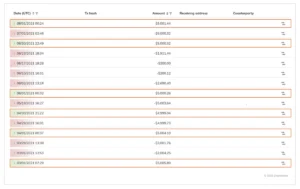
The collaboration proved critical in turning the tide against the hackers. For instance, as investigators traced stolen tranches of USDT across various wallet addresses, they flagged specific destinations possessing administrative freeze capabilities. Working in tandem with law enforcement agencies, Chainalysis supplied the necessary technical evidence and supporting intelligence to Tether’s compliance team. This rapid escalation enabled Tether to take immediate action, successfully freezing over $4 million in stolen USDT.
Additional coordination with other institutional partners yielded similar results, bringing the total amount of frozen funds to nearly $10 million within the first 24 hours of the exploit. This multi-layered intervention demonstrated the growing maturity of the cryptocurrency ecosystem’s defense mechanisms, where public-private partnerships can effectively neutralize a portion of illicit proceeds before they are fully liquidated.
Broader Implications for Latin America’s Crypto Hub
The security incident at Mercado Bitcoin carries significant implications for the broader cryptocurrency landscape in Latin America. As Brazil solidifies its position as one of the region’s primary fintech and digital asset hubs, exchanges operating within the jurisdiction face escalating scrutiny regarding their cybersecurity frameworks, internal controls, and hot-wallet risk management.
Mercado Bitcoin, established in 2013 and owned by 2TheMoon (part of the larger holding company M2), has long positioned itself as a beacon of regulatory compliance and institutional security in Brazil. The exchange serves millions of users and handles billions of reais in trading volume annually. An attack of this magnitude highlights the persistent sophistication of advanced persistent threat (APT) groups and state-sponsored cybercriminal syndicates that continually probe centralized exchanges for architectural flaws.
Furthermore, the multi-chain nature of the attack points to a troubling evolution in cybercriminal methodologies. As platforms increasingly adopt interoperability solutions and cross-chain bridges to cater to user demand for multi-asset trading, these very features create expanded attack surfaces. Hackers are no longer content with breaching a single blockchain ledger; they are executing synchronized, cross-ecosystem heists that demand equally sophisticated, real-time countermeasures from the blockchain security sector.
Ongoing Investigations and Future Outlook
While the immediate intervention successfully locked down nearly $10 million, the investigation is far from over. The remaining balance of the stolen $49 million continues to move across the blockchain, as the perpetrators attempt to mix, bridge, and launder the remaining assets through various decentralized protocols and obfuscation services.
Chainalysis and law enforcement agencies have emphasized that their involvement extends well beyond the initial emergency window. Analysts are continuing to track the residual funds, applying real-time behavioral analytics and behavioral clustering to label addresses associated with the theft. By keeping these illicit movements visible and sharing updated intelligence with global partners, the investigative team aims to alert exchanges, over-the-counter (OTC) brokers, and liquidity providers worldwide to reject deposits originating from the hack.
As the digital asset industry continues to scale, incidents like the Mercado Bitcoin breach serve as both a stark reminder of the persistent threats facing centralized platforms and a testament to the efficacy of modern blockchain intelligence. The rapid mobilization of cross-border investigators, stablecoin issuers, and law enforcement agencies has established a new benchmark for incident response, proving that transparency and collaboration remain the cryptocurrency sector’s most potent defenses against financial crime.