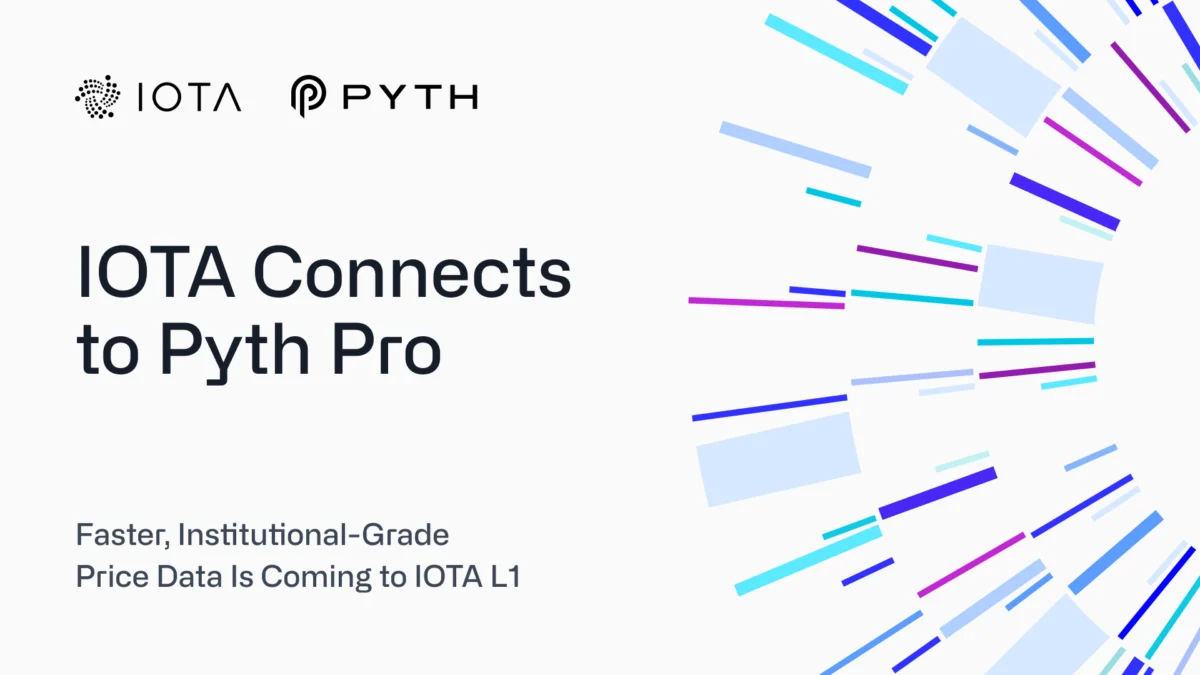
The decentralized finance landscape on the IOTA network is undergoing a significant architectural transformation following the successful integration of Pyth Pro, the next-generation, institutional-grade price feed infrastructure developed by the Pyth Network. This major upgrade transitions IOTA Layer 1 developers and decentralized applications away from legacy systems toward a high-performance framework characterized by ultra-low latency, enhanced reliability, and access to an expansive catalog of more than 3,000 real-time price feeds. The migration is part of a broader, network-wide evolution orchestrated by Pyth to sunset its older decentralized architecture and establish a commercial, highly scalable data distribution model tailored to both Web3 innovators and traditional financial institutions.
The integration arrives at a crucial juncture for the blockchain industry, where the boundaries separating traditional finance from decentralized finance continue to blur. Applications spanning perpetual exchanges, algorithmic lending protocols, and real-world asset tokenization require financial data feeds that match the speed, precision, and security demanded by Wall Street trading desks. By embedding Pyth Pro into its infrastructure, IOTA aims to empower its developer ecosystem with the enterprise-level tools necessary to build sophisticated, high-frequency financial products capable of competing directly with legacy financial systems.
Understanding the Infrastructure Shift: From Pythnet to Pyth Pro
To fully comprehend the magnitude of this upgrade, it is necessary to examine the underlying mechanics of the previous system and the architectural imperatives driving the transition. Historically, decentralized applications operating on the IOTA network relied on real-time price feeds powered by Pythnet—a dedicated, application-specific decentralized network of institutional nodes. While Pythnet successfully decentralized the data-sourcing process, it operated within the constraints of cross-chain communication limitations, primarily utilizing the Wormhole messaging bridge to relay cryptographically verified price updates to various blockchain environments, including IOTA.
While this setup served the initial phases of IOTA’s smart contract expansion, the demands of modern decentralized applications have evolved exponentially. High-frequency trading models, automated market makers, and complex derivatives platforms require price updates delivered at sub-second speeds to mitigate risks such as toxic arbitrage and oracle manipulation during periods of high market volatility.
Recognizing these industry-wide performance bottlenecks, the Pyth Network engineered Pyth Pro as an institutional-tier solution. Pyth Pro consolidates an extensive array of financial instruments—spanning global equities, futures, exchange-traded funds, commodities, foreign exchange, cryptocurrencies, and fixed-income assets—into a unified, streamlined distribution network. Instead of relying solely on decentralized node-to-node relay mechanisms that could introduce latency, Pyth Pro leverages standardized, high-speed application programming interfaces to deliver institutional-grade data directly to financial firms, trading desks, and blockchain protocols with unprecedented efficiency.
Comprehensive Asset Coverage and Technical Advantages
The deployment of Pyth Pro on IOTA fundamentally expands the operational horizons for developers constructing decentralized applications on the network. Under the previous Pythnet iteration, price feeds were largely restricted to core digital assets and prominent cryptocurrencies, limiting the scope of financial products that could be conceptualized on-chain.
With Pyth Pro, IOTA developers gain immediate access to more than 3,000 distinct price feeds, encompassing multi-asset classes that bridge the gap between digital economies and traditional markets. This multi-market exposure is particularly vital for the burgeoning sector of real-world asset tokenization, a narrative that has gained significant traction across the blockchain ecosystem. Platforms seeking to tokenize traditional securities, commodities, or fiat-denominated debt instruments now possess the requisite oracle infrastructure to price these assets accurately and transparently in real time.
Furthermore, the latency improvements introduced by Pyth Pro address one of the most persistent vulnerabilities in decentralized finance: oracle lag. In traditional decentralized oracle setups, price updates are often pushed on-chain via push-based mechanisms that consume valuable block space or pull-based mechanisms that require user interaction, both of which can introduce delays during congested market conditions. Pyth’s pull oracle design, refined and accelerated within the Pyth Pro framework, allows applications to request the latest price update dynamically at the exact moment of transaction execution, ensuring that smart contracts always execute against the most accurate, cryptographically verified market prices available.
Chronology of the Transition and Critical Deadlines
The integration of Pyth Pro into IOTA is not an isolated event but rather a synchronized, ecosystem-wide migration mandated by the Pyth Network governance and core contributors. The timeline for this transition involves strict operational milestones that developers must navigate to prevent service disruptions in their respective decentralized applications.
The foundational phases of the upgrade began with the gradual rollout of Pyth Pro to select institutional partners and high-throughput blockchain networks. As the infrastructure demonstrated its stability and scalability, the Pyth Network officially announced the systematic retirement of Pythnet, signaling that the network’s technological center of gravity was shifting permanently to the new architecture.
For developers building on IOTA and other supported networks utilizing the legacy Pyth Core infrastructure, a strict migration deadline has been established: August 18. After this date, legacy Pyth Core feeds associated with the retired Pythnet infrastructure will cease to function, rendering any dependent smart contracts vulnerable to stale data or complete operational failure. Consequently, IOTA-based development teams have been urged to update their smart contract integrations, modify their price feed endpoint references, and adopt the new Pyth Pro specifications well ahead of the deadline to ensure uninterrupted service for their user bases.
Economic Evolution and the Shift to a Commercial Model
A notable dimension of the migration from Pythnet to Pyth Pro is the underlying economic restructuring of the oracle service. Historically, many decentralized oracle networks operated on heavily subsidized or entirely free data distribution models to bootstrap initial adoption across emerging blockchain ecosystems. While effective for early-stage growth, these models often faced long-term sustainability challenges regarding node operator compensation, data provider incentives, and infrastructure maintenance costs.
Pyth Pro introduces a commercial, revenue-based economic model designed to align the long-term interests of institutional data providers, network validators, and protocol consumers. By establishing transparent, tiered subscription pricing for traditional financial institutions and high-volume commercial entities accessing the data via standard APIs, the network creates a sustainable revenue flywheel.
For the IOTA ecosystem, this transition reflects the maturation of decentralized finance from an experimental playground into a professionalized, institutional-grade financial layer. While the shift introduces subscription and data-access considerations for developers, it guarantees the long-term viability, security, and accuracy of the price feeds supporting high-value transactions. Institutional data providers—such as market makers, traditional exchanges, and proprietary trading firms—are incentivized to supply high-fidelity data to the Pyth network precisely because the infrastructure is capable of monetizing and distributing that data securely across both traditional and decentralized markets.
Implications for IOTA Developers and the Broader DeFi Landscape
The arrival of Pyth Pro on IOTA L1 carries profound implications for the network’s competitive positioning within the crowded layer-1 blockchain sector. Historically recognized for its unique Directed Acyclic Graph architecture tailored for Internet of Things micro-transactions and feeless data transfer, IOTA has methodically expanded its capabilities into the realm of smart contracts and decentralized finance with the launch of IOTA EVM and advanced L1 programmability.
For developers operating within this expanding environment, the availability of institutional-grade oracles removes a major technical barrier to entry. Building sophisticated financial primitives—such as decentralized lending markets with dynamic liquidation thresholds, synthetic asset generators, options protocols, and perpetual futures exchanges—requires absolute confidence in underlying price feeds. An oracle failure or delayed price update can result in catastrophic bad debt accumulation or unfair liquidations, eroding user trust and crippling protocol adoption.
By integrating Pyth Pro, IOTA provides its builders with a robust safety net backed by cryptographically secure, multi-source aggregated pricing. This technical assurance is expected to attract sophisticated development teams from other ecosystems who demand high-performance infrastructure before deploying capital-intensive financial applications.
Furthermore, the upgrade aligns with IOTA’s strategic focus on enterprise adoption and real-world utility. As institutional capital increasingly explores blockchain rails for asset settlement, compliance, and operational efficiency, the demand for TradFi-compatible data standards becomes paramount. Protocols that can seamlessly ingest traditional market data alongside native crypto assets will capture the lion’s share of institutional liquidity in the coming years.
Looking Ahead: The Future of Oracles on IOTA
As the August 18 migration deadline approaches, the immediate focus for the IOTA community centers on execution: ensuring that all active dApps successfully transition their codebases to utilize the Pyth Pro endpoints. Community developers, foundation representatives, and technical guides have been actively disseminating documentation to assist teams through the migration process, minimizing friction and preventing any disruption to live smart contracts.
Over the long term, the integration of Pyth Pro marks a milestone in IOTA’s evolution as a comprehensive, multi-faceted blockchain network capable of supporting institutional-grade financial engineering. By replacing legacy systems with a scalable, high-speed, and commercially sustainable oracle infrastructure, IOTA strengthens its foundation for the next wave of decentralized finance innovation, bridging the gap between open-source blockchain technology and the rigorous demands of global traditional finance.