In the high-stakes environment of organ transplantation, every second counts. When a donor organ becomes available, a race against time begins immediately. A human heart, for instance, remains medically viable outside the body for only a matter of hours. During this narrow window, a complex network of medical professionals, provincial coordinators, regional hospitals, and national agencies must act in absolute synchronicity. Every consent form, medical clearance, diagnostic test, and matching protocol must be flawlessly executed and instantly verifiable. A single misplaced document, a delayed authorization, or an unverified signature can break the chain of custody, resulting in the tragic loss of a potential life-saving transplant.
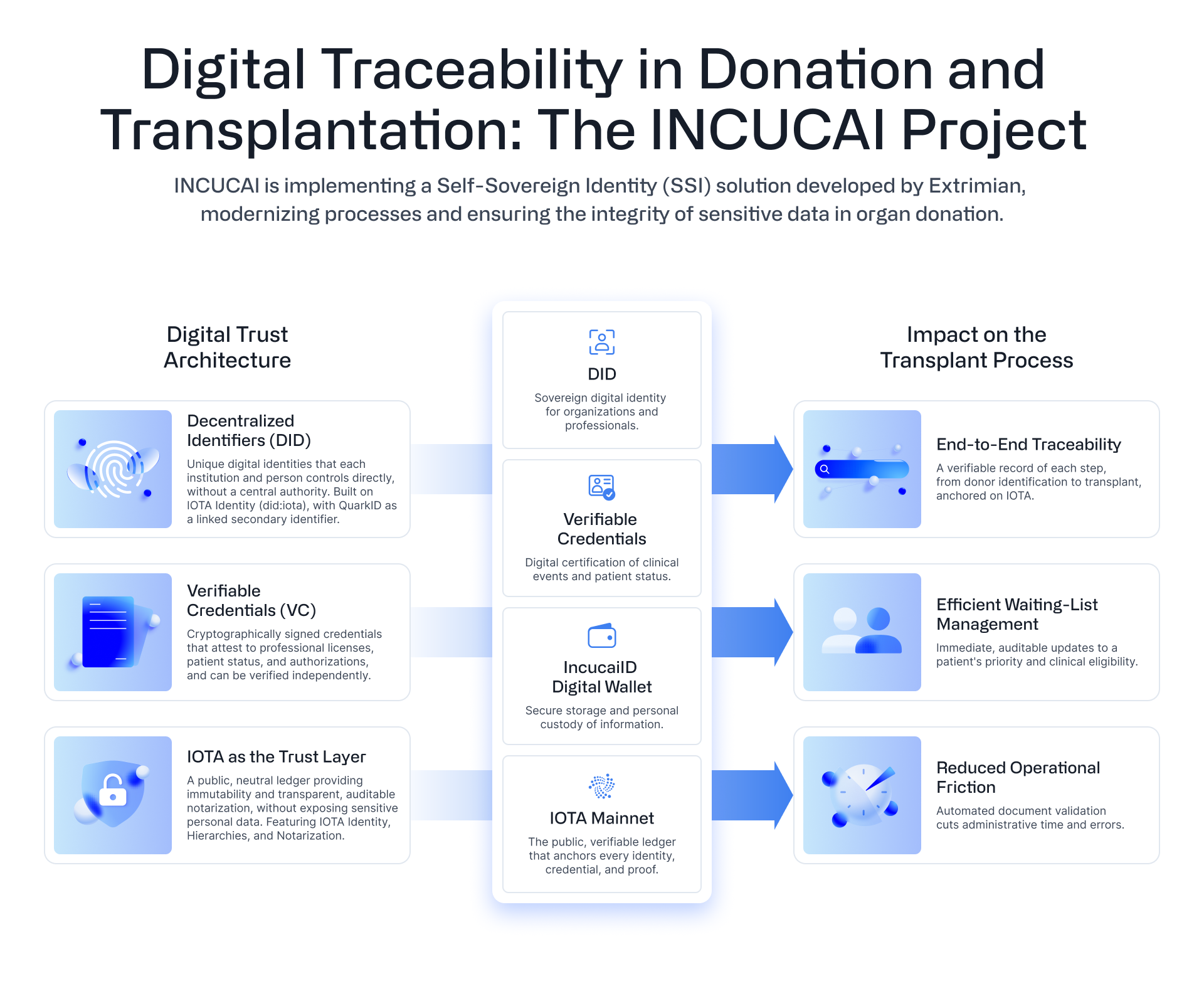
To mitigate these risks and modernize a vital national infrastructure, Argentina has taken a historic step. The country’s central authority for organ, tissue, and cell donations—the Instituto Nacional Central Único Coordinador de Ablación e Implante (INCUCAI)—has integrated a live, publicly verifiable digital-identity system onto the IOTA mainnet. Developed in partnership with Latin American decentralized-identity pioneer Extrimian, this nationwide framework leverages blockchain-based cryptography and self-sovereign identity (SSI) principles to secure the administrative and legal processes governing organ procurement and transplantation across the South American nation.
Background and Context of Argentina’s Transplant Infrastructure
Operating at the intersection of public health, legal compliance, and regional administration, INCUCAI oversees the national waiting list and coordinates activities across 24 distinct jurisdictional procurement agencies. This expansive network encompasses every Argentine province alongside the Autonomous City of Buenos Aires, weaving together an intricate web of public and private hospitals, surgical centers, and regional health ministries.
Historically, coordinating life-or-death decisions across such a vast decentralized network has posed immense administrative hurdles. Paper trails, manual verification processes, and siloed database systems introduced friction and vulnerability into a process that demands absolute transparency and speed. Recognizing the need for a robust digital backbone, INCUCAI initiated efforts to upgrade its technological infrastructure, aiming to eliminate bureaucratic bottlenecks while reinforcing unassailable legal certainty for every step of the donation lifecycle.
Enter Extrimian, a leading regional technology firm specializing in self-sovereign identity and decentralized digital infrastructure. Extrimian was tasked with designing a solution that could unify these disparate provincial nodes without compromising security, speed, or privacy. For the underlying public network, Extrimian selected IOTA—a scalable, feeless-capable public ledger designed for high-throughput, real-world utility. By deploying a neutral layer where institutional identities and document integrity can be cryptographically verified, the collaboration successfully bridged the gap between legacy administrative frameworks and cutting-edge distributed ledger technology.
Chronology and Implementation Timeline
The rollout of Argentina’s onchain transplant system represents the culmination of extensive technical development, regulatory alignment, and institutional cooperation.
The foundation of the project was solidified through rigorous testing and architectural design by Extrimian and the IOTA Foundation, ensuring compliance with global open standards, including World Wide Web Consortium (W3C) specifications for decentralized identifiers (DIDs) and verifiable credentials.
The initiative reached a major legal and operational milestone in June 2026 with the formal publication of Resolution 199/2026 in the Argentine Official Gazette (Boletín Oficial). This legislative decree authorized the widespread implementation of electronic signatures across all processes managed via SINTRA (Sistema Nacional Procuración y Trasplante de Argentina), the country’s central procurement and transplant information system.
By June 10, 2026, the decentralized infrastructure went fully live on the IOTA Mainnet. This deployment established cryptographically secure, publicly verifiable institutional identities for INCUCAI and all 24 provincial procurement agencies. Shortly thereafter, INCUCAI launched IncucaiID, the ecosystem’s dedicated mobile wallet application available on the Apple App Store and Google Play. The phased rollout officially commenced with heart and lung transplant waiting-list registrations, setting the stage for subsequent expansion into other organ categories and broader SINTRA workflows.
Technological Architecture: Privacy-Preserving Cryptography
A primary concern in deploying distributed ledger technology within healthcare environments is the preservation of patient privacy and medical confidentiality. The INCUCAI-Extrimian architecture addresses this by adhering strictly to data minimization principles.
At no point is patient-identifiable information (PII) or sensitive medical history stored on the public blockchain. Instead, the system utilizes cryptographic hashes—mathematical fingerprints—of documents and process steps. These immutable proofs are anchored directly to the IOTA mainnet, allowing auditors, doctors, and regulatory bodies to independently verify that a document or authorization exists in its exact original state without exposing the underlying personal data.
Furthermore, critical components of the infrastructure are integrated with ARSAT, Argentina’s state-owned telecommunications and satellite infrastructure company. This ensures that core elements remain anchored within national sovereign boundaries, balancing decentralized verification with local institutional governance.
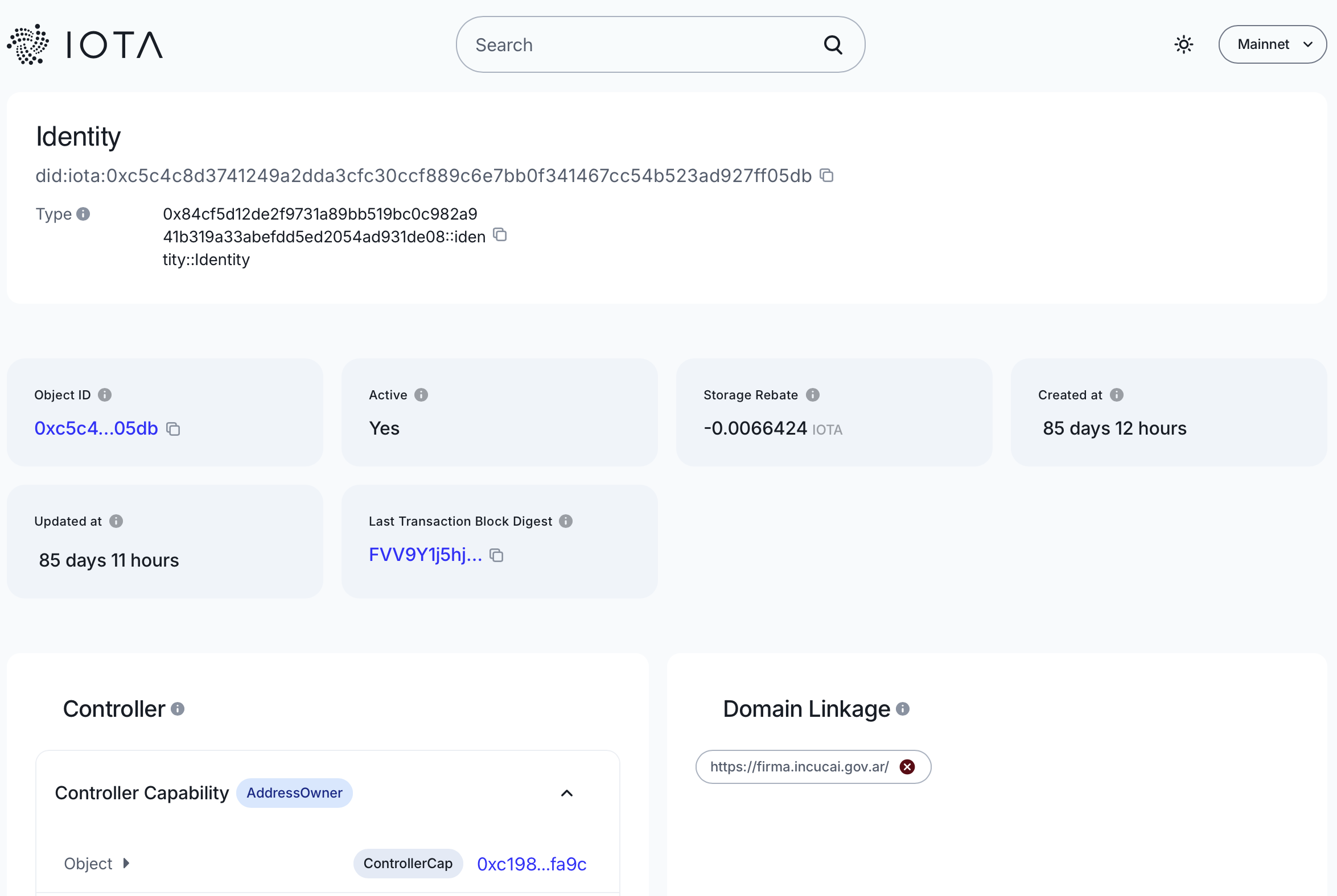
To reinforce security and prevent bad actors from spoofing official agencies, INCUCAI’s onchain identity is cryptographically linked to its official government web domains (such as firma.incucai.gov.ar). Independent verification confirms that the entity controlling the DID matches the accredited government institution, allowing anyone to audit the system’s authenticity via the public IOTA Explorer.
Official Statements and Institutional Perspectives
The successful deployment of a national-scale blockchain application for organ donation has drawn praise from key leaders across the public and private sectors, emphasizing the tangible value of decentralized technology in addressing real-world challenges.
Daniela Hansen Krogh, Director of Information Technology and Information Systems at INCUCAI, highlighted the ethical and operational imperatives driving the digital transformation:
"Trust is at the heart of every organ donation and transplantation process. Our responsibility is to ensure that every decision is supported by reliable, secure, and verifiable information. By incorporating decentralized identity and cryptographic verification into our national systems, we are strengthening the integrity, traceability, and legal certainty of every critical stage, while safeguarding sensitive patient information. This initiative reflects INCUCAI’s ongoing commitment to modernizing Argentina’s transplant system through secure, transparent, and citizen-centered digital innovation."
Echoing these sentiments, Dominik Schiener, Co-Founder and Chairman of the IOTA Foundation, underscored the broader significance of the deployment:
"This is what IOTA’s open technology can do for critical public services at national scale: real infrastructure, already coordinating decisions that save lives."
Esteban Musso, Professional Services Manager and Partner at Extrimian, emphasized the foundational role of trust in digital transformation:
"At Extrimian, we believe that trust is the foundation of every digital transformation. By combining open standards with privacy-preserving technologies, we’ve helped build a solution that enhances traceability, security, and interoperability while respecting the privacy of every participant. Projects like this demonstrate that decentralized technologies are no longer a vision for the future—they are delivering tangible value today in critical public services."
Fact-Based Analysis of Implications and Future Outlook
The integration of IOTA and Extrimian’s technology into Argentina’s national transplant apparatus carries far-reaching implications for public administration, digital identity, and healthcare logistics.
From an administrative standpoint, the elimination of physical document transfer and manual provincial checks dramatically reduces the latency of transplant coordination. In a medical scenario where hours dictate success or failure, removing bureaucratic friction can directly increase the number of successful organ placements.
Legally, the introduction of tamper-proof electronic signatures backed by immutable blockchain anchors provides an unprecedented level of auditability. Every authorization, consent form, and listing update is permanently recorded with cryptographic proof, protecting medical institutions, practitioners, and patient families against disputes, fraud, or administrative errors.
Looking forward, the success of the INCUCAI initiative serves as a compelling proof-of-concept for the adoption of decentralized identity solutions within national healthcare systems globally. By demonstrating that public ledgers can operate in tandem with state infrastructure—such as Argentina’s ARSAT—while strictly adhering to privacy mandates, the project establishes a scalable blueprint for modernizing critical public services through open, verifiable technology.