In a noteworthy shift in corporate treasury management, Digital Commodities, a Canadian public company, has executed a strategic pivot by divesting a portion of its physical gold holdings to acquire Solana (SOL). This transaction, announced on September 28, marks a significant departure from traditional treasury hedging strategies, signaling a growing institutional appetite for high-growth digital assets over the long-standing "safe haven" status of precious metals. The company acquired approximately C$100,000 worth of Solana, representing roughly 5% of its estimated net asset value. While the dollar amount remains relatively modest in the context of institutional finance, the shift in asset allocation strategy highlights a fundamental change in how corporations are beginning to classify digital assets within their balance sheets.
The Evolution of Corporate Treasury Strategies
Traditionally, corporate treasuries have operated under a conservative mandate, prioritizing capital preservation and liquidity. Gold has long been the primary hedge against inflation and currency devaluation. However, the rise of the digital economy has introduced new variables. By moving directly from a physical commodity—gold—into a volatile, high-growth blockchain asset like Solana, Digital Commodities is challenging the conventional wisdom of risk-adjusted returns.
Corporate crypto treasuries typically raise capital through equity offerings, debt issuance, or by utilizing existing cash reserves. The decision to liquidate a physical asset to purchase a blockchain-native token is an explicit portfolio allocation decision. It reflects a tactical move to prioritize potential capital appreciation over the static, protective nature of precious metals. This shift suggests that for some market participants, the perceived risk of missing out on blockchain infrastructure growth now outweighs the historical stability of physical gold.
Maintaining the Bitcoin Foundation
Despite the pivot toward Solana, Digital Commodities has maintained its commitment to its core reserve strategy. The company’s treasury remains anchored by 11 Bitcoin (BTC), which serves as its primary digital reserve asset. This distinction is critical: the company is not abandoning its conservative digital base but is instead creating a multi-tiered hierarchy of assets.
By categorizing Bitcoin as a long-term "reserve foundation" and Solana as a "growth-oriented" asset, the company is mirroring the strategies of larger financial institutions that distinguish between store-of-value assets and utility-driven investments. In this framework, Bitcoin functions as the corporate equivalent of digital gold, while Solana is treated as an equity-like play on the expansion of decentralized finance (DeFi) and AI-integrated blockchain networks.
The Logic Behind the Solana Allocation
The selection of Solana as the inaugural asset for this growth bucket is not coincidental. Solana has positioned itself as a high-throughput, low-latency blockchain capable of supporting the computational demands of emerging technologies, particularly artificial intelligence. The thesis driving this investment—as suggested by management—is that future economic activity, especially in the AI sector, will increasingly rely on the underlying infrastructure provided by high-performance blockchains.
While this thesis remains speculative, the decision to allocate capital toward it reflects a belief that Solana’s network ecosystem will capture significant value as AI applications begin to require decentralized settlement layers. Unlike traditional investments in gold, which are essentially bets on macroeconomic instability, the investment in Solana is a direct bet on the technological infrastructure of the next digital era.
Broader Market Implications and Risks
The move by Digital Commodities serves as a case study for the risks and rewards of diversifying into volatile digital assets. Solana, while offering substantial growth potential, carries network-specific risks, including congestion issues and the inherent volatility of the crypto market. When compared to the relative stability of physical gold, the volatility profile of the company’s treasury has effectively increased.
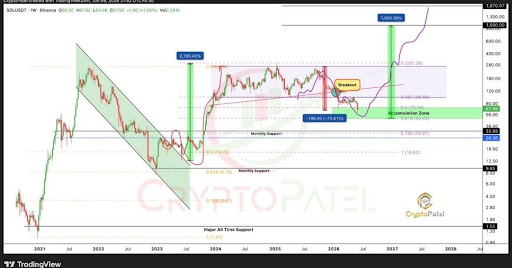
Furthermore, the lack of a direct, proven correlation between AI development and Solana’s price appreciation means that the company is effectively taking a venture-capital-style risk within its treasury. If the AI-blockchain synergy fails to materialize as expected, the company faces the prospect of losing the value that was once safely stored in physical gold. However, the decision to limit the allocation to 5% of the net asset value suggests a measured approach, allowing the firm to participate in the upside of the crypto sector without jeopardizing the solvency of the core enterprise.
Chronology of the Shift
The transition began in late September 2025, following a period of market consolidation where Digital Commodities evaluated its long-term asset performance. The decision to liquidate gold was finalized in the days leading up to the September 28 announcement. This timing is noteworthy, as it coincided with a period of broader market activity where Bitcoin’s price began to stabilize near the $84,000 mark, providing a steady baseline for the company’s core holdings.
Following the acquisition of the SOL tokens, the company indicated that it would continue to monitor the performance of its growth bucket. Management has explicitly stated that they are open to evaluating other digital assets that meet their criteria for growth, technological utility, and infrastructure potential. This suggests that the current 5% allocation may be the first step in a broader, phased strategy to increase exposure to the digital asset ecosystem.
Analytical Perspectives on Treasury Diversification
Financial analysts observing this trend note that Digital Commodities is part of a growing movement of smaller, agile public companies that are no longer treating digital assets as a single, undifferentiated category. Historically, corporate crypto adoption was limited to "Bitcoin-only" strategies, as seen in firms like MicroStrategy. The shift toward a tiered portfolio—separating reserve assets from growth assets—is a hallmark of a maturing market.
The move also poses questions for shareholders. While some investors may view the pivot as a bold, forward-thinking strategy that maximizes the utility of corporate capital, others may express concern regarding the increased volatility profile of the balance sheet. In traditional finance, gold is held to protect against "black swan" events. By trading gold for Solana, the company has effectively swapped a hedge against global systemic failure for a bet on technological adoption.
Looking Ahead: The Future of Digital Treasuries
As Digital Commodities continues to operate under this new framework, the market will be watching to see how the company manages the volatility of its new holdings. The success or failure of this experiment could influence other small-to-mid-cap public companies that are currently sitting on cash or gold reserves and weighing the potential benefits of shifting those assets into the digital economy.
The emergence of "growth-oriented" digital asset buckets suggests that the role of a corporate treasurer is evolving. It is no longer enough to simply protect capital from inflation; the modern corporate treasurer is increasingly expected to identify and capitalize on thematic shifts in the global economy. Whether Solana serves as a successful pioneer for this strategy remains to be seen, but the intent is clear: for Digital Commodities, the future of the corporate treasury lies in the balance between the stability of Bitcoin and the speculative potential of the broader blockchain ecosystem.
This development is likely to be viewed as a benchmark for how public companies navigate the intersection of traditional treasury management and the decentralized, high-speed world of digital commodities. As the regulatory environment becomes more defined and institutional custody solutions for digital assets become more robust, the barrier to entry for such maneuvers will continue to lower, potentially leading to a broader institutional migration from legacy assets to digital infrastructure. For now, the focus remains on the September 28 pivot, a small but significant marker in the ongoing integration of blockchain assets into the bedrock of corporate finance.