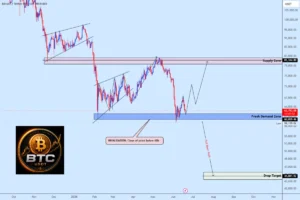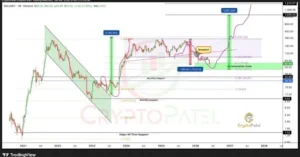
Recent shifts in cryptocurrency market dynamics suggest that capital is beginning to rotate away from the flagship digital asset, Bitcoin, and toward alternative cryptocurrencies, commonly known as altcoins. According to market analyst Justcryptopays, Bitcoin’s recent decisive break below a critical technical trendline has altered short-term sentiment. This technical breakdown, coupled with Bitcoin’s ongoing struggle to maintain decisive support above the psychological $90,000 threshold—currently trading around $90,525—has prompted traders to reevaluate their exposure across the broader digital asset ecosystem.
For the better part of the market’s history, Bitcoin has served as the undisputed bellwether of the digital asset economy, traditionally capturing the lion’s share of institutional and retail capital while single-handedly dictating overarching market sentiment. However, whenever Bitcoin experiences prolonged consolidation, tests crucial macroeconomic boundaries, or encounters localized weakness, capital often cascades downward into large-cap altcoins, DeFi protocols, Web3 ecosystems, and speculative assets. As the market navigates the early phases of 2026, analysts are closely monitoring whether this capital flight from Bitcoin will spark a sustained altcoin season, or alt-season, helping the broader ecosystem shake off the lingering bearish momentum carried over from late 2025.
The Historical Context of Capital Rotation in Crypto Markets
To understand the current market behavior, one must examine the cyclical nature of cryptocurrency liquidity. Historically, capital enters the crypto market via Bitcoin, viewed by institutional investors as "digital gold" and the safest entry point into the asset class. As Bitcoin rallies and establishes new local highs, its dominance—measured as a percentage of the total cryptocurrency market capitalization—tends to peak.
Once Bitcoin reaches a plateau or experiences heightened volatility, profit-taking ensues. Sophisticated investors and retail traders frequently move these realized gains into major altcoins such as Ether (ETH), Solana (SOL), and XRP. This rotation is driven by the search for higher percentage yields, as altcoins often possess lower market capitalizations that allow for more explosive upward price movements compared to a multi-trillion-dollar asset like Bitcoin.
Throughout 2024 and 2025, market cycles were heavily influenced by regulatory developments, macroeconomic inflation metrics, and the launch of spot exchange-traded funds (ETFs) for both Bitcoin and Ether. While these institutional vehicles anchored Bitcoin near historic valuation tiers, they also created a bifurcated market where Bitcoin frequently outperformed the rest of the asset class. Consequently, many altcoins spent extended periods testing multi-year lows relative to their Bitcoin trading pairs. The emergence of a potential technical shift in early 2026 suggests that market participants are once again primed to diversify their holdings.
Chronology of the Recent Market Shift
The current market configuration is the culmination of weeks of tight consolidation and changing technical patterns across primary exchanges.

In the final weeks of 2025, Bitcoin faced mounting selling pressure as macroeconomic headwinds and profit-taking capped its upward trajectory near previous all-time highs. Despite brief rallies attempting to secure territory well above the $90,000 mark, bullish momentum steadily waned.
As trading volumes tapered off heading into the transition of the year, Bitcoin failed to defend a primary ascending trendline that had guided its price action for several months. Technical analysts noted that the breach of this trendline invalidated a series of higher lows, signaling a potential loss of short-term institutional momentum.
Concurrently, major altcoins began showing relative strength. Assets like Chainlink (LINK) broke key moving averages, such as the 21-day moving average, signaling an influx of localized demand. Concurrently, Layer-1 networks like Solana, Cardano, and emerging Web3 protocols experienced an uptick in on-chain activity and derivative open interest.
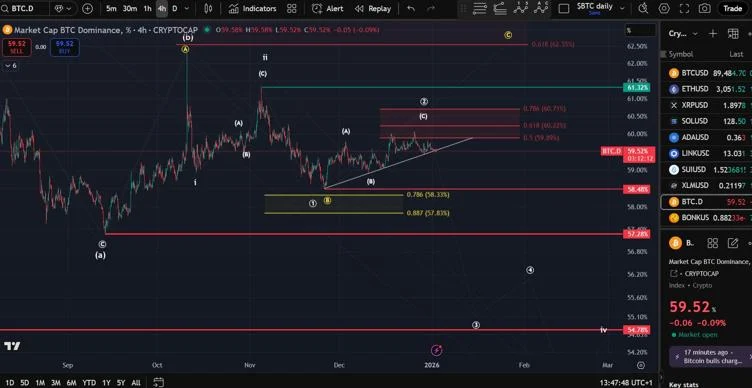
By mid-January 2026, Bitcoin’s localized tests of the $90,000 psychological threshold brought renewed volatility. Each time Bitcoin struggled to establish a firm floor above this key price point, capital began migrating toward alternative assets. Analytics platforms highlighted a subtle yet noticeable downward drift in Bitcoin market dominance, a classic precursor to broader altcoin market rallies.
Supporting Data and Technical Indicators
Market data from prominent tracking platforms and independent analysts underline the shifting landscape. Bitcoin’s inability to consolidate above $90,525 has created a zone of hesitation among short-term speculators. When an asset of Bitcoin’s size encounters resistance at major psychological milestones, derivatives markets often see a spike in liquidations of leveraged long positions, forcing traders to hedge their exposure by rotating funds into lower-cap assets with divergent technical setups.
Simultaneously, key altcoin technical indicators are flashing early recovery signals. Ethereum has maintained relative stability against Bitcoin during recent market pullbacks, a historical indicator that precedes institutional accumulation of altcoins. Furthermore, decentralized finance (DeFi) total value locked (TVL) metrics have stabilized, reflecting renewed user engagement across borrowing, lending, and liquidity-pooling protocols.
Trading volume distribution across centralized and decentralized exchanges has also begun to shift. While Bitcoin historically commands over 50% to 60% of daily global crypto trading volume, recent metrics indicate a growing percentage of transactional activity flowing into alternative tokens, memecoins, and cross-chain utility assets. This dispersion of volume indicates that market participants are actively hunting for yield and capitalizing on short-term price inefficiencies across various blockchain ecosystems.
Official Responses and Institutional Perspectives
While retail traders celebrate the prospect of an altcoin revival, institutional asset managers and research firms maintain a cautious yet observant stance. Institutional commentary released by major digital asset research desks, including insights historically echoed by research divisions of leading exchanges like Binance, emphasizes that altcoin rallies are rarely uniform. Unlike Bitcoin, which benefits from standardized institutional products like spot ETFs, the altcoin market is highly fragmented.
Institutional analysts point out that capital rotation is currently selective rather than broad-based. Instead of a rising tide lifting all altcoins equally, liquidity is gravitating toward assets with clear utility, robust developer activity, and established market liquidity—such as Ether, Solana, XRP, and Cardano. Speculative assets, including memecoins, continue to experience high volatility, driven primarily by retail sentiment rather than long-term fundamental adoption.
Risk management executives at major digital asset funds have noted that while the technical breakdown of Bitcoin’s trendline opens the door for alternative asset outperformance, macroeconomic variables remain paramount. Interest rate decisions by global central banks, liquidity injections, and regulatory clarity regarding token classifications will ultimately dictate whether an altcoin rally can sustain momentum across a multi-month horizon.
Broader Impact and Market Implications
The unfolding market dynamics carry significant implications for traders, investors, and project developers alike. For retail and institutional investors, a shift away from Bitcoin dominance introduces both heightened opportunity and elevated risk. Altcoins historically offer superior risk-adjusted returns during periods of aggressive capital rotation, but they also carry sharper downside risks during broader market corrections. Navigating this environment requires disciplined risk management, portfolio diversification, and an understanding of sector-specific fundamentals.
For developers and builders within the Web3 ecosystem, an altcoin resurgence provides vital breathing room. Sustained capital inflows into alternative layer-1s, layer-2 scaling solutions, and decentralized applications help fund ongoing development, incentivize network security, and attract talent back to non-Bitcoin protocols. Increased trading activity translates to higher fee generation for blockchain networks, reinforcing the economic security of decentralized ecosystems.
Looking ahead, the market stands at a critical crossroads. If Bitcoin successfully defends the $90,000 support band and reclaims its previous trendline, capital may quickly flow back into the flagship asset, cutting short any nascent altcoin rallies. Conversely, if Bitcoin continues to consolidate sideways or drift lower, the conditions will remain favorable for altcoins to capture market share, potentially setting the stage for a prolonged and diversified alt-season as 2026 progresses. Market participants across the board are advised to monitor on-chain metrics, exchange inflows, and macroeconomic catalysts closely as these trends continue to develop.