The current landscape of the cryptocurrency market is defined by a dichotomy of localized excitement and overarching structural consolidation. While isolated rallies—most notably the explosive price discovery observed in assets like Hyperliquid—have captured the attention of retail traders and institutional analysts alike, the broader market metrics suggest that a full-scale "alt season" remains elusive. For investors navigating the current volatility, understanding the distinction between opportunistic spot rallies and a cyclical rotation of capital out of Bitcoin is essential for maintaining a balanced portfolio.
Understanding the Altcoin Season Index
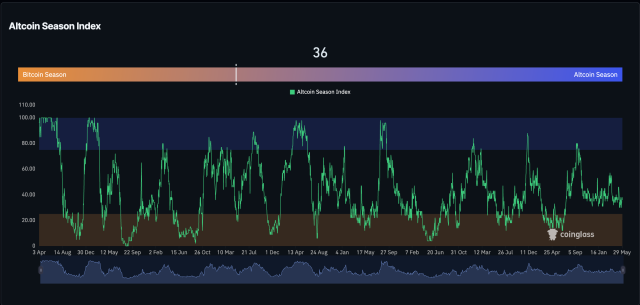
The industry-standard benchmark for determining the onset of an altcoin season is the Altcoin Season Index. This metric functions by evaluating the performance of the top 100 digital assets by market capitalization, excluding Bitcoin, against the performance of Bitcoin itself over a rolling 90-day window. The index yields a score between 1 and 100. By convention, an "alt season" is formally recognized only when the index surpasses the 75-point threshold. A score of 75 indicates that at least 75 of the top 100 altcoins have outperformed Bitcoin consistently over the previous three months.
Currently, the index sits at a score of 36. This reading, provided by market data platforms such as Coinglass, places the market firmly in "Bitcoin season" territory. Despite the visual appeal of individual tokens hitting all-time highs, the aggregate data confirms that the vast majority of altcoins are failing to outpace the primary cryptocurrency.

The Chronology of Market Dominance
To contextualize the current state of the market, one must examine the progression of Bitcoin dominance (BTC.D). Historically, the crypto market operates in cycles where liquidity flows from Bitcoin into Ethereum, then into large-cap altcoins, and finally into speculative micro-caps.
Throughout the first half of 2025, Bitcoin has maintained a remarkably resilient grip on market liquidity. As of the most recent weekend data, Bitcoin dominance climbed back above 59.8%, a figure that serves as a significant hurdle for any sustained altcoin breakout. When Bitcoin dominance rises, it signals that capital is either flowing into Bitcoin from fiat or being rotated out of riskier altcoin positions back into the relative safety of the market leader.
For an alt season to materialize, historical data suggests a fundamental reversal must occur: Bitcoin dominance must experience a sharp, sustained decline. This decline typically accompanies a period of low volatility for Bitcoin, allowing traders to seek higher yields elsewhere. Currently, the market lacks this catalyst. The recent price action, while optimistic for specific projects, does not reflect the broad-based capital migration necessary to trigger an alt season.
Dissecting the Performance of Ethereum
Ethereum remains the primary litmus test for the health of the altcoin ecosystem. As the second-largest cryptocurrency and the bedrock of decentralized finance (DeFi) and smart contract applications, Ethereum’s performance relative to Bitcoin (ETH/BTC) is often considered a leading indicator.

In previous market cycles, a definitive alt season was preceded by a strengthening ETH/BTC pair. However, in the current market climate, Ethereum has struggled to maintain its relative value against Bitcoin. This underperformance is a critical structural issue. Without Ethereum leading the charge or at least holding parity with Bitcoin’s growth, the probability of the rest of the altcoin market sustaining a rally is significantly diminished. The current trend suggests that while Ethereum is participating in the broader market recovery, it is not serving as the engine of growth required to lift the broader "alt" cohort.
Why Isolated Rallies Are Not "Season" Indicators
The confusion regarding the onset of an alt season often stems from the tendency to conflate individual project success with market-wide trends. Assets like Hyperliquid, which recently reached new all-time highs, benefit from specific catalysts—such as protocol updates, increased utility, or localized liquidity injections. These are idiosyncratic events rather than systemic market movements.
When a single project surges due to technical developments or venture capital interest, it can create a "wealth effect" illusion, making it seem as though the entire market is trending upward. However, when analyzed through the lens of the top 100 index, these rallies are revealed to be statistical outliers. A true alt season is characterized by a "rising tide" phenomenon, where the median performance of the top 100 assets exceeds that of Bitcoin. At a score of 36, the data indicates that most of these assets are currently struggling to keep pace with Bitcoin’s growth, let alone outperform it.
Institutional Influence and Market Maturation
The current market cycle is distinct from previous iterations due to the heightened presence of institutional capital. With the advent of spot Bitcoin ETFs and increased participation from traditional financial institutions, the liquidity profile of the market has changed. Bitcoin is increasingly treated as a "macro hedge" or a "digital gold" equivalent.
This institutional preference for Bitcoin creates a higher barrier to entry for altcoins. Institutional investors typically require deep liquidity and established regulatory frameworks, two areas where Bitcoin and Ethereum currently lead. Consequently, the rotation of capital from Bitcoin into smaller altcoins is now subject to more rigorous risk assessment than in the retail-driven markets of 2017 or 2021. This reality makes the "Alt Season" a much harder threshold to cross, as it requires a broad, sustained increase in risk appetite that is currently tempered by macro-economic uncertainty.
Implications for Market Participants
For investors, the data-driven reality of a 36-point index score suggests a cautious approach. While the temptation to chase "alt" gains is high, the market is currently favoring assets with high correlation to Bitcoin’s stability.
- Strategic Allocation: The data suggests that Bitcoin remains the dominant driver of market returns. Investors should monitor the BTC.D metric closely; a drop below the 55% level would be the first tangible sign of a shift in momentum.
- Focus on Fundamentals: In an environment where the broader market is not in a confirmed "season," project-specific fundamentals—such as network usage, developer activity, and revenue generation—are more important than ever. Isolated rallies in tokens with weak fundamentals are prone to rapid reversals.
- Patience for Confirmation: Analysts suggest that waiting for the Altcoin Season Index to cross the 50-point mark before aggressively increasing exposure to smaller altcoins can help mitigate the risk of "false starts."
Conclusion
While the recent performance of select altcoins has provided a much-needed sense of vitality to the crypto space, the objective data does not support the narrative that an alt season has begun. With the Altcoin Season Index stagnant at 36 and Bitcoin dominance trending upward, the market remains firmly in a cycle of Bitcoin-led growth.
The transition to an alt season requires a fundamental shift in market psychology and capital allocation, specifically involving a breakdown in Bitcoin dominance and a recovery in the ETH/BTC pair. Until these structural conditions are met, the current rallies should be viewed as localized opportunities rather than the start of a market-wide phenomenon. Investors are advised to rely on quantitative metrics rather than anecdotal price spikes to navigate this complex environment, ensuring that their portfolios remain aligned with the broader flow of institutional and retail capital. As the market continues to evolve, the distinction between high-conviction projects and speculative volatility will remain the most critical factor in achieving long-term success.