The development of frontier artificial intelligence is one of the most resource-intensive and strategically vital endeavors in modern technology, carrying profound implications for national security, economic dominance, and global military power. Recognizing this reality, the United States government has implemented a strict regime of export controls and service bans designed to restrict users and companies within the People’s Republic of China from accessing advanced AI platforms such as OpenAI’s ChatGPT, Anthropic’s Claude, and Google’s Gemini. However, new findings from blockchain analytics and cybersecurity investigations reveal that these geographic and political barriers are being systematically circumvented. A sophisticated, resilient shadow economy of "proxy services" has emerged, allowing restricted entities to bypass U.S. restrictions, access frontier models at a fraction of their true development cost, and accelerate their own domestic AI capabilities.
The Mechanics of the AI Proxy Underground
To understand how the restriction-evasion network operates, one must examine the operational structure of the proxy ecosystem. When a user in a restricted jurisdiction attempts to query a Western frontier AI model, traditional geolocation and identification checks block the connection. Proxy services act as digital middlemen, maintaining accounts and localized infrastructure in permitted regions while routing queries from banned users through a concealed intermediary network. These services operate much like commercial software-as-a-service platforms, offering polished web interfaces, volume-based subscription models, and API integrations.
Users can purchase account credits or top-up balances through a variety of payment gateways. While many transactions rely on conventional Chinese domestic digital payment processors—including WeChat Pay and AliPay—a significant and growing portion of the economy is underpinned by cryptocurrency. According to a comprehensive survey of 100 active AI proxy domains conducted by the Chainalysis Global Intelligence Team, approximately 40% of these platforms accept digital assets, with stablecoins representing the vast majority of crypto-denominated transactions.
The integration of cryptocurrency is not merely a convenience for international users; it is a calculated mechanism designed to obfuscate financial trails, evade state-enforced capital controls, and maintain off-grid transactional capabilities for sensitive or corporate actors. Furthermore, the survey revealed that these proxy payments rarely flow directly to the ultimate operators. Instead, they frequently pass through third-party custodial cryptocurrency services and payment processors. This multi-layered financial architecture introduces operational distance between the end consumer and the service provider, shielding the illicit infrastructure from direct regulatory scrutiny while presenting severe compliance challenges for legitimate, regulated cryptocurrency exchanges that may unknowingly ingest tainted funds.
The Threat of Model Distillation

The existence of a commercial shadow market for American AI models extends far beyond simple user curiosity; it strikes at the heart of U.S. national security by facilitating "model distillation." Distillation is a machine-learning training technique whereby a smaller, less resource-intensive model is trained using the outputs, logic, and reasoning patterns of a vastly superior frontier model. By leveraging the capabilities of advanced U.S. systems via proxy queries, Chinese AI laboratories can bypass the immense computational expense and years of foundational research required to train competitive models from scratch.
This illicit knowledge transfer has drawn intense scrutiny from both private-sector labs and government defense agencies. In recent months, Anthropic formally accused three prominent China-based artificial intelligence laboratories—DeepSeek, Moonshot, and MiniMax—of orchestrating large-scale distillation attacks against Claude. According to Anthropic’s findings, these entities utilized approximately 24,000 fraudulent accounts funneled through proxy services to systematically harvest capabilities and optimize their domestic algorithms.
The security implications of this practice are severe. Frontier models developed by U.S. laboratories undergo rigorous safety testing, alignment, and adversarial hardening to prevent misuse. However, when these capabilities are extracted and embedded into foreign models through distillation, the resulting systems frequently lack the original guardrails. Last month, the U.S. National Security Agency (NSA), alongside international intelligence partners, issued a formal warning highlighting that China-based AI companies utilizing distillation techniques to mimic U.S. frontier models pose distinct and escalating threats across critical infrastructure, military, economic, and cyber domains.
Chronology of an Evolving Digital Black Market
The timeline of U.S. AI export controls and the subsequent evolution of the proxy shadow economy highlights a classic cat-and-mouse dynamic between regulators, AI developers, and illicit service providers:
- October 2022 to October 2023: The U.S. Department of Commerce implements sweeping export controls targeting advanced semiconductors, specifically high-end graphics processing units (GPUs) essential for AI training, and broadens restrictions on technology exports to China. In response, Chinese AI entities face immediate hardware bottlenecks.
- Late 2023 to 2024: Major U.S. AI labs strengthen regional blockades, blocking direct API access and consumer web interfaces for IP addresses located in China and select allied regions. Concurrently, informal, decentralized workarounds emerge on Chinese social media platforms and developer forums, offering shared API keys and basic VPN-adjacent tunneling.
- 2025: The informal workarounds mature into a segmented, highly profitable commercial supply chain. Upstream vendors engage in "account farming" and automated model swapping, while downstream proxy platforms scale up operations, introducing sophisticated subscription tiers and multi-currency checkout options, including stablecoins.
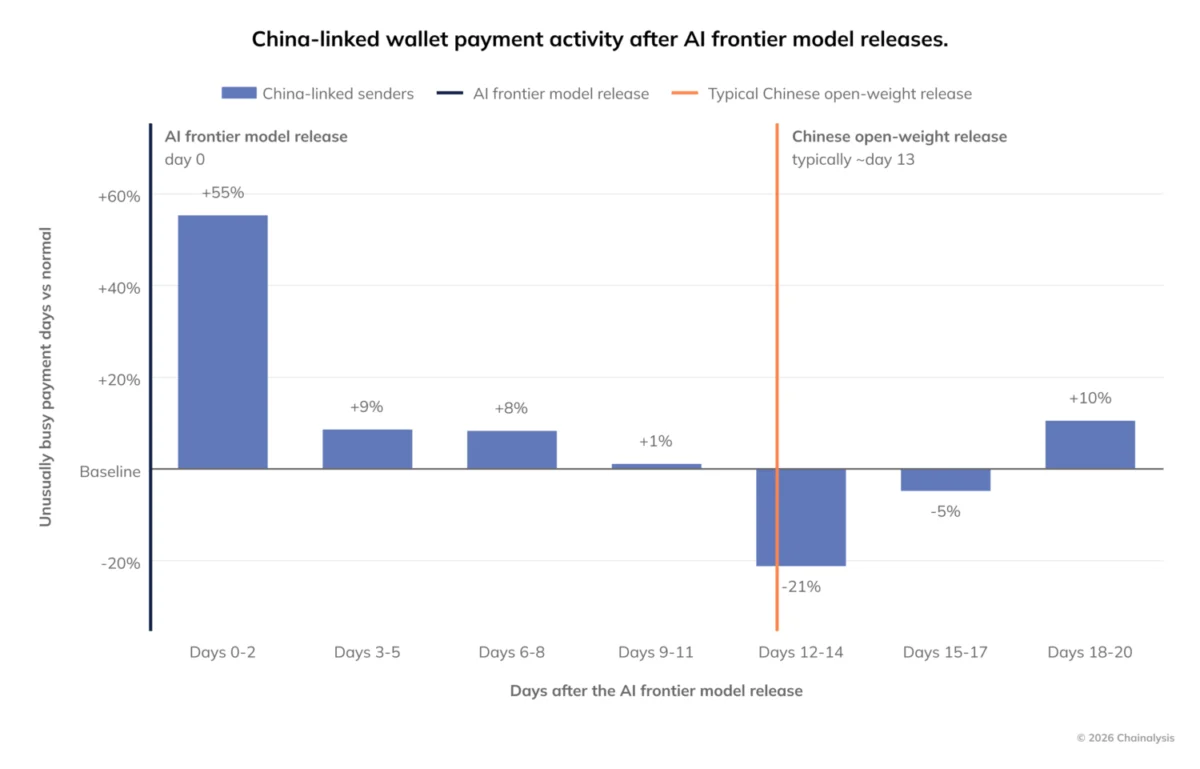
- August 2026: Investigative disclosures by blockchain intelligence firms highlight that suspected China-linked wallet activity within the proxy ecosystem experiences statistically significant transaction volume spikes precisely during the 72-hour windows immediately following major U.S. frontier model releases. This behavior strongly correlates with automated or rapid-response capability harvesting.
- Late 2026: Government agencies, including the NSA, and private AI labs publicly acknowledge the scale of proxy-driven model distillation, prompting calls for coordinated cross-border regulatory enforcement and advanced blockchain tracking.
Data and Insights from Blockchain Analytics
To determine whether cryptocurrency transactions within the proxy shadow economy are actively tied to the deployment of new American AI models, researchers analyzed transaction patterns across suspected China-linked wallets interacting with known proxy payment infrastructure. The empirical data reveals a clear and recurring anomaly: wallet activity and funding surges consistently spike in the three-day period following the public release of a new U.S. frontier model.

While aggregate blockchain data cannot independently prove the exact intent behind every transaction, the timing of these financial surges strongly aligns with the operational workflows of model distillation. When a Western lab introduces a more capable foundational model, Chinese developers utilizing proxy networks have an immediate incentive to acquire access tokens, fund accounts, and initiate automated query scripts to harvest the new model’s enhanced reasoning parameters before defensive rate-limiting or account bans can be enforced.
Geographically, the wallets funding these services are heavily concentrated in China, as well as regional financial hubs such as Hong Kong, Singapore, Japan, and South Korea. This geographic distribution confirms that operators are leveraging neighboring jurisdictions as operational staging grounds to obscure their ultimate physical locations while routing traffic into the Western cloud infrastructure hosting the AI models.
Implications and the Role of Blockchain Intelligence
The entrenchment of the AI proxy shadow economy exposes a fundamental vulnerability in purely geographic and perimeter-based cybersecurity defenses. Traditional enforcement mechanisms—such as blocking specific IP ranges, requiring stringent know-your-customer (KYC) checks at the primary application layer, or restricting hardware shipments—are proving insufficient when an industrial-scale intermediary market exists to bypass them. The multi-tiered supply chain of the proxy ecosystem ensures redundancy: if U.S. authorities or AI labs succeed in shutting down one upstream vendor or proxy domain, alternative providers rapidly absorb the displaced traffic.
Combating this illicit network requires a paradigm shift toward integrated intelligence-led enforcement. Because a substantial portion of the proxy economy relies on cryptocurrency and third-party payment processors to settle transactions, blockchain analytics has become an indispensable tool for regulators and compliance officers. By tracing transactional flows across distributed ledgers, investigators can map the interconnected relationships between anonymous proxy operators, custodial payment gateways, and mainstream cryptocurrency exchanges.
Identifying these critical pressure points allows law enforcement agencies, financial institutions, and AI labs to collaboratively disrupt the financial lifeblood of the shadow market. Without targeted interventions that bridge traditional cybersecurity protocols with advanced blockchain intelligence, the enforcement gap will continue to widen, enabling foreign competitors to reap the rewards of American technological innovation without bearing its costs or adhering to its safety standards.