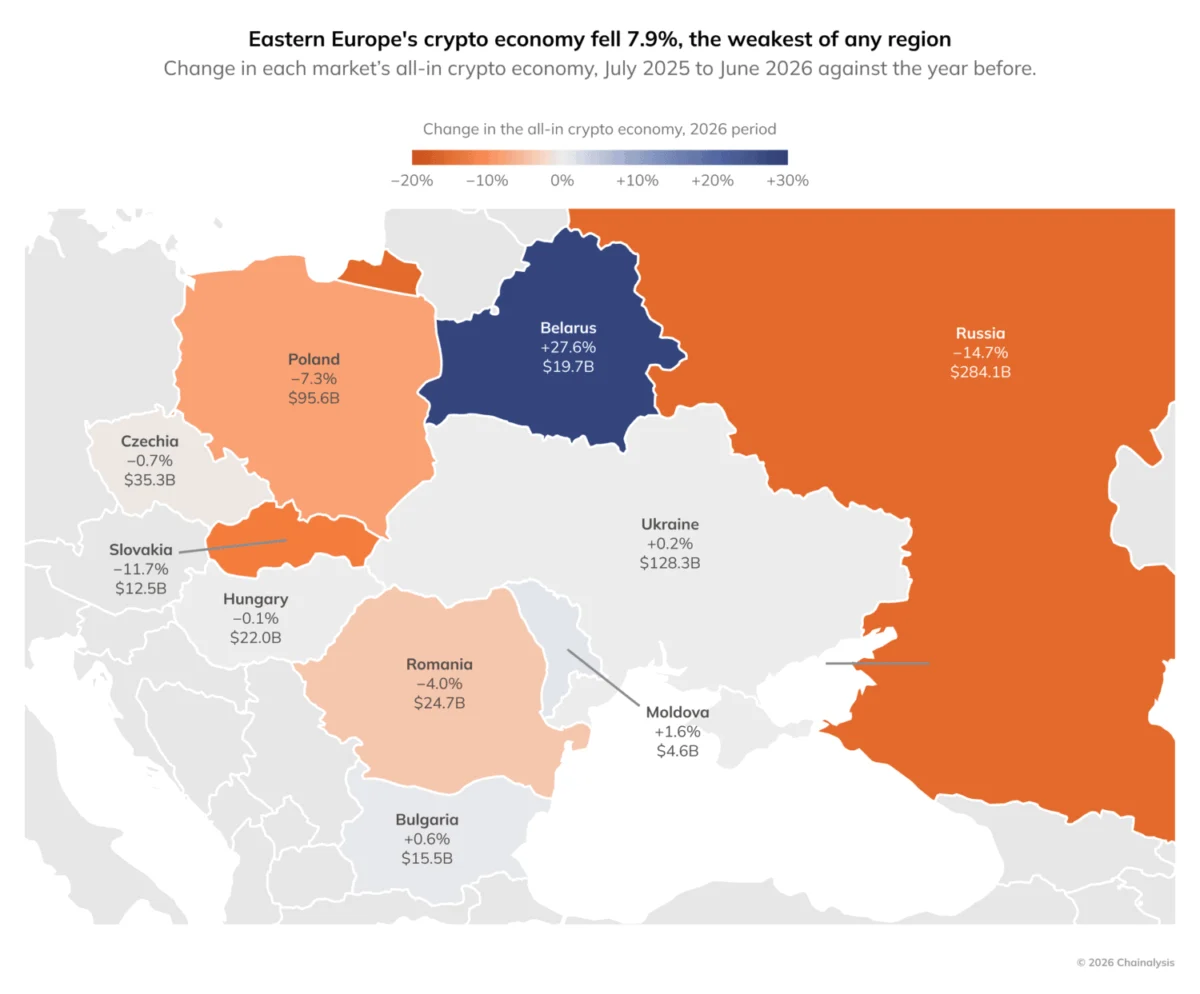
The Eastern European digital asset landscape experienced a challenging period in the year leading up to June 2026, registering the weakest performance of any global region tracked by blockchain analytics firm Chainalysis. According to the excerpt from the upcoming 2026 Geography of Cryptocurrency Report, the region’s aggregate all-in crypto economy contracted from $697.1 billion down to $642.1 billion. This represents a 7.9% year-over-year decline, a notable underperformance compared to the modest 1.6% contraction observed globally across the same timeframe.
Despite the overarching downturn in total transactional volume, the region’s underlying behavior reveals a complex mosaic of adaptation. Local populations are navigating complex geopolitical conflicts, shifting tax policies, and regulatory vacuums surrounding the European Union’s Markets in Crypto-Assets (MiCA) framework. While institutional and high-value transfers experienced sharp pullbacks, retail participants, cash-heavy alternative rails like ATMs, and decentralized cross-border remittance corridors proved remarkably resilient, underscoring a structural shift in how Eastern Europeans interact with digital assets.

Contraction Across Categories and the Rise of Retail
The 7.9% reduction in Eastern Europe’s crypto economy was largely uniform across nearly all measured categories, with one notable exception: domestic peer-to-peer (P2P) volume surged by an astounding 330% period-over-period. Country-level performance displayed a polarized landscape. Five of the ten primary Eastern European jurisdictions—Bulgaria, Czechia, Hungary, Moldova, and Ukraine—experienced minimal volatility, shifting less than 2% in either direction. Belarus recorded the fastest regional growth at 27.6%, though analysts note that its status as a heavily sanctioned market confines this growth to a minor share of total regional activity.
A deeper examination of transaction sizes highlights a significant demographic shift toward everyday users. Retail-sized transfers, defined as those under $10,000, accounted for 13.1% of the total value sent by Eastern Europeans to cryptocurrency services. This figure outpaced Sub-Saharan Africa at 12.0% and eclipsed the global average of 10.1%, giving Eastern Europe the highest retail concentration of any tracked region.

This retail dominance materialized not because small-scale transfers surged exponentially, but because high-value transactions experienced a steep contraction. While retail value directed toward services grew by a healthy 8.3%, transfers valued at $10,000 and above plummeted from $591.5 billion down to $488.6 billion. Consequently, the regional market has pivoted toward a heavily retail-weighted posture even as its overall capitalization shrinks.
Cash-Heavy Infrastructure Defies Global Trends
While online institutional volumes retreated, cash-dependent crypto services bucked both regional and global trends. Globally, the value received by crypto ATMs and P2P exchanges fell by 25.6%; in Eastern Europe, however, this sector grew by 1.5%. Eastern Europe and the Middle East and North Africa (MENA) remained the only two global regions where this cash-heavy service group expanded against the broader downward trend.

This regional growth was propelled almost entirely by automated teller machines, which nearly doubled in transaction volume from $17.3 million to $33.9 million. Poland and Romania emerged as the primary drivers of this trend, accounting for an overwhelming 92% of the absolute increase in regional ATM activity. Poland, in particular, solidified its status as a regional powerhouse, capturing 39% of Eastern Europe’s total crypto ATM value and handling nearly triple the transaction volume of Romania, its closest regional competitor. On a global scale, Poland’s robust ATM network vaulted the country into third place worldwide for ATM transaction volume, trailing only the United States and Canada.
Tracing the On-Chain Lifelines of Ukrainian Refugees
More than four years following the onset of Russia’s full-scale invasion, the humanitarian and economic fallout continues to leave a distinct imprint on blockchain ledgers. Ukraine’s deep-rooted financial connections to its expansive diaspora and refugee population remain clearly visible through on-chain analytics.

During the study period, wallet-to-wallet cross-border stablecoin remittance flows directed into Ukraine totaled $12 billion. A rigorous cross-referencing of data across 36 countries in Western Europe, Eastern Europe, and North America revealed a nearly proportional correlation: nations hosting larger pre-war diasporas and post-2022 Ukrainian refugee populations sent correspondingly higher volumes of crypto back to Ukraine. For instance, a country with twice the Ukrainian expatriate population registered approximately double the dollar-denominated crypto inflows to Ukraine.
Canada emerged as the largest absolute sender of retail-sized remittance transfers (under $10,000) to Ukraine, funneling $359 million. This reflects Canada’s established pre-war diaspora of roughly 1.3 million residents alongside approximately 300,000 arrivals who sought refuge following the 2022 escalation. While major European destination countries like Germany and Poland house significantly larger absolute populations of Ukrainian refugees, their close proximity and integrated banking ties manifest differently in transaction topologies.
When viewed as a share of outbound transfers rather than absolute dollar volume, Ukraine’s gravitational pull on neighboring economies becomes even more striking. Among 21 nearby markets with at least $5 million in outbound retail stablecoin P2P volume, Ukraine ranked as the number one destination for 16 of them, and sat within the top three destinations for 19. The median market directed 27.7% of its retail stablecoin P2P volume to Ukraine—more than triple Ukraine’s 8.2% share of global inbound flows. Moldova led this metric, channeling nearly 45% of its cross-border wallet transfers to Ukraine, while Estonia, Lithuania, Romania, Serbia, and Bulgaria directed between 23% and 40%.

Regulatory Vacuums and Market Adaptation: The Case of Poland
The resilience of cash-heavy services and stablecoins intersects directly with a rapidly evolving regulatory environment. As of October 2026, Poland lacks a finalized national act implementing the European Union’s landmark Markets in Crypto-Assets (MiCA) regulation. The legislative process encountered repeated gridlock after the Polish president vetoed implementation bills three times between December 2025 and June 2026, with the Sejm failing to override the third veto in September.
This legislative stalemate created severe operational hurdles. Because Poland has not designated a national competent authority to process applications, local crypto businesses cannot obtain a MiCA Crypto-Asset Service Provider (CASP) authorization domestically. Complicating matters further, the EU-wide MiCA transitional period expired on July 1, 2026. Consequently, legacy Virtual Asset Service Provider (VASPs) registrations under domestic law no longer suffice to operate legally. Crypto businesses must either secure a MiCA authorization via passporting from another EU member state or face mandatory cessation of services within the bloc.

Industry experts suggest that this regulatory ambiguity, paired with institutional caution regarding centralized web-based platforms, helped drive Polish users toward physical cash infrastructure and stablecoin rails. Tristan Fong, Co-Founder of international ATM operator Localcoin, noted that physical terminals frequently appeal to demographics harboring skepticism toward digital exchanges.
"Crypto ATMs typically attract customers that are nervous about web-based exchanges being unreliable, or even worse, fake scam websites," Fong explained, emphasizing that physical machines situated in trusted retail locations with responsive phone support build essential consumer confidence.
Data from Poland indicates that ATM withdrawals outgrew every other off-ramp category, surging by 120% while centralized exchange deposits dropped by 5%. Notably, 90% of Poland’s ATM transactions involved stablecoins rather than Bitcoin. Observers note that while ATMs remain fully subject to anti-money laundering (AML) and MiCA compliance standards, their physical accessibility offered a pragmatic alternative for users navigating the national regulatory vacuum.

Stablecoins Eclipse Bitcoin in Peer-to-Peer Networks
Poland’s rapid embrace of stablecoins extended well beyond physical terminals into digital peer-to-peer ecosystems. Throughout the observation period, wallet-to-wallet stablecoin transfers—both domestic and cross-border—quadrupled in volume, while Bitcoin P2P transfers contracted by one-third. By March 2026, monthly stablecoin P2P volume surpassed Bitcoin for the first time in Polish history, a performance gap that continued to widen through the conclusion of the study.
Representatives from regional digital asset exchanges corroborated this structural shift. A spokesperson for Lithuania-headquartered exchange WhiteBIT observed that stablecoin adoption has evolved far beyond speculative trading. "The volume of payments in stablecoins continues to grow steadily—separate infrastructure projects are already being built to support this, not just trading platforms," the spokesperson stated. "Today, stablecoin users are no longer just traders. We see ordinary users who use them to protect their savings from inflation, especially in markets with unstable national currencies."

While the Polish zloty remained relatively stable compared to currencies in neighboring conflict-affected zones, the frictionless utility of stablecoins for rapid, low-cost value transfer cemented their status as preferred digital instruments over volatile legacy assets like Bitcoin.
Tax Policy Shocks and Romania’s Temporary DeFi Pivot
Similar to Poland, Romania faced a regulatory bottleneck regarding the delayed designation of a national MiCA competent authority as of late 2026. However, transaction patterns in Romania were predominantly dictated by fiscal policy adjustments rather than regulatory paralysis alone.

In July 2025, the Romanian government announced a sweeping tax increase on individual capital gains derived from cryptocurrencies, raising the levy from 10% to 16% effective January 1, 2026. This announcement triggered an immediate and aggressive behavioral response among local crypto holders. Instant-exchange usage in Romania expanded by 59% over the period—the fastest growth rate among high-volume markets in Eastern Europe—totaling $41.8 million compared to $26.4 million previously.
The timing of this surge correlates directly with the government’s announcement. Between July and December 2025, leading up to the implementation of the tax hike, Romanians funneled $25.1 million through instant exchanges, accounting for 60% of the entire annual volume in that category. Comparative analysis shows that Romania’s exchange deposits swung dramatically from outperforming the regional average prior to the tax announcement to severely underperforming afterward.
Furthermore, Romania’s utilization of exchange alternatives such as Decentralized Exchanges (DEXs) and P2P platforms spiked temporarily above regional norms. In the third quarter of 2025, Romania’s share of crypto directed toward exchange alternatives sat 7.5 percentage points above the Eastern European average, remaining 4.4 points above average in the fourth quarter. Once the 16% tax rate formally took effect in January 2026, usage metrics quickly reverted to the regional mean. Market analysts interpret this transient spike as an aggressive maneuver by traders utilizing stablecoins as a liquid unit of account to rapidly rotate assets and adjust portfolios ahead of heightened fiscal scrutiny.

Broader Implications for the Regional Digital Economy
The trajectory of Eastern Europe’s digital asset economy through 2026 highlights a region defined by tactical flexibility and real-time adaptation. Rather than retreating uniformly from the blockchain ecosystem in the face of macroeconomic headwinds, participants across the region utilized decentralized tools to solve immediate, localized challenges.
Ukrainian communities successfully leveraged stablecoin rails to sustain multi-billion-dollar familial and humanitarian lifelines across international borders. Polish consumers gravitated toward physical ATMs and stablecoins as reliable conduits amid national legislative stalemates over European Union compliance frameworks. Meanwhile, Romanian traders leveraged decentralized and instant exchange infrastructure to temporarily optimize portfolios ahead of impending tax burdens.

Ultimately, the 2026 data illustrates that Eastern Europe’s crypto market contraction masks a resilient, utility-driven core. As regulatory frameworks such as MiCA eventually solidify and geopolitical pressures evolve, the infrastructure built during this period of intense adaptation will likely form the foundation for the region’s next phase of digital economic integration.