The cryptocurrency ecosystem is grappling with the aftermath of what is indisputably the largest digital asset heist in financial history. On October 29, 2026, malicious actors siphoned an unprecedented $6.4 billion from Binance hot wallets across multiple blockchain networks. According to comprehensive on-chain intelligence and forensic assessments released by blockchain analytics firm Chainalysis, the catastrophic breach bears the unmistakable operational fingerprints of TraderTraitor, a notorious state-sponsored North Korean cybercrime syndicate. The incident not only eclipses all previous records for digital asset thefts but also ranks as one of the single-largest financial crimes ever recorded globally, underscoring severe systemic vulnerabilities within centralized exchange architecture and heightening geopolitical concerns regarding state-backed cyber warfare.
Anatomy of an Unprecedented Digital Heist
The sophisticated operation commenced at approximately 4:20 p.m. Eastern Time on October 29, catching the digital asset industry entirely off guard. Investigators tracking the initial vectors of the attack discovered that funds began draining systematically from Binance hot wallets spanning various blockchain protocols.

On the Ethereum network, the exploit mechanics revealed a high degree of technical sophistication. The attacker utilized an operational wallet previously funded through Tornado Cash—a prominent decentralized crypto mixer designed to obscure transaction trails—to submit valid, cryptographically signed authorizations. These authorizations effectively tricked the affected Binance hot wallet into executing attacker-deployed code. Once the malicious code was authorized, the perpetrator commanded the compromised wallet to sweep its substantial asset reserves directly into addresses under external, malicious control. Concurrently, across other impacted blockchains, unauthorized transfers were executed through what initially appeared to be ordinary, signed transactions, further complicating the immediate technical diagnosis of the breach.
The perpetrators immediately entered a high-stakes, breathless race against time. While a significant portion of the pilfered capital was denominated in unfreezable, decentralized cryptocurrencies such as Bitcoin and Ether (ETH)—assets that inherently resist external censorship or seizure—billions more were held in centralized stablecoins, predominantly Tether (USDT) and USD Coin (USDC). Unlike decentralized tokens, these stablecoin assets possess built-in compliance mechanisms that allow their respective issuers to freeze tokens in coordination with law enforcement agencies and specialized blockchain intelligence firms like Chainalysis.
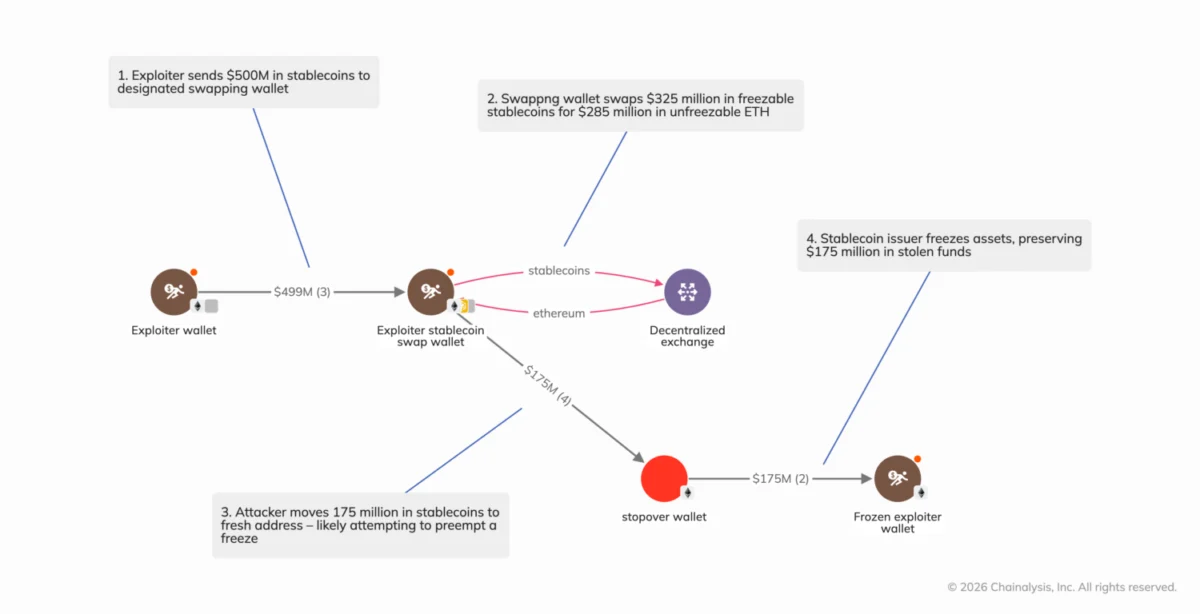
Recognizing that a window for intervention was rapidly closing, the hacker attempted to preempt centralized blacklists by aggressively churning freezable stablecoins into censorship-resistant alternatives. Within a frantic 20-minute window, the exploiter funneled $500 million in stablecoins into specialized conversion wallets, successfully swapping $325 million worth of stablecoins for $285 million in Ether. Ten minutes later, an additional $175 million in stablecoins was pushed through a labyrinth of stopover wallets in an attempt to outpace impending blacklist declarations.
Despite these frantic measures, the global cryptocurrency industry mobilized at an unprecedented velocity. By 5:14 p.m. Eastern Time—less than an hour after the initial breach was detected—stablecoin issuers, acting in parallel with law enforcement and blockchain security analysts, initiated widespread freezes. Through a synchronized, cross-chain emergency response, approximately $2.8 billion of the stolen funds have been successfully frozen to date. While this massive containment effort does not diminish the sheer scale of the historic theft, it highlights a maturing digital asset economy increasingly capable of coordinated emergency intervention.

Attribution and the Shadow of TraderTraitor
Within hours of the exploit, cybersecurity researchers and intelligence analysts began examining transaction fingerprints to identify the perpetrators. While early laundering anomalies hinted at state-sponsored involvement, definitive proof materialized when Chainalysis investigators observed on-chain commingling between the assets stolen from Binance and funds linked to a major exploit against digital asset platform Bitget earlier that month—an attack already formally attributed to North Korean threat actors.
This direct, undeniable on-chain intersection cemented the intelligence community’s assessment. At 12:30 a.m. Eastern Time on October 30, Chainalysis publicly attributed the Binance hack to TraderTraitor. Also known by various intelligence monikers, TraderTraitor is a specialized cybercrime unit operating under the direction of the Democratic People’s Republic of Korea (DPRK). The group has established a prolific track record of targeting global cryptocurrency exchanges, decentralized finance (DeFi) protocols, and individual investors. For years, Western intelligence agencies and cybersecurity firms have warned that North Korea relies heavily on these illicit cyber operations to generate vital foreign currency, effectively bypassing international economic sanctions to fund the regime’s military and weapons programs.
Automated Laundering and Evolving Illicit Techniques

As forensic investigators continue to track the unfreezable remnants of the $6.4 billion cache, they have uncovered unprecedented money laundering patterns that suggest a high degree of automation. Rather than employing traditional, linear transfer methods, the hackers have deployed programmatic scripts capable of executing thousands of transactions within compressed timeframes.
Investigators observed thousands of addresses following a rigid, identical lifecycle: receiving an exact denomination of 1 TRX (Tron’s native token), taking in additional tranches of stolen capital, and subsequently forwarding the funds to downstream destinations. Furthermore, many of these addresses frequently recirculated funds back to nodes involved earlier in the sequence. This circular, highly repetitive transaction structuring points away from manual human intervention and strongly indicates the use of custom smart contracts or automated bot scripts designed to deliberately confuse blockchain sleuths and overwhelm automated compliance monitoring systems.
Implications for Centralized Exchanges and Regulatory Compliance
The sheer magnitude of the Binance exploit has sent shockwaves through the global financial sector, prompting urgent re-evaluations of security postures among centralized exchanges (CEXs) and regulatory bodies alike. Centralized platforms remain deeply attractive targets for sophisticated threat actors due to the immense volume of capital they custody, regardless of their operational jurisdiction or regulatory compliance standards.

Security experts emphasize that while the breach is historic in scale, the underlying vector—targeting hot wallets that require constant online connectivity for liquidity management—remains an inherent risk in digital asset exchange infrastructure. In the wake of the incident, industry leaders have called for accelerated adoption of advanced cryptographic safeguards, hardware security modules (HSMs), multi-party computation (MPC) protocols, and real-time anomaly detection frameworks.
For compliance and risk management teams, the incident serves as an urgent stress test. Platforms utilizing advanced blockchain intelligence tools, such as Chainalysis KYT (Know Your Transaction) and Address Screening products, have been equipped with real-time exposure monitoring capabilities. These tools allow compliance officers to immediately identify whether incoming or outgoing funds touch addresses tainted by the Binance exploit, thereby neutralizing the utility of the stolen capital within compliant financial ecosystems.
As the investigation enters its subsequent phases, investigators expect the remaining unfreezable funds to continue shifting through complex, automated laundering networks across multiple blockchains. While Binance, law enforcement agencies, and blockchain analytics firms maintain round-the-clock monitoring to disrupt further movement, the event stands as a stark reminder of the evolving sophistication of state-sponsored cyber threats and the ongoing race between malicious actors and the defenders securing the digital economy.