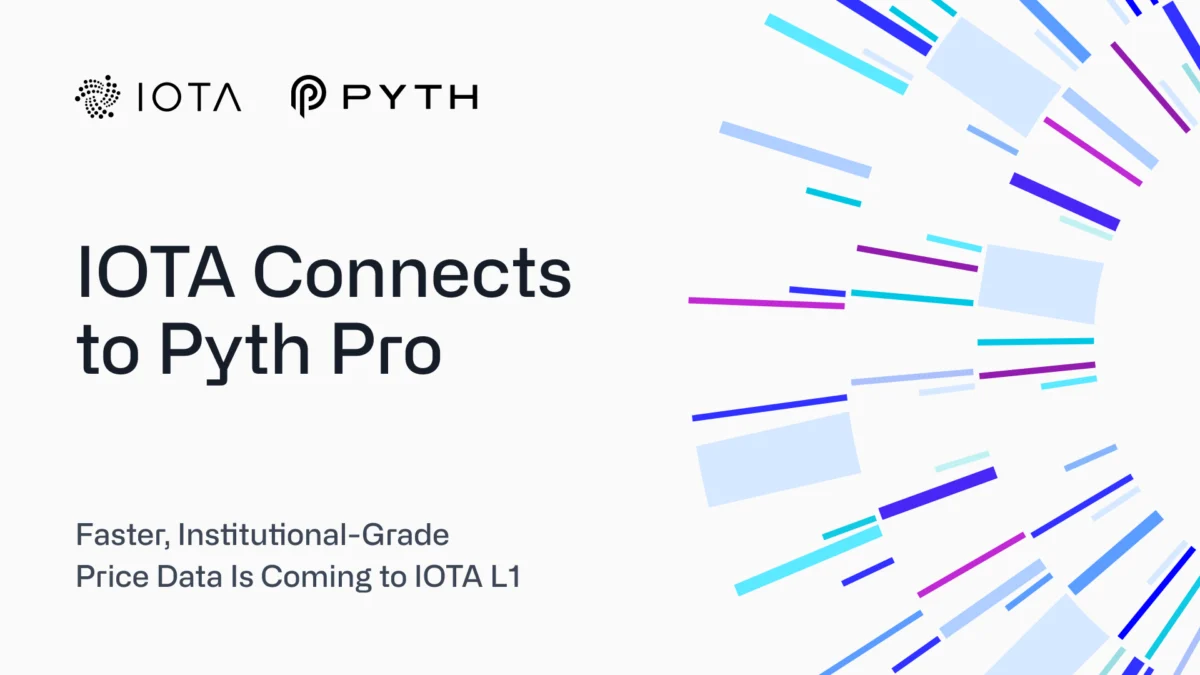
The decentralized oracle network Pyth has officially completed a transformative network-wide migration, bringing its advanced Pyth Pro infrastructure to the IOTA Layer 1 blockchain. This significant upgrade replaces the legacy Pythnet architecture, endowing IOTA developers with ultra-low latency, enhanced reliability, and access to an expansive catalog of more than 3,000 institutional-grade price feeds. As the decentralized finance (DeFi) sector converges increasingly with traditional financial markets, this technical evolution aims to bridge a critical gap by providing real-time, highly secure data feeds for complex financial applications, derivatives platforms, and real-world asset (RWA) tokenization projects operating within the IOTA ecosystem.
The transition, which is part of a broader, systemic overhaul across the entire Pyth Network ecosystem, shifts the foundational framework from a free, decentralized relay model to a robust, commercialized institutional tier. For builders and smart contract developers operating on IOTA, this means adapting to a new operational standard. With the retirement of the original Pythnet infrastructure—which previously relied on the Wormhole cross-chain messaging bridge—developers must actively migrate their smart contracts to the new Pyth Core architecture before the strict deadline of August 18, or risk facing service interruptions as legacy price feeds permanently cease to function.
Understanding the Technical Shift: From Pythnet to Pyth Pro
To fully appreciate the scope of the IOTA integration, one must examine the architectural evolution of the Pyth Network itself. Since its inception, Pyth has distinguished itself from traditional oracle solutions by sourcing its data directly from first-party publishers—including major market makers, global financial exchanges, and prominent trading desks—rather than secondary aggregators. This direct-sourcing model significantly reduces the risk of data manipulation and cuts down the time it takes for market movements to reflect on-chain.
The initial iteration of this service, known as Pythnet, operated as a dedicated application-specific blockchain (appchain) built using the Cosmos SDK. Pythnet aggregated high-frequency price data and then utilized cross-chain messaging protocols, primarily the Wormhole bridge, to securely relay those prices to dozens of destination blockchains, including IOTA. While this system successfully bootstrapped decentralized price delivery across the multi-chain universe, it exhibited inherent limitations in latency, scalability, and the sheer volume of institutional data it could seamlessly process under peak network congestion.
Recognizing the escalating demands of institutional traders and sophisticated DeFi protocols, the Pyth Network contributors engineered Pyth Pro. This next-generation infrastructure is explicitly designed to handle the rigorous demands of traditional financial (TradFi) institutions entering the digital asset space. Pyth Pro consolidates over 3,000 distinct price feeds spanning a comprehensive spectrum of asset classes. These include equities, global futures, exchange-traded funds (ETFs), commodities, foreign exchange (FX) rates, traditional cryptocurrencies, and complex fixed-income instruments.
By unifying these diverse data points into a single, high-performance distribution network, Pyth Pro delivers information to both traditional financial firms and decentralized applications via standardized, high-speed APIs. For IOTA users, the integration of Pyth Pro translates into sub-second price refreshes, cryptographically verified market data, and a level of execution certainty that was previously challenging to achieve on open-ledger networks without specialized enterprise tooling.
Broader Industry Context and the Commercialization of Oracle Services
The migration to Pyth Pro is not an isolated event tailored exclusively for IOTA; rather, it reflects a monumental industry-wide pivot. For years, decentralized oracle networks operated largely on a subsidized, free-to-use model to rapidly capture market share and attract early-stage developers. However, as decentralized applications mature into multi-billion-dollar economic engines, the sustainability of maintaining high-cost, hyper-secure institutional infrastructure without a transparent economic model has come under intense scrutiny.
Pyth’s transition to Pyth Pro introduces a revenue-based economic model designed to align the long-term incentives of data publishers, protocol governors, and network infrastructure operators. By implementing tiered subscription pricing for institutional-grade data consumers while maintaining robust core access for decentralized builders, Pyth aims to establish a self-sustaining financial flywheel. This commercialization phase mirrors the maturation of other core Web3 infrastructure components, such as RPC (Remote Procedure Call) node providers and enterprise-grade security auditing firms, which have similarly transitioned from experimental community projects to essential, revenue-generating commercial services.
For the IOTA Foundation and the broader IOTA developer community, aligning with this institutional-grade shift is vital. IOTA has increasingly focused its strategic roadmap on enterprise adoption, institutional asset management, trade finance, and the tokenization of real-world assets through initiatives like the IOTA EVM and specialized Layer 1 enhancements. High-fidelity financial data is the lifeblood of these use cases. Whether an application involves automated market makers (AMMs), lending and borrowing protocols, decentralized perpetual exchanges, or complex synthetic asset platforms, the accuracy and speed of the underlying price feeds directly dictate the protocol’s solvency and security against flash loan attacks and market manipulation.
Chronology and Key Deadlines for IOTA Developers
The rollout of Pyth Pro across supported blockchain ecosystems has been executed in carefully managed phases to ensure minimal disruption to active decentralized applications. However, the definitive decommissioning of the legacy infrastructure imposes a strict operational timeline that developers cannot ignore.
- Initial Deployment Phase: Pyth Network developers deploy the updated Pyth Core contracts and establish the foundational routing for Pyth Pro across supported networks, including IOTA Layer 1.
- Announcement and Transition Window: The official sunsetting of Pythnet is communicated to the global developer community, accompanied by comprehensive technical documentation, migration guides, and developer support channels.
- Coexistence Period: A temporary operational window during which both legacy Pythnet feeds and the new Pyth Pro infrastructure remain accessible, allowing development teams to test, audit, and gradually transition their smart contracts.
- The August 18 Deadline: The absolute cutoff date established by the Pyth Network. All developers utilizing Pyth price feeds on the Pyth Core framework must complete their smart contract migration to the new infrastructure. Any integrations failing to update before this timestamp will experience a permanent cessation of live price data feeds, potentially freezing dependent decentralized applications.
Implications for the IOTA Ecosystem and DeFi Growth
The integration of Pyth Pro into IOTA yields multifaceted implications for the network’s economic activity and developer sentiment. Historically, IOTA has distinguished itself through its feeless, Directed Acyclic Graph (DAG) architecture, making it exceptionally well-suited for Internet of Things (IoT) microtransactions, machine-to-machine economies, and data integrity use cases. However, capturing significant market share in the broader DeFi and institutional financial sectors requires robust, high-frequency financial tooling.
By embedding Pyth Pro into IOTA’s infrastructure stack, the barrier to entry for sophisticated financial developers drops substantially. Protocols that previously hesitated to deploy on IOTA due to concerns over oracle latency or data depth can now leverage the exact same institutional-grade data feeds utilized by leading Wall Street quantitative trading desks and top-tier crypto derivatives exchanges.
Furthermore, this upgrade strategically positions IOTA to capture the burgeoning market for Real-World Asset (RWA) tokenization. As traditional financial institutions tokenize equities, bonds, and commodities on public and permissioned ledgers, the demand for verified, real-time off-chain price data becomes paramount. Because Pyth Pro natively aggregates traditional asset classes alongside crypto assets, IOTA-based applications can now construct hybrid financial products that seamlessly bridge traditional finance with decentralized rails.
Strategic Analysis: Balancing Cost, Speed, and Decentralization
While the technical advantages of Pyth Pro are evident, industry analysts continue to monitor the broader philosophical implications of the oracle sector’s shift toward commercialized, institutional tiers. Decentralization purists occasionally voice concerns regarding the centralization vectors introduced by first-party publisher models and subscription-based cost structures. Critics argue that as oracle networks adopt enterprise-grade pricing and tiered subscription models, smaller independent developers or early-stage protocols might face higher operational hurdles compared to the era of universally free, community-subsidized data feeds.
Conversely, proponents of the Pyth Pro model argue that security and reliability cannot be treated as charitable endeavors. In high-stakes financial environments where a single misreported price feed can trigger millions of dollars in cascading liquidations, robust economic incentives are required to guarantee that data publishers consistently deliver accurate, tamper-proof information. The transition to a sustainable revenue model ensures that first-party publishers—such as Jane Street, Virtu Financial, and other global market makers—remain economically incentivized to continuously supply high-frequency data to decentralized networks even during periods of extreme market volatility.
For IOTA developers, the path forward requires a pragmatic appraisal of these trade-offs. The integration of Pyth Pro ultimately empowers builders with the tools necessary to compete at the highest levels of modern financial engineering. By adhering to the mandatory migration timeline and updating their smart contracts ahead of the August 18 deadline, IOTA developers ensure their applications remain secure, performant, and fully synchronized with the global vanguard of decentralized finance.
Conclusion
The arrival of Pyth Pro on IOTA Layer 1 signifies a mature evolution for both networks. By replacing legacy infrastructure with an ultra-low latency, institutional-grade price feed network encompassing over 3,000 assets, IOTA solidifies its technical readiness for the next generation of Web3 adoption. As the decentralized ecosystem marches past the August 18 migration deadline, the successful integration of Pyth Pro paves the way for a more robust, secure, and financially sophisticated IOTA landscape—one capable of bridging the gap between decentralized applications and traditional institutional finance with unprecedented precision.