The operational deployment of the Starfish consensus protocol on the IOTA Mainnet via the v1.21.1 release—which introduced protocol version 24—marks a significant milestone in the evolution of Directed Acyclic Graph (DAG) based distributed ledgers. Developed to address fundamental bottlenecks in Byzantine Fault Tolerant (BFT) systems, Starfish fundamentally rethinks the relationship between transaction dissemination, data availability, and finality. Authored from the perspective of Sebastian Mueller and the IOTA Foundation’s Research team, the protocol moves beyond traditional linear-chain architectures and uncertified DAG frameworks to tackle the synchronization challenges that frequently plague high-throughput decentralized networks.
Background and Context of the Starfish Integration
For years, distributed ledger technology has grappled with the inherent trade-offs between throughput, latency, and network resilience. Traditional consensus mechanisms often treat message dissemination—the mechanism by which transactions and blocks are shared across nodes—as mere infrastructure plumbing. However, in DAG-based systems, this assumption breaks down. A DAG is not merely an abstract commitment structure for ordering events; it is a live record of mutual knowledge. Every block points explicitly to prior blocks observed by a validator, functioning simultaneously as an ordering tool and a synchronization mechanism.
Prior iterations of DAG-based BFT protocols, such as Mysticeti, achieved impressive speeds by avoiding per-block quorum certificates in the interest of low median latency. Yet, these uncertified models introduced subtle vulnerabilities. Academic literature, including studies on desynchronization attacks, revealed scenarios where honest participants could fail to commit leaders even after the network achieved stability. When validators advanced rounds without generating their own blocks, structural holes emerged in the DAG. Starfish was engineered specifically to eliminate these vulnerabilities by tightly coupling dissemination with consensus, ensuring that liveness is maintained even under adverse network conditions.
Chronology of the v1.21.1 Mainnet Deployment
The journey toward the Starfish consensus activation followed a rigorous research, development, and testing lifecycle before its integration into production infrastructure:
- Initial Theoretical Framework (2022–2023): Groundbreaking academic research, including foundational work presented in papers such as "Cordial Miners" (Keidar, Naor, Shapiro; DISC 2023), established the necessity of cordial dissemination, wherein validators proactively forward data required by their peers.
- Testnet Experimentation and Prototyping: The IOTA Foundation iteratively tested uncertified DAG models against the newly proposed Starfish architecture, focusing heavily on tail-latency reduction and bandwidth optimization under simulated network congestion.
- Protocol Specification and Release Preparation (Early 2026): Codebases were finalized, introducing protocol version 24 as a core component of the software stack.
- Mainnet Activation (May 2026): The v1.21.1 release officially deployed Starfish to the IOTA Mainnet, transitioning theory into live operational reality across a globally distributed validator set.
Core Architectural Innovations: Dissemination and Data Availability
To comprehend why Starfish represents a structural leap forward, one must examine its core design pillars: the separation of metadata from payload, the implementation of Reed-Solomon erasure coding, and the integration of a Push pacemaker.
In conventional protocols, transaction payloads travel tightly bound along the consensus path, creating bandwidth bottlenecks as network throughput scales. Starfish decouples these elements. Block headers carry strictly consensus-relevant metadata—such as references, votes, timings, and commitments—allowing the network to push lightweight headers aggressively without saturating validator connections with heavy payloads upfront.
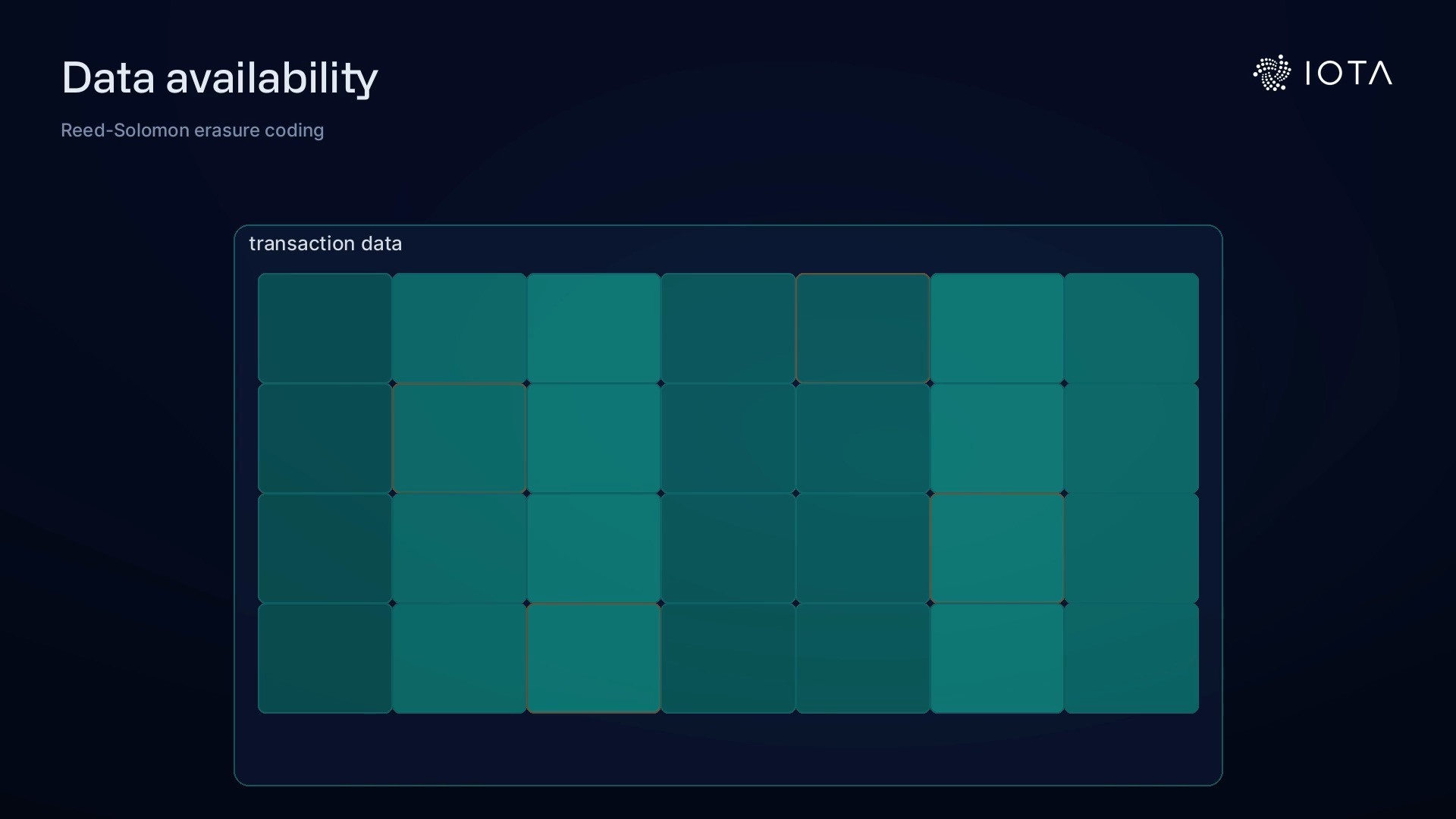
To manage payloads efficiently without resorting to naive broadcasting or vulnerable pull-based recovery mechanisms, Starfish utilizes Reed-Solomon encoding. Transaction data within a block is fragmented across validators with calculated redundancy. Crucially, the reconstruction threshold is established at $f+1$ valid fragments, while a Data Availability Certificate (DAC) requires $2f+1$ acknowledgments from the validator set. This mathematical distinction ensures that data availability is guaranteed by the causal history of the DAG itself, completely removing the need for a separate, bolted-on availability round.
Furthermore, Starfish implements a "Push pacemaker." By mandating that a validator must propose its own block before advancing to subsequent rounds, the protocol prevents validators from drifting ahead and leaving operational gaps in the DAG. This structural enforcement guarantees that the network maintains the necessary topological integrity to commit leaders reliably.
Comparative Performance Metrics and Variance Control
While industry benchmarks frequently emphasize peak throughput and median (p50) latency, engineering reliability requires a granular focus on variance and tail latency (p99). Production networks operate in heterogeneous environments characterized by variable geographic distribution, transient hardware delays, and occasional node misbehavior.
Mainnet metrics recorded following the activation of Starfish demonstrate profound improvements in network predictability:
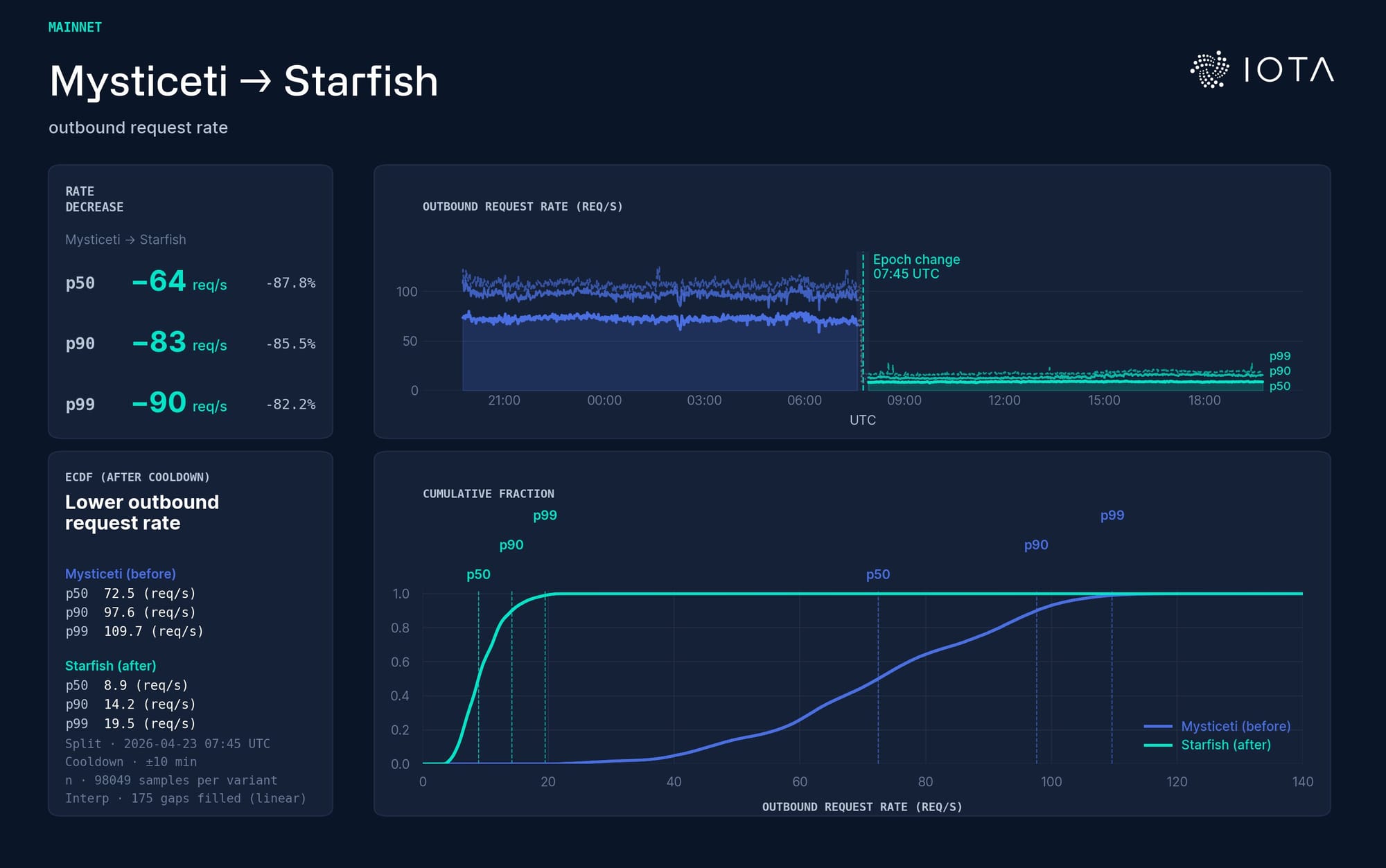
- Outbound Request Rate: Post-Starfish deployment, outbound request rates—signifying the pull path where a validator must actively query a peer for missing history—dropped by approximately an order of magnitude. Validators spend significantly less time executing recovery routines on the critical path.
- Commit Latency and Tails: While median commit latencies experience a negligible adjustment due to the added availability verification step, tail latency sees dramatic enhancement. Specifically, p99 commit latency improved from roughly 486 ms down to 312 ms. The Empirical Cumulative Distribution Function (ECDF) curves confirm a tighter, more reliable performance band with fewer outlier delays.
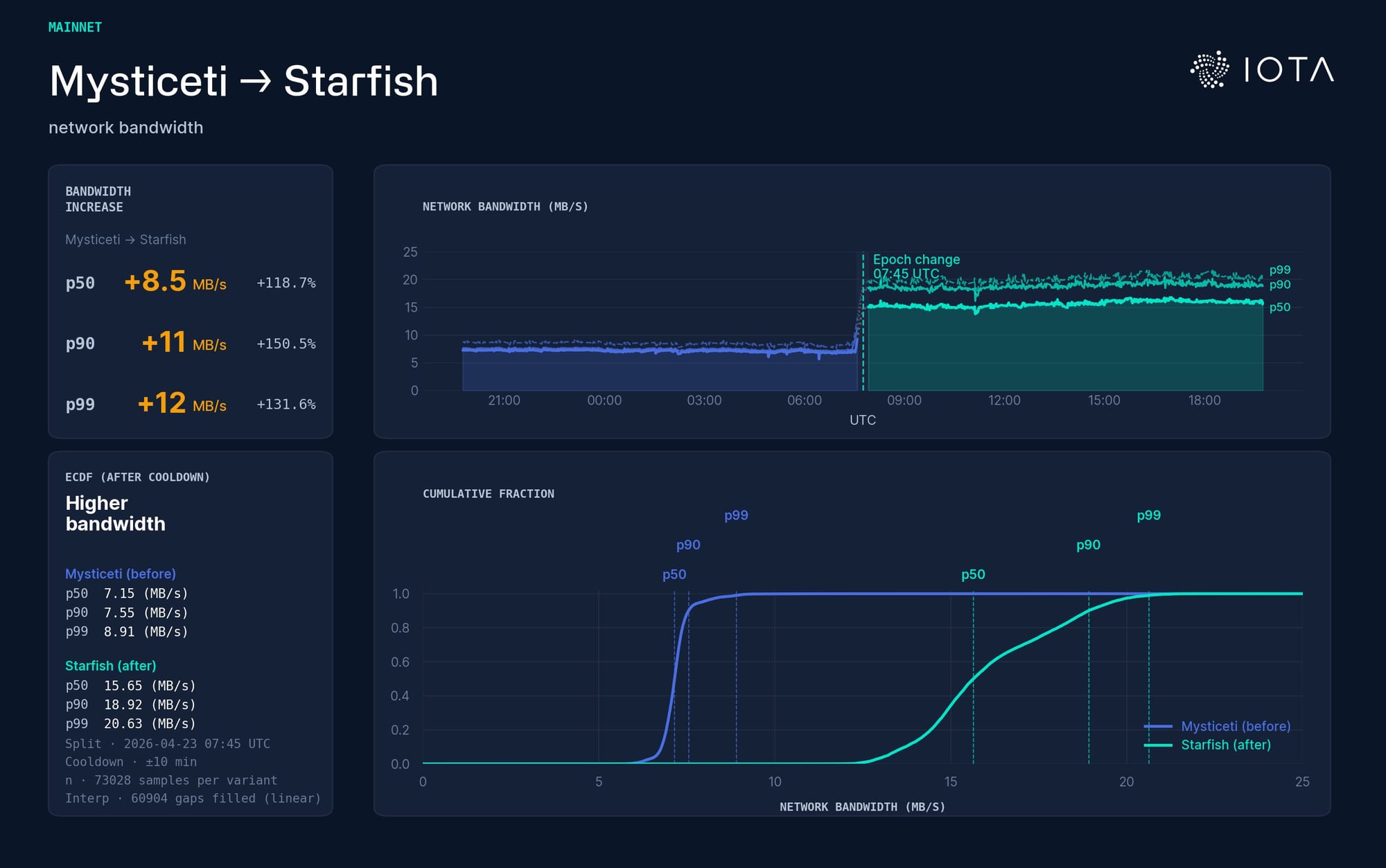
- Bandwidth Utilization: Starfish utilizes roughly twice the bandwidth during active windows compared to uncertified predecessors like Mysticeti. However, this is structured, upfront communication designed to preemptively eliminate downstream recovery costs, resulting in a more stable and resilient consensus rhythm.
Statements and Industry Implications
While commercial and open-source blockchain initiatives frequently prioritize short-term marketing metrics over systemic robustness, the architectural philosophy behind Starfish signals a maturation within the IOTA ecosystem.
Industry analysts and core developers have noted that by elevating data dissemination to a core pillar of consensus design rather than treating it as an afterthought, IOTA has addressed one of the most stubborn theoretical challenges in distributed ledger engineering. By prioritizing low variance over raw, unverified speed, the protocol establishes a blueprint for enterprise-grade reliability.
Fact-Based Analysis of Broader Implications
The successful mainnet activation of Starfish carries several distinct implications for the broader Web3 and distributed systems landscape:
- Redefining DAG Reliability: By solving the historical liveness vulnerabilities of uncertified DAGs through structural pacemakers and integrated data availability certificates, Starfish proves that high-speed consensus does not need to sacrifice deterministic safety guarantees.
- The Shift Toward Distribution Control: The emphasis on reducing p99 tail latency and operational variance offers a new standard for benchmarking enterprise infrastructure, steering the industry away from misleading peak-throughput claims.
- Real-World Adaptability: Because the protocol is explicitly engineered to handle the asynchronous, heterogeneous realities of global validator networks without degrading catastrophically, it provides a highly resilient foundation for decentralized applications requiring high-frequency, dependable state finality.
Ultimately, Starfish demonstrates that the true measure of a consensus protocol lies not merely in how it behaves under ideal laboratory conditions, but in how gracefully it maintains order when the network is stressed. Through this technical overhaul, IOTA has successfully bridged academic consensus theory with the rigorous demands of real-world production infrastructure.