In a landmark integration of public administration and distributed ledger technology, Argentina’s national organ donation authority has successfully migrated its foundational verification layers onto a live, publicly accessible blockchain network. The Instituto Nacional Central Único Coordinador de Ablación e Implante (INCUCAI), operating in coordination with 24 provincial agencies and the Autonomous City of Buenos Aires, has integrated decentralized digital identity (SSI) and tamper-proof electronic notarization into its national infrastructure. Developed in partnership with Latin American decentralized identity firm Extrimian and anchored on the IOTA mainnet, the system fundamentally transforms how medical data, patient consents, and legal authorizations are handled across the country’s extensive healthcare network.
This digital overhaul addresses one of modern medicine’s most stringent operational challenges: time-sensitive organ allocation. When a viable organ becomes available, a critical countdown begins. A human heart, for instance, remains viable outside the body for only a matter of hours. Within this narrow window, a complex chain of custody must be executed flawlessly. Hospitals, regional procurement agencies, and national coordinators must act in exact sequence. Every piece of paperwork—ranging from medical diagnostics and donor consent forms to transport authorizations—must be authenticated immediately. Historically, administrative bottlenecks, misplaced documents, or fraudulent verifications have posed existential threats to this fragile chain of survival. By shifting identity verification and document signing onto an immutable ledger, Argentina has built a system designed to eliminate human error, bypass centralized vulnerabilities, and establish unquestionable legal certainty.
Chronology of a National Digital Transformation
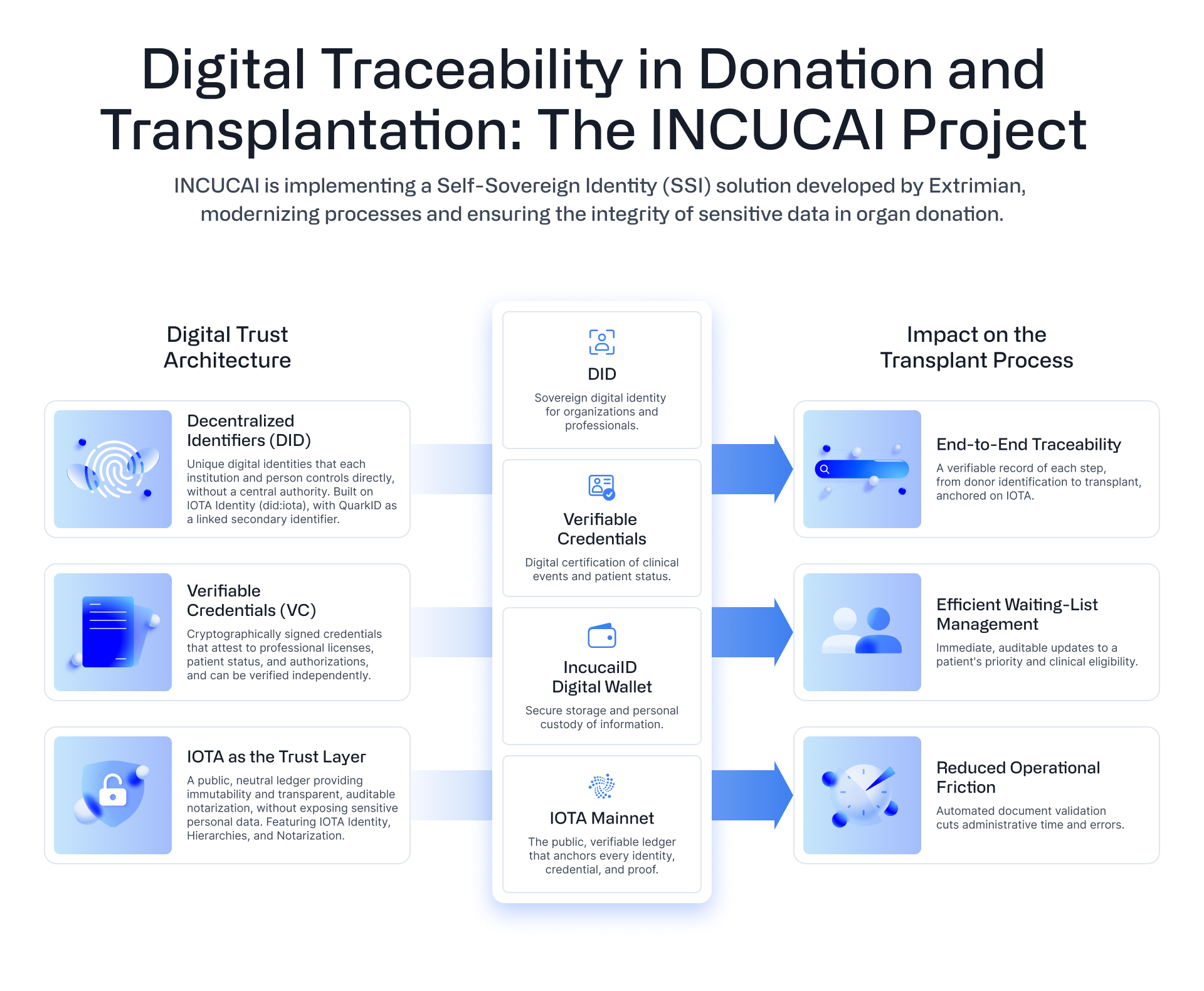
The path toward Argentina’s onchain medical infrastructure spans several months of regulatory reform, infrastructural testing, and technical deployment. The groundwork was solidified when Extrimian integrated IOTA as the neutral public layer capable of verifying institutional identities and document integrity without reliance on third-party gatekeepers.
By June 2026, the framework achieved formal regulatory backing. Through Resolution 199/2026, published officially in the Boletín Oficial, INCUCAI mandated the rollout of electronic signatures across all processes managed by SINTRA (the National Procurement and Transplant Information System) and its affiliated institutional frameworks. This resolution provided the legal foundation required to transition certification, authorization, and validation acts into traceable, blockchain-backed procedures.
On June 10, 2026, the system officially went live on the IOTA Mainnet. Following the mainnet launch, the rollout expanded directly to end-users with the introduction of IncucaiID, an official ecosystem wallet available for download on major mobile application stores. The initial phase of deployment prioritized the waiting-list registration workflow, beginning specifically with heart and lung transplant lists. Plans are already underway to expand the infrastructure to cover remaining organ lists and, eventually, all administrative processes managed under the SINTRA umbrella, steering the national network toward a fully paperless, frictionless environment.
Technical Architecture: Privacy Meets Immutability
At the core of the INCUCAI-Extrimian deployment is a strict adherence to data privacy coupled with absolute cryptographic verifiability. A primary concern when integrating distributed ledger technology into healthcare systems is the protection of sensitive medical records and personally identifiable information (PII). The architecture successfully resolves this by ensuring that no patient-identifiable data is ever stored on the blockchain.
Instead, the system relies on cryptographic hashes—mathematical fingerprints of documents and process steps—that are anchored securely to the IOTA ledger. This structure guarantees that while the underlying medical data remains strictly confidential and off-chain, the integrity of every document and authorization step can be mathematically verified at any time. If a single character within a signed document is altered, its cryptographic hash changes, immediately signaling a breach of integrity.
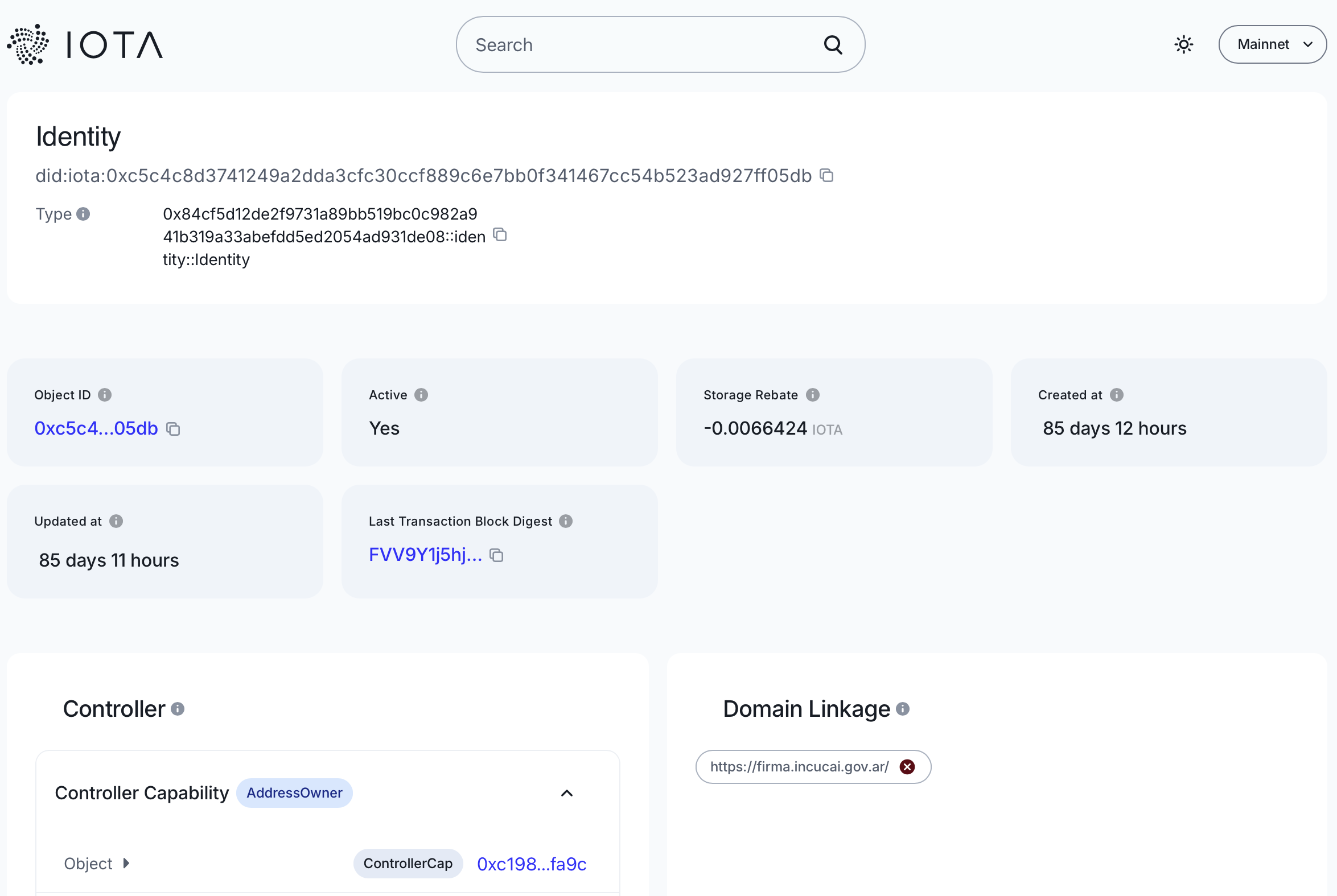
The technical framework draws heavily on open global standards. Digital identities and verifiable credentials strictly adhere to W3C (World Wide Web Consortium) specifications. Furthermore, INCUCAI’s onchain institutional identity is cryptographically linked to its official governmental domain (firma.incucai.gov.ar), enabling any citizen, auditor, or medical professional to confirm that an entity belongs to the legitimate state institution rather than an impostor. Additionally, critical components of the platform operate on ARSAT, Argentina’s state-owned telecommunications and infrastructure enterprise, ensuring that vital sovereign assets remain under national administrative control.
Governance and Verification
Operating under the open-source ethos of "don’t trust, verify," the system was subjected to rigorous independent audits. Independent observers and technical foundations reviewed public endpoints via the IOTA Explorer and confirmed that all 24 provincial agency identities successfully resolved onchain. Direct ledger queries verified that the entities controlling each decentralized identifier (did:iota) matched their accredited roles within the national trust federation.
The introduction of IncucaiID enables patients, authorized healthcare professionals, and administrative staff to hold their credentials within a secure, self-sovereign wallet. Users selectively disclose only the precise credentials required for a given step in the donation or transplant pipeline, minimizing data exposure while maximizing administrative transparency. Document notarizations executed by INCUCAI’s root authority address require minimal gas fees, maintaining high operational efficiency without imposing financial burdens on public infrastructure.
Official Statements and Institutional Perspectives
The successful deployment has drawn widespread praise from public sector leaders and technology pioneers alike, highlighting the convergence of civic duty and advanced cryptography.
Daniela Hansen Krogh, Director of Information Technology and Information Systems at INCUCAI, emphasized the human element behind the technical upgrade: "Trust is at the heart of every organ donation and transplantation process. Our responsibility is to ensure that every decision is supported by reliable, secure, and verifiable information. By incorporating decentralized identity and cryptographic verification into our national systems, we are strengthening the integrity, traceability, and legal certainty of every critical stage, while safeguarding sensitive patient information. This initiative reflects INCUCAI’s ongoing commitment to modernizing Argentina’s transplant system through secure, transparent, and citizen-centered digital innovation."
Echoing this sentiment, Esteban Musso, Professional Services Manager and Partner at Extrimian, pointed to the broader trajectory of digital transformation in public administration: "At Extrimian, we believe that trust is the foundation of every digital transformation. By combining open standards with privacy-preserving technologies, we’ve helped build a solution that enhances traceability, security, and interoperability while respecting the privacy of every participant. Projects like this demonstrate that decentralized technologies are no longer a vision for the future—they are delivering tangible value today in critical public services."
Dominik Schiener, Co-Founder and Chairman of the IOTA Foundation, highlighted the significance of deploying enterprise-grade ledger technology at a national sovereign scale: "This is what IOTA’s open technology can do for critical public services at national scale: real infrastructure, already coordinating decisions that save lives."
Broader Implications and Future Outlook
The integration of blockchain-based identity and notarization into Argentina’s organ transplant ecosystem signals a paradigm shift in how governments can leverage decentralized architectures for essential public services. Traditionally, state-managed databases have suffered from silos, vulnerability to unauthorized alterations, and inefficient bureaucratic handoffs between regional jurisdictions. By establishing a unified, tamper-proof trust layer that spans national and provincial entities, Argentina has set a global precedent for institutional transparency.
The implications extend far beyond organ transplantation. The successful live implementation of Resolution 199/2026 demonstrates that decentralized identifiers and verifiable credentials can be successfully integrated into highly regulated, mission-critical government frameworks without compromising citizen privacy or relying on centralized cloud monopolists. As INCUCAI continues to phase in the remaining waiting lists and administrative workflows under the SINTRA umbrella, the framework stands as a robust blueprint for nations seeking to modernize public administration, eliminate paper-based fraud, and embed verifiable trust directly at the source of life-saving operations.