In the intricate, high-stakes ecosystem of organ transplantation, time is measured not merely in hours, but in minutes. When a viable organ becomes available, a complex, nationwide chain reaction is triggered. Across dozens of hospitals, provincial health bureaus, and national coordinating bodies, a multidisciplinary team must operate with infallible synchronization. Every medical record, authorization, and donor consent must be meticulously verified. In this realm, a single lost form, a clerical error, or a fraudulent signature can mean the tragic difference between life and death. Recognizing these vulnerabilities, Argentina has taken a pioneering leap into the future of public administration by integrating decentralized ledger technology into its national organ procurement framework.
The Instituto Nacional Central Único Coordinador de Ablación e Implante (INCUCAI) serves as Argentina’s national authority for organ, tissue, and cell donation and transplantation. Operating under the umbrella of the Ministry of Health, INCUCAI shoulders the monumental responsibility of managing the national waiting list, overseeing organ allocation, and coordinating operations alongside 24 jurisdictional procurement agencies—encompassing every Argentine province alongside the Autonomous City of Buenos Aires—as well as an extensive network of public and private healthcare facilities.
To fortify this life-saving infrastructure against administrative friction and human error, INCUCAI partnered with Extrimian, a prominent Latin American enterprise specializing in decentralized digital identity and self-sovereign identity (SSI) architectures. Together, they have deployed a live, publicly verifiable digital-identity and document-signing system anchored directly to the IOTA mainnet. This technological overhaul represents a paradigm shift for Latin American public infrastructure, marrying cryptographic security with the rigorous demands of national healthcare administration.
The Anatomy of a Decentralized Public Infrastructure
The core challenge facing INCUCAI was twofold: achieving absolute transparency and tamper-proof traceability across a fragmented national network while strictly preserving the confidentiality of patients and grieving families. Centralized databases, while traditional, inherently introduce single points of failure, potential vulnerabilities to unauthorized tampering, and a lack of neutrality that multi-jurisdictional public projects demand.
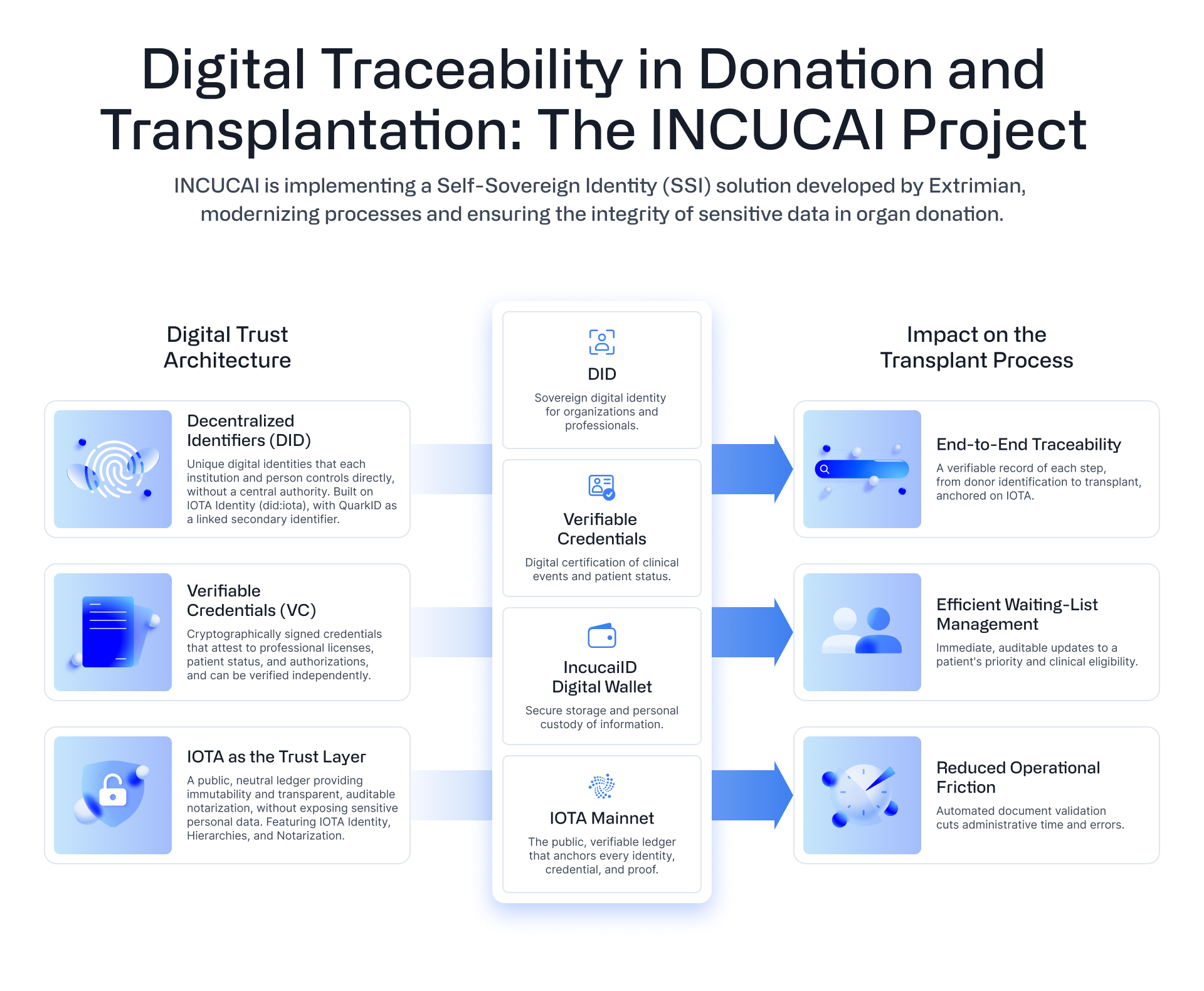
To overcome these hurdles, Extrimian utilized self-sovereign identity principles, empowering individuals and institutions with direct cryptographic control over their credentials. Rather than inventing a bespoke ledger, Extrimian selected IOTA as the underlying public network. IOTA provides a scalable, feeless or low-cost, and environmentally sustainable ledger where institutional identities and document integrity can be audited in real time without reliance on commercial intermediaries or gatekeepers.
Crucially, the architecture adheres to a strict privacy-by-design mandate. No personally identifiable information (PII) or sensitive medical records are ever stored on the public blockchain. Instead, the system employs cryptographic hashes—mathematical fingerprints—of official documents and procedural steps. These hashes are permanently anchored to the IOTA ledger. This ensures that doctors, regulatory agencies, and patient advocates can independently verify that an authorization or medical record has not been altered since its creation, while the underlying data remains securely encrypted off-chain.
Chronology and Deployment Milestones
The integration of blockchain technology into Argentina’s transplant system is the culmination of years of technological development, strategic planning, and regulatory modernization. The timeline of this transformation highlights a methodical approach to national-scale digital adoption:
- Pre-2025: Conceptualization and preliminary testing of self-sovereign identity frameworks within Latin American public-sector environments, laying the groundwork for institutional integration.
- Early 2026: Development and technical auditing of the Extrimian-INCUCAI bridge, aligning W3C-compliant decentralized identifiers (DIDs) with Argentina’s governmental infrastructure, including hosting components on ARSAT, the country’s state-owned telecommunications infrastructure.
- June 10, 2026: The decentralized infrastructure officially goes live on the IOTA Mainnet, enabling independent verification of institutional credentials across all 24 provincial jurisdictions.
- June 18, 2026: Resolution 199/2026 is officially published in the Boletín Oficial (National Official Gazette), legally mandating electronic signatures powered by the new architecture for all processes managed via SINTRA (Argentina’s National Procurement and Transplant Information System).
- July 2026: Public rollout of IncucaiID, the ecosystem’s official mobile wallet application on iOS and Android, beginning initially with waiting-list registrations for heart and lung transplants before expanding to other organs and tissues.
The Technological Framework and Verification Protocols
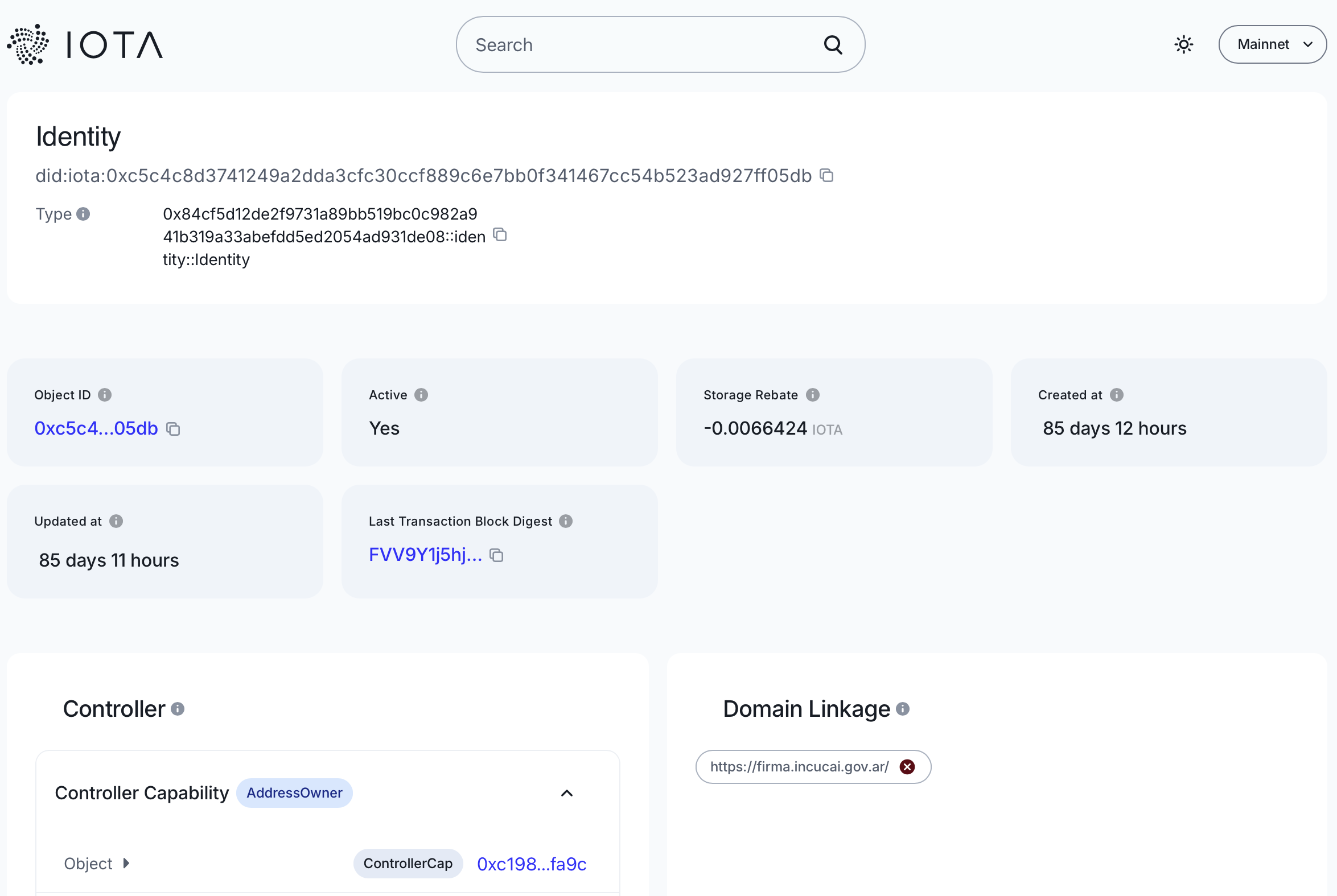
The system’s robustness relies on open, internationally recognized standards. The identities and verifiable credentials issued within the network strictly adhere to World Wide Web Consortium (W3C) specifications. Furthermore, INCUCAI’s foundational institutional identity features cryptographic linkage to its official government web domain, allowing any citizen or auditor to verify that a digital credential genuinely originates from the authentic state authority rather than a malicious imposter.
A vital element of the deployment involves Argentina’s state-owned telecommunications company, ARSAT. By integrating parts of the infrastructure with ARSAT, the Argentine government ensures that critical sovereign control is maintained over domestic data routes while leveraging the global, decentralized verification properties of the IOTA network.
To prove the efficacy of the system, the IOTA Foundation conducted an independent audit working exclusively from public endpoints and the IOTA Explorer. Observers were able to resolve all 24 provincial identities, confirm that the trust federation matched the onchain data, and verify via direct ledger queries that the entities controlling each identity were precisely those accredited by the state. This "don’t trust, verify" paradigm establishes a gold standard for public accountability.
Regulatory Integration via Resolution 199/2026
Technology alone cannot transform a national bureaucracy; it must be matched by legal modernization. This milestone was achieved with the issuance of Resolution 199/2026, promulgated in the national Official Gazette in June 2026. This landmark legal framework formally incorporates electronic signatures into every operational process managed through SINTRA.
At the center of user interaction is IncucaiID, an official mobile wallet application now downloadable on Apple’s App Store and Google Play. Through IncucaiID, medical professionals, administrative staff, and patients interact with the system securely. Healthcare personnel can sign medical authorizations, families can grant donor consents, and patients can manage their waiting-list status with cryptographic certainty. The application ensures that users hold their own credentials and selectively disclose only the data required for a given step in the donation workflow, minimizing data exposure.
Initial deployment of the IncucaiID wallet and electronic signature workflow focuses specifically on the national waiting lists for heart and lung transplants—procedures where time is most critical. Subsequent phases will systematically integrate liver, kidney, tissue, and corneal registries, culminating in a fully paperless, frictionless national organ procurement ecosystem.
Official Statements and Institutional Perspectives
The intersection of advanced cryptography and humanitarian public service has drawn praise from leaders across the technology and healthcare sectors, highlighting the practical utility of decentralized systems in solving real-world crises.
Esteban Musso, Professional Services Manager and Partner at Extrimian, emphasized the foundational role of trust in digital transformation. "At Extrimian, we believe that trust is the foundation of every digital transformation," Musso stated. "By combining open standards with privacy-preserving technologies, we’ve helped build a solution that enhances traceability, security, and interoperability while respecting the privacy of every participant. Projects like this demonstrate that decentralized technologies are no longer a vision for the future—they are delivering tangible value today in critical public services."
Echoing this sentiment, Daniela Hansen Krogh, Director of Information Technology and Information Systems at INCUCAI, underscored the human element behind the technical architecture. "Trust is at the heart of every organ donation and transplantation process," remarked Krogh. "Our responsibility is to ensure that every decision is supported by reliable, secure, and verifiable information. By incorporating decentralized identity and cryptographic verification into our national systems, we are strengthening the integrity, traceability, and legal certainty of every critical stage, while safeguarding sensitive patient information. This initiative reflects INCUCAI’s ongoing commitment to modernizing Argentina’s transplant system through secure, transparent, and citizen-centered digital innovation."
Dominik Schiener, Co-Founder and Chairman of the IOTA Foundation, pointed to the broader significance of the deployment for the blockchain industry at large. "This is what IOTA’s open technology can do for critical public services at national scale: real infrastructure, already coordinating decisions that save lives," Schiener noted.
Broader Implications and Future Outlook
The successful integration of IOTA and Extrimian into INCUCAI’s operations signals a potential turning point for how governments worldwide approach digital identity and document notarization. For years, blockchain technology has faced skepticism regarding its practical utility beyond speculative financial assets. However, deployments of this scale demonstrate that distributed ledgers offer unmatched utility when applied to high-stakes administrative processes requiring multi-party trust, immutability, and strict jurisdictional boundaries.
By removing manual paperwork, eliminating bureaucratic bottlenecks, and providing an unalterable audit trail, Argentina has not only optimized the operational efficiency of its transplant network but has also reinforced public confidence in a system where transparency is paramount. As other nations grapple with the modernization of legacy public health infrastructure, the Argentine model serves as a compelling blueprint: a harmonious convergence of sovereign state governance, privacy-first cryptographic design, and open public ledger technology working in tandem to preserve human life.