The decentralized finance landscape on Ethereum Mainnet has reached a notable milestone with the official launch of multicollateral margin on Synthetix. In what protocol developers are calling a foundational shift for decentralized derivatives trading, Ethereum’s native asset, Ether (ETH), can now be posted directly as collateral to trade perpetual swaps (perps) without requiring users to liquidate their holdings or bridge to layer-two scaling solutions.
This development marks the first time in Ethereum’s history that users can utilize ETH as native collateral for trading perpetual contracts directly on the Ethereum Layer 1 network. By integrating ETH alongside the existing USDT-based margin system, Synthetix is aiming to tap into a substantial pool of dormant capital while streamlining capital efficiency for active derivatives traders, basis traders, and decentralized finance (DeFi) participants.
Background Context and the Evolution of Synthetix Perps
To understand the significance of this deployment, one must examine the architectural trajectory of Synthetix within the broader Ethereum ecosystem. Launched originally as a synthetic asset issuance platform, Synthetix has progressively pivoted to focus heavily on its perpetual futures engine, positioning itself as a premier liquidity layer for decentralized derivatives.
Historically, decentralized perpetual exchanges have grappled with the fragmented nature of liquidity across various Layer 2 rollups and sidechains. While scaling networks have successfully reduced transaction fees and increased throughput, a substantial portion of the Ethereum ecosystem’s total value locked (TVL)—specifically hundreds of billions of dollars in native ETH—remains anchored to the Ethereum Mainnet.
By keeping trade execution and settlement strictly on Layer 1, Synthetix has carved out a distinct niche for traders who prioritize maximum security guarantees, economic composability, and direct interaction with the foundational Ethereum ledger. However, previous iterations of the exchange relied exclusively on USDT as collateral. This restriction forced traders wishing to use the platform to either sell their ETH for stablecoins—thereby sacrificing upside price exposure—or navigate complex, multi-step borrowing and wrapping maneuvers. The introduction of native ETH margin removes this friction, aligning the protocol’s margin requirements with the primary asset held by long-term ecosystem participants.
Mechanics of Native ETH Margin and Unified Accounts
Under the new multicollateral system, depositing ETH onto Synthetix allows traders to maintain their bullish price exposure while simultaneously securing leveraged positions across any USDT-settled market available on the exchange.
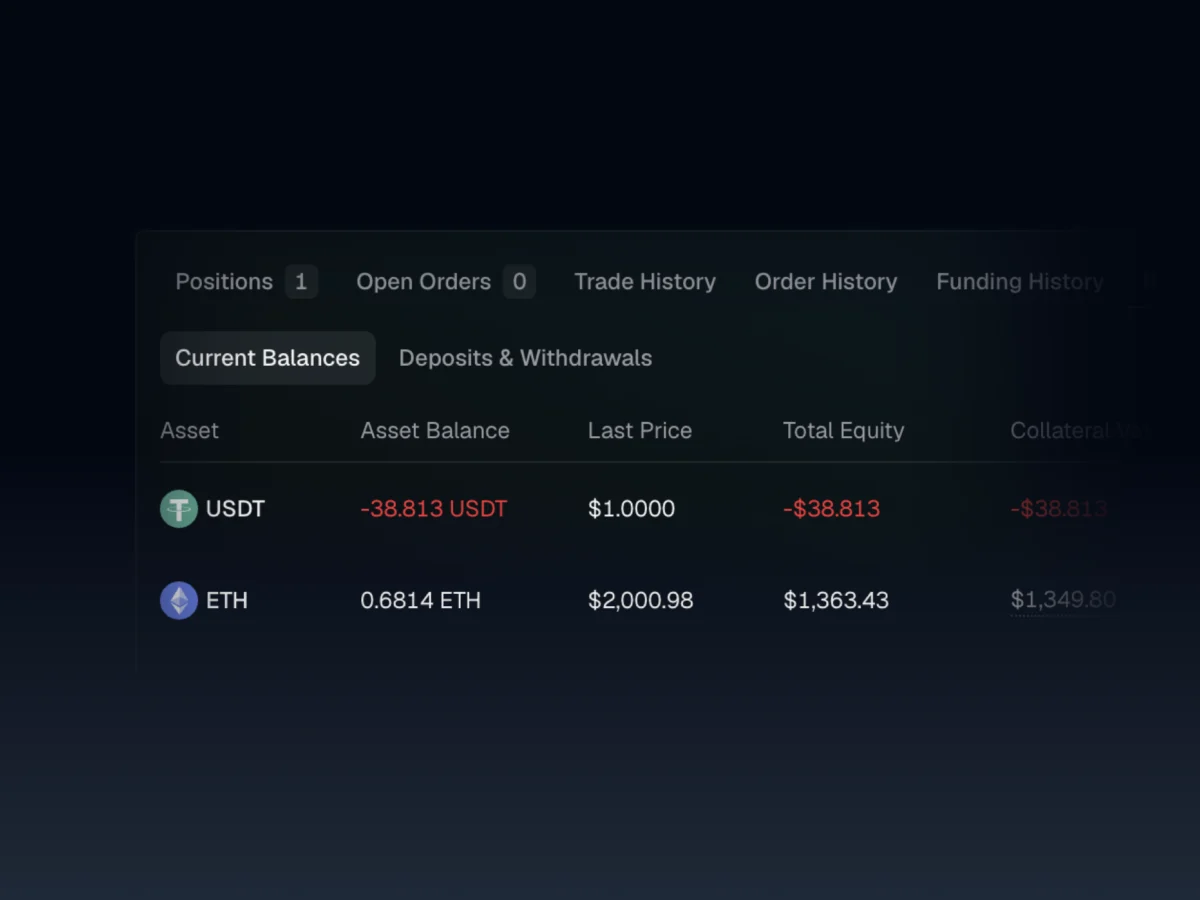
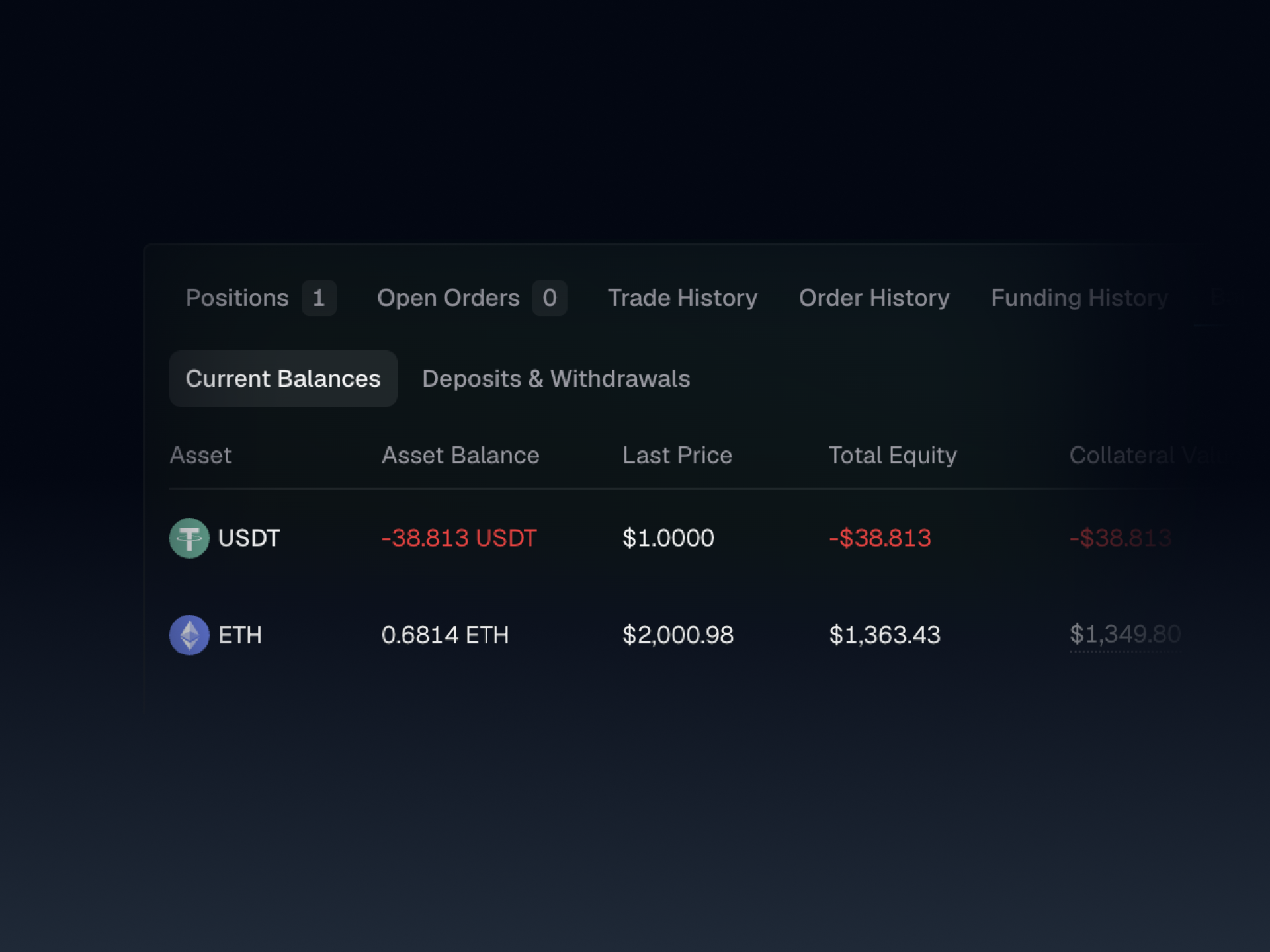
The architecture relies on a unified multicollateral margin account where ETH and USDT work in tandem to back open positions. When a user deposits ETH, the protocol calculates its live index price and applies a standard risk discount, commonly referred to as a "haircut." This valuation yields the account’s official "Collateral Value," which determines the borrowing and leverage capacity of the user.
Because all derivative positions on Synthetix settle in USDT, transactional expenses such as funding rates, trading fees, and realized profit and loss (PnL) continue to be denominated in USDT. Consequently, if a user opens positions backed entirely by ETH collateral without maintaining a positive USDT cash balance, their USDT account balance may temporarily reflect a negative figure. This negative balance represents an intentional, protocol-backed debt structure secured by the underlying ETH collateral. Traders retain the flexibility to clear this deficit at any point by utilizing the platform’s internal swap feature to convert a portion of their deposited ETH directly into USDT.
Protocol developers emphasize that risk management remains paramount under this setup. Because ETH is a volatile asset subject to market fluctuations, a sudden downward movement in the price of ETH will reduce the account’s overall margin buffer, even if the user’s open perpetual positions remain flat. To safeguard system solvency, the protocol incorporates an automated mechanism whereby a portion of the user’s ETH collateral can be systematically converted to USDT if the account’s debt threshold is breached. Consequently, active management and continuous monitoring of collateral health ratios are advised for participants utilizing high leverage.
Optimizing DeFi Strategies: The Efficiency of Basis Trades
Beyond serving as a vehicle for leveraged directional trading, the integration of ETH multicollateral margin is expected to transform the execution of staple decentralized finance strategies, most notably the basis trade.
The basis trade—a market-neutral strategy involving the simultaneous purchase of a spot asset and the shorting of a corresponding futures contract to capture funding rates—has long been a cornerstone of professional crypto arbitrage. Previously, executing an efficient basis trade on-chain often required cumbersome interactions across multiple lending markets and derivative platforms.
With native ETH margin now live, a trader can deposit ETH as collateral and concurrently open an equivalent short ETH perpetual position within the same interface. This creates a delta-neutral structure where the spot-like price exposure of the collateral and the short position’s PnL largely offset one another. The trader can thus capture periodic funding payments without incurring directional market risk or sacrificing their foundational ETH holding.
Market analysts note that lower friction for basis traders typically results in tighter bid-ask spreads and more competitive pricing across the exchange’s entire order book. As professional liquidity providers find it easier to maintain delta-neutral books, overall market depth improves, benefiting casual and institutional traders alike.
Implications for the Broader Ethereum Ecosystem
The strategic implications of unlocking native ETH as margin extend far beyond the immediate user base of Synthetix. With well over $100 billion in idle ETH sitting natively on Ethereum Mainnet, the potential addressable market is vast.
Industry observers have highlighted the potential "flywheel effect" if decentralized derivatives protocols successfully capture a meaningful share of global crypto derivatives volume. Increased activity on Layer 1 Synthetix generates higher fee throughput, deeper liquidity, and tighter integration with other native DeFi primitives, such as lending protocols and automated market makers.
Furthermore, the Synthetix development team has confirmed that ETH is merely the vanguard of a broader multicollateral rollout. Infrastructure updates currently in the pipeline are designed to accommodate additional non-USDT assets, including yield-bearing tokens such as liquid staking derivatives (LSDs). The inclusion of yield-generating collateral would allow users to earn baseline staking rewards while simultaneously utilizing those same assets as margin for derivatives trading, representing a significant leap in capital efficiency.
Official Guidance and Getting Started
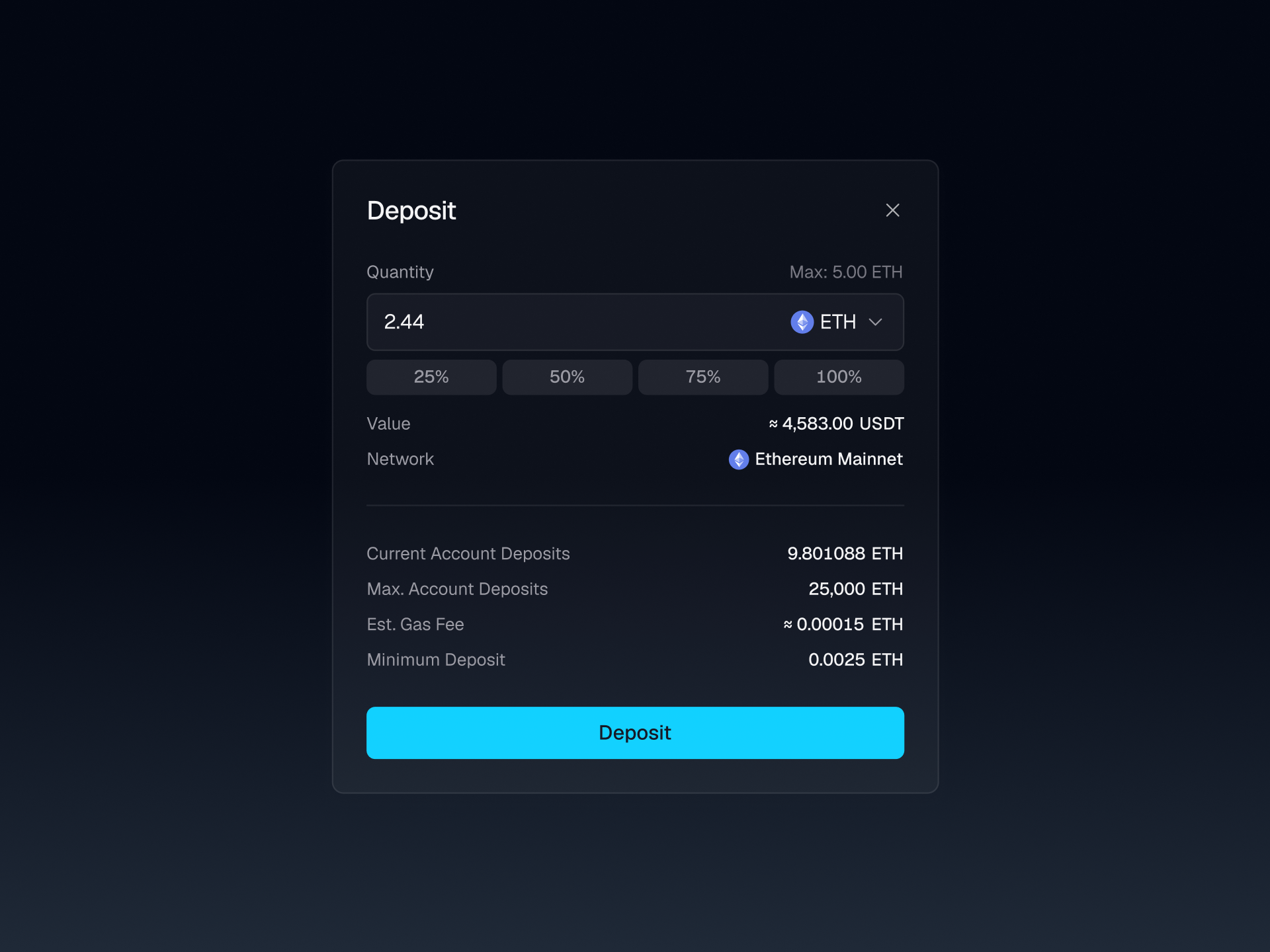
For traders looking to transition to the new system, Synthetix has published comprehensive documentation detailing minimum deposit requirements, maximum account caps, and asset-specific risk parameters. The deposit interface itself displays current limits for each accepted token to ensure transparency.
As the platform phases in higher caps and additional collateral types, community governance and core contributors continue to monitor system stability under live market conditions. Users seeking assistance or technical clarification can access support channels directly through the protocol’s official documentation portal.
The deployment of multicollateral margin signals a maturing phase for decentralized derivatives, bridging the gap between passive asset holding and active margin utility on the world’s most economically secure smart contract platform.