In an era where modern supply chains, clinical trials, and multinational logistics networks span fragmented databases and disconnected spreadsheets, the integrity of business data has become a critical vulnerability. Records are frequently altered, backfilled, or disputed across organizational boundaries, forcing external partners, regulators, and consumers to rely on fragile, exported reports rather than verifiable histories. Addressing this fundamental trust deficit, the IOTA Foundation has officially launched IOTA Audit Trails, an innovative open-source solution designed to anchor governed, ordered, and tamper-resistant record histories directly onto a shared public ledger.
Available immediately as an alpha release, the toolkit introduces a versatile Move package, a typed Rust SDK, and WebAssembly (WASM) bindings tailored for JavaScript and TypeScript applications. By bridging the gap between private enterprise databases and public distributed ledgers, IOTA Audit Trails enables organizations to prove not only that data remains unaltered, but precisely who authorized an action, when it occurred, and under what specific operational permissions it was executed.
The Fragmented Trust Problem in Modern Enterprise Operations
Every complex business workflow inevitably leaves a sprawling digital trail. A high-value manufactured component moves through dozens of third-party suppliers; a clinical trial collects sensitive study events across international medical facilities; a global customs workflow requires simultaneous multi-agency approvals; and compliance teams must regularly review the evidentiary foundation behind critical corporate decisions.
Historically, these records reside in siloed internal systems, relational databases, manual spreadsheets, and application-specific audit logs. This fragmentation introduces severe operational vulnerabilities. Internal access controls are almost exclusively localized to single applications, leaving organizations vulnerable to insider threats, accidental data corruption, or retroactive alterations. Furthermore, when disputes arise between external stakeholders—such as suppliers, insurers, or regulatory bodies—verifying the true sequence of events requires cumbersome, manual audits and an inherent reliance on centralized administrators or exported data transcripts.
Traditional internal audit systems are structurally incapable of solving this cross-organizational challenge. While they successfully assist internal IT teams with incident investigations and routine corporate reporting, their reliance on a single database or a central authority breaks down the moment a business workflow crosses company lines. Regulators and downstream partners are routinely forced to accept data on faith rather than independent cryptographic and logical verification.
Bridging the Gap: Architecture and Operational Mechanics of IOTA Audit Trails
Building upon the foundation of the existing IOTA Notarization toolkit—which allows developers to anchor isolated, individual records to the ledger—IOTA Audit Trails scales this capability into fully governed, chronologically ordered histories. Rather than forcing organizations to expose sensitive internal documents, proprietary business logic, or confidential personal data on a public network, the framework utilizes an efficient off-chain storage model paired with on-chain cryptographic anchoring.
Under this architecture, sensitive source material remains stored securely within private enterprise environments. Only the corresponding cryptographic hashes, structural references, event metadata, and operational proofs are written to the IOTA public ledger. This guarantees absolute data integrity, sequence ordering, and availability without compromising organizational privacy, regulatory compliance, or trade secrets.

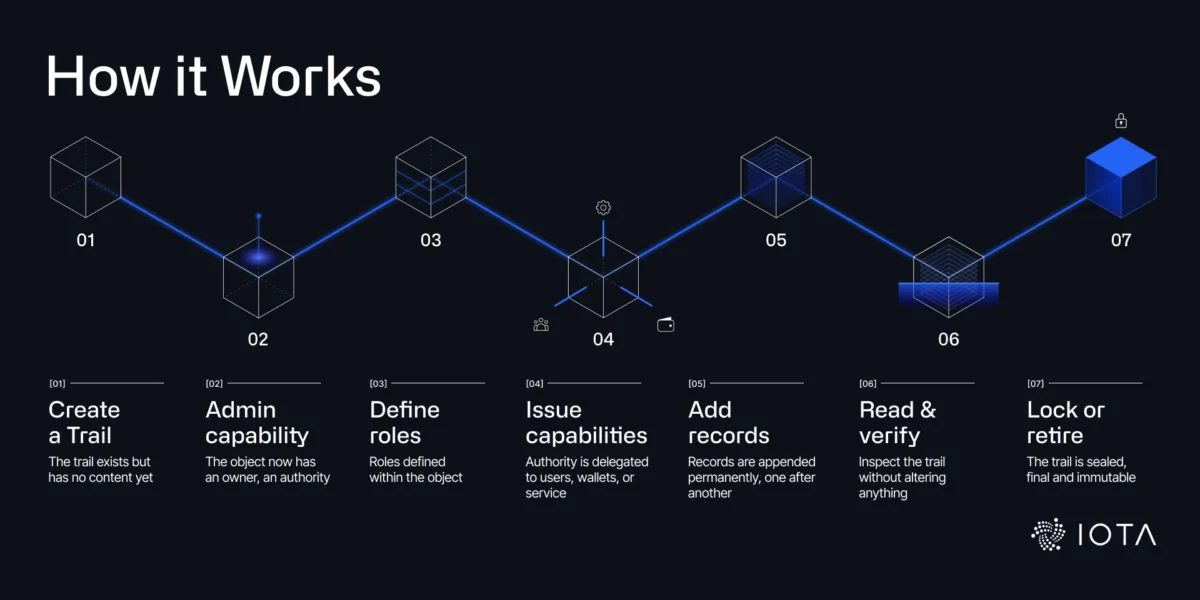
The core operational unit is a shared onchain object representing an immutable audit trail. Each record within this trail can contain arbitrary text or binary data, customizable metadata, and specific classification tags. Crucially, the trail framework natively incorporates immutable creation metadata, updatable operational logs, strict locking configurations, and comprehensive role-based access control (RBAC) rules.
This design transforms the fundamental nature of data verification. Instead of merely answering the baseline question of whether a piece of data has been modified, IOTA Audit Trails provides verifiable answers to complex governance inquiries: Who added this specific record? Under what assigned role? In what precise chronological sequence? And governed by which organizational lifecycle rules?
Robust Developer Tooling and Flexible Integration Paths
To accelerate enterprise adoption, the IOTA Foundation has engineered the Audit Trails alpha release with a heavy emphasis on developer ergonomics and cross-platform flexibility. The solution is distributed across three primary integration pathways, ensuring seamless compatibility with diverse modern technology stacks:
- Move Package: Designed for on-chain contract logic and native execution on the IOTA network, enabling developers to enforce strict state transitions and governance rules directly at the protocol level.
- Typed Rust SDK: Tailored for high-performance backend enterprise integrations, allowing legacy enterprise resource planning (ERP) and supply chain management systems to interact natively with audit trails.
- WebAssembly (WASM) Bindings: Built specifically for JavaScript and TypeScript developers, facilitating direct integration into modern web applications, browser-based portals, and decentralized front ends.
Additionally, the official repository features ready-to-run examples addressing real-world enterprise use cases, including automated customs clearance workflows, clinical trial tracking, and Digital Product Passports (DPPs). To ensure maximum architectural flexibility, transaction construction has been completely decoupled from submission. Development teams can seamlessly plug IOTA Audit Trails into custom wallet architectures, internal enterprise signing infrastructures, or specialized gas station workflows without disrupting existing operational procedures.
Industry Applications: Transforming Cross-Boundary Verification
The general-purpose nature of IOTA Audit Trails makes it uniquely suited for industries where operational records cross organizational boundaries, carry significant regulatory weight, or require independent verification by external third parties.
- Supply Chains and Digital Product Passports: Manufacturers can securely record the entire lifecycle of a physical component—from raw material sourcing and factory assembly to maintenance updates, regulatory inspections, and eventual recycling. Downstream consumers and environmental regulators can independently verify the authenticity and sustainability claims of a product without trusting the manufacturer’s marketing assertions.
- Legal and Regulatory Compliance: Corporate compliance departments can establish immutable, verifiable audit histories for high-stakes approvals, corporate filings, contractual obligations, and regulated operational decisions, drastically reducing the time and expense associated with third-party audits.
- Global Trade and Customs Clearance: Multi-party customs workflows can leverage shared audit trails to coordinate clearance steps, safety inspections, and official declarations. Because updates are strictly role-scoped, each participating customs agency and shipping partner can interact with a single, trusted source of truth.
- IoT and Industrial Automation: Automated machinery and industrial Internet of Things (IoT) deployments can utilize the ledger to record critical sensor attestations, machine events, remote maintenance actions, and system state transitions, establishing an unbroken chain of custody for autonomous operations.
Broader Implications and Strategic Outlook
The introduction of IOTA Audit Trails marks a significant maturity milestone for enterprise-grade distributed ledger technology. By shifting the focus from speculative financial applications to foundational data integrity and cross-organizational governance, the IOTA Foundation is addressing a multi-billion-dollar enterprise pain point.
As regulatory scrutiny intensifies globally across sectors like healthcare, aerospace, finance, and sustainable manufacturing, the demand for verifiable provenance will only accelerate. Systems that rely on centralized databases and isolated logs will increasingly struggle to satisfy the transparency demands of modern consumers, global regulators, and interconnected business ecosystems.
By providing a developer-friendly toolkit that enforces structural accountability without sacrificing privacy, IOTA Audit Trails offers a pragmatic blueprint for the future of digital trust. Development teams are currently invited to experiment with the alpha release, deploy test architectures on the IOTA Testnet, and contribute feedback to the broader open-source builder community as the protocol matures toward production-ready mainnet deployment.