In a coordinated international law enforcement sweep executed on October 27, 2026, the U.S. Attorney’s Office for the Eastern District of Virginia, alongside the FBI Washington Field Office, announced the court-authorized seizure of virtualine.net. The domain served as the primary digital gateway for Virtualine, a prominent and highly destructive bulletproof hosting (BPH) provider that had long operated as a foundational pillar for the global cybercrime economy. The sweeping multi-jurisdictional disruption was achieved through close cooperation with foreign law enforcement partners, including Germany’s Polizei Hessen, the Netherlands’ Politie Midden-Nederland, and the United Kingdom’s National Crime Agency (NCA).
The operation also leveraged critical private-sector intelligence support. Blockchain analysis firm Chainalysis, working in tandem with OverRIPE—a specialized coalition of independent security researchers and professionals dedicated to tracking and mitigating malicious hosting threats—provided essential technical mapping that allowed authorities to pinpoint and neutralize Virtualine’s deeply entrenched infrastructure.
The takedown of virtualine.net marks a significant milestone in the ongoing global effort to dismantle the specialized service layer that enables ransomware operators, state-sponsored threat groups, and transnational fraudsters to operate with relative impunity. By targeting the hosting providers rather than solely focusing on individual threat actors, international law enforcement agencies are increasingly seeking to cut off the oxygen supply of modern cybercrime.
Understanding Bulletproof Hosting and Its Role in Global Cybercrime
Bulletproof hosting providers represent a critical vulnerability within the architecture of the modern internet. Unlike conventional web hosting services that maintain strict compliance departments, respond promptly to Digital Millennium Copyright Act (DMCA) takedown notices, and cooperate with law enforcement subpoenas, BPH providers deliberately ignore abuse complaints and legal requests. Operating primarily out of jurisdictions with lax regulatory enforcement or leveraging complex corporate shells, these providers offer offshore infrastructure explicitly designed to resist disruption.
For criminal networks, bulletproof hosting is the indispensable engine that powers persistent operations. BPH infrastructure is routinely utilized to host ransomware command-and-control (C2) servers, spear-phishing kits, sophisticated malware distribution networks, illicit carding shops, stolen credentials (infostealer logs), and dark web marketplaces. By guaranteeing uptime and shielding illicit operators from accountability, BPH providers lower the barrier to entry for novice cybercriminals while giving advanced syndicates a resilient backbone.
Virtualine, which operated under a revolving door of aliases including Secury, Massgod, Spamhouse, Lanedo, and Omegatech, was among the most brazen actors in the BPH ecosystem. Rather than attempting to mask its illicit business model, Virtualine openly advertised its services to the criminal underworld on major Russian-language and English-language cybercrime forums, such as Exploit.in and HackForums.
Chronology of an Investigation and Brazen Criminal Operations
The downfall of Virtualine was preceded by years of escalating criminal operations and increasingly arrogant public messaging by the hosting provider’s administrators. A chronological review of Virtualine’s operations highlights the brazen nature of its business model and the methodical closing of the net by international authorities.
In September 2024, a representative of Virtualine published a direct solicitation on the cybercrime forum Exploit.in. In response to a prospective client inquiring about acceptable use policies, Virtualine explicitly stated: “You can use Virtualine for all illegal/black hat activities (including phishing, carding, email spam, port scanning and all others) except for child contents and terrorism activities.”
By June 2025, buoyed by a growing client base and a lack of immediate enforcement actions, Virtualine adopted a mocking tone toward traditional security measures. In a post on HackForums, the provider boasted that “Virtualine ignored more abuse than your last three therapists.”
As law enforcement pressure mounted globally in late 2025 and early 2026, Virtualine attempted to innovate its illicit offerings. In March 2026, the provider introduced a specialized “additional protection plan” designed to outmaneuver international investigations. The plan promised that upon receiving a formal law enforcement request or court order, Virtualine would automatically migrate a customer’s criminal infrastructure to an unrelated shell company before reactivating the server under a new guise, effectively neutralizing traditional takedown efforts.
Despite Virtualine’s public disclaimers regarding child exploitation content, federal prosecutors allege that the provider crossed severe legal lines. Court documents and investigative findings reveal that Virtualine knowingly hosted a criminal online forum that trafficked in sexually suggestive and explicit images and videos of both minors and adults. Furthermore, the platform promoted a dedicated "hack-for-hire" service, allowing malicious actors to illegally harvest intimate content from victims’ personal accounts.
The Cryptocurrency Nexus and On-Chain Exposure

A vital component of Virtualine’s operational model was its financial architecture. The hosting provider accepted direct Bitcoin payments through unhosted wallet addresses. This configuration allowed criminal clients to pay for hosting services without triggering the automated compliance checks, Know-Your-Customer (KYC) verifications, or anti-money laundering (AML) flags standard on centralized cryptocurrency exchanges. According to the U.S. Department of Justice, Virtualine subsequently engaged in complex layering and laundering schemes to obscure the origins of the illicit proceeds.
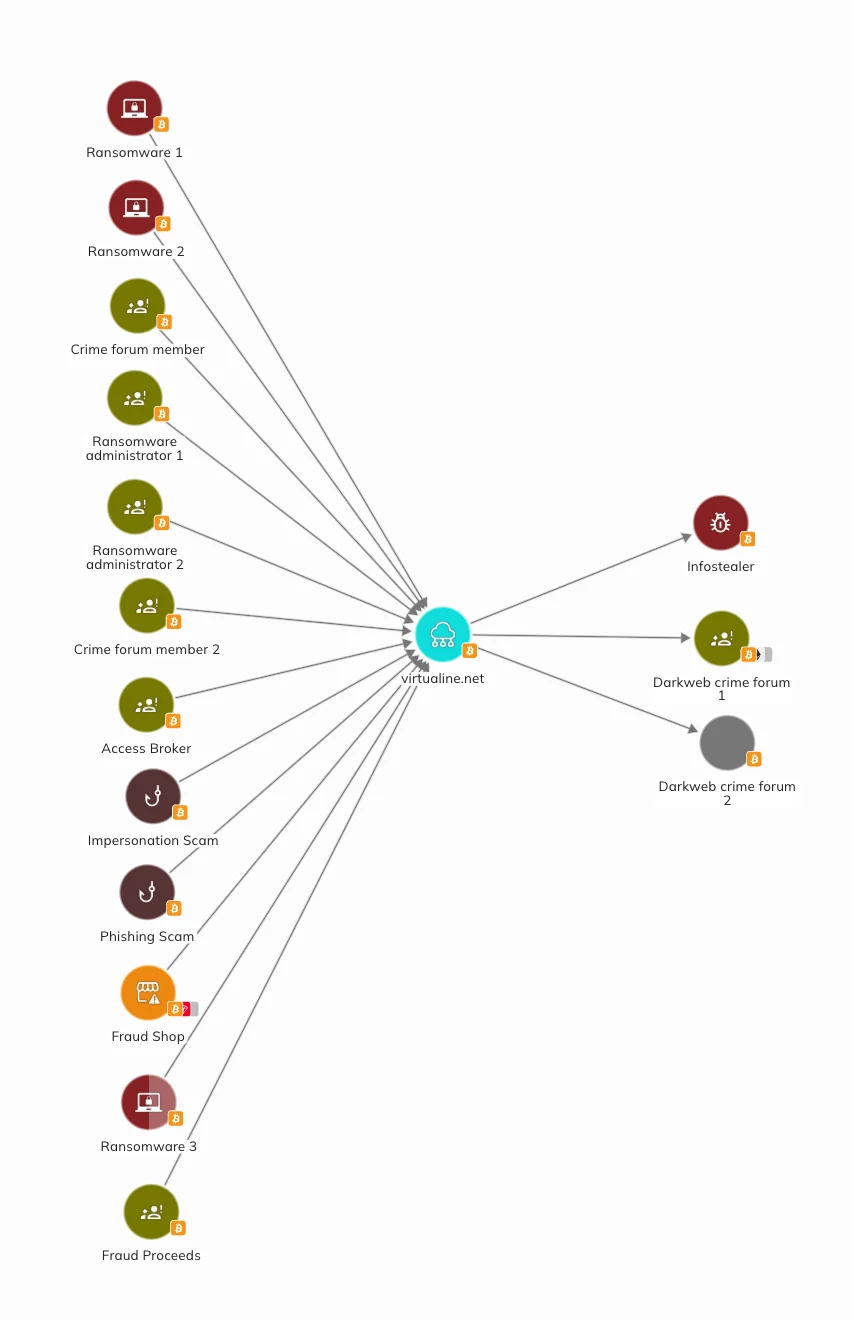
On-chain analysis conducted by Chainalysis utilizing specialized forensic tools such as Chainalysis Reactor revealed the vast, interconnected nature of Virtualine’s financial footprint. The provider’s wallet addresses displayed direct exposure to a cross-section of the broader global cybercrime ecosystem. Funds flowed directly between Virtualine and ransomware operators, infostealer infrastructure, prominent Russian-language hacking forums, illicit drug and fraud marketplaces, and high-volume phishing schemes.
This on-chain nexus underscores a profound systemic reality of the modern digital underground: cryptocurrency frequently serves as the universal settlement layer for diverse criminal enterprises. A single bulletproof hosting provider can simultaneously collect revenue from ransomware extortionists, credential-theft rings, and identity thieves, blending these illicit revenue streams into a unified financial pool.
Official Responses and Institutional Perspectives
The coordinated takedown of virtualine.net elicited strong statements from participating law enforcement agencies and private sector partners, emphasizing the necessity of public-private collaboration in modern cybersecurity enforcement.
Law enforcement officials stressed that the operation demonstrates the borderless nature of modern policing against transnational cybercrime. By pooling intelligence from the U.S., Germany, the Netherlands, and the United Kingdom, authorities were able to pierce the corporate veil maintained by Virtualine and sever its access to the global internet. Representatives from the FBI Washington Field Office noted that the seizure serves as a direct warning to other BPH providers operating under the false assumption that offshore incorporation and cryptocurrency payments grant permanent immunity.
Private sector partners echoed these sentiments, highlighting the growing importance of blockchain intelligence in mapping cybercriminal infrastructure. Chainalysis and OverRIPE representatives emphasized that tracking the financial lifelines of bulletproof hosting providers is often the most effective method for uncovering the full scope of their illicit client portfolios. By systematically labeling and tracking the cryptocurrency addresses associated with Virtualine, compliance professionals and financial institutions are now better equipped to identify downstream risks.
Implications for Compliance Teams and Financial Institutions
The disruption of Virtualine carries immediate and actionable implications for compliance teams, financial institutions, and cryptocurrency exchanges worldwide. The enforcement action underscores that bulletproof hosting providers are not merely fringe technical services, but rather the foundational infrastructure that enables ransomware, infostealers, and online fraud to scale globally.
For cryptocurrency compliance professionals, exposure to known bulletproof hosting payment addresses must be treated as a high-severity risk indicator. Because BPH wallets frequently commingle funds from ransomware extortion, sophisticated malware campaigns, and illicit marketplaces, transactions touching these addresses signal deep integration with violent or highly disruptive criminal networks.
Following the seizure, Chainalysis updated its product suite to formally label the cryptocurrency addresses associated with Virtualine. Compliance teams are advised to screen their transaction monitoring alerts for historical or pending interactions with these flagged entities. Failure to recognize the systemic risk posed by BPH funding channels can expose institutions to severe regulatory penalties and unwitting complicity in transnational money laundering.
Broader Impact and Future Outlook
The dismantlement of Virtualine’s digital infrastructure represents a notable victory for international law enforcement, yet cybersecurity experts acknowledge that the broader threat landscape remains resilient. The demand for resilient, non-compliant hosting continues to drive a shadowy market of opportunistic entrepreneurs willing to fill the void left by fallen providers.
Nevertheless, the innovative "protection plans" and migratory tactics deployed by Virtualine prior to its seizure indicate that BPH providers are feeling the heat of coordinated international pressure. As global law enforcement agencies increasingly synchronize their legal authorities, share real-time intelligence, and partner with private blockchain analytics firms, the operational costs and risks for bulletproof hosting providers are climbing exponentially.
The successful takedown of virtualine.net sends an unequivocal message to the cybercrime underground: offshore havens and cryptographic obfuscation are no longer absolute shields against the reach of global justice.