The market for high-performance AI compute hardware has long operated behind a veil of non-disclosure agreements, private broker channels, and opaque, invitation-only pricing structures. Much like the nascent Bitcoin mining industry in 2020, where hardware pricing was determined by whispered back-channel negotiations rather than public benchmarks, the current AI infrastructure landscape has lacked a centralized, transparent reference point. This information asymmetry has forced data center operators, cloud service providers, and venture-backed AI firms to navigate a landscape where an 8-GPU NVIDIA HGX node’s true market value is often speculative. To address this structural challenge, Hashrate Index has officially launched its AI Hardware Price Index, a definitive tool designed to bring granular, data-driven transparency to the procurement of critical AI infrastructure.
The Evolution of Compute Transparency
For several years, the rapid acceleration of generative AI has created an insatiable demand for H100 and B300-series GPU clusters. While demand has been public and global, supply chain dynamics remained heavily shielded. OEMs and ODMs traditionally provide quotes only upon formal request, and the secondary market—crucial for firms looking to scale compute capacity without the multi-month wait times associated with direct-from-manufacturer orders—has historically functioned through private networks that do not surface pricing data.

By tracking the median asking prices of specific, air-cooled 8-GPU HGX nodes, Hashrate Index is effectively standardizing a chaotic market. The methodology focuses on the "last observed ask" from a curated panel of vendors, ensuring that the index reflects real-world market sentiment. By avoiding interpolation or smoothing, the platform provides a raw, unfiltered view of what sellers are actually demanding for their inventory. This initiative mirrors the success of the platform’s ASIC Price Index, which became an industry standard for Bitcoin miners assessing the ROI of their hardware investments.
Methodology and Data Integrity
The challenge in pricing AI hardware lies in the lack of a standardized unit of measure, as builds vary significantly by CPU, memory, and storage configurations. Hashrate Index has chosen to prioritize the "HGX node" as the base unit, specifically excluding liquid-cooled variants and partial chassis to maintain a consistent baseline. Because the HGX baseboard constitutes the vast majority of the bill of materials, variations in auxiliary components like RAM or storage have a negligible impact on the overall price compared to the GPU core.
The index operates on a live, rolling basis. Each listing is held in the dataset until the vendor reprices or removes it. By calculating the median across all active listings, the index mitigates the risk of outliers—such as extreme, time-sensitive markups from opportunistic resellers or aggressive, volume-discounted pricing—from skewing the aggregate view. This approach provides a realistic window into market volatility, though it is critical to note that these figures represent asking prices rather than final, closed transaction values. In a market where supply is often constrained by lead times, the asking price serves as a high-fidelity proxy for the "replacement cost" of compute capacity.
Current Market Dynamics: A Statistical Overview
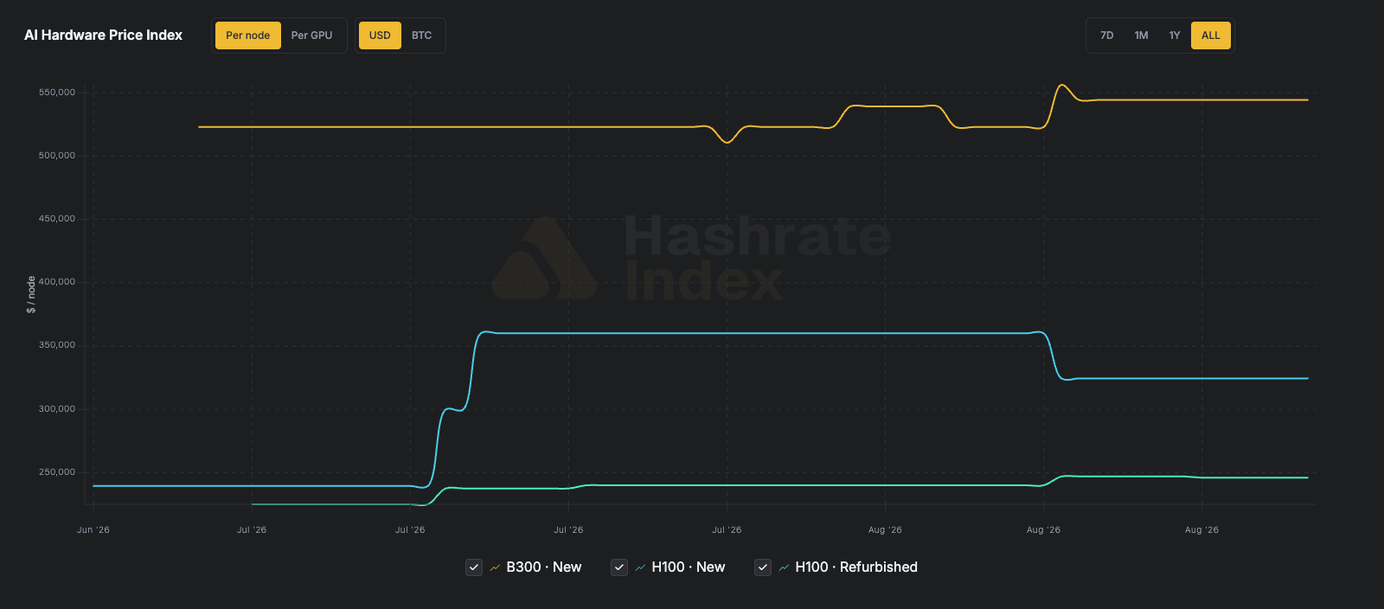
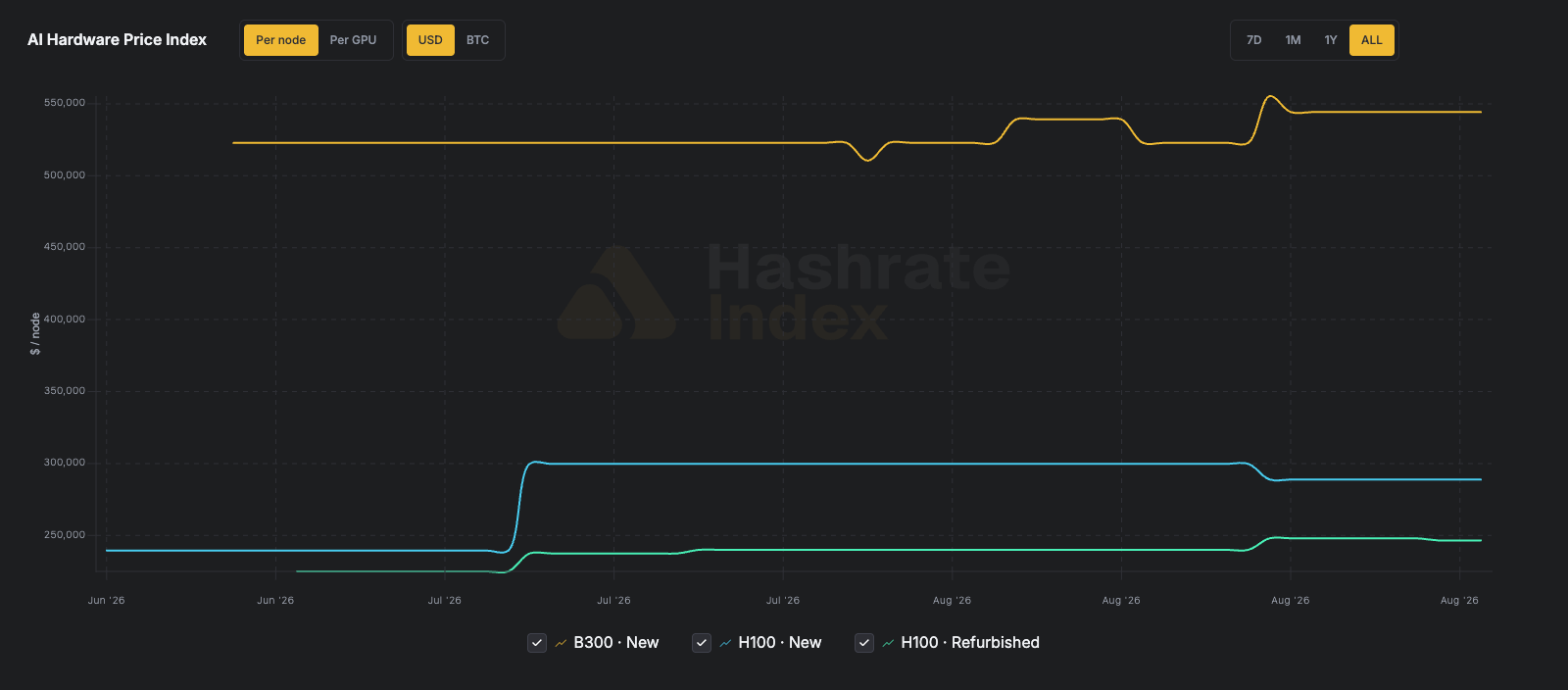
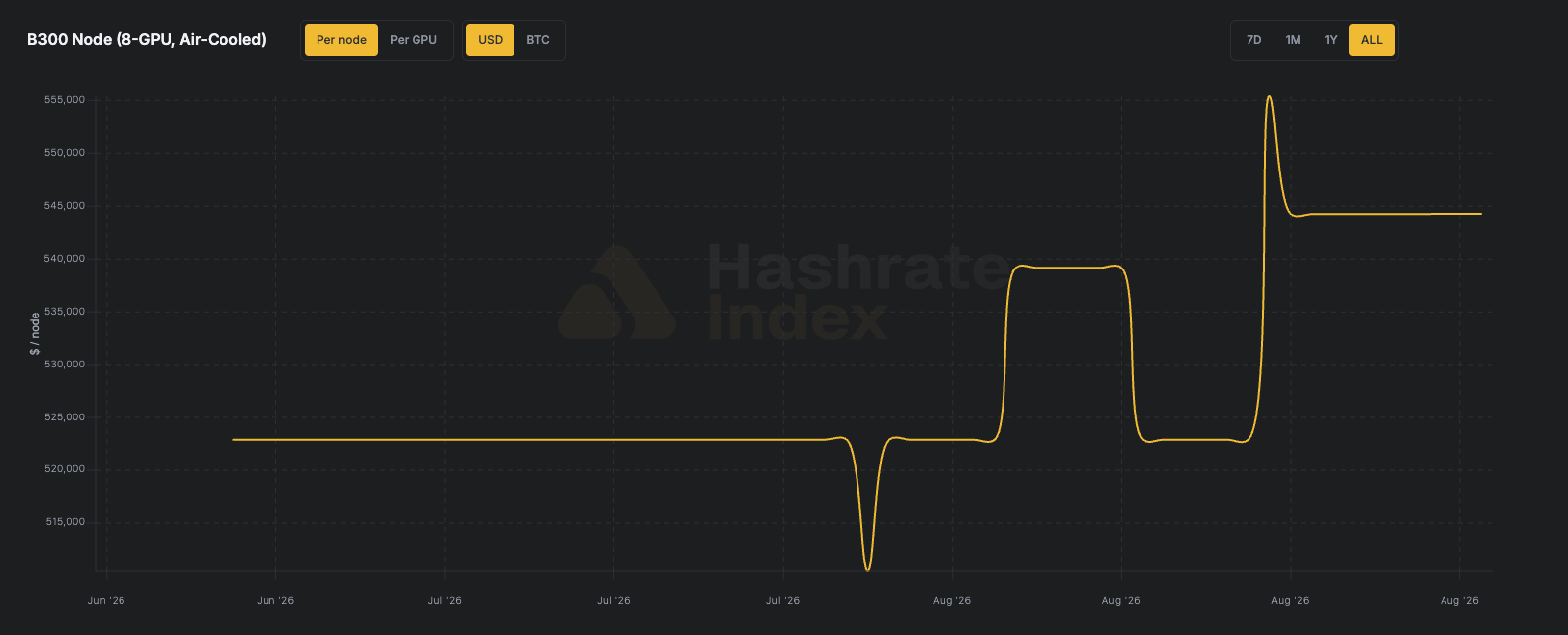
The data currently reflected in the index reveals significant dispersion across hardware generations. As of late August 2026, the spread between the lowest and highest advertised prices for 8-GPU B300 nodes remains remarkably wide, with a 1.71x delta between the floor and the ceiling. This spread is a direct consequence of the "urgency premium"—the additional cost companies are willing to pay for immediate delivery versus the standard wait times for new, factory-direct shipments.
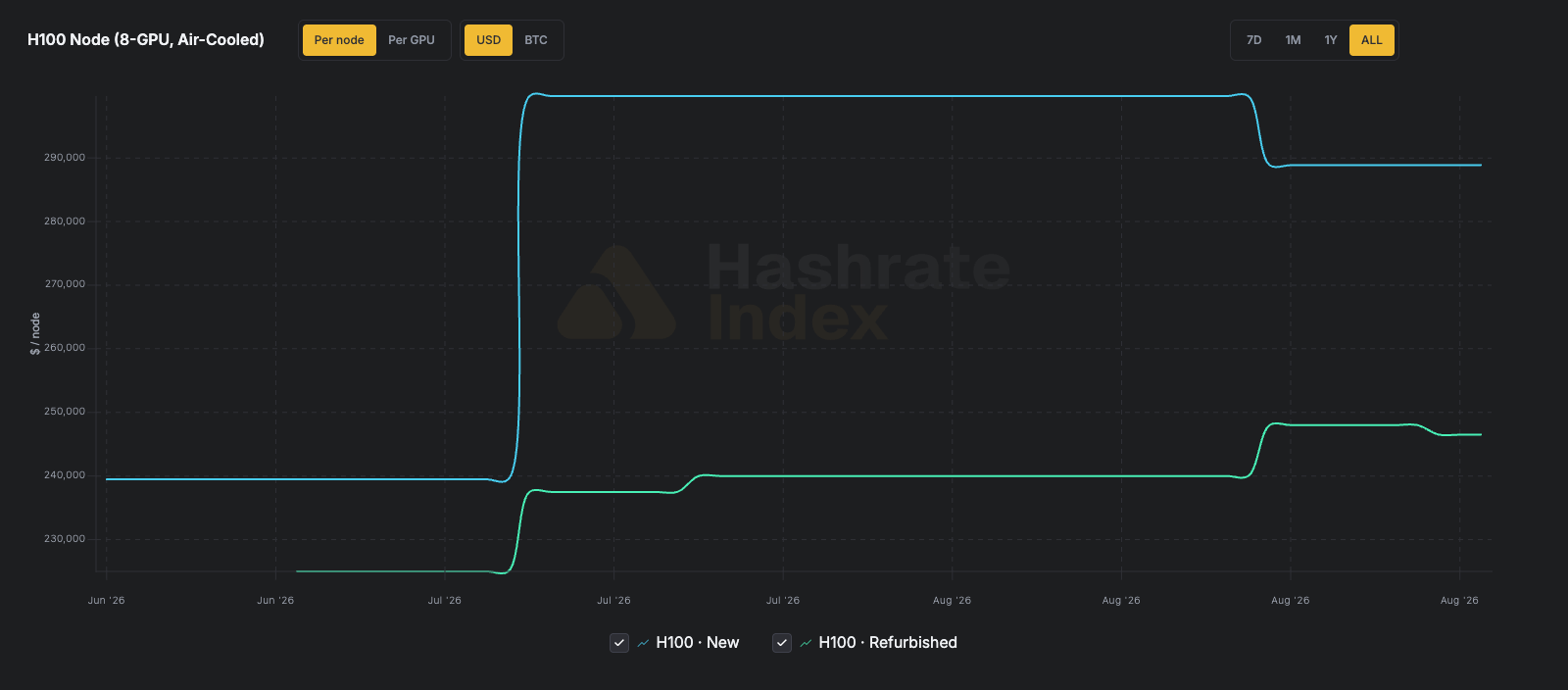
Comparing generational shifts, the Blackwell Ultra (B300) platform currently demands a premium of approximately 1.68x over the Hopper (H100) architecture. While the performance gap between the two generations is substantial, the market premium remains tempered by the continued availability of H100 units. This indicates that H100 infrastructure remains the workhorse of the current AI ecosystem, with a healthy secondary market keeping prices competitive.
Perhaps most revealing is the relationship between new and refurbished units. Refurbished H100 nodes currently trade at roughly 76% of the asking price for new units. This ratio serves as a vital signal for capital expenditure planning; when the price of refurbished nodes drops too close to the price of bare HGX baseboards, it signals to operators that it is more cost-effective to assemble custom systems rather than purchase pre-integrated solutions.
The Strategic Value for AI Infrastructure Operators
For data center operators and institutional investors, this index provides more than just a pricing chart; it offers a basis for asset valuation and risk management. As AI compute increasingly shifts toward a commodity-like status, the ability to benchmark hardware costs against historical trends is essential for forecasting operational expenses.
Furthermore, the integration of Bitcoin-denominated pricing within the index is a strategic nod to the intersection of energy, mining, and AI. With many large-scale mining operations pivoting to high-performance computing (HPC) to optimize their existing power infrastructure, the ability to price AI hardware in BTC—the native currency of their revenue streams—provides a unique financial hedge. This dual-currency view allows firms to assess whether their mining margins are sufficient to support the capital-intensive pivot toward AI infrastructure.
Broader Implications for the AI Economy
The launch of a public AI hardware index signals a maturation of the AI industry. When a commodity—whether it is oil, grain, or computing power—moves from private negotiation to public, transparent pricing, it typically heralds a period of increased efficiency and lower barriers to entry.
For potential investors, the implications are twofold. First, the transparency of the hardware market will likely attract more institutional capital, as investors feel more confident in the valuation of the underlying assets. Second, the ability to track hardware price fluctuations in real-time may lead to the development of financial derivatives or hedging products. If firms can accurately track the depreciation and resale value of their GPU clusters, they can better manage the lifecycle of their infrastructure, potentially reducing the massive upfront capital risks that currently plague the sector.
Looking Ahead: The Future of Compute Commodities
Luxor Technology Corporation, the parent organization behind Hashrate Index, has indicated that this is merely the first phase of an expanded compute commodity suite. By bridging the gap between Bitcoin mining hardware and general-purpose AI hardware, the company is positioning itself as a central clearinghouse for the data that powers the modern compute economy.
The expansion of these datasets will likely include more granular metrics regarding power efficiency, rack-density requirements, and secondary market liquidity. As the industry moves beyond the initial "gold rush" phase of AI development, the focus will inevitably shift toward operational efficiency and cost optimization. In such a climate, data-driven procurement will be the differentiator between firms that scale profitably and those that are sidelined by hardware-related overhead.
A Call for Industry Standardization
While the Hashrate Index provides a robust framework, the industry as a whole remains fragmented. The lack of a centralized exchange for compute hardware means that price discovery will continue to be a challenge for smaller players who lack the direct relationships with major manufacturers like NVIDIA or primary ODMs. However, by surfacing the median market price, Hashrate Index is providing a benchmark that can be utilized in contract negotiations, lease-versus-buy analyses, and insurance valuations.
As the industry moves into the latter half of the decade, the transparency provided by these tools will be essential. The reliance on private, opaque pricing was a hallmark of the industry’s infancy. Today, as AI compute becomes the foundational infrastructure of the global economy, the movement toward public, verifiable data is not just a trend—it is a necessity for the long-term sustainability of the artificial intelligence ecosystem. Investors, developers, and data center operators should monitor these shifts closely, as the hardware market remains the single most significant gatekeeper to the future of high-performance computing.