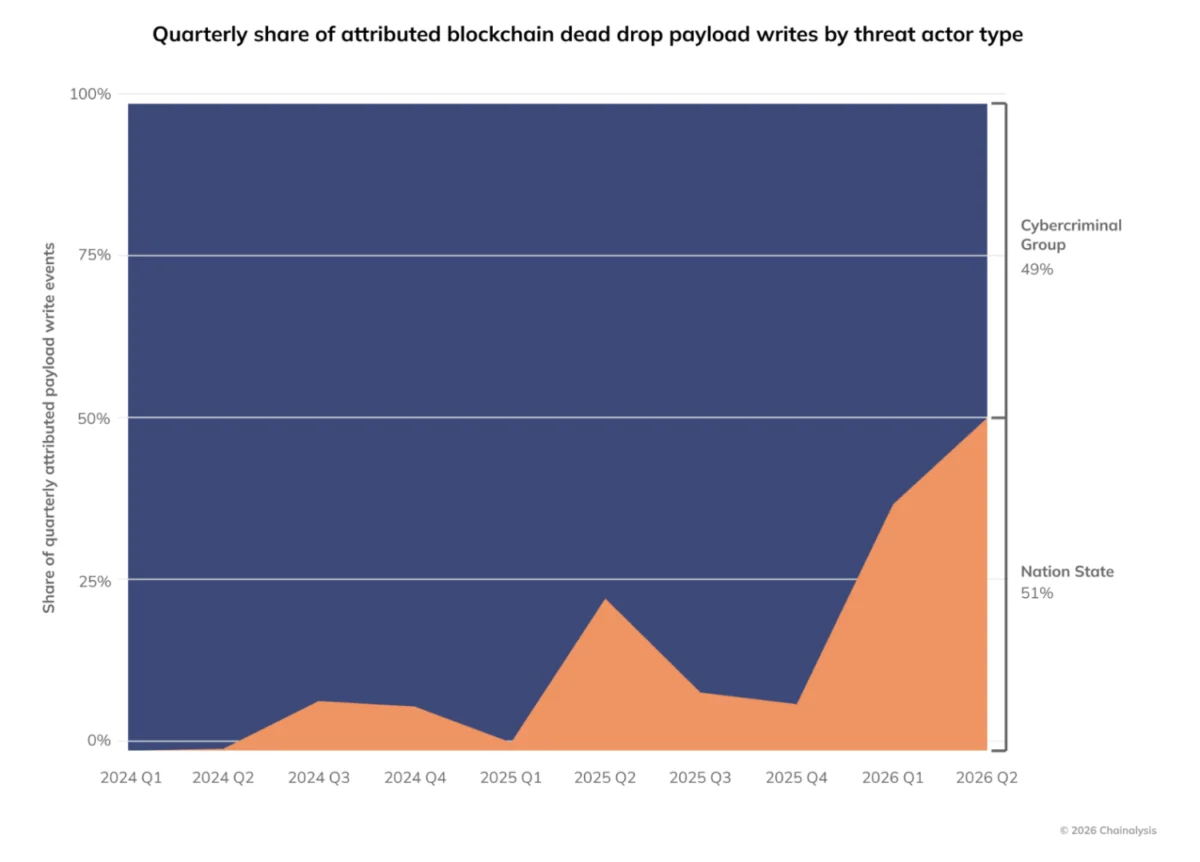
As digital defenders refine their capabilities to intercept malicious cyber activities, threat actors are continuously innovating to secure a strategic advantage. A rapidly expanding segment of the cybercriminal underground—ranging from financially motivated syndicates to advanced nation-state groups backed by regimes in Iran, North Korea, and Russia—is increasingly turning to public blockchains to anchor their infrastructure. Rather than relying on centralized web servers that remain vulnerable to domain seizures, hosting provider takedowns, and DDoS mitigations, these actors are exploiting decentralized, censorship-resistant networks to sustain long-term campaigns.

Security researchers at blockchain analytics firm Chainalysis have categorized this evolving tradecraft under the umbrella term "blockchain dead drops" (BDDs). By embedding malicious code, command-and-control (C2) configurations, and infrastructure pointers directly into on-chain transactions and smart contracts, threat actors ensure their infected endpoints can retrieve operational instructions on demand. Because public ledgers are permanent and impossible to take offline, this technique grants cyber campaigns unprecedented longevity, allowing attackers to communicate with compromised machines without the constant fear of losing their relay infrastructure.
The Primary Mechanics of Blockchain Dead Drops

The danger posed by blockchain dead drops lies not in enhanced destructive power, but rather in exceptional campaign durability. Traditional web2 infrastructure can be dismantled swiftly through cooperation with hosting providers, domain registrars, and cloud services. In contrast, blockchain-based coordination layers survive domain seizures and repository removals, adding a formidable challenge to corporate cybersecurity and threat intelligence teams.
Traditional threat-intelligence platforms frequently fail to monitor or interpret on-chain activity, creating a critical visibility gap. Because attackers leverage cheap, globally accessible networks, they can easily circumvent conventional security controls. The integration of open-source artificial intelligence coding tools has further lowered the technical barrier to entry. Following the proliferation of unconstrained open-weight large language models, BDD attacks have surged dramatically, registering a 420% increase over a recent 12-year window and expanding by 440% since the widespread adoption of AI coding assistants. Current telemetry indicates malicious writes to public blockchains have jumped from roughly 2.06 daily occurrences to more than 11.1 per day.

A Chronological Evolution: From Bitcoin OP_RETURN to EtherHiding
The history of blockchain dead drops spans more than a decade, beginning with rudimentary implementations on the Bitcoin network and evolving into sophisticated, multi-chain operations. The earliest recorded iteration dates back to September 2013, when a variant of the Necurs botnet utilized Namecoin—a Bitcoin fork—to store C2 domain information securely.

Innovation in this space accelerated over the next several years. In 2019, operators behind banking malware encoded C2 IP addresses into the exact amounts of Satoshis being transferred across the Bitcoin network. That same year, the creators of the Glupteba cryptocurrency-mining botnet embedded malicious operational instructions directly into Bitcoin’s OP_RETURN data field, demonstrating that public blockchains could effectively double as persistent storage arrays for illicit software.
A major paradigm shift occurred in mid-2023 with the introduction of "EtherHiding" on Ethereum Virtual Machine (EVM) compatible networks, most notably the Binance Smart Chain (BSC). When operators of the ClearFake infostealer faced aggressive infrastructure disruptions by content delivery networks like Cloudflare, they migrated their payload delivery mechanism into smart contracts on BSC. Because the underlying network could not be shuttered, the campaign successfully maintained continuity. Within months, unrelated groups began replicating the methodology, leading to the deployment of the Smargaft DDoS botnet on BSC by December 2023.

By late 2024 and early 2025, advanced persistent threat (APT) groups adopted these tactics. Iranian state-sponsored actors began embedding C2 configurations within Bitcoin transactions, while North Korean operators integrated EtherHiding into deceptive social engineering campaigns targeting cryptocurrency professionals.
Notable Case Studies: DPRK, Iran, and Russian MaaS

Recent forensic investigations highlight how distinct geopolitical and criminal factions utilize BDDs in unique ways, demonstrating the versatility of the architecture.
In the case of North Korean operations, groups tracked by threat intelligence providers as UNC5342 have deployed multi-chain redundancy strategies. In early 2025, these actors used smart contracts to target job-seeking crypto developers with credential-stealing malware. To ensure maximum resilience, researchers discovered an advanced secondary technique utilizing TRON and Aptos blockchains. Infected endpoints query TRON first; if unreachable, they fallback to Aptos. Both networks yield encoded pointers directing the malware to a final payload stored on the Binance Smart Chain. This multi-chain relay mechanism forces defenders to coordinate simultaneous interventions across three distinct blockchain ecosystems to disrupt a single operation.

Meanwhile, threat actors suspected of operating under the direction of Iran’s Ministry of Intelligence have leveraged the Bitcoin blockchain’s OP_RETURN field. Rather than establishing dedicated infrastructure, these operators execute micro-transactions directed at historical, unspendable wallet addresses—such as those historically linked to Bitcoin creator Satoshi Nakamoto. The financial transfers themselves are irrelevant; the core value rests in the encoded routing data inside the transaction bytes. Malware deployed on victim machines automatically parses these transactions to identify current C2 endpoints, providing the operators with an easily rotated, low-footprint communications channel.
Concurrently, Russian-language cybercriminals have commercialized BDD capabilities through a Malware-as-a-Service (MaaS) framework. Documented extensively by security firms including Securonix, Trinity Cyber, and LevelBlue, this ecosystem involves subscription-based toolkits sold on underground forums. Operating primarily on the Polygon and Binance Smart Chain networks, a central administrator deploys fleets of programmable resolver contracts. These contracts are rented or leased to downstream affiliates executing click-fix campaigns, fraudulent stablecoin schemes, and clipboard-hijacking operations. On-chain analysis reveals that a single master wallet can control dozens of near-identical resolver contracts, allowing analysts to connect previously disparate criminal campaigns to a unified operator.

Defense Strategies and Industry Responses
Mitigating the risks introduced by blockchain dead drops presents significant architectural challenges for enterprise security teams. Cybersecurity experts emphasize that attempting to block blockchain traffic at the network perimeter is impractical and counterproductive. Restricting outbound traffic to Ethereum or other major public ledgers would require blacklisting public RPC endpoints operated by infrastructure providers like Infura, Alchemy, and Cloudflare. Such broad measures would inevitably disrupt legitimate decentralized finance applications, enterprise blockchain integrations, and cryptocurrency wallets, while failing to stop determined attackers who can easily run their own local network nodes.

Instead, cybersecurity analysts advocate for the integration of specialized blockchain intelligence tools. Because every on-chain transaction, state update, and contract deployment is immutable and permanently timestamped, defenders can leverage on-chain analytics to trace operator wallets, analyze funding histories, and map out entire infrastructure fleets. By pairing endpoint monitoring—such as tracking outbound JSON-RPC requests to public blockchain nodes—with advanced ledger analytics, organizations can uncover hidden threat vectors that evade traditional signature-based detection systems.
As threat actors continue to exploit the permanence and decentralization of public ledgers, security professionals must adapt by bridging the gap between traditional IT security and blockchain visibility, transforming the transparency of distributed ledgers into an investigative advantage.