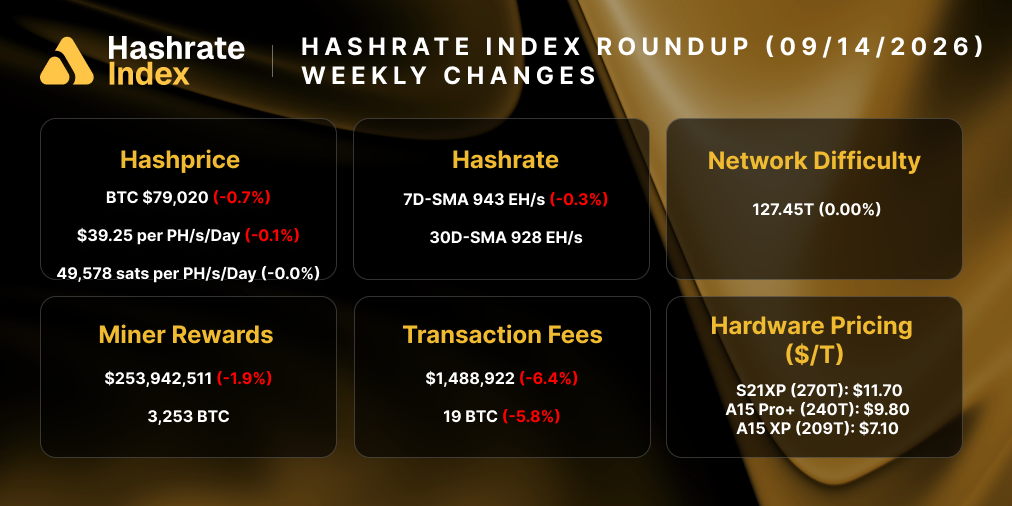
The global Bitcoin mining landscape experienced a period of stagnation over the week ending September 14, 2026, as key network metrics remained largely flat, signaling a consolidation phase for infrastructure providers. Miners collectively secured approximately 3,253 BTC in block rewards, a valuation reaching roughly $253 million at current market prices. This performance underscores the ongoing challenges within the sector, where transaction fees—a critical component of mining profitability—accounted for only 0.59% of total rewards, totaling 19 BTC or approximately $1.49 million.
Market Overview and Bitcoin Price Dynamics
The price of Bitcoin saw a marginal decline of 0.7% over the seven-day period, sliding from $79,581 to $79,020. This contraction contributes to a wider, year-to-date performance dip of 9.6%, reflecting a broader period of market recalibration. Institutional interest, as measured by CME Bitcoin Futures, indicates a cautious optimism, with the October contract trading at $79,700, reflecting a 0.9% premium over spot prices. Conversely, the November outlook appears more bearish, with futures trading at $77,610, a 1.8% discount, suggesting that market participants are hedging against potential volatility in the coming quarter.
Hashprice Trends and Revenue Stability
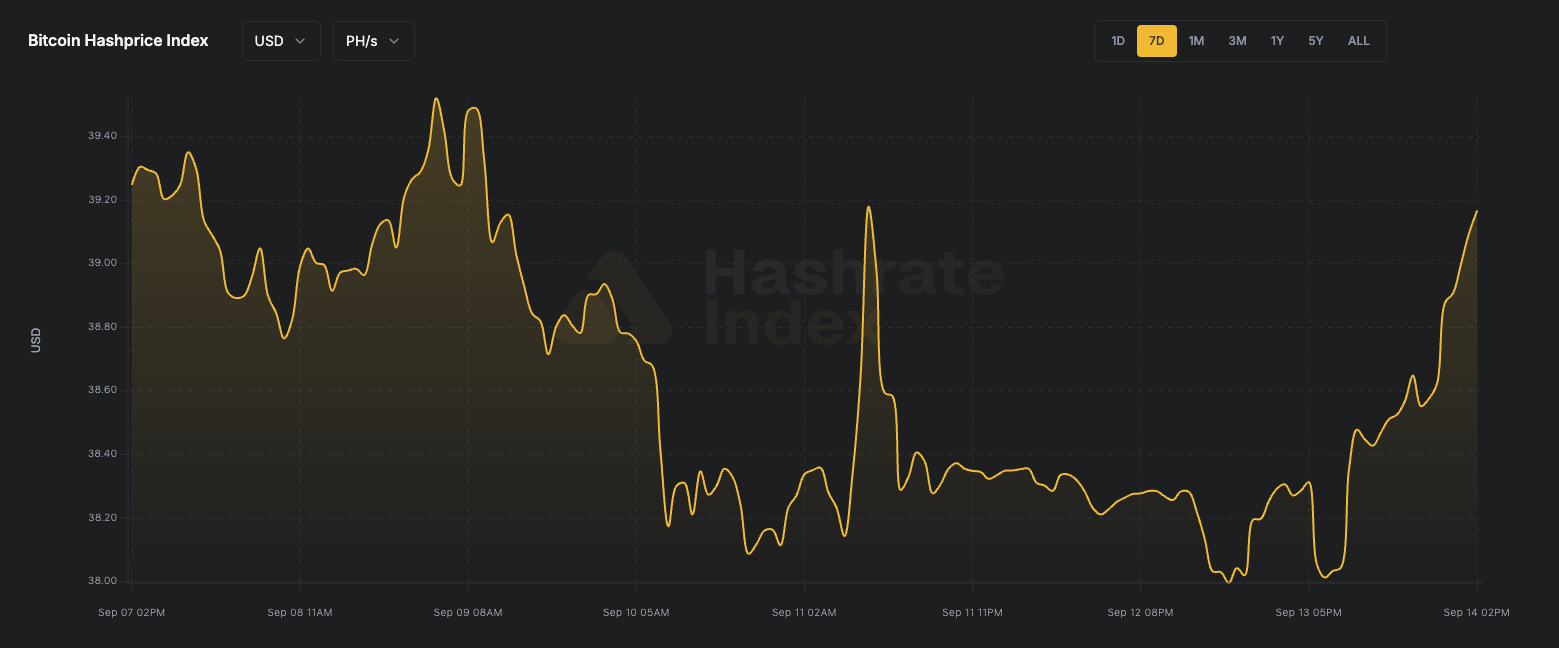
The Bitcoin Hashprice—a vital metric representing the expected revenue per unit of computing power—remained nearly static, shifting from $39.29 per PH/s/day to $39.25 per PH/s/day, a negligible change of -0.1%. This stability, while providing a degree of predictability for capital expenditure planning, highlights the pressure on miners to maintain operational efficiency in an environment of high difficulty and tempered price action.
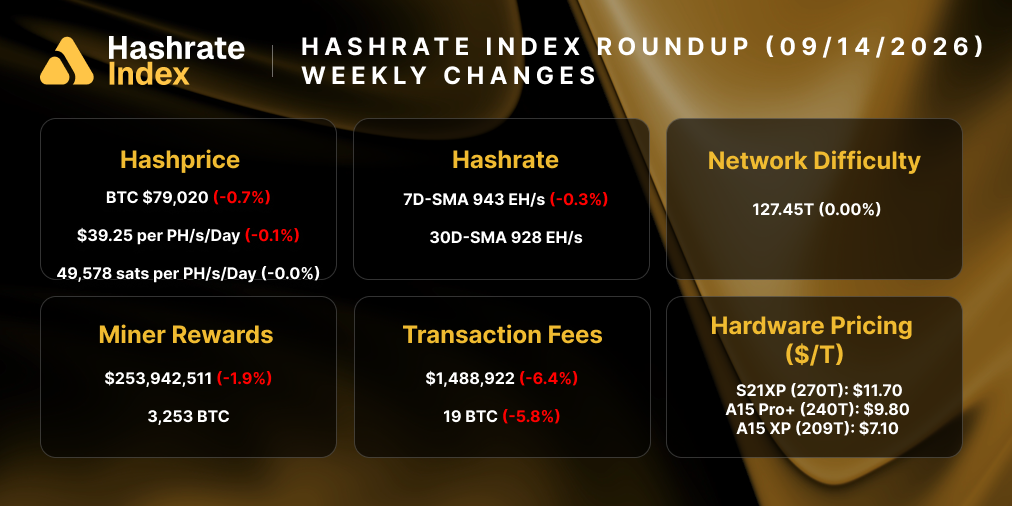
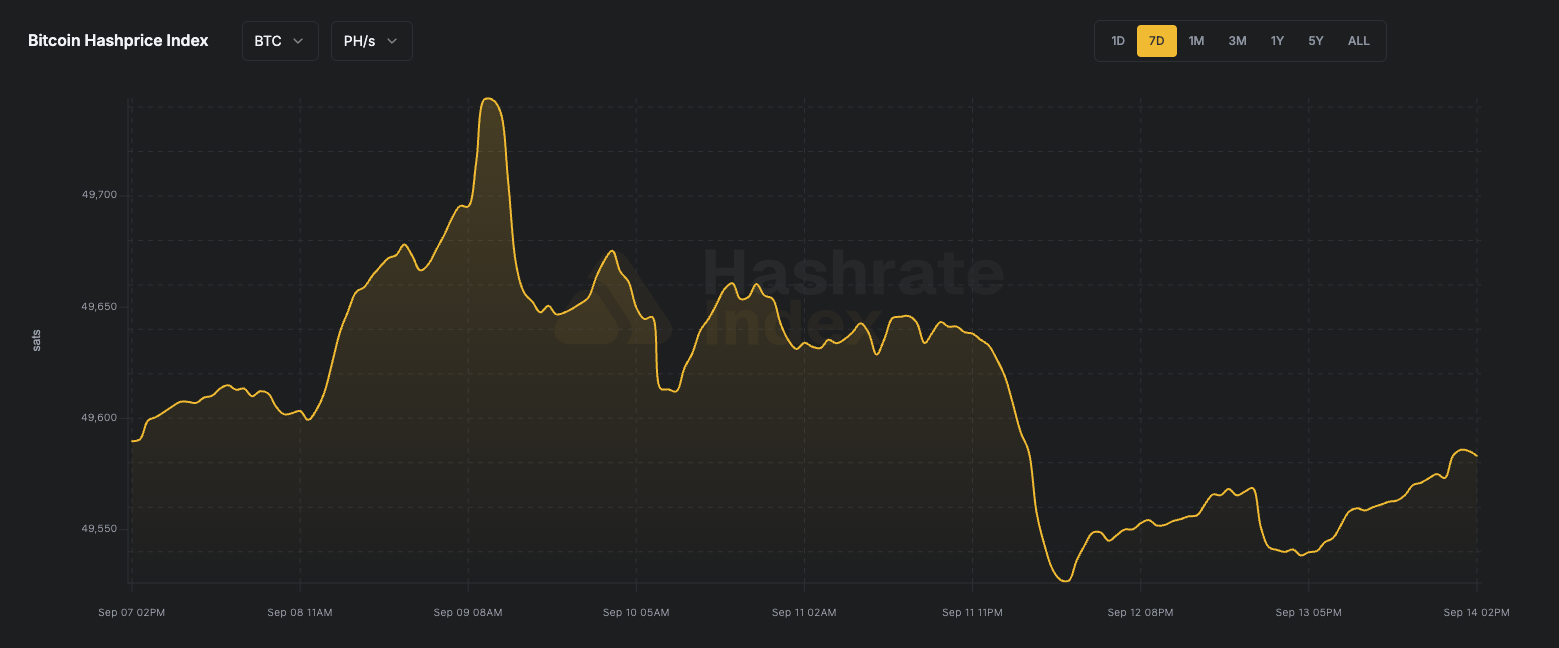
When analyzing the metrics in BTC terms, the hashprice held steady at 0.00049578 BTC per PH/s/day. This flatline indicates that while the nominal price of Bitcoin is fluctuating, the underlying competition for block rewards remains constant. The 30-day average hashprice has shown a minor uptick of 3.2% in USD terms, though the 30-day BTC-denominated average is down 0.7%, illustrating how fluctuating transaction fee revenue continues to influence the bottom line of mining operations.
Network Hashrate and Difficulty Adjustments
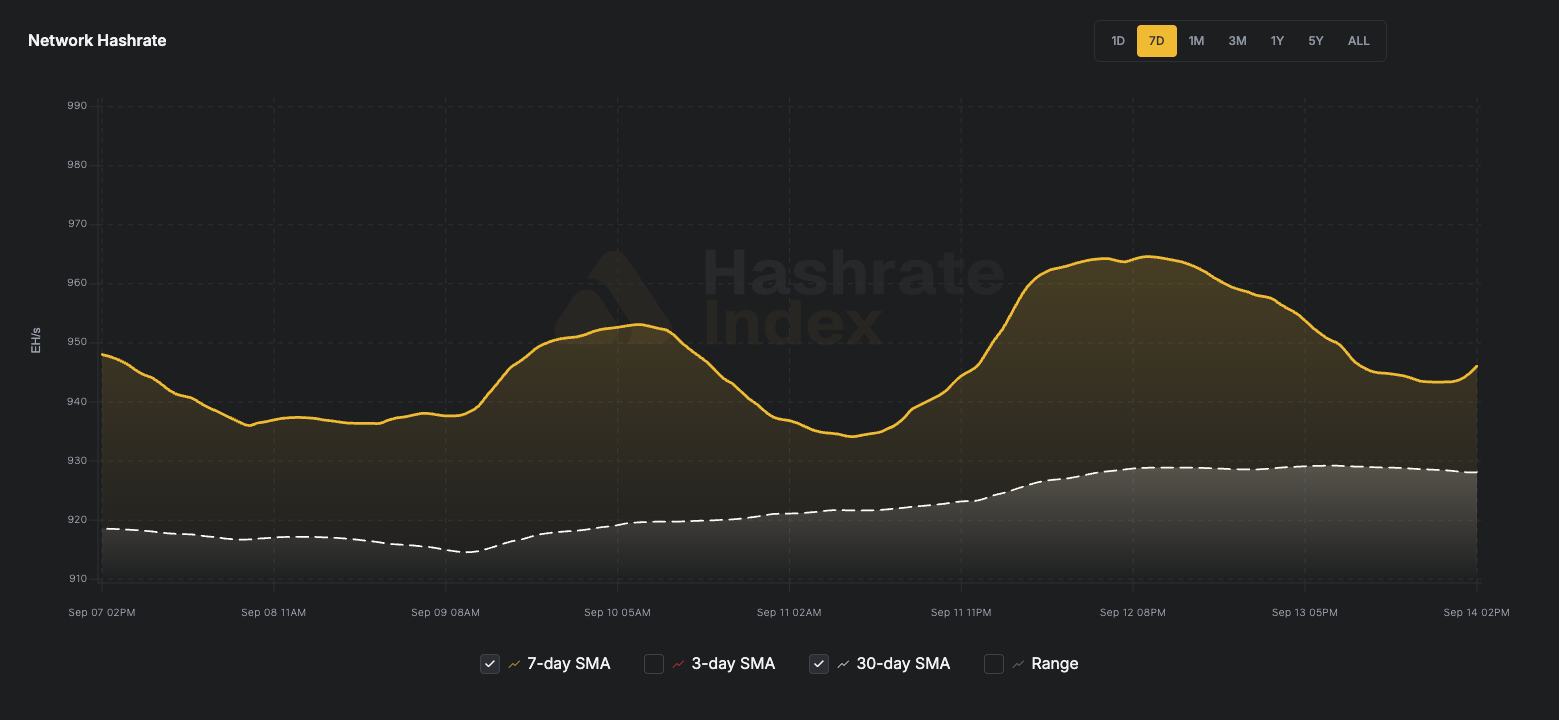
The Bitcoin network’s total hashrate, measured by a 7-day simple moving average (SMA), retracted slightly from 946 EH/s to 943 EH/s, representing a 0.3% decrease. This adjustment is reflective of the ongoing fleet optimization cycles where older, less efficient hardware is routinely decommissioned in favor of next-generation ASIC miners.
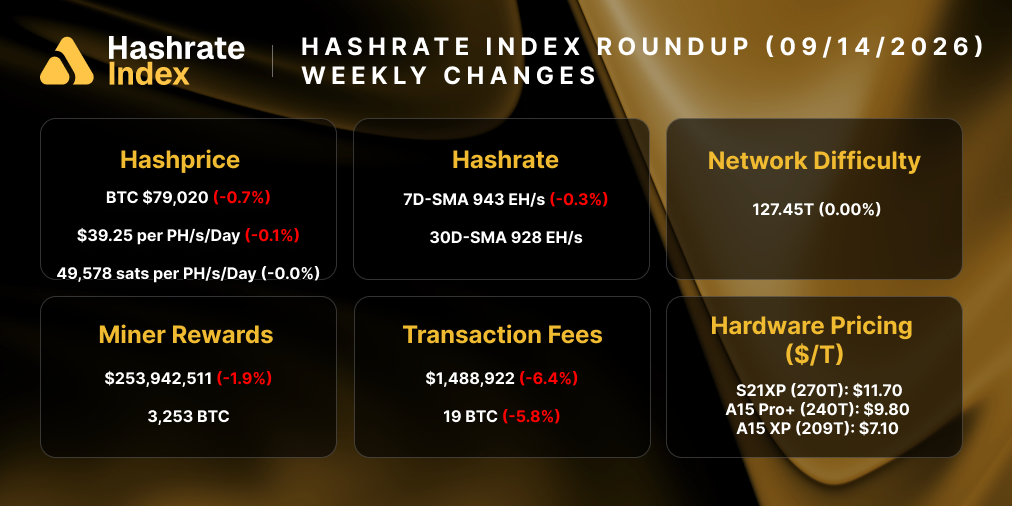
The most recent network difficulty adjustment, which occurred on September 5, 2026, increased the complexity of mining by 1.31%, bringing the difficulty level to 127.45T. Current data indicates that the network is operating at an average block time of 9 minutes and 30 seconds. Given the current pace of block discovery, analysts anticipate a further upward adjustment of approximately 5.26% on September 19, 2026. This trend suggests that despite the flat price action, the network continues to attract more computing power, likely due to large-scale operators deploying new hardware capacity.
Transaction Fees and Revenue Composition
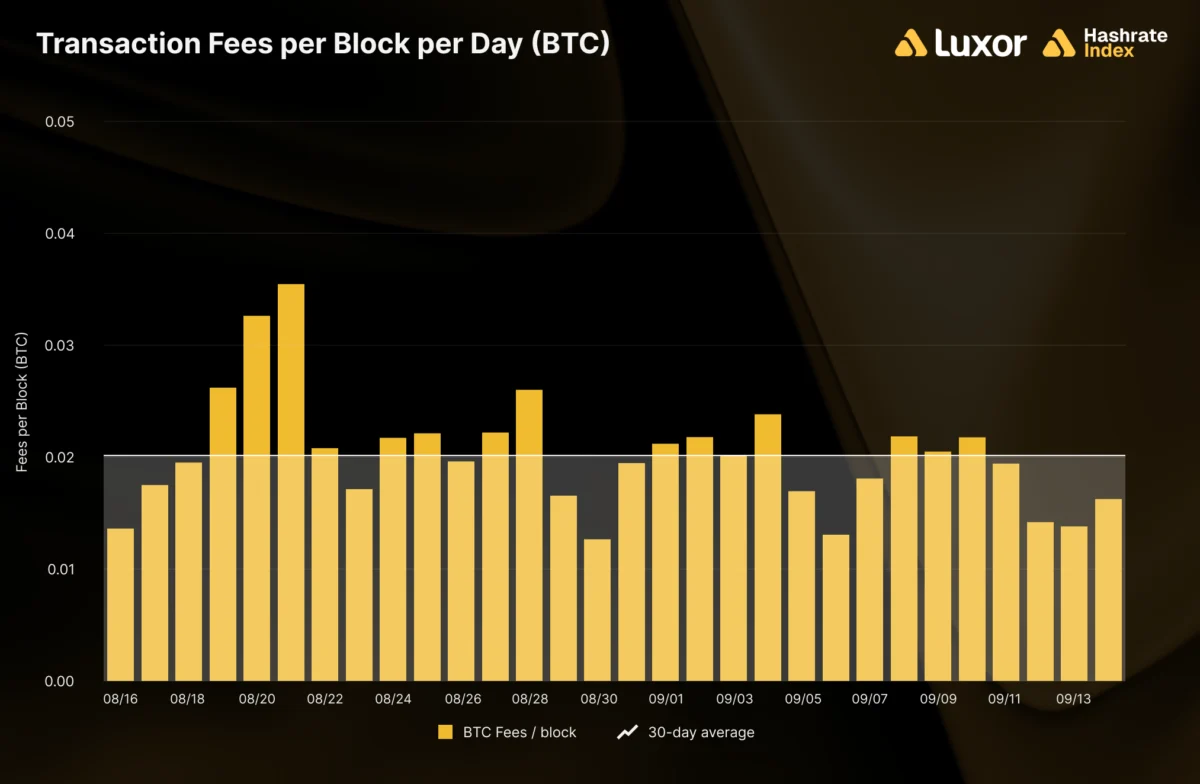
Transaction fee revenue continues to be a point of discussion among industry analysts. Over the past week, miners collected an average of 0.0183 BTC per block in transaction fees, a 5% decline from the previous week’s 0.0193 BTC. Over a 30-day horizon, the average fee per block has trended downward by 9.6%, reaching 0.0202 BTC. This decline indicates lower network congestion and a reduction in high-fee activity, which historically serves as a crucial revenue buffer during periods of stagnant Bitcoin price appreciation. For mining firms, the reliance on block subsidies over transaction fees remains a vulnerability, particularly as the network moves toward future halving events where subsidies will be significantly reduced.
Forward Market Projections
The Luxor Hashrate Forward Market provides a window into institutional expectations for the next six months. As of the September 14 report, the forward market is pricing in an average hashprice of $36.92, or 0.00047 BTC. This forward curve suggests that the market does not anticipate a significant breakout in mining profitability in the short term, encouraging firms to focus on operational expenditure management and energy procurement strategies rather than relying on rapid price appreciation.
Analysis of Public Mining Equities
The public Bitcoin mining sector faced a challenging week, with several major stocks recording significant declines. The market reaction appears to be a broader reflection of the crypto-equity sector’s sensitivity to both Bitcoin’s price performance and the ongoing increase in mining difficulty.
Notable movements include:
- CIFR (Cipher Mining): Experienced a 14.0% decline, closing at $15.91.
- WULF (TeraWulf): Saw a 12.4% drop to $15.65.
- IREN (Iris Energy): Fell by 7.0%, closing at $43.63, despite maintaining a substantial market capitalization of $17.19 billion.
- ANY (Sphere 3D): Remained a notable outlier, surging 18.0% to $2.89, highlighting idiosyncratic performance within the sector despite the broader downward trend.
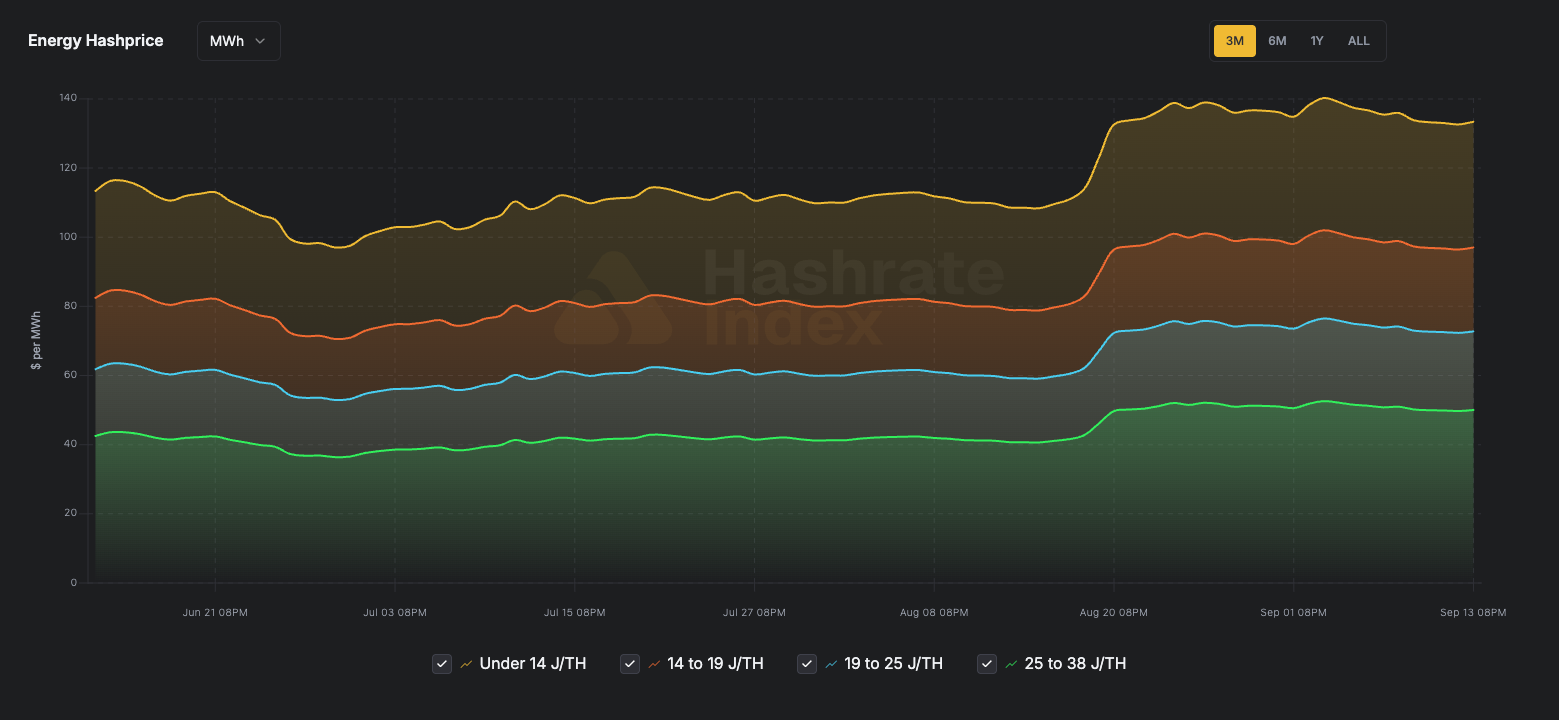
The underperformance of several mining stocks compared to the relative stability of the Bitcoin spot price suggests that investors are increasingly scrutinizing the "hashrate-to-market-cap" ratio and the impact of the rising difficulty rate on future margins. Firms with high energy costs or less efficient hardware are seeing their valuations compressed as the network difficulty continues to climb, effectively "squeezing" the margins of operators who have not achieved the economies of scale necessary to thrive in a 127.45T difficulty environment.
Broader Implications for the Industry
The current state of the Bitcoin mining industry, as of mid-September 2026, is one of institutional maturation. The shift from volatile, speculative growth to a focus on efficiency and energy arbitrage is evident in the data. As the network difficulty trends toward higher levels, the barrier to entry for smaller, home-based or low-efficiency miners continues to rise.
The reliance on upcoming difficulty adjustments and the cooling of transaction fee volumes underscore the importance of mining firmware and optimized infrastructure. The "all-in-one" approach, exemplified by current promotional efforts in the industry—such as the incentivized participation in "best share" mining contests—points toward a culture that values granular hardware optimization.
Looking ahead, the industry remains tethered to the broader macroeconomic environment. With CME futures pointing toward a potential softening of Bitcoin’s price in November, mining operators are likely to maintain a defensive posture. The primary objective for firms through the end of the year will be to secure low-cost, long-term power purchase agreements (PPAs) and to upgrade fleets with more efficient SHA-256 compute units.
In conclusion, the week of September 14, 2026, serves as a microcosm of the current mining cycle: a balanced, albeit stagnant, market where the network’s resilience is tested by rising difficulty and flat revenue metrics. While the short-term outlook for mining profitability remains conservative, the underlying network hash rate suggests that infrastructure providers remain committed to the long-term viability of the Bitcoin protocol. For investors and operators alike, the message is clear: in an era of consistent difficulty increases, operational efficiency is no longer a competitive advantage—it is a prerequisite for survival.