Foundry, the prominent digital asset infrastructure company and operator of Foundry USA—the world’s largest Bitcoin mining pool by total hashrate—has officially announced plans to launch a dedicated Zcash (ZEC) mining pool tailored specifically for institutional entities and public companies. Slated to go live in April 2026, this strategic expansion marks a significant milestone for the privacy-centric cryptocurrency, bridging a long-standing infrastructure gap between institutional financial standards and decentralized privacy networks.
The announcement comes at a pivotal time for Zcash, which has experienced a notable resurgence in network activity, growing computational power, and evolving regulatory dialogues surrounding digital asset privacy and compliance. By leveraging its extensive expertise in managing large-scale mining operations in the United States, Foundry aims to provide corporate and institutional miners with a secure, reliable, and compliant gateway to participate in the Zcash ecosystem.
Main Facts and Core Infrastructure Details
Under the leadership of CEO Mike Colyer, Foundry is positioning itself to capture the growing corporate demand for diversified mining operations. The newly announced Zcash mining pool will replicate the rigorous operational standards, security protocols, and transparency measures that have made Foundry USA a dominant force in the Bitcoin mining sector.
A mining pool operates by allowing geographically dispersed miners to pool their computational power—measured as hashrate—over a decentralized network. By combining resources, participants increase their statistical probability of successfully validating a block and earning the associated block rewards, thereby smoothing out the revenue streams for individual operators.
For Zcash, the introduction of an institutional-grade mining pool addresses a critical vulnerability. Historically, the infrastructure supporting privacy coins has lagged behind the mature, highly institutionalized ecosystem surrounding Bitcoin and Ethereum. Public companies and regulated financial entities aiming to participate in Zcash mining faced hurdles regarding compliance, reporting standards, and enterprise-grade reliability. Foundry’s entry into the space is designed to resolve these friction points, offering a U.S.-based, highly compliant mining environment.

Chronology and Background Context
Launched in 2016, Zcash was developed as a privacy-focused alternative to Bitcoin. While foundational cryptocurrencies like Bitcoin and Ethereum rely on pseudonymous public ledgers where transaction histories and wallet addresses are transparently viewable by anyone, Zcash utilizes advanced cryptographic protocols—specifically zk-SNARKs (Zero-Knowledge Succinct Non-Interactive Arguments of Knowledge)—to enable shielded transactions. This technology allows the network to verify the validity of transactions without revealing the sender, receiver, or transaction amount.
Despite its core focus on financial privacy, Zcash shares foundational roots with Bitcoin. It was originally built upon Bitcoin’s codebase and utilizes a Proof-of-Work (PoW) consensus mechanism. Consequently, Zcash adheres to similar economic principles: a fixed supply cap of 21 million ZEC, block rewards distributed to miners upon successful block generation, and a halving schedule that reduces the block reward by half approximately every four years.
Over the years, Zcash has navigated a complex regulatory landscape. Because privacy coins inherently obscure transaction data, they have frequently faced scrutiny from global regulators concerned about illicit finance. However, advocates and developers have consistently maintained that privacy and regulatory compliance can coexist. Zcash’s architecture allows users to choose between transparent and shielded addresses, demonstrating that privacy-enhancing technologies can be integrated within compliant digital financial frameworks.
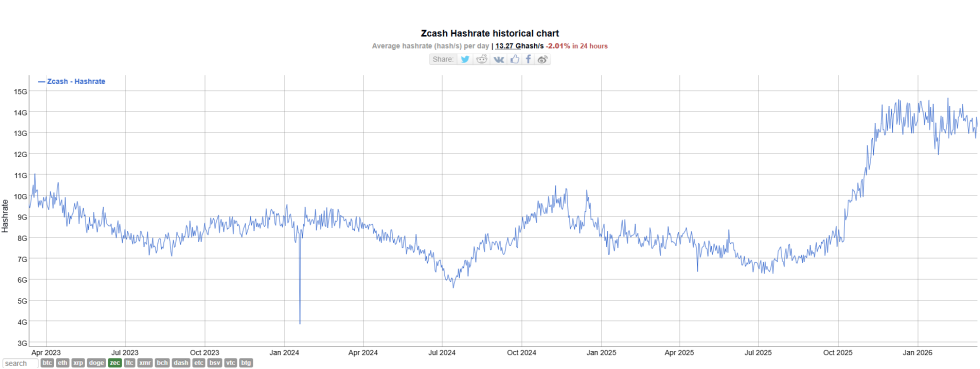
Foundry’s decision to enter the Zcash ecosystem follows a period of substantial growth in the network’s fundamental metrics. Network hashrate—a key indicator of overall security and miner participation—has experienced a dramatic upward trajectory over recent months. According to data from BitInfoCharts, the total computing power secured by the Zcash blockchain hovered below 8 Ghash/s in October of the preceding year. By early 2026, that figure surged significantly, stabilizing above 13 Ghash/s. This robust expansion in network security signaled to infrastructure providers like Foundry that institutional and commercial interest in Zcash mining was primed for expansion.
Official Responses and Industry Reactions
The announcement has elicited widespread enthusiasm from developers, privacy advocates, and core contributors within the Zcash ecosystem.

Mike Colyer, CEO of Foundry, emphasized the maturation of the asset class in the official press release, noting that while Zcash has successfully evolved into an institutional-grade asset, the supporting mining infrastructure had not kept pace. By expanding into ZEC, Foundry aims to rectify this imbalance.
Zooko Wilcox, founder of Zcash and chief product officer at Shielded Labs—an independent support organization for ZEC based in Switzerland—welcomed the news with strong endorsement. “We at Shielded Labs are delighted that Foundry—the largest Bitcoin mining pool, and one based in North America—is launching an enterprise-grade Zcash mining pool,” Wilcox stated. The endorsement from a key figure in the Zcash community underscores the strategic importance of attracting North American institutional backing to a privacy-focused network.
Market Conditions and ZEC Price Action
While network fundamentals such as hashrate have exhibited strong positive momentum, the market valuation of Zcash has experienced short-term volatility. At the time of reporting, Zcash (ZEC) is trading around the $209 mark, registering a correction of more than 11% over a trailing seven-day period. Market analysts attribute this price movement to broader macroeconomic headwinds and routine market retracements following earlier recovery rallies across the wider digital asset sector.
Despite short-term price fluctuations, industry observers point out that mining infrastructure investments are long-term commitments. Operators like Foundry typically evaluate assets based on network security, cryptographic utility, and multi-year supply economics rather than immediate intraday price volatility.
Broader Impact and Implications for the Digital Asset Sector
Foundry’s impending launch of an institutional-grade Zcash mining pool in April 2026 carries several profound implications for the broader cryptocurrency landscape.
First, it signals a growing institutional appetite for digital assets beyond the traditional large-cap titans of Bitcoin and Ethereum. As public companies and institutional portfolios seek diversification, privacy coins with robust technological frameworks are increasingly being re-evaluated through a professionalized lens.
Second, the involvement of a major U.S.-based entity like Foundry highlights an ongoing trend toward geographic decentralization and regulatory alignment in specialized sectors like mining. By providing a domestic, enterprise-grade pool for Zcash, Foundry bridges the gap between decentralized privacy tech and corporate compliance requirements.
Finally, the initiative may pave the way for enhanced regulatory clarity regarding privacy-preserving networks. As institutional stakeholders integrate deeper into the Zcash mining ecosystem, the demand for transparent reporting tools that respect user privacy while satisfying anti-money laundering (AML) standards will likely drive further innovation in hybrid blockchain architecture.
As the April 2026 launch date approaches, industry stakeholders will closely monitor how Foundry’s integration impacts Zcash’s hashrate distribution, corporate mining participation, and the broader intersection of institutional finance and cryptographic privacy.