Foundry, the digital asset infrastructure firm and operator of Foundry USA—the world’s largest Bitcoin mining pool—has officially announced its strategic expansion into the Zcash (ZEC) ecosystem. The company intends to launch a dedicated, institutional-grade Zcash mining pool in April 2026, a move designed to bridge the gap between sophisticated financial entities and the specialized requirements of privacy-preserving blockchain technology. This initiative marks a significant milestone for Zcash, a cryptocurrency that has long occupied a unique niche by combining the transparency of a public ledger with the option for shielded, private transactions. By providing a North American-based, enterprise-ready infrastructure, Foundry aims to cater to public companies and institutional investors who require high standards of compliance, reliability, and reporting—features that have historically been lacking in the Zcash mining sector.
The decision to enter the Zcash market comes at a pivotal time for the privacy coin. Despite its technological maturity and the robustness of its cryptographic foundations, Zcash has faced challenges in attracting the same level of institutional infrastructure as Bitcoin. Mike Colyer, the CEO of Foundry, highlighted this disparity in a recent press statement, noting that while Zcash has matured into an asset class capable of supporting institutional interest, the underlying mining infrastructure has failed to keep pace. The launch of the Foundry Zcash pool is specifically engineered to resolve this "infrastructure deficit," offering a platform that mirrors the stability and professional oversight of the company’s flagship Bitcoin mining operations.
The Strategic Importance of Institutional-Grade Infrastructure
For institutional players, the barriers to entry in cryptocurrency mining are often related to regulatory compliance, geographical security, and the reliability of pool operators. Foundry USA has dominated the Bitcoin mining landscape by offering a US-based operation that adheres to strict standards of transparency and reporting. By applying this same model to Zcash, Foundry provides a pathway for public companies to participate in the ZEC network without the risks associated with smaller, less-regulated pools based in opaque jurisdictions.
The "institutional-grade" designation implies several critical features. First, it ensures that the pool will provide detailed financial auditing and reporting tools, allowing public companies to account for their rewards in accordance with standard accounting principles. Second, it guarantees high uptime and low latency, which are essential for maximizing the efficiency of expensive mining hardware. Finally, the North American base of operations provides a level of legal and operational predictability that is highly valued by conservative investment firms and corporate treasuries.

Understanding Zcash: Privacy, Compliance, and Tokenomics
To understand the impact of Foundry’s move, it is necessary to examine the technical and economic framework of Zcash. Launched in 2016, Zcash was built on the foundation of the Bitcoin codebase but introduced a revolutionary cryptographic tool known as zk-SNARKs (Zero-Knowledge Succinct Non-Interactive Arguments of Knowledge). This technology allows the network to verify transactions without revealing the sender, receiver, or the amount involved.
While Bitcoin and Ethereum are often described as anonymous, they are more accurately categorized as pseudonymous. Every transaction is recorded on a public ledger, and with the help of sophisticated on-chain analysis tools, identities can often be linked to specific wallet addresses. Zcash solves this by offering "shielded" addresses. However, it also supports "transparent" addresses, allowing for a hybrid approach where users can choose privacy for personal security while utilizing transparency for auditing or regulatory compliance. This dual nature is what Foundry refers to as the coexistence of financial privacy and compliant digital infrastructure.
From an economic perspective, Zcash mirrors Bitcoin’s scarcity model. It has a hard supply cap of 21 million tokens. New ZEC tokens are minted through a Proof of Work (PoW) consensus mechanism, where miners compete to solve complex mathematical problems to secure the network and validate transactions. Like Bitcoin, Zcash undergoes "halving" events approximately every four years, which reduce the issuance rate of new tokens by 50%, creating a disinflationary pressure intended to preserve the asset’s value over time.
Analyzing the Recent Zcash Hashrate Boom
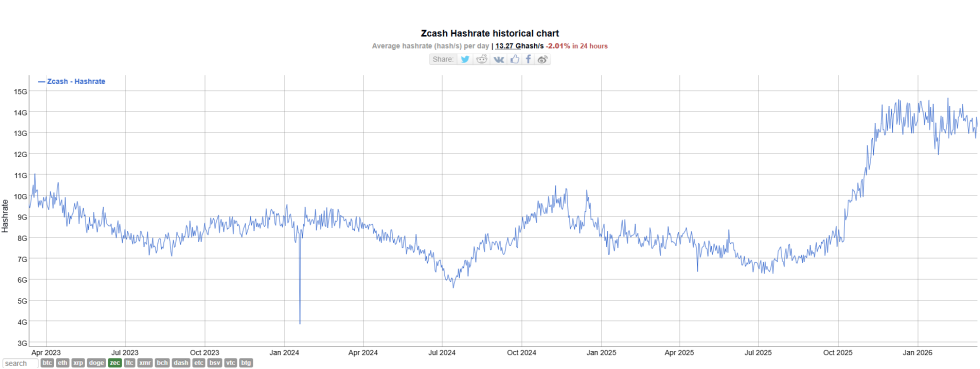
Foundry’s expansion is supported by strong fundamental data indicating a renewed interest in Zcash mining. According to data from BitInfoCharts, the Zcash network hashrate—a measure of the total computational power dedicated to securing the blockchain—has experienced a significant surge in recent months. In October 2025, the hashrate was hovering below 8 Ghash/s. By early 2026, it had climbed to over 13 Ghash/s, representing a nearly 60% increase in network security and miner participation.
This boom in hashrate is often a precursor to institutional involvement. A rising hashrate suggests that more efficient mining hardware, such as Application-Specific Integrated Circuits (ASICs), is being deployed on the network. For a company like Foundry, which manages massive fleets of mining hardware and provides financing for equipment, this trend represents a growing market of miners looking for a stable, high-performance pool to join. The increased hashrate also makes the network more resistant to 51% attacks, further enhancing the "institutional-grade" appeal of the asset.

Chronology of the Announcement and Industry Reaction
The announcement of the April 2026 launch has been met with enthusiasm from the core Zcash community. Shielded Labs, an independent organization based in Switzerland that supports the Zcash ecosystem, has been vocal in its approval. Zooko Wilcox, the founder of Zcash and Chief Product Officer at Shielded Labs, emphasized the importance of having a major North American player like Foundry enter the space. Wilcox noted that the presence of an enterprise-grade pool is a vital step toward the long-term sustainability and decentralization of the Zcash network.
The timeline for the launch—April 2026—suggests that Foundry is taking a methodical approach to development. This period will likely involve rigorous testing of the pool’s architecture to ensure it can handle the unique cryptographic demands of Zcash blocks, which differ from Bitcoin’s SHA-256 algorithm. The lead time also allows Foundry to coordinate with its existing partners and clients who may be interested in diversifying their mining portfolios into privacy-preserving assets.
Broader Implications for the Privacy Coin Market
Foundry’s entry into Zcash mining carries implications that extend beyond a single mining pool. It signals a shift in how privacy-focused assets are perceived by the broader financial industry. For years, privacy coins have faced scrutiny from regulators concerned about their potential use in illicit activities. However, the narrative is shifting toward the necessity of privacy for legitimate business operations.
In a corporate context, transaction privacy is not about hiding illegal acts; it is about protecting trade secrets, preventing front-running by competitors, and ensuring the security of high-value transfers. By providing a compliant infrastructure for Zcash, Foundry is validating the idea that privacy and regulation are not mutually exclusive. This could pave the way for other privacy-centric technologies to find a foothold in the traditional financial system.
Furthermore, this move reinforces the longevity of Proof of Work for specialized assets. While many networks are transitioning to Proof of Stake (PoS), Zcash continues to utilize PoW to maintain a high level of security and fair distribution. Foundry’s investment in a ZEC pool suggests that one of the world’s most successful mining companies still sees significant value and longevity in the PoW model, provided the underlying asset offers a unique and necessary utility.
Market Context and Future Outlook
As of the current reporting period, Zcash (ZEC) is trading at approximately $209. While the token has experienced a weekly retracement of roughly 11%, the long-term outlook remains focused on infrastructure development rather than short-term price volatility. The price of ZEC has historically been sensitive to developments in its privacy tech and its accessibility to major investors. The introduction of a Foundry-backed pool is expected to provide a "floor" of institutional support that could stabilize the ecosystem.
Looking toward the April 2026 launch, the industry will be watching closely to see how many of Foundry’s existing Bitcoin mining clients choose to allocate hashrate to the new Zcash pool. If successful, this could lead to a more balanced distribution of hashrate across the Zcash network, reducing the influence of any single dominant mining entity and furthering the goal of decentralization.
In conclusion, Foundry’s planned Zcash mining pool represents a strategic bridge between the world of high-finance and the cutting edge of cryptographic privacy. By leveraging its experience as the leader in Bitcoin mining, Foundry is poised to transform the Zcash mining landscape into a professional, transparent, and institutionally-viable sector. This development not only bolsters the security and maturity of Zcash but also sets a new standard for how privacy-preserving blockchains can be integrated into the global financial infrastructure. As the April 2026 launch approaches, the move stands as a testament to the evolving nature of digital assets, where privacy is increasingly viewed as a prerequisite for the next generation of institutional finance.