Foundry, the operator of the world’s most prolific Bitcoin mining pool, has officially announced its strategic expansion into the privacy-centric cryptocurrency sector with the upcoming launch of a Zcash (ZEC) mining pool tailored specifically for institutional participants. Scheduled to debut in April 2026, the new initiative represents a significant pivot for the North American mining giant, which currently dominates the Bitcoin network via its Foundry USA pool. The move is designed to address a perceived deficit in the professional mining infrastructure currently supporting Zcash, providing a compliant, high-security environment for public companies and large-scale institutional miners to contribute computational power to the ZEC network.
The announcement comes at a time when the digital asset industry is witnessing a divergence between retail-driven speculative assets and privacy-focused protocols that offer robust utility for secure financial transactions. By entering the Zcash ecosystem, Foundry intends to apply the same operational rigors and transparency standards that propelled its Bitcoin operations to the top of the global rankings. The new pool will be based in the United States, adhering to domestic regulatory standards while offering the technical sophistication required by enterprise-level entities.
The Strategic Rationale Behind Foundry’s Expansion
Foundry’s decision to launch a Zcash-specific pool is rooted in the maturation of Zcash as an asset class. Despite its long-standing presence in the market, Zcash has historically lacked the institutional-grade mining "plumbing" that characterizes the Bitcoin ecosystem. Mike Colyer, CEO of Foundry, emphasized that while Zcash has evolved into an asset suitable for institutional portfolios, the underlying infrastructure has not seen a commensurate level of professionalization.
For institutional miners, particularly those listed on public stock exchanges, participating in decentralized networks requires a high degree of certainty regarding the provenance of rewards, the security of the pool, and the transparency of the payout structures. Existing Zcash mining pools, while functional, often lack the rigorous auditing and compliance frameworks that larger corporations demand. Foundry’s entry is expected to bridge this gap, potentially attracting a new wave of capital into the Zcash mining hardware market.
Furthermore, the expansion allows Foundry to diversify its revenue streams. As the Bitcoin network undergoes periodic halvings and faces increasing competition, established mining operators are looking toward other Proof-of-Work (PoW) assets that offer sustainable economics and a clear value proposition. Zcash, with its fixed supply and established brand, fits the profile of a "blue-chip" PoW asset that complements a Bitcoin-centric mining strategy.

Technical Foundations: Zcash and the Bitcoin Lineage
Zcash was launched in 2016 as a fork of the Bitcoin codebase, meaning it shares several fundamental economic properties with the world’s largest cryptocurrency. Like Bitcoin, Zcash has a hard cap of 21 million tokens. It also utilizes a halving mechanism approximately every four years to manage inflation and ensure long-term scarcity. However, Zcash distinguishes itself through its implementation of zk-SNARKs (Zero-Knowledge Succinct Non-Interactive Arguments of Knowledge), a form of cryptography that allows users to verify transactions without revealing the sender, receiver, or transaction amount.
In the current digital landscape, most blockchains are pseudonymous rather than anonymous. While Bitcoin addresses do not inherently carry names, the public nature of the ledger allows chain analysis firms to deanonymize users by tracking transaction patterns. Zcash offers a solution to this through its "shielded" addresses, which provide a layer of financial privacy essential for certain corporate and individual use cases.
The Foundry press release noted that Zcash demonstrates how financial privacy can coexist with compliant digital infrastructure. This balance is critical for institutional adoption, as it allows entities to protect sensitive financial data while still providing the necessary transparency for audits and regulatory reporting.
Analyzing the Recent Surge in Network Hashrate
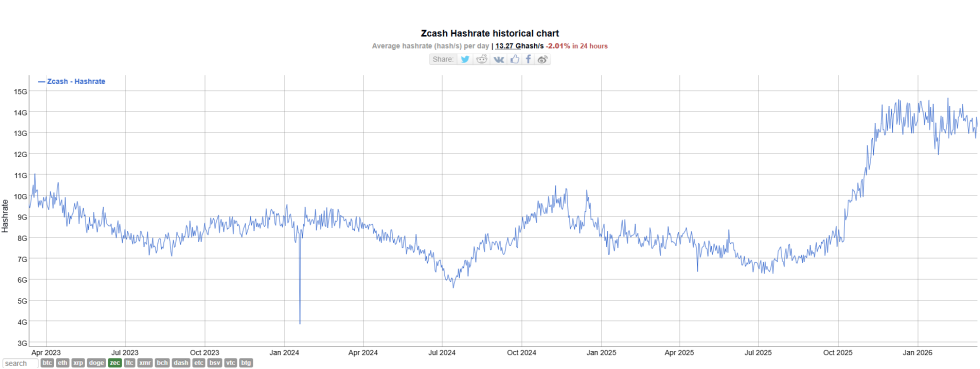
The timing of Foundry’s announcement coincides with a period of remarkable growth for the Zcash network. Data from BitInfoCharts indicates a significant upward trend in the computing power, or hashrate, dedicated to the ZEC blockchain. In October 2025, the Zcash hashrate was recorded at less than 8 Ghash/s. By early 2026, that figure has climbed to over 13 Ghash/s, representing an increase of more than 60% in a matter of months.
A rising hashrate is generally viewed as a sign of network health and security. It indicates that miners are increasingly confident in the future value of the asset, leading them to deploy more hardware or upgrade existing rigs. The surge in hashrate also suggests that specialized mining hardware, such as Equihash ASICs (Application-Specific Integrated Circuits), is becoming more efficient and widely available.
Foundry’s entry into the space is likely to accelerate this trend. As the largest operator in the Bitcoin space, Foundry’s endorsement of Zcash serves as a powerful signal to hardware manufacturers and other large-scale miners that the network is a viable destination for significant capital expenditure.

Chronology of Zcash Development and Mining Milestones
To understand the significance of Foundry’s move, it is necessary to look at the timeline of Zcash’s evolution:
- October 2016: Zcash is officially launched by the Zerocoin Electric Coin Company (now Electric Coin Co.), led by Zooko Wilcox.
- 2018–2020: The network undergoes several major upgrades, including "Sapling" and "Blossom," which significantly improve the speed and efficiency of shielded transactions.
- November 2020: The first Zcash Halving occurs, reducing the block reward from 6.25 ZEC to 3.125 ZEC. This event also saw the introduction of the "Dev Fund," which allocates a portion of rewards to support further development and ecosystem growth.
- 2022–2024: The network navigates various regulatory challenges regarding privacy coins while continuing to refine its zero-knowledge proof technology.
- Late 2025: The Zcash hashrate begins a sharp ascent, moving from 8 Ghash/s toward historical highs.
- March 2026: Foundry announces the April 2026 launch of its institutional Zcash mining pool.
Zooko Wilcox, the founder of Zcash and currently the Chief Product Officer at Shielded Labs, expressed strong support for Foundry’s initiative. Shielded Labs, an independent support organization based in Switzerland, has been instrumental in fostering the Zcash ecosystem. Wilcox noted that having a North American-based, enterprise-grade pool from an operator of Foundry’s caliber is a major milestone for the decentralization and security of the network.
Broader Implications for the Privacy Coin Market
The launch of an institutional Zcash pool by a major US-based firm carries heavy implications for the broader privacy coin market. For years, privacy-focused assets have faced scrutiny from regulators who fear their potential for misuse in illicit activities. This has led to the delisting of various privacy coins from major exchanges in certain jurisdictions.
However, Foundry’s involvement suggests a shift toward a more nuanced understanding of privacy technology. By operating a transparent, US-based pool, Foundry provides a "clean" path for institutional participation. This could potentially set a precedent for how other privacy protocols interact with the traditional financial system. If Zcash can prove that privacy and compliance are not mutually exclusive, it may pave the way for broader acceptance of zero-knowledge technologies in mainstream finance.
From a market perspective, the increased security provided by a larger and more diverse mining base often correlates with lower volatility and higher liquidity. As more professional miners enter the ZEC ecosystem, the "sell pressure" from mining rewards becomes more predictable, and the overall robustness of the network makes it a more attractive prospect for long-term investors.
Market Reaction and Price Performance
At the time of the announcement, the price of Zcash (ZEC) was trading at approximately $209. While the coin has experienced a retracement of roughly 11% over the past week, its long-term trajectory remains a point of interest for analysts. The retracement is viewed by many as a standard market correction following a period of recovery.
Historically, the introduction of institutional infrastructure has served as a catalyst for asset appreciation. While Foundry’s pool is not scheduled to go live until April 2026, the anticipation of increased network security and institutional involvement may provide a floor for the asset’s price. Traders are closely watching the $200 support level, as a sustained hold above this mark, combined with the news of Foundry’s expansion, could signal a renewed bullish phase for ZEC.
Conclusion and Future Outlook
The launch of the Foundry Zcash mining pool in April 2026 is poised to be a landmark event for the Proof-of-Work landscape. It signals the end of the era where Zcash was primarily the domain of hobbyist miners and niche privacy advocates, ushering in a period of professionalized, large-scale operations.
For Foundry, the move reinforces its position as a dominant force in the global mining industry, capable of shaping the trajectory of multiple blockchains. For Zcash, it provides the structural support needed to fulfill its promise as a secure, private, and institutional-grade digital currency. As the 2026 launch date approaches, the industry will be watching closely to see how this infusion of North American institutional hashrate affects the decentralization, security, and market dynamics of one of the world’s most prominent privacy-preserving protocols.